Volkswagen worker organizations
Volkswagen Group is headquartered in Germany with operations in 31 countries. With 120,000 employees in Germany and 600,000 globally, it is one of the most well organized labour backed companies in the world. The role that Works Councils and IG Metall play is unique even within Germany. VW workers have some of the strongest collective agreements. With the exception of the United States and China, all of its major locations are represented in the Global Works Council and local trade union bodies. VW has a strong tradition and practice of social partnership and co-determination rights globally.[1]
Organizational structure
The chair of the World-, European-, Group- and General Works Council is Daniela Cavallo since May 2021, replacing Bernd Osterloh. She is the first woman chair at VW and is arguably the most powerful employee representative in all of Germany.[2]
Volkswagen is organized on multiple levels, locally, regionally, nationally and by marque. The heart of its labour representation is in Wolfsburg, Germany. Its headquarter plant has over 65,000 employees or half of the German workforce. In the 2018 local Works Council election, 86% of employees voted for the IG Metall list or 66 out of 75 total Works Council seats, with only two other lists competing. A network of 2,500 rank and file IG Metall shop stewards ensure the IG Metall backed Works Council has extensive influence and reach in the workplace. Additionally VW pays for an additional 70 administrative personnel to help the Works Council carry out its duties.[3]
Supervisory Board
IG Metall and the Works Council have the right to appoint 10 employee representatives or half of VW's Supervisory Board.[4] Seven of the seats are reserved for elected employees and three are reserved for trade unions i.e IG Metall, including its president Jörg Hofmann. Additionally on the employer side, Lower Saxony state holds two seats, which are filled by Social Democrats Stephan Weil and Bernd Althusmann.[5][6]
Public ownership
A provision in the 1960 Volkswagen Act that privatised VW, stipulates 80% of shareholders are needed to pass any major decisions. Lower Saxony state has a voting share of 20.2%, ensuring a veto power on any major decisions.[7] Because of this, the German Employer Association precludes VW from membership or negotiating sectoral agreements with any regional branches of the Employers' Associations in the Metal sector (Gesamtmetall). Unlike BMW or Daimler, this means there is only one federally negotiated collective bargaining agreement between VW and IG Metall, which is more favourable to workers as a result.[8]
Early origins
1937–1945: Nazi origins
Volkswagen (VW) was established in Wolfsburg, Germany in 1937 by the German Labour Front, a Nazi organization.[9] It is estimated by historians that 60-70% of the workforce were enslaved or forced labour including from Arbeitsdorf, a concentration camp specifically built for providing VW with enslaved labour.[10][11] Workers were subject to racialised hierarchies when it came to housing, nutrition and treatment, with Jews and "Eastern Workers" on the bottom of the hierarchy.[12]
1945–1949: British occupying power
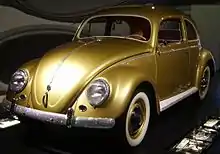
In July 1945, with pressure from Social Democrats and Communists, a provisional Works Council (German: Betriebsvertretung, lit. 'Factory representation') was authorized by the British occupying power. It was expressly forbidden for the Works Council to discus politics or practice co-determination. However, it had informational and discussion rights. By November 1945, the first democratically elected Works Council was voted in.[13]: 48–49
Given Volkswagen's origins and the political climate after the end of World War II, British Major Hirst was tasked with the "denazifcation" of Volkswagen in the autumn of 1945; which initially applied solely to VW management on a limited scale. In January 1946, Hirst declared the denazification process as complete, to the dismay of the General Union (Allgemeine Gewerkschaft)[note 1] and Works Council. 228 mid to lower level managers were selected for dismissal due to alleged Nazi associations in June 1946.[13]: 14–17 One year later, the Works Council still had limited co-determination rights, particularly when it came to reinstating dismissed Nazi sympathizers.[13]: 19
In addition to infighting between the Social Democrats (SPD) and Communists (KPD), right-wing union opposition candidates from the German Right Party (Deutsche Rechtspartei; DRP) ran for the first time in 1948. In the following 1949 Works Council elections, due to the political climate (DRP won 70% of the Wolfsburg city council election)[14] and a workforce composed of Wehrmacht officers, freed soldiers and German refugees from the East; the two leading trade unions IG Metall and Deutsche Angestellten Gewerkschaft reserved 6 spots in their Works Council election lists for the far right-wing candidates as a strategy of neutralizing the opposition.[13]: 52–55
The transfer of Volkswagen by the British authorities to the governments of Lower Saxony and the newly formed West German government in 1949, completed the transfer of ownership to Germany. One year after its founding, IG Metall became the dominant union force in VW, coinciding with the German period of economic recovery.[13]: 55, 91
Transnational activity
Transnational activity and organizing started in the 1970s between German workers and workers at foreign plants in Belgium, Brazil, Mexico and South Africa. The German Works Council was particularly concerned with the political developments of Apartheid South Africa and the military dictatorship in Brazil. The International Solidarity working group in Wolfsburg, along with the VW World Group Committee established in 1979 by International Metal Workers' Federation played a role in promoting international coordination.[15]
European Works Council
With the acquisition of SEAT, VW had operations in 3 European states: Germany, Belgium and Spain. The German Works Council and foreign members of the Group set in motion the formation of a European Works Council structure. The first meeting was in 1990, with a signed agreement in 1992; a full two years prior to the 1994 European Works Council directive.[15]
Global Works Council
The Volkswagen World Group Council also known as Volkswagen Global Works Council, formed in 1998, was among the first World Councils of its kind at any company, chaired by Klaus Volkert. The preamble and provisions were copied nearly verbatim from the VW European Works Council agreements, with a different formula for representation. It consisted of 27 seats, 20 of them European and 7 not.[15]
A general tension exists between the interests of the workers in the host country (Germany) and foreign member states of the European and Global Works Council, but workers in foreign states also gain strategic benefits from having close access to a well resourced trade union (IG Metall) and the German Works Council.[1]
| Country | Number of members | By marque |
|---|---|---|
| Germany | 11 | 8 Volkswagen, 2 Audi, 1 VW Sachsen |
| Spain | 3 | 2 SEAT, 1 VW Navarra |
| Belgium | 1 | 1 VW Brussels |
| Czech Republic | 1 | 1 Skoda |
| Slovakia | 1 | 1 VW Skoda |
| Poland | 1 | 1 VW Poznan |
| United Kingdom | 1 | 1 Rolls Royce/Bentley |
| Portugal | 1 | 1 AutoEuropa |
| European total | 20 | |
| Mexico | 1 | 1 VW Mexico |
| Brazil | 4 | 4 VW Brazil |
| Argentina | 1 | 1 VW Argentina |
| South Africa | 1 | 1 VW South Africa |
| Non European total | 7 |
Global Framework Agreements
In 2002, VW Group, the European and Global Works Councils signed 'Declaration on Social Rights and Industrial Relationships at Volkswagen', a Global Framework Agreement with the International Metalworkers' Federation[note 2] affirming the ILO Core Labour Standards.[16]
In 2012, VW Group and the IndustriALL Global Union global union federation signed a Global Framework Agreement 'Charter on Temporary Work for the Volkswagen Group', specifying the terms and conditions of agency workers at VW and its subsidiaries,[17] however VW limits it to countries represented in the Global Works Council, formally excluding China.[18] In later years, Chinese temporary workers at FAW-Volkswagen cited the Global Framework Agreement in addition to Chinese labour law.[19]
In 2019, IndustriALL suspended its agreement with VW over its refusal to bargain with the United Auto Workers in the United States.[20]
United States
Chattanooga, Tennessee
The Volkswagen Chattanooga Assembly Plant has attracted international attention after it was proposed that employees elect a union in order to implement a Works Council that has co-determination, consultation and participation rights with management.[21][22]
The United Auto Workers attempted unsuccessfully to unionize the Chattanooga plant in 2014. This was defeated in a 712-626 vote. It was backed by Volkswagen and the IG Metall union in Germany. There was, however, considerable opposition from US business groups and Republican politicians.[23][24][25] Despite a failed unionization vote at the plant, Volkswagen recognized members who have joined UAW Local 42. After the close vote against the UAW, Volkswagen announced a new policy allowing groups representing at least 15% of the workforce to participate in meetings, with higher access tiers for groups representing 30% and 45% of employees.[26] This prompted anti-UAW workers who opposed the first vote to form a rival union, the American Council of Employees.[27] In December, 2014, the UAW was certified as representing more than 45% of employees.[28]
The UAW again attempted to unionize the plant in June 2019. This failed by a 52 to 48 percent margin.[29] Unlike in 2014, Volkswagen management was not supportive of the union vote.[21]
Westmoreland, Pennsylvania
Volkswagen of America entered Westmoreland County, Pennsylvania in 1976 and immediately recognized United Auto Workers via a card check.[8]
Volkswagen renamed the plant to Volkswagen Westmoreland Assembly after acquiring it from Chrysler.[30] For the assembly line, Volkswagen did not develop its own skill base for Westmoreland, instead bringing in workers from Detroit, Michigan. 100 workers were also brought in from Great Britain.[31] A pool of 40,000 people applied for jobs at Westmoreland.[32] No more than 20% of the workers had ever worked for an automobile manufacturer,[33] and the average age of workers was 24-26; at the time this was considered a demographic that was "independent and militant."[33] VWoA chose employees not by skills, but by how long they had been unemployed.[34]
The plant was organized by the United Auto Workers; a 1992 New York Times article described it as the only "transplant" factory (a factory of a foreign automotive company in the US) that the UAW had succeeded in representing, and that the plant "began with a strike and lurched from problem to problem before closing".[35]
From the outset, minorities picketed the site, seeking fair treatment in the hiring process[36] and by its first 20 months of operation, workers had staged six walkouts.[37]
On October 13, 1978, six months after the plant opened, UAW workers staged a wildcat strike at Westmoreland for salaries equal to those received by General Motors Corporation employees.[38] Picketing workers chanted "No Money, No Bunny."[39] In 1981, Westmoreland Assembly avoided a strike when it reached agreement with the UAW over essentially the same issue: the disparity between wages earned at Westmoreland, where assemblers made an average of $10.76 per hour, and those at domestic auto plants in Detroit, where GM and Ford assemblers made an average of $11.42 per hour.[40]
Volkswagen settled a 1983 discrimination suit with the United Auto Workers to settle claims that they discriminated against black employees at Westmoreland Assembly. Plaintiffs had sought $70 million when filing suit, charging that management had initiated or tolerated "a pattern and practice" of limited hiring and promotions of black people, that black workers were also subject to arbitrary firings and demotions and that the company openly allowed racial insults and threats in the workplace. Volkswagen of America Inc. denied the charges and later settled the case in 1989, paying 800 plaintiffs $670,000 and the United Auto Workers $48,000.[41] The most prominent black executive at the Westmoreland factory and spokesman for the "VW Black Caucus" committed suicide, bringing further notoriety to the suit.[42]
On July 14, 1988, VWoA closed the plant.[43]
Notes
- The Deutscher Gewerkschaftsbund of which IG Metall is part of, was not founded until 1949.
- International Metalworkers Federation later became the IndustriALL Global Union
References
- Whittall, M.; Lucio, M. M.; Mustchin, S.; Telljohann, V.; Sánchez, F. R. "Workplace trade union engagement with European Works Councils and transnational agreements: the case of Volkswagen Europe". European Journal of Industrial Relations.
- Menzel, Stefan (23 April 2021). "Wechsel im Betriebsrat: Daniela Cavallo wird Volkswagens erste Betriebsratschefin – Wer sie ist und was sie auszeichnet" [Daniela Cavallo becomes Volkswagen's first Works Council chair – Who she is and what makes her special]. Handelsblatt (in German). Retrieved 5 December 2021.
- Kaleta, Phillip; Wehmeyer, Jan C. (4 December 2021). "Ende der Alleinherrschaft? Der IG Metall droht in der Autobranche eine Zersplitterung der Betriebsräte — analog zur Parteienlandschaft" [End of independence? IG Metall is threatened with a fragmentation of the works councils in the automotive industry - analogous to the party landscape]. Business Insider (in German). Retrieved 5 December 2021.
- Kreijger, Gilbert (28 February 2018). "Handelsblatt explains: Why German corporate governance is so different". Handelsblatt. Retrieved 5 December 2021.
- "Lower Saxony's new government says will keep Volkswagen stake". Reuters. 22 November 2017.
- "Members of the Supervisory Board and Committees". Volkswagen Group. 31 December 2020. Retrieved 6 December 2021.
- Barker, Alex (22 October 2013). "Germany keeps right to veto VW takeovers". Financial Times. Retrieved 5 December 2021.
- Silvia, Stephen J. (2017). Organizing German automobile plants in the USA An assessment of the United Auto Workers' efforts to organize German-owned automobile plants. Düsseldorf: Hans Böckler Stiftung. pp. 32–37. ISBN 978-3-86593-257-0. OCLC 1187437205.
- Manfred Grieger; Ulrike Gutzmann; Dirk Schlinkert, eds. (2008). Volkswagen Chronicle (PDF). Historical Notes. 7. Volkswagen AG. ISBN 978-3-935112-11-6. Archived from the original (PDF) on 16 December 2010. Retrieved 21 December 2009.
- Gabler, Neal (15 December 2015). "Volkswagen's Nazi-Era Blood Crimes". The Nation. ISSN 0027-8378. Retrieved 22 October 2021.
- "Volkswagen: The "People's Car" and the Nazi State". United States Holocaust Memorial Museum. Retrieved 22 October 2021.
- Place of remembrance of forced labor in the Volkswagen Factory (PDF). Volkswagen. 1999. ISBN 978-3935112086.
- Lupa, Markus (1999). The British and their Works: The Volkswagenwerk and the occupying power 1945 – 1949 (PDF) (2 ed.). Volkswagen AG, Corporate Archives. ISBN 978-0837613130.
- Kraus, Alexander (November 2016). "Zwischen Bestürzung und Fassungslosigkeit. Fremd- und Eigendeutungen des DRP-Wahlsieges von 1948 in Wolfsburg" [Between dismay and bewilderment. Foreign and personal interpretations of the DRP election victory of 1948 in Wolfsburg] (PDF). Wolfsburg Newspaper Archive.
- Rüb, Stefan (May 2002). "World works councils and other forms of global employee representation in transnational undertakings: A survey". Arbeitspapiere, Hans-Böckler-Stiftung. 55.
- "Volkswagen signs framework agreement". IndustriALL Global Union. 7 June 2002. Retrieved 6 December 2021.
- "Volkswagen Group adopts charter for temporary work". Automotive World. 30 November 2012. Retrieved 6 December 2021.
- Sherrard, Michael G.; Wisskirchen, Gerlind (2014). "Next Up for North American Employers and Unions? International and Corporate Social Responsibility". ABA Journal of Labor & Employment Law. 29 (2): 245–282. ISSN 2156-4809.
- "One year on, the struggle continues for Volkswagen workers in Changchun". China Labour Bulletin. 8 November 2017. Retrieved 6 December 2021.
- Brooks, Chris (18 April 2019). "Volkswagen Abandons Union Neutrality with Anti-UAW Letter". Labor Notes. Retrieved 6 December 2021.
- Scheiber, Noam (15 June 2019). "Volkswagen Factory Workers in Tennessee Reject Union". The New York Times. ISSN 0362-4331. Retrieved 5 December 2021.
- Slaughter, Jane (14 February 2014). "Volkswagen Workers Vote on Union, Works Council Scheme". Truthout. Retrieved 5 December 2021.
- Barrett, Paul M (17 February 2014). "UAW's Devastating Defeat in Tennessee: Four Blunt Points". Bloomberg News. Retrieved 11 August 2020.
- Bachman, Justin (18 February 2014). "How Volkswagen's Tennessee Plant Could End Up Organized Without the UAW". Bloomberg News. Retrieved 11 August 2020.
- Boudette, Neal E. (15 February 2014). "Union Suffers Big Loss at Tennessee VW Plant". Wall Street Journal.
- Snavely, Brent (12 November 2014). "VW welcomes UAW, other unions in Tenn". Detroit Free Press. Archived from the original on 3 October 2015. Retrieved 2 October 2015.
- DePillis, Lydia (19 November 2014). "The strange case of the anti-union union at Volkswagen's plant in Tennessee". Washington Post. Archived from the original on 4 October 2015. Retrieved 2 October 2015.
- Snavely, Brent (8 December 2014). "UAW certified to represent VW workers in Tennessee". Detroit Free Press. Archived from the original on 4 October 2015. Retrieved 2 October 2015.
- Allyn, Bobby (15 June 2019). "Tennessee Workers Reject Union At Volkswagen Plant — Again". NPR. Washington, D.C. Retrieved 16 June 2019.
- "Rearview Mirror". Ward's AutoWorld. April 1, 2000. Archived from the original on July 28, 2011. Retrieved May 29, 2011.
- Jürgens, Ulrich (19 November 1998). "Implanting Change: The role of 'Indigenous Transplants' in Transforming the German Productive Model". In Boyer, Robert; Charron, Elsie; Jürgens, Ulrich; Tolliday, Steven (eds.). Between Imitation and Innovation, the Transfer and Hybridization of Productive Models in the International Automobile Industry. Oxford University Press. p. 332. ISBN 9780191583940.CS1 maint: date and year (link)
- Wylie, William H. (10 April 1978). "Westmoreland Rabbits On Parade". The Pittsburgh Press. p. 1.
- Moody, John P. (13 October 1978). "Radicals dim start up hopes". Pittsburgh Post Gazette. p. 2.
- Pare, Mike (29 May 2011). "VW Tries it Again in U.S." May 29th, 2011. Chattanooga Times Free Press.
- Levin, Doran P. (23 June 1992). "'Transplant' Car Makers Redefine the Industry". The New York Times.
- Acton, Robin (August 24, 2008). "Local workers recall East Huntingdon plant closing". Pittsburgh Tribune-Review. Archived from the original on January 31, 2013. Retrieved May 29, 2011.
In November 1987, Volkswagen of America officials chose Thanksgiving week to tell employees that the East Huntingdon plant would end its 10-year run and close six months later. ~ Minorities picketed the site, seeking fair treatment in the hiring process. ~ By 1981, car buyers were tired of the Rabbit that hit the American market in 1974. Sales dipped as gas prices fell and consumer preference shifted to larger models. John Wolkonowicz, senior automotive analyst for Global Insight in Lexington, Mass., watched the demise of the unreliable compact that cost more than its competition and lacked quality."It was probably the most troublesome Volkswagen ever built," Wolkonowicz said.
- Wilson, Linda S. (4 January 1980). "VW laying off 4,000 Due to W.Va. Strike". Pittsburgh Post-Gazette.
- Brinkley, David; Scott, Jim (13 October 1978). "Headline: Auto Workers Strike / Pennsylvania VW Plant". NBC Evening News. Vanderbilt Television News Archive.
Wildcat strike by auto workers at New Stanton, Pennsylvania, Volkswagen plant, for salaries equal to those received by General Motors Corporation employees, reported Situation this creates for UAW in trying to get other foreign auto makers to build US plants noted.
- No Money, No Bunny, Honey. Mother Jones. January 1979. p. 11.
- "Tentative Contract Reached By Volkswagen and U.A.W." The New York Times. 1 November 1981. p. 36.
A tentative contract has been reached between Volkswagen and Local 2055 of the United Automobile Workers, the company said today. A spokesman, Chet Bahn, said the accord was reached late last night. No details were released pending ratification by the union's membership. The proposal will be presented to the union's rank-and file tomorrow. A strike deadline of 12:01 A.M. Monday had been set at the Westmoreland County factory, which employs 4,600 workers. A major issue reportedly was a gap between the wages earned by assemblers here and their counterparts at domestic auto plants in Detroit. Assemblers make an average of $10.76 an hour at Volkswagen but $11.42 at General Motors and Ford.
- "Discrimination Suit Is Settled". The New York Times. 19 April 1989. p. 20.
- Franklin, Ben A. (29 January 1983). "Bias Suit Made Grimmer by a Suicide". The New York Times.
- Kiley, David (22 April 2002). Getting the bugs out: the rise, fall, and comeback of Volkswagen in America. John Wiley & Sons, Inc. pp. 131, 134. ISBN 9780471225980.CS1 maint: date and year (link)
External links
| Ownership |  | ||||||||||||
|---|---|---|---|---|---|---|---|---|---|---|---|---|---|
| Divisions and subsidiaries |
| ||||||||||||
| Shareholdings |
| ||||||||||||
| Products and technologies |
| ||||||||||||
| Discontinued brands |
| ||||||||||||
| Places | |||||||||||||
| People |
| ||||||||||||
| Motorsport | |||||||||||||
| Other | |||||||||||||
| |||||||||||||
