WISP (quantum mechanics)
In quantum mechanics, the acronym WISP refers to a largely hypothetical weakly interacting sub-eV particle, or weakly interacting slender particle, or weakly interacting slim particle – low-mass particles which rarely interact with conventional particles, if ever. With the exception of “active” neutrinos, all WISPs are hypothetical particles.
The term is essentially synonymous with axion-like particle (ALP).
Discussion
Although left-chiral neutrinos and right-chiral antineutrinos – “active” neutrinos – are known to exist, and technically do satisfy the description of the term, “WISP” is most often used to refer to a low-mass hypothetical particle which is a dark matter candidate. Examples include:[1]
- Axion – long standing hypothetical strong force related light particle
- Sterile neutrino – never-observed particles explicitly excluded from weak interactions (if they exist) as well as the strong and electromagnetic forces
- Supersymmetric particles, particularly the lightest supersymmetric particle which might be a
- ⌑ Chargino – supersymmetric fermions that are electrically charged composites of superpartners to bosons
- or perhaps a
- ⌑ Neutralino – supersymmetric fermions that are electrically neutral composites of superpartners to bosons
All WISPs are dark matter candidates, except for active neutrinos, whose cumulative density could not be sufficient to account for the observed effects of dark matter, based on current estimates of their numbers and mass.[1]
Sources
The various sources of WISPs could possibly include, hot astrophysical plasma and energy transport in stars.[2] Note however, that since they remain hypothetical (except neutrinos) the means of creation of WISPs depends on the theoretical framework used to propose them.
Massive counterpart
WISPs are the low-mass counterpart of weakly interacting massive particles (WIMPs).
See also
References
- Lindner, Axel; Ringwald, Andreas; Majorovits, Béla (4 March 2021). "In search of WISPs". CERN Courier. Searches for New Physics. CERN. Retrieved 5 March 2021.
- "In search of WISPs". CERN Courier. 2021-03-04. Retrieved 2021-05-07.
| Elementary |
| ||||||||||||||||||||||||
|---|---|---|---|---|---|---|---|---|---|---|---|---|---|---|---|---|---|---|---|---|---|---|---|---|---|
| Composite |
| ||||||||||||||||||||||||
| Quasiparticles | |||||||||||||||||||||||||
| Lists | |||||||||||||||||||||||||
| Related | |||||||||||||||||||||||||
 Physics portal Physics portal | |||||||||||||||||||||||||
| Forms of dark matter | 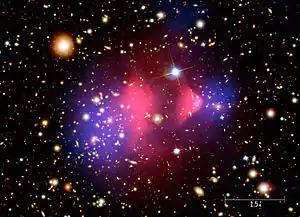 | ||||||
|---|---|---|---|---|---|---|---|
| Hypothetical particles | |||||||
| Theories and objects | |||||||
| Search experiments |
| ||||||
| Potential dark galaxies | |||||||
| Related | |||||||