Wechselapparat
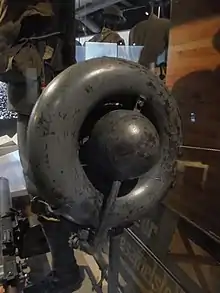
The Wechselapparat ("Wex") was a World War I German flamethrower introduced in 1916 to replace the earlier Kleif. Developed by Richard Fiedler, as early as 1901. It had a doughnut-shaped backpack fuel container with a spherical propellant container (nitrogen) in the middle that blasted the gasoline. The containers were made of car rims. Wex used a magnesium ignition system. This design was updated before the Second World War to become flamethrower model 35. However, model 35 was considered too fragile so it was soon replaced by the model 41, a simpler construction with smaller, horizontal, cylindrical backpack containers.
| Wechselapparat | |
|---|---|
 | |
| Type | Flamethrower |
| Place of origin | German Empire |
| Service history | |
| Used by | German Empire, Ottoman Empire, Austria-Hungary Captured examples used by Entente forces |
| Wars | First World War |
The doughnut-shaped container design was copied by the British during World War II as the Flamethrower, Portable, No 2.
"Wechselapparat" is German for "exchange apparatus".

References
- Flamethrowers of the German Army 1914-1945 by Fred Koch