Western Wheel Works
Western Wheel Works was a Chicago bicycle company started by Adolph Schoeninger in 1866. It was one of the largest bicycle makers in the world.[1] In 1899 it joined a trust which controlled 95 percent of the bicycle manufacturing market.[2]
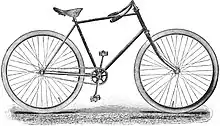 Western Wheel Works bicycle, 1892 | |
| Industry | Manufacturing |
|---|---|
| Founded | 1866 in Chicago, U.S. |
| Founder | Adolph Schoeninger |
| Headquarters | |
| Products | Bicycles |
Number of employees | 1500 |
History
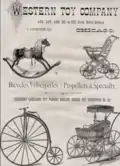
In 1865, Schoeninger and his partner F. Westermann started out manufacturing toys and other novelties under the name Western Toy Company. The factory burned down in 1866.[3] In 1866 Western toy Works took over another factory which produced toy and baby carriages.[4] The Western toy Company specialized in toy wagons.[5]
The toy company operated until the Great Chicago Fire of 1871.[6] By 1872 Schoeninger obtained financing from European banks and rebuilt.[4] In 1887 The Western Toy Company purchased the Vergho Rubling Co., a former toy dealer.[7]
The company began making safety bicycles bicycles in the late 1880s, under the Crescent name.[5] It also manufactured tricycles and children's bikes in 1890.[8] By 1890 it was among the largest bicycle manufacturers in the world.[9] It is known as a pioneer in the mass production of bicycles: rather than machining bicycle "parts such as hubs, sprockets, chain guards, fenders, and rims", it employed the much faster process of stamping them,[10] thereby more than doubling the output of the factory in 1891.[11]
In 1893 Schoeninger transferred his ownership of the company to his two son in laws and he started a new company called the Home Rattan Company.[4]
By 1897 the company employed 1500 people and produced 350 bicycles a day.[4]
In 1899 the company joined a trust which was set up to control the bicycle market in the United States. Forty-two factories were part of the trust; the major barrier to organizing it was the manufacturer of rubber tires. It was decided that tires would be purchased from the "Rubber King", Charles R. Flint.[12]
Gallery
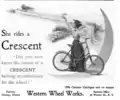 Crescent bicycle advertisement, July 1896
 "The Procession of Crescent riders is increasing daily"
 1896 baby ad
 1896 marketing to women
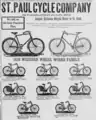 Advertisement for 1894 model Crescent bicycles
 1895 hill climbing
 1895 ad
 1895 catalog
 Inside Western Wheel Works, 1899
 Baby advertisement for Western Wheel Works, 1896
References
- "Crescent Wheels for 1899". Birmingham Age Herald. 22 November 1898. Retrieved 11 December 2021.
- "Only One Bicycle Trust". Daily Times. 21 May 1899. Retrieved 11 December 2021.
- La Touche, Royal L. (1 January 1892). Chicago and Its Resources Twenty Years After 1871-1891 A Commercial History Showing the Progress and Growth of Two Decades from the Great Fire to the Present Time. Chicago Illinois: The Chicago Times Company. p. 143. Retrieved 12 December 2021.
- Unrivaled Chicago. Chicago and New York: Rand McNally and Company. 1897. p. 69. ISBN 978-0484513128. Retrieved 11 December 2021.
- Hounshell, David A. (1984). From the American system to mass production, 1800-1932 : the development of manufacturing technology in the United States. Baltimore: Johns Hopkins University Press. p. 209. ISBN 978-0801831584. Retrieved 13 December 2021.
- Moses, John (2010). Biographical dictionary and portrait gallery of the representative men of. Chicago Illinois: The Lewis Publishing company. p. 521. ISBN 978-1149752647. Retrieved 11 December 2021.
- "Heavy Failure". Decatur Daily Review. 11 January 1887. Retrieved 12 December 2021.
- "Boys and Girls". Fort Wayne Weekly Gazette. 14 August 1890. Retrieved 11 December 2021.
- "Cycling Chicago". Philadelphia Inquirer,. 27 July 1890. Retrieved 11 December 2021.CS1 maint: extra punctuation (link)
- Dodge, Pryor (1996). The Bicycle. Paris: Flammarion. p. 162.
- Tatarsky, Daniel (2016). The splendid book of the bicycle. London: Portico. ISBN 978-1910232569. Retrieved 12 December 2021.
- "The Bicycle Trust". Cincinnati Commercial Tribune. 29 July 1899. Retrieved 11 December 2021.
External links

 |
Wikimedia Commons has media related to Western Wheel Works. |
| General and technical | |
|---|---|
| Utility and slow recreation | |
| Sports-related cycling and fast-paced recreation | |
| Health, safety and infrastructure |
|
| Other | |
| Lists | |
| |
