Willi Graf
Wilhelm Graf (better known as Willi Graf)[1] (2 January 1918 – 12 October 1943) was a member of the White Rose (Weiße Rose) resistance group in Nazi Germany. The Catholic church added him to the Martyrology of the Catholic Church on November 3, 1999. In 2017, his cause for canonization was opened up.[2][3]
Willi Graf | |
|---|---|
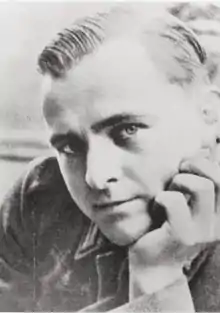 | |
| Layperson and Martyr | |
| Born | Wilhelm Graf 2 January 1918 Kuchenheim, Euskirchen, Germany |
| Died | 12 October 1943 (aged 25) Stadelheim Prison, Giesing, Munich, Germany |
| Honored in | Catholic Church |
Early life
Willi Graf was born in Kuchenheim near Euskirchen. In 1922, his family moved to Saarbrücken, where his father ran a wine wholesaler and managed of the Johannishof, the second largest banquet hall in the city.[4] Graf attended school at the Ludwigsgymnasium. It was not long before he joined, at the age of eleven, the Bund Neudeutschland, a Catholic youth movement for young men in schools of higher learning, which was banned after Hitler and the Nazis came to power in 1933. In 1934, Graf joined the Grauer Orden ("Grey Order"), another Catholic movement which became known for its anti-Nazi rhetoric.[5][6] It, too, was banned and for this reason, it formed many splinter youth groups.
Graf showed conviction in his beliefs from a young age. Although compulsory at the time, he refused to associate with the Hitler Youth, even when he was threatened with becoming ineligible to go to University unless he joined the Hitler Youth.[7][8][9] While other future members of the White Rose initially embraced the Hitler Youth, Graf never did so. Moreover, in his address book he crossed out the names of friends who had joined the Hitler Youth, refusing to associate with them.[1] In 1935, at the age of 17, Graf and a few friends marched in an annual May Day parade.[7] The parade was dominated by swastikas, brown-shirted Hitler Youth troops marching in formation, and "Sieg Heils." However, Graf and his friends marched under their tattered school flag, making great effort to stand out from their peers. They did not don any swastikas, or participate in any of the "Sieg Heil" salutes.[7]
Arrest
After his Abitur, the German equivalent of Baccalauréat, in 1937, Willi Graf did his six-month Reichsarbeitsdienst and afterwards began his medical studies at the University of Bonn.[10] In 1938, he was arrested along with other members of the Grauer Orden and charged by a court in Mannheim with illegal youth league activities–the Bünde having been banned–in relation with his unlawful field trips, camping excursions and other meetings with the Grauer Orden.[11] The charges were later dismissed as part of a general amnesty declared to celebrate the Anschluss.[12][13] The detention had lasted three weeks. His time in jail did not weaken his decision to participate in anti-Nazi activities or organizations.
German army
In early 1940, Graf was conscripted into the German army as student-soldier. From 1940 to 1942, Graf participated in various war deployments in Europe as a medical orderly.[14] During these deployments he experienced the depths of war which included seeing the Warsaw ghetto in Poland and harsh treatment of Russian civilians. He was horrified by the suffering he witnessed.[15] In his army medic files it was observed that his care of the ill was "exemplary". Dr. Webel, the Chief Medical Officer, said that Graf "showed himself to be an intrepid medic who never thought about his own safety." Graf was granted the Iron Cross, 2nd class with swords, for his actions.[16]
White Rose
In 1942, as a member of the Second Medicine Students' Company of Ludwig Maximilian University of Munich, he came into contact with the Nazi resistance organization, the White Rose. He became an active member of this resistance group, which had been started by Alexander Schmorell and Hans Scholl in early 1942.[17] Graf's main role in the White Rose was to function as a recruiter in other cities around Germany. He also participated in anti-Nazi and anti-Hitler graffiti campaigns.[18]
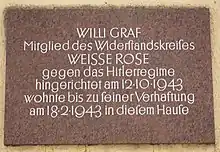
On 18 February 1943, Sophie and Hans Scholl went to the Ludwig Maximilian University to leave flyers out for the students to read. They were seem by a Gestapo informer and captured. At around midnight on February 18, Gestapo agents came for Willi and his sister, who was sharing the living space. His sister was released soon after.[17] Willi’s trial was set for April 19, 1943. At his trial, Willi was sentenced to death at the Volksgerichtshof for high treason, Wehrkraftzersetzung (undermining the troops' spirit), and furthering the enemy's cause.[19] Willi Graf was beheaded on 12 October 1943 at Stadelheim Prison in Munich, after around six months of solitary confinement.[20] During this 6-month period the Gestapo used psychological torture to try to extract information from Graf about other White Rose members and other anti-Nazi movements.[16] Willi never gave up any names, taking on blame for the White Rose activities in order to protect others who had not yet been arrested.[21][22]
In his last letter to his parents, he wrote:
On this day I'm leaving this life and entering eternity. What hurts me most of all is that I am causing such pain to those of you who go on living. But strength and comfort you'll find with God and that is what I am praying for till the last moment. I know that it will be harder for you than for me. I ask you, Father and Mother, from the bottom of my heart, to forgive me for the anguish and the disappointment I've brought you. I have often regretted what I've done to you, especially here in prison. Forgive me and always pray for me! Hold on to the good memories.... I could never say to you while alive how much I loved you, but now in the last hours I want to tell you, unfortunately only on this dry paper, that I love all of you deeply and that I have respected you. For everything that you gave me and everything you made possible for me with your care and love. Hold each other and stand together with love and trust.... God's blessing on us, in Him we are and we live.... I am, with love always, Willi.[1]
Legacy
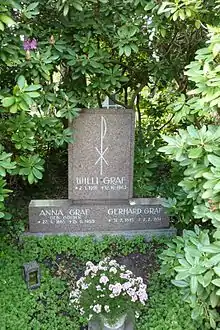
After the war, his remains were transferred to the St. Johann Cemetery in Saarbrücken.[23] Seven schools in Germany have been named after him, among them the Willi-Graf-Gymnasium in Munich and Saarbrücken-St. Johann; a student residence in Munich also honours Graf by bearing his name. In 2003, Willi Graf was posthumously awarded the status of honorary citizen of Saarbrücken.[24]
The Catholic Church in Germany included Graf in their list of martyrs of the 20th century.[25][2]In 2017, the archbishop of Munich and Freising, initiated the first step in the process of beatification, a preliminary investigation in which theologians and historians will analyse the life and writings of Graf.[26][27]
In film
There have been two films about the White Rose that portray Willi Graf:
In the 1982 movie Die Weisse Rose, Graf was portrayed by Ulrich Tulkur.
in the film Sophie Scholl: The Final Days (2005), Graf was portrayed by Maximilian Brückner.
References
- dissertant., Richards-Wilson, Stephani, 1963-. Willi Graf of the White Rose : the role of Bildung in his decision to resist National Socialism. OCLC 862422400.
- Royal, Robert (2000). The Catholic martyrs of the twentieth century : a comprehensive world history. New York: Crossroad Pub. ISBN 0-8245-1846-2. OCLC 44435813.
- dissertant., Richards-Wilson, Stephani, 1963-. Willi Graf of the White Rose : the role of Bildung in his decision to resist National Socialism. OCLC 862422400.
- Saarbrücker Zeitung (1. January 2018), So lebte Willi Graf im Saarland
- Schäfers 2013, p.295
- Willi Graf Bundeszentrale für politische Bildung
- Frey, Reed (2019). "Conscience before Conformity: Hans and Sophie Scholl and the White Rose Resistance in Nazi Germany by Paul Shrimpton". Newman Studies Journal. 16 (1): 124–125. doi:10.1353/nsj.2019.0012. ISSN 2153-6945. S2CID 201765330.
- Schäfer, Bernhard (2013). Willi Graf, in Barbara Stambolis, Jugendbewegt geprägt: Essays zu autobiographischen Texten von Werner Heisenberg, Robert Jungk und vielen anderen. V&R unipress GmbH. p. 298. ISBN 978-3-8471-0004-1.
- Willi Graf Bundeszentrale für politische Bildung
- Huch, Ricarda (1997). In einem Gedenkbuch zusammeln: Bilder deutscher Widerstandskämpfer. Leipziger Universitätsverlag. pp. 121–126. ISBN 978-3-931922-80-1.
- Schäfers 2013, pp.295-296
- Schäfers 2013, p.299
- Willi Graf Bundeszentrale für politische Bildung
- Willi Graf, Gedenkstätte Deutscher Widerstand
- Schäfer 2013, p.301
- Frey, Reed (2019). "Conscience before Conformity: Hans and Sophie Scholl and the White Rose Resistance in Nazi Germany by Paul Shrimpton". Newman Studies Journal. 16 (1): 124–125. doi:10.1353/nsj.2019.0012. ISSN 2153-6945. S2CID 201765330.
- Stern, Fritz; Hanser, Richard (1979). "A Noble Treason: The Revolt of the Munich Students against Hitler". Foreign Affairs. 58 (2): 426. doi:10.2307/20040455. ISSN 0015-7120. JSTOR 20040455.
- Willi Graf, Gedenkstätte Deutscher Widerstand
- 1917-1998., Scholl, Inge (2011). The White Rose : Munich, 1942-1943. Wesleyan University Press. ISBN 978-0-8195-7272-1. OCLC 767498250.CS1 maint: numeric names: authors list (link)
- Willi Graf, Gedenkstätte Deutscher Widerstand
- Goergen, Peter (2009). Willi Graf - ein Weg in den Widerstand. Röhrig Universitätsverlag. p. 175. ISBN 978-3-86110-458-2.
- Willi Graf Bundeszentrale für politische Bildung
- Ulrich, Bernd. "Der Widerstandskämpfer Willi Graf". Deutschlandfunk 2.1.2018.
- Saarbrücker Zeitung (1. January 2018), So lebte Willi Graf im Saarland
- Helmut Moll (ed.), im Auftrag der Deutschen Bischofskonferenz (2015): Zeugen für Christus. Das deutsche Martyrologium des 20. Jahrhunderts. 6th edition, Paderborn: Ferdinand Schöningh. pp. 486-488
- Erzbistum prüft Seligsprechung für NS-Gegner Graf. website of the Erzbistum München, 27. Dezember 2017
- Bahners, Patrick, Schweigen bis zum Tod, Frankfurter Allgemeine, 2 January 2018
Further reading
- Blaha, Tatjana: Willi Graf und die weiße Rose. Eine Rezeptionsgeschichte, Saur, München 2003, ISBN 978-3-598-11654-4.
- Eltcher, Louis R. Traitors or Patriots? A story of German Anti-Nazi Resistance. ISBN 978-1-5320-4676-6
- Gebel, Hans-Joseph. Konsequent – von der Schulbank bis zum Schaffott, in: Gedenkschrift zum 50. Jahrestag der Hinrichtung des Saarbrücker Widerstandskämpfer Willi Graf, Stadtverwaltung, Saarbrücken, p. 28–37.
- Gebel, Hans-Joseph. Willi Graf, ein Lebensbild. Zum 40. Jahrestag seiner Hinrichtung am 12. Oktober 1943, in: Zeitschrift für die Geschichte der Saargegend vol. 31 (1983).
- Graf, Willi. Willi Graf. Briefe und Aufzeichnungen, Fischer, Frankfurt/M. 1994, ISBN 978-3-596-12367-4. (NOTE: only available in German)
- Heinrichs,Theo. Willi Graf, Mitglied der Widerstandsgruppe "Weiße Rose", in: Gerd G. Koenig (Hrsg.): Cuchenheim 1084–1984, Euskirchen 1984, p. 153–163.
- Moll, Helmut. Den Widerstand mit dem blutigen Tod bezahlt. Katholiken unter Hitlers Terror im Euskirchener Raum, in: Euskirchen im 20. Jahrhundert, Stadtverwaltung, Euskirchen 2002, p. 239–260.
- Richards-Wilson, Stephani. Willi Graf of the White Rose: The Role of Bildung in His Decision to Resist National Socialism. 2013.
- Royal, Robert. The Catholic Martyrs of the Twentieth Century: A comprehensive World History. ISBN 9780824518462 (p. 159)
- Vielhaber, Klaus (editor): Gewalt und Gewissen. Willi Graf und die "Weisse Rose". Eine Dokumentation, Herder, Freiburg/B. 1964.
- Vieregg, Hildegard (editor): Willi Grafs Jugend im Nationalsozialismus im Spiegel von Briefen, Gruppe Willi Graf im Bund Neudeutschland, München 1984.
- Vielhaber, Klaus. Willi Graf. Von den Wurzeln der "Weißen Rose", in: Hirschberg vol. 10 (1983)
External links
- Willi Graf in the German National Library catalogue
Authority control  | |
|---|---|
| General | |
| National libraries | |
| Other | |