Alexander Schmorell
Alexander Schmorell (German pronunciation: [ʔalɛkˈsandɐ̯ ˈʃmo:ʁɛl]; Russian: Александр Гугович Шморель, romanized: Aleksandr Gugovich Shmorel', pronounced [ɐlʲɪksəndr ɡʊɡəvʲɪt͡ʂ ʂmərʲɪlʲ]; 16 September 1917 – 13 July 1943) was a Russian-German student at Munich University who, with five others, formed a resistance group (part of the Widerstand) known as White Rose (German: Weiße Rose) which was active against the Nazi German regime from June 1942 to February 1943.[1] In 2012, he was glorified as a saint and passion bearer by the Russian Orthodox Church Outside Russia, and is venerated by Eastern Orthodox Christians throughout the world.[2]
Saint Alexander Schmorell | |
|---|---|
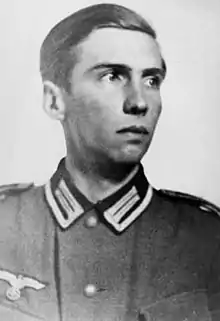 Alexander Schmorell in mandatory Wehrmacht uniform, c. 1942. | |
| Saint and Passion bearer | |
| Born | 16 September 1917 Orenburg, Russian Empire |
| Died | 13 July 1943 (aged 25) Munich, Nazi Germany |
| Venerated in | Eastern Orthodox Church |
| Canonized | 5 February 2012, Munich, Germany by ROCOR |
| Major shrine | Cathedral of the Holy New-Martyrs and Confessors of Russia, Munich, Bavaria, Germany |
| Feast | 13 July |
Early life
Schmorell's father was Hugo Schmorell, a German-born physician who was raised in the Russian Empire. Schmorell's mother was Natalia Vedenskaya, a Russian and the daughter of a Russian Orthodox priest. Schmorell was baptised in the Russian Orthodox Church. His mother died of typhus during the Russian Civil War when he was two years old. In 1920, his widowed father married a German woman, Elisabeth Hoffman, who, like him, was raised in Russia. They left Russia and moved to Munich, Weimar Germany, in 1921, when Schmorell was four years old. His Russian nanny, Feodosiya Lapschina, came along with them and she took his late mother's place in his upbringing. Alexander Schmorell grew up bilingual, speaking both German and Russian natively. His friends gave him the nickname 'Schurik', a nickname he would be called by his closer friends for the rest of his life.[3] He was an Eastern Orthodox Christian who considered himself both German and Russian. As declared in the Gestapo's interrogations, he was a convinced Tsarist and then an archenemy of the Bolsheviks.
Military service
After his Abitur (equivalent to high level High School diploma), he was called into the Reich Labour Service (Reichsarbeitsdienst) and then into the Wehrmacht (German Army during the Nazi era).[4] In 1938, he took part in the Anschluss and eventually in the invasion of Czechoslovakia.
After his military service, the artistically gifted Alexander Schmorell began studies in medicine in 1939 in Hamburg. In the autumn of 1940, he returned with his student corps to Munich where he came to know Hans Scholl, and later Willi Graf. Together with Hans Scholl, Schmorell assembled the White Rose's first four anti-Nazi leaflets. In the second leaflet, Schmorell wrote a passage containing an outcry against the Holocaust.[5]
The Russian front
In June 1942, Schmorell took part as a medical auxiliary in the campaign on the Eastern Front, together with Hans Scholl, Willi Graf and Jürgen Wittenstein, and came to strongly oppose the Nazis' treatment of enemy soldiers and civilians. Once back from Russia, he continued his studies in Munich in 1942–1943.
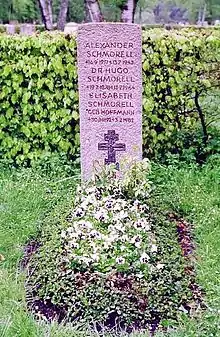
Dissident
In December 1942, Schmorell, along with Hans Scholl, sought contact with Professor Kurt Huber. Together in 1943 they wrote the fifth leaflet, "Aufruf an alle Deutschen!" ('Appeal to all Germans!'), which Schmorell then distributed in Austrian cities. Along with Hans Scholl and Willi Graf, he also painted words such as "Nieder mit Hitler" ('Down with Hitler') and "Freiheit" ('Freedom') on house walls in Munich. It is sometimes suggested that he and Sophie Scholl (Hans' sister) had a romance, although Sophie was previously engaged to Fritz Hartnagel. However, little evidence of this exists outside Lillian Groag's play The White Rose.
After the arrests of Christoph Probst and Hans and Sophie Scholl, Schmorell attempted to escape to Switzerland. Fierce weather forced him to come back to Munich, where he was recognized during an air raid alarm. He was captured by the Gestapo on February 24, the same day as Sophie, Hans and Christoph's funeral.[2][1]
Trial and execution
On April 19. 1943 Alexander Schmorell was put on trial, along with 13 other members of the White Rose group. Schmorell, Willi Graf, and Kurt Huber were sentenced to death. The others received prison sentences. Alexander Schmorell's execution was carried out on July 13, 1943. As he was led to his death he told his lawyer, "I'm convinced that my life has to end now, early as it may seem, for I have fufilled my life's mission. I wouldn't know what else I have to do on this earth." [6]
Sainthood
_20200123_170127.jpg.webp)
Completing the act of canonization, Schmorell was glorified as a saint and passion bearer by the Russian Orthodox Church Outside Russia in Munich, Germany on February 5, 2012.[7]
In film
Schmorell was portrayed by Johannes Suhm in the film Sophie Scholl: The Final Days (2005).
References
- Hanser, Richard (2012). A noble treason : the story of Sophie Scholl and the White Rose Revolt against Hitler. San Francisco. ISBN 978-1-58617-557-3. OCLC 796754063.
- Über das Leben und das Werk des Märtyrers Alexander von München. In: Sobor.de, 30. September 2011.
- "Their Story". white-rose-studies.
- Ulli Stang (Eds.): Sophie und Hans Scholl: 22. Febr. 1942 von Nazis ermordet. Edited by DKP Marburg, Stadtteilgruppe Nord Am Grün 9, Marburg 1983, p. 3.
- "Alexander Schmorell", German Resistance Memorial
- Forest, Jim (2016-06-10). "Alexander Schmorell, freed from the tyranny of fear". U.S. Catholic. Retrieved 2021-11-21.
- "Neumärtyrer Alexander Schmorell: Die Engel staunten ob deiner Geduld". FAZ. 7 February 2012. p. 27.
Further reading
- Perekrestov, Elena (2017). Alexander Schmorell: Saint of the German Resistance. Holy Trinity Publications. ISBN 978-0884654216.
- New Martyr Alexander (Schmorell) - American Carpatho-Russian Orthodox Diocese of the U.S.A. (ACROD)
- Hanser, Richard. A Noble Treason: The Revolt of the Munich Students against Hitler. ISBN 9781586175573
External links
- The White Rose Foundation, with background information about the White Rose (In German)
- The 6 leaflets (In German)
- Biography of Alexander Schmorell (In German)
- OrthodoxWiki.org – Alexander Schmorell
- Alexander Schmorell: a Witness in Dark Times
- Article on His Glorification (Canonization)
- Canonization in Munich: Saint Alexander Schmorell
- Alexander Schmorell, freed from the tyranny of fear - U.S. Catholic (uscatholic.org)
Authority control  | |
|---|---|
| General | |
| National libraries | |
| Other | |