Woman Times Seven
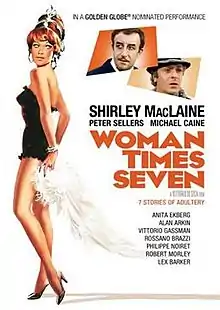
Woman Times Seven (Italian: Sette volte donna) is a 1967 Italian/French/American co-production comedy-drama film consisting of seven episodes, all starring Shirley MacLaine, most of which deal with aspects of adultery.
| Woman Times Seven | |
|---|---|
 | |
| Directed by | Vittorio De Sica |
| Screenplay by | Cesare Zavattini |
| Produced by | Arthur Cohn |
| Starring | |
| Cinematography | Christian Matras |
| Edited by |
|
| Music by | Riz Ortolani |
Production companies |
|
| Distributed by |
|
Release date |
|
Running time | 108 minutes |
| Countries |
|
| Language | English |
Cast
- "Funeral Procession"
- Shirley MacLaine as Paulette
- Peter Sellers as Jean
- Elspeth March as Annette
- Vittorio De Sica as Mourner (uncredited)
- "Amateur Night"
- Shirley MacLaine as Maria Teresa
- Rossano Brazzi as Giorgio
- Judith Magre as Bitter Thirty
- Catherine Samie as Jeannine
- Laurence Badie as Prostitute
- Zanie Campan as Prostitute
- Robert Duranton as Didi
- "Two Against One"
- Shirley MacLaine as Linda
- Vittorio Gassman as Cenci
- Clinton Greyn as MacCormack
- "Super Simone"
- Shirley MacLaine as Edith
- Lex Barker as Rik
- Elsa Martinelli as Pretty Woman
- Robert Morley as Dr. Xavier
- Jessie Robins as Marianne, Edith's Maid
- "At the Opera"
- Shirley MacLaine as Eve Minou
- Patrick Wymark as Henri
- Michael Brennan as Mr. Lisiere
- Adrienne Corri as Mme. Lisiere
- Jacques Ciron as Féval (uncredited)
- Roger Lumont as Nossereau (uncredited)
- Roger Trapp as Crosnier (uncredited)
- "The Suicides"
- Shirley MacLaine as Marie
- Alan Arkin as Fred
- "Snow"
- Shirley MacLaine as Jeanne
- Michael Caine as Handsome Stranger
- Anita Ekberg as Claudie
- Philippe Noiret as Victor
- Georges Adet as Old Man (uncredited)
- Jacques Legras as Salesman (uncredited)
Episodes
Paulette/Funeral Procession
Leading a walking funeral procession behind the hearse containing the remains of her late husband, a widow is propositioned by her family doctors. Vittorio De Sica has a cameo as one of the mourners.
Maria Teresa/Amateur Night
Surprised at finding her husband in bed with her best friend, a shocked wife vows revenge by planning to have sex with the first man whom she sees. She meets a group of prostitutes who help her accomplish her goal.
Linda/Two Against One
A Scotsman and an Italian are invited to the room of a translator who reads T. S. Eliot in the nude. Linda has a photo of her lover on a table.
Edith/Super Simone
Ignored by her bestselling author husband who is only interested in his fictional female creation Simone, a neglected wife turns her visions of herself as Simone into reality. Her shocked husband invites a psychiatrist to dinner to examine her for mental illness, but the husband, guest and housekeeper insist that the guest is a lawyer.
Eve/At the Opera
A fashion queen is horrified when her archrival Mme Lisari is photographed in what her husband had promised was an exclusive creation for her alone. The head of research and development at her husband's fashion house suggests planting a bomb Lisari's car. Louis Alexandre Raimon has a cameo as himself.[1]
Marie/Suicides
Two lovers, feeling rejected by the world, decide to commit suicide in their small room, dressed for the wedding that they will never have. But the man is afraid of pills, does not want to mess up his tuxedo by jumping out of the window and cannot trust his lover to shoot him.
Jeanne/Snow
Two friends meet for lunch on a winter afternoon. They notice a handsome but seedy-looking man who appears to be following them. Claudie suggests that the two leave the restaurant and go their separate ways to see which one he follows. As Paris is hit by a sudden blizzard, Jeanne realizes that the man is following her.
Production
Woman Times Seven was the first of what was projected to be three films made by Joseph E. Levine, producer Arthur Cohn and Vittorio De Sica working together.[2] As Levine and De Sica had critical and financial success with the films Marriage Italian Style and Yesterday, Today and Tomorrow, Levine asked De Sica for a similar film, and De Sica used some sketches made by his collaborator Cesare Zavattini as the basis.[3] The first choice for the lead role, Natalie Wood, declined the role.[4]
The concepts of adultery in the film have a European flavor. For example, Vittorio Gassman's character reminds Clinton Greyn's character that divorce is, at the time of filming, impossible for an Italian.
The film was shot in Paris. Wardrobe was supplied by Pierre Cardin, jewelry by Van Cleef & Arpels, furs by Henri Stern and hairdressing by Louis Alexandre Raimon.
Lord Lucan, later to be suspected of murder, unsuccessfully screen-tested for a role in the film. After that failure, he declined an invitation from Albert R. Broccoli to audition for the part of James Bond.[5]
Reception
In a contemporary review for The New York Times, critic Bosley Crowther harshly denounced the film: "For a man who has treated women as nicely as Vittorio De Sica has—as witness the several classic characters he has created with Sophia Loren—it is shocking and thoroughly bewildering to find him kicking them around as he does in his new picture ... Not one of the seven silly females whom Shirley MacLaine portrays in this series of seven blackout sketches provokes any feeling but disgust—or possibly embarrassment and pity—for the weaker (shall we say minded?) sex. Not one of them has the charm, the humor or the vitality we've come to expect in Mr. De Sica's women. And not one of them shows a spark of truth."[6]
Variety wrote: "Woman Times Seven means a seven-segment showcase for the talents of Shirley MacLaine, playing in tragicomedy and dramatic fashion a variety of femme types. MacLaine is spotted in many different adult situations, and largely convinces with each switcheroo."[7]
Box office
According to Fox records, the film needed to earn $2,975,000 in rentals to break even and made $1,100,000, meaning it made a loss.[8]
References
- "Fashion: Alexandre the Great: what a hair-stylist". October 21, 1998.
- "THE VERY RICH HOURS OF JOE LEVINE". September 9, 1967 – via www.newyorker.com.
- Cardullo, Bert Vittorio De Sica: Director, Actor, Screenwriter (2002), McFarland, p.180
- Hallowell, John The Truth Game (1969), Simon and Schuster, p. 150
- Moore, Sally Lucan: Not Guilty (1987), Sidgwick & Jackson Limited, pp. 72–73
- Crowther, Bosley (June 28, 1967). "Screen: 'Woman Times Seven' Opens". The New York Times. p. 38.
- Variety Staff (January 1, 1967). "Woman Times Seven".
- Silverman, Stephen M (1988). The Fox that got away : the last days of the Zanuck dynasty at Twentieth Century-Fox. L. Stuart. p. 326.