Women Who Fight Roundabout
The Women Who Fight Roundabout (Spanish: Glorieta de las mujeres que luchan)[2] is a temporary public sculpture installed to honor the victims of femicide in Mexico. It was installed on the afternoon of 25 September 2021 by a group of feminists, who placed it on the empty plinth where a statue of Christopher Columbus had previously been. The site, a roundabout on Paseo de la Reforma Avenue in Cuauhtémoc, Mexico City, was also symbolically renamed as "Glorieta de las mujeres que luchan".
| Glorieta de las mujeres que luchan | |
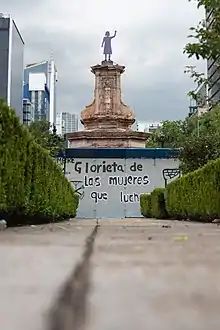 The roundabout a few hours after the sculpture was installed | |
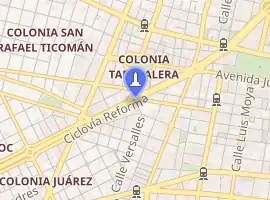
Location | |
| Coordinates | 19°25′59″N 99°09′17″W |
|---|---|
| Location | Mexico City, Mexico |
| Designer | Feminists |
| Type | Antimonumenta |
| Material | Cardboard |
| Height | 1.9 m (6 ft 3 in)[1] |
| Opening date | 25 September 2021 |
| Dedicated to | Women |
Background
The statue of Christopher Columbus in Paseo de la Reforma was removed on 10 October 2020 prior to an attempted demonstration to topple it two days later—on Columbus Day.[3] According to the government of the city, it was removed as part of a series of restorations performed by the National Institute of Anthropology and History (INAH).[4] Mayor Claudia Sheinbaum said public debates would be held in 2021 to determine the future of the monument.[5] However, these were not conducted[2] and the government of the city decided to replace the statue of Columbus with Tlalli, a large female head statue by Pedro Reyes who was inspired by the Olmec colossal heads (of men) and his intention was to honor 500 years of the resistance of Mexican indigenous women.[6] Tlalli sparked several controversies, including the selection of Reyes, a mestizo male, to represent Mexican indigenous women.[3][7] Because of the controversies, Sheinbaum postponed the installation and commented that a committee would take care of the situation.[3]
Installation and description
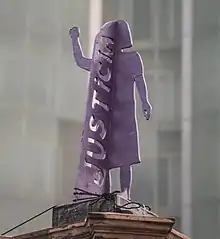
During the afternoon of 25 September 2021, a group of feminists crossed the protective fences of the monument and installed – in the manner of a Latin American antimonumenta – a purple cardboard woman with her fist raised.[8] Additionally, they painted the names of murdered and disappeared women on the protective fences, like that of Marisela Escobedo Ortiz.[9] Some names include those of living women who, they say, have resisted injustices.[9]
They named it the Glorieta de las mujeres que luchan (Spanish for Women Who Fight Roundabout). They noted that the authorities had tried to decide on a new statue, but they had failed and had appointed an artistic committee to decide on a new statue. The new committee would include indigenous women. However, the feminists did not want to impose their choice of a statue saying: "You decide the figure, we rename[d] the roundabout."[2] They further explained that their figure was "to honor the 'invisible' Afro-Mexican and indigenous women that have had to defend their lands, education, right to live, as well as the women who were erased from history, the Zapatistas, and the female human rights defenders."[2]
The names were covered in white paint by the city government within 12 hours. The next day a group of feminists returned and wrote the names again, and added, "You will not erase us".[10] During an abortion rights demonstration on 3 October 2021, the names were re-added after having been covered again during the week.[11][12]
Day of the Dead altar
On October 31, an altar was placed in the main path of the roundabout, where feminists wrote "México Feminicida" (Mexico Femicidal). They also placed cempasúchil flowers and papel picado with the phrase "Fue el estado" (It was the state) cut into them.[13]
Removal
On 12 October 2021, the government of the city announced that a replica of The Young Woman of Amajac will replace the monument to Columbus.[14] Three days later, feminist groups urged the authorities to not remove the piece unless the roundabout is formally renamed as the Women Who Fight Roundabout. They also criticized that the artwork that will replace it is believed to have been a young elite woman or a ruler.[15]
See also
References
- "Antimonumenta en Glorieta de Colón sí representa a las mujeres indígenas, responde colectiva" [Antimonumenta in Columbus Roundabout does represent indigenous women, replies feminist colective]. SDP Noticias (in Spanish). 28 September 2021. Retrieved 19 November 2021.
- Wilson, George (27 September 2021). "Feminists rename the Colón roundabout in Mexico City as Las Mujeres que Luchan roundabout". 24 News Recorder. Retrieved 5 October 2021.
- "Mexican feminists install a statue of a woman to replace one where Columbus stood". The Fresno Bee. Mexico City. EFE. 25 September 2021. Retrieved 9 October 2021.
- Roa, Wendy (10 October 2020). "Retiran estatua de Cristobal Colón en Paseo de la Reforma" [Statue of Christopher Columbus removed from Paseo de la Reforma]. Excélsior (in Spanish). Mexico City. Archived from the original on 29 July 2021. Retrieved 7 September 2021.
- Alejo Santiago, Jesús; Sánchez Medel, Leticia (12 October 2020). "Cristobal Colón. Monumento, símbolo del colonialismo: López Luján" [Christopher Columbus. Monument, symbol of colonialism: López Luján]. Milenio (in Spanish). Archived from the original on 19 October 2020. Retrieved 7 September 2021.
- "¿Quién es Pedro Reyes, el artista que creará la escultura de una indígena en lugar del Colón, en Reforma?" [Who is Pedro Reyes, the artist that will create the sculpture of an indigenous person in place of Columbus, in Reforma?]. El Universal (in Spanish). 5 September 2021. Archived from the original on 5 September 2021. Retrieved 7 September 2021.
- "Critican escultura de mujer indígena que sustituirá a Colón; es una cabeza olmeca con nombre náhuatl" [Sculpture of indigenous woman that will substitute Columbus criticized; it's an Olmec head with a Nahuatl name]. El Financiero. 10 September 2021. Archived from the original on 10 September 2021. Retrieved 10 September 2021.
- Hernández, Carlos (25 September 2021). "Feministas toman el monumento a Colón y la renombran como "Las mujeres que luchan"" [Feminists take over the monument to Columbus and rename it "The women who fight"]. El Sol de Nayarit. Retrieved 5 October 2021.
- San Martín, Neldy (3 November 2021). "'No nos van a borrar'" ['You will not erase us']. Proceso (in Spanish). Archived from the original on 3 November 2021. Retrieved 3 November 2021.
- Vargas, Marcela (28 September 2021). ""No nos van a borrar": El mensaje de la glorieta de las mujeres que luchan" ["You will not erase us": The message of the Women Who Fight Roundabout]. Corriente Alterna (in Spanish). National Autonomous University of Mexico. Retrieved 5 October 2021.
- Gutiérrez, Sáshenka (4 October 2021). "The visual cry of "women who fight" against violence in Mexico". El País. News Europa. EFE. Retrieved 5 October 2021.
- "Retoman Glorieta de las Mujeres que Luchan" [The Women Who Fight Roundabout is reinstated]. La Jornada (in Spanish). Mexico City. 3 October 2021. Retrieved 5 October 2021.
- Rangel, Azucena (31 October 2021). "En CdMx, realizan ofrenda para víctimas de feminicidio en Reforma" [In Mexico City, an offering for victims of feminicide is made in Reforma]. Milenio. Archived from the original on 1 November 2021. Retrieved 4 November 2021.
- Agren, David (12 October 2021). "Mexico City to replace Columbus statue with pre-Hispanic sculpture of woman". The Guardian. Retrieved 12 October 2021.
- San Martín, Nedly (15 October 2021). "Exigen a Sheinbaum mantener antimonumenta de Mujeres que Luchan en la glorieta de Colón" [Sheinbaum demanded to keep anti-monument of Mujeres que Luchan in the Colón Roundabout]. Proceso (in Spanish). Retrieved 15 October 2021.
External links
 Media related to Glorieta a las mujeres que luchan at Wikimedia Commons
