Woodwardopterus
Woodwardopterus is a genus of prehistoric eurypterid classified as part of the family Mycteroptidae. The genus contains one species, W. scabrosus, from the Lower Carboniferous of Glencartholm, Scotland.[1] Originally itwas known as Eurypterus scabrosus, being later found to be generically distinct and successfully classified as part of the family Mycteroptidae. Latter in 2005, was assigned to its own genus, and linked to a new own family, Woodwardopteridae inside Mycteropoidea, probably as a sister taxon of Megarachne.[2]
| Woodwardopterus | |
|---|---|
Scientific classification  | |
| Kingdom: | Animalia |
| Phylum: | Arthropoda |
| Subphylum: | Chelicerata |
| Order: | †Eurypterida |
| Superfamily: | †Mycteropoidea |
| Family: | †Mycteroptidae |
| Genus: | †Woodwardopterus Kjellesvig-Waering, 1959 |
| Type species | |
| †Woodwardopterus scabrosus Woodward, 1887 | |
| Species | |
| |
A possible second species, ?W. freemanorum was named in 2021 and come from Changhsingian (Late Permian) beds of the Baralaba Coal Measures, Bowen Basin, central Queensland.[3] This possible second species is important due to be the geologically youngest Eurypterid discovered (at least 11 Ma younger than any previously known relative), showing that large sweep-feeding eurypterids persisted until the end-Permian extinction in the southern high latitudes of Gondwana.[3]
See also
References
- Tetlie, O. E. (2007). "Distribution and dispersal history of Eurypterida (Chelicerata)". Palaeogeography, Palaeoclimatology, Palaeoecology. 252 (3–4): 557–574. Retrieved 30 November 2021.
- Selden, P. A.; Corronca, J. A.; Hünicken., M. A. (2005). "The true identity of the supposed giant fossil spider Megarachne". Biology Letters. 1 (1): 44–48. Retrieved 30 November 2021.
- Poschmanna, Markus J.; Rozefelds, Andrew (2021). "The last eurypterid – a southern high-latitude record of sweep-feeding sea scorpion from Australia constrains the timing of their extinction". Historical Biology. 33 (12): 121–138. Retrieved 30 November 2021.
| ||
| Taxonomy | 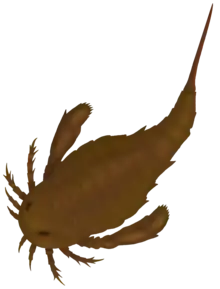 | |
| Geochronology |
| |
| Geography |
| |
| Notable genera | ||
| Ichnogenera | ||
| Related groups | ||
| Related articles | ||
 Category Category | ||