Wrexham County Borough
Wrexham County Borough (Welsh: Bwrdeistref Sirol Wrecsam) is a county borough in the north-east of Wales. The county borough has a population of nearly 135,000 inhabitants, with around 63,000 residing either within the town of Wrexham or in the surrounding conurbation of urban villages and its only two urban towns, Chirk and Holt. The remainder live to the south and east of the town in more rural areas, including the county borough's large salient in the Ceiriog Valley. The area has strong links with coal-mining. The county borough was formed on 1 April 1996. Borough status was inherited from the town of Wrexham, granted over 150 years ago. Most of the area was previously part of the district of Wrexham Maelor – with several communities coming from Glyndŵr – in the county of Clwyd.
Wrexham County Borough Bwrdeistref Sirol Wrecsam | |
|---|---|
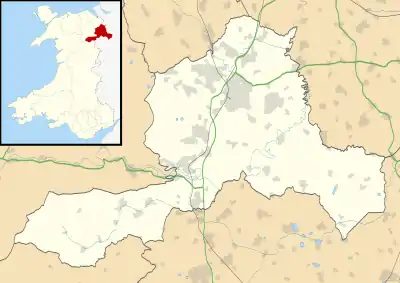 Wrexham County Borough shown within Wales | |
| Coordinates: 53.05°N 3.00°W | |
| Sovereign state |  United Kingdom United Kingdom |
| Constituent country |  Wales Wales |
| Preserved county | Clwyd |
| Established | 1 April 1996 |
| Administrative HQ | Wrexham |
| Government | |
| • Type | Principal council |
| • Body | Wrexham County Borough Council |
| • Executive | TBA (council NOC) |
| • Leader | Mark Pritchard (Independent) |
| • Mayor | Ronnie Prince (Independent) |
| • Chief Executive | Ian Bancroft |
| • MPs | Sarah Atherton (C) Simon Baynes (C) |
| Area | |
| • Total | 193 sq mi (499 km2) |
| Area rank | 10th |
| Population (2017) | |
| • Total | 136,055 |
| • Rank | 10th |
| • Density | 700/sq mi (270/km2) |
| • Ethnicity | 97.6% white |
| Time zone | UTC+0 (Greenwich Mean Time) |
| • Summer (DST) | UTC+1 (British Summer Time) |
| GSS code | W06000006 |
| ISO 3166-2 | GB-WRX |
| NUTS 3 code | UKL23 |
| ONS code | 00NL |
| Website | www.wrexham.gov.uk |
The area includes a portion of the eastern half of the historic county of Denbighshire and two exclaves of historic Flintshire: English Maelor and the parish of Marford and Hoseley. In 2021, the county borough placed a bid for UK City of Culture 2025 (from 2025 areas can apply), moving to the shortlist in October 2021.
Government
The region is governed as a unitary authority by Wrexham County Borough Council. Most offices of the council are situated within Wrexham town centre, around Llwyn Isaf and the Civic Centre around Chester Street. The headquarters of the organisation is at the Guildhall, Queens Square.
Schools
Top performing Secondary schools in Wrexham County Borough.
Percentages are those achieving at least 5 GCSEs at grades A*-C, according to the latest inspection report by Estyn.
All schools English medium unless stated:
| % | Name | Location |
|---|---|---|
| 86% | The Maelor School | Penley |
| 61% | Ysgol Morgan Llwyd (bilingual) | Wrexham |
| 56% | Ysgol Rhiwabon | Ruabon |
| 49% | St Joseph's Catholic & Anglican High School* | Wrexham |
| 48% | Darland High School* | Rossett |
| 44% | Ysgol y Grango* | Rhosllannerchrugog |
| 41% | Ysgol Clywedog* | Wrexham |
| 38% | Ysgol Bryn Alyn* | Gwersyllt |
| 36% | Rhosnesni High School* | Wrexham |
*Incomplete secondary school which does not have a Sixth Form
Twinning

Wrexham is twinned with the German district of Märkischer Kreis and the Polish town of Racibórz.
The first twinning was established on 17 March 1970 between the former Kreis Iserlohn and Wrexham Rural District. Its early success ensured that, after local government reorganisation in both countries in the mid-seventies, the twinning was taken over by the new councils of Märkischer Kreis and Wrexham Maelor Borough Council and, in 1996, by Wrexham County Borough Council.
In 2001 Märkischer Kreis entered a twinning arrangement with Racibórz, a county in Poland, which was formerly part of Silesia, Germany. In September 2002, a delegation from Racibórz visited Wrexham and began discussions about co-operation which led to the signing of Articles of Twinning between Wrexham and Racibórz in March 2004. The Wrexham area has strong historical links with Poland. Following World War II, many service personnel from the Free Polish armed forces who had been injured received treatment at Penley Polish Hospital. Many of their descendants remain in the area.
Gallery
.jpg.webp) St Giles' Parish Church, Wrexham
St Giles' Parish Church, Wrexham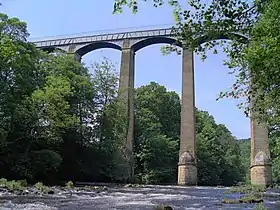 Pontycysyllte Aqueduct - A UNESCO World Heritage Site
.jpg.webp) Erddig Hall, Wrexham
Erddig Hall, Wrexham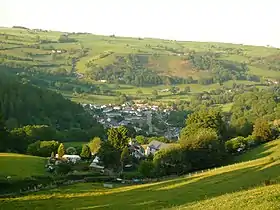

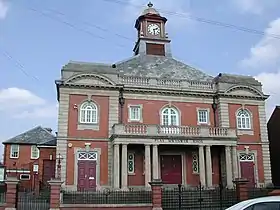 Stiwt Theatre, Rhosllannerchrugog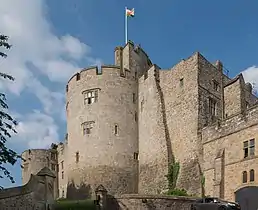
See also
- List of places in Wrexham County Borough for a list of towns and villages
External links
 |
Wikimedia Commons has media related to Wrexham County Borough. |
 |
Wikivoyage has a travel guide for Wrexham (county). |
- Council website
- Wrexham County Borough at Curlie
- Electoral Arrangements Order 1998 – description of Wards
- Wrexham Council Ward Map
- Wrexham.com Website
- NHS Review of substance misuse including Ward Deprivation Map and detailed population/age group figures (PDF Viewer Required)
| Principal settlements | 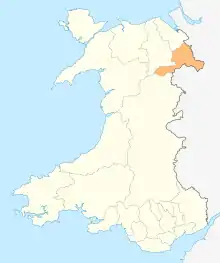 | |
|---|---|---|
| Communities |
| |
| Other villages and areas |
| |
| Universities and colleges | ||
| Castles | ||
| Buildings and structures | ||
| Rivers | ||
| Geography | ||
| Topics | ||
Authority control  | |
|---|---|
| General | |
| Other | |