Yale Golf Course
The Yale Golf Course, or Yale University Golf Course, is a golf course in New Haven, Connecticut owned and operated by Yale University. Yale is home to the men and women's Yale Golf Team and hosts three collegiate invitational tournaments each year. The course is primarily open to university students, alumni, and the university community.
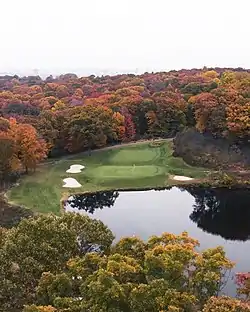 The famous 9th hole at Yale | |
| Club information | |
|---|---|
| Location | New Haven, Connecticut, U.S. |
| Established | Surveyed 1923, constructed 1924-1925, opened for play April, 1926 |
| Type | Private |
| Owned by | Yale University |
| Total holes | 18 |
| Tournaments hosted | Macdonald Cup, Yale Spring Invitational, Yale Invitational |
| Website | yalegolf |
| Designed by | Charles Blair Macdonald and Seth Raynor [1] |
| Par | 70 |
| Length | 6,825 yards (6.241 km)[2] |
| Course rating | 73.5[2] |
| Slope rating | 140[2] |
| Course record | 60, Li Wang (2016 Macdonald Cup) |
History
Most Yale students traveled to Race Brook Country Club in Orange, however it was not convenient to campus. Upon seeing a sustained enthusiasm for the game among Yale undergraduates, George Adee wrote a proposal to the Yale Athletic Association out of concern and frustration in 1922. By this time, Princeton already had a university course while Harvard had begun discussions for a course of their own.[3] Adee's proposal revolved around asking Sarah Wey Tompkins, the window of Ray Tompkins, to purchase and donate a plot of land on which Yale could build a course of their own. Ray Tompkins was a former Yale football captain in 1882 and again in 1883 and had amassed a large wealth while serving as the president of the Chemung Canal Trust Company in New York. Upon his death in 1918, Tompkins left his wife Sarah an estate worth over a million dollars. However, in his will existed a provision that upon the death of his wife the remainder of his wealth would be given to Yale "to furnish facilities for extending and developing the practice of athletic exercises on the part of students of the University". In 1923 following Adee's proposal, Yale approached Sarah Tompkins in hopes that she would purchase a plot of land known of the Greist Estate and donate it to the University. She accepted without hesitation and the 720 acres (290 ha) was purchased for $375,000.[4]
Following the donation of the Griest Estate by Sarah Tompkins, a Yale Golf Committee was formed. With George Adee as its first chairman and J.F. Byers and Jess Sweetser on the committee, they contacted golf course architect Charles Blair Macdonald to confirm the possibility of having a golf course on the estate. Upon viewing the property and seeing its potential, Macdonald agreed to serve as a consultant to the project. Macdonald pushed for the hiring of a former associate of his, Seth Raynor, to be the course architect. Raynor was paid $7,500 to complete the project and began surveying the land in the summer of 1923.[5]
To fund the golf course, the Board of Control of the Yale Athletic Association reached out to alums with the opportunity to become either a patron of the Ray Tompkins Memorial, a founder, or a member of the Yale Golf Club. To become a patron, one would have to pay $1000 but would be granted, “all privileges of the Ray Tompkins Memorial, including unrestricted lifetime use of the Yale Golf Course, and the option to make during lifetime one transfer of his rights, subject to the approval of the Board of Control.” Some of the alums who supported became patrons include Edwin Herr, George Adee, W. T. Adee, Charles Tiffany, Edward S. Harkness, M.N. Buckner, M.J. Warner, Clarence Blakeslee, Oliver Gould Jennings, J. Frederic Byers, Eben Byers, Charles Merrill, S. Brink Thorne, Julian Curtiss, Henry Havemeyer, Harry Rosenbaum, and S.B. Rosenbaum. Founders of the Yale Golf Club received lifetime use of the course, subject to restriction during the college year based on undergraduate use of the course. Founders within a 25-mile radius of the University paid $750 while those beyond 25 miles paid $500. Members of the Yale Golf Club received use, of course, subject to restrictions during the college year based on undergraduate use of the course. The initiation fee was $250 in addition to annual dues of $40 for those within a 25-mile radius of the university, or $20 for those beyond the 25-mile radius.[6]
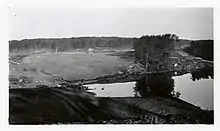
The clearing of the Griest Estate began during the summer of 1923. The crew had to blast, dig and drain the land that was mostly swampland.
Macdonald described it:
The building of it was a difficult engineering problem. The land was high, heavily wooded, hilly, and no part of it had been cultivated for over forty years. There were no roads or houses upon it. It was a veritable wilderness when given to Yale ... When in the timber one could not see fifty feet ahead, the underbrush was so thick.
In total 120 acres of the estate was made available for the course. Heavier construction began in April 1924. The project initially began with 60 workers and rose to 150 at the height of the project. Although the crew ran into irrigation issues that required 35,000 feet (11 km) of pipes to correct and the project itself ran way over budget, the course officially opened for play on April 15, 1926. Upon opening, the course set up as a 6,552-yard (5.991 km) par 71.[7] The courses' final cost was a then-record $400,000. One reviewer, Herbert Warren Wind wrote that the Yale Golf Course was, "a back-breaking job over an untouched plot of rugged land whose hazards and greens have the kind of dimensions that one would have expected of Michelangelo."[8]
Tournaments hosted
Yale Golf Course has hosted many significant golf tournaments. These includes amateur tournaments like the U.S. Junior Amateur Golf Championship,[9] NCAA Regional Championships, Macdonald Cup,[10] and the Yale Spring Invitational.[11]
It addition it has hosted some significant professional tournaments. It hosted the Connecticut Open in 1931 and 1981.[12] In addition, the course also hosted a Ben Hogan Tour event, New Haven Open, in the early 1990s.[13]
Rankings
Course

First hole
Par 4
Original Lengths: Championship Course - 410 yards, Regular Course - 399 yards, Short Course - 379 yards.
Notes - The description of the hole from Alumni Magazine August 28, 1925 mentions the green is a double green of the “Road Hole type on the right and a punchbowl on the left set into a bit of a hollow bunkered left and right.” [18]
Second hole
Par 4
Original Lengths: Championship Course - 365 yards, Regular Course - 349 yards, Short Course - 338 yards.
Notes - There was once a short fairway bunker on the left side that was filled in during the 1970s. The green emulates the “Cape” template by jutting out, “seemingly into mid-air.” The right side of the green was lowered approximately 18” in the 1950s. The two bunkers on the left were once a single bunker. That trap is the deepest on the course and one of the deepest ever built. [19]
Third hole
Par 4
Original Lengths: Championship Course - 380 yards, Regular Course - 370 yards, Short Course - 310 yards.
Notes - The original third green was a double punchbowl until it was altered sometime during the 1940s. The green was made smaller and the 40 yards of the original bunker was filled in.
Fourth hole
Par 4
Original Lengths: Championship Course - 440 yards, Regular Course - 426 yards, Short Course - 284 yards.
Notes - The number one handicapped hole. It has been included among several lists of the greatest holes in golf. The green is a reverse Road template based on the Road Hole at St. Andrews.
Fifth hole
Par 3
Original Lengths: Championship Course - 135 yards, Regular Course - 131 yards, Short Course - 117 yards.
Notes - This hole emulated the “Short” template, inspired by a hole at Brancaster, home to the Royal West Norfolk Golf Club. It was built with a prominent “horseshoe” feature that was removed. A notation for the hole during the report to the committee mention this green being a “horseshoe-island” type.
Sixth hole
Par 4
Original Lengths: Championship Course - 350 yards, Regular Course - 342 yards, Short Course - 318 yards.
Notes - This hole incorporates elements of the Leven template. The current back tee is not original. The green once had an s-shaped raised spine running left to right that was taken out. This original notes for the hole mention a sand dune on the interior of the hazard. It is visible in construction photographs. The berm short left of the green was also referred to as a sand dune in the original notes.
Seventh hole
Par 4
Original Lengths: Championship Course - 368 yards, Regular Course - 348 yards, Short Course - 323 yards.
Notes - The fairway was once an impassable swamp. The approach plays to an elevated knoll.
Eighth hole
Par 4
Original Lengths: Championship Course - 415 yards, Regular Course - 409 yards, Short Course - 372 yards.
Notes - The construction notes list this green is a Cape-Redan type. The green presently stretches 75 yards from front to back. Bunkers on either side are among the deepest on the course.
Ninth hole
Par 3
Original Lengths: Championship Course - 225 yards, Regular Course - 210 yards, Short Course - 190 yards.
Notes - A hole inspired by the Biarritz template, inspired by the Chasm Hole that briefly existed in France during the 19th century.
Tenth hole
Par 4
Original Lengths: Championship Course - 405 yards, Regular Course - 373 yards, Short Course - 342 yards.
Notes - Undulating fairway with an elevated green behind two bunkers. There is a significant slope to the front right corner of the green that is inspired by the Valley of Sin on the 18th green of St. Andrews.
Eleventh hole
Par 4
Original Lengths: Championship Course - 425 yards, Regular Course - 370 yards, Short Course - 295 yards.
Notes - The description of this hole in the committee report said “ 2 shot Rev. Redan” as the green cants from left to right.
Twelfth hole
Par 4
Original Lengths: Championship Course - 406 yards, Regular Course - 340 yards, Short Course - 340 yards.
Notes - The approach to hole 12 is inspired by the Alps hole at Prestwick. The area short of the front bunker has been amended and restored several times. It does not present in its original shape.
Thirteenth hole
Par 3
Original Lengths: Championship Course - 190 yards, Regular Course - 190 yards, Short Course - 190 yards.
Notes - The third of four par-3s, the Redan Hole is the only hole that the yardage (190 yards) was the same for all three sets of tees.
Fourteenth hole
Par 4
Original Lengths: Championship Course - 372 yards, Regular Course - 335 yards, Short Course - 320 yards.
Notes - There was once a fairway bunker left of the fairway, and the original hole description includes mention of a bunker behind the green.
Fifteenth hole
Par 3
Original Lengths: Championship Course - 188 yards, Regular Course - 170 yards, Short Course - 135 yards.
Notes - The final par 3. This hole follows the Eden template, based on the 11th hole at St. Andrews. The Hill bunker on the left was altered during the bunker restoration program by Roger Rulewich.
Sixteenth hole
Par 5 Original Lengths: Championship Course - 445 yards, Regular Course - 420 yards, Short Course - 410 yards.
Notes - The first par-5 of the round. The hole incorporated a large mound on the right side of the fairway.
Seventeenth hole
Par 4
Original Length: Championship Course - 425 yards, Regular Course - 415 yards, Short Course - 415 yards.
Notes - This hole requires a drive to a blind fairway. The green is similar to the 11th hole at the National Golf Links, with a plateau, also known as a double plateau feature behind a bunker complex inspired by the Principal's Nose on the 16th fairway of the St. Andrew's Old Course.
Eighteenth hole
Par 5
Original Lengths: Championship Course - 608 yards, Regular Course - 510 yards, Short Course - 470 yards.
Notes - The second and final par 5 is controversial for its blind shots. There was once a fairway bunker on the upslope of the left fairway that was removed in the 1960s
References
- "Yale Golf Course; About Us". yale.edu. Yale University. Retrieved 28 August 2020.
- "Yale Golf Course Detailed Scorecard". bluegolf.com. Blue Golf. Retrieved 28 August 2020.
- "1923–1926: Building the Yale Golf Course". campuspress.yale.edu. William Kelly and John Godley. Retrieved 6 September 2020.
- "The Site". campuspress.yale.edu. William Kelly and John Godley. Retrieved 6 September 2020.
- "The Site". campuspress.yale.edu. William Kelly and John Godley. Retrieved 6 September 2020.
- "Ray Tompkins Memorial" (PDF). Yale Athletic Association. Retrieved 15 August 2021.
- "Seth J. Raynor: The course architect". campuspress.yale.edu. William Kelly and John Godley. Retrieved 8 September 2020.
- "Yale Golf Course | About Us". yalegolf.yale.edu. Yale University. Retrieved 9 September 2020.
- "U.S. Junior Amateur History". usga.org. United States Golf Association. Retrieved 9 September 2020.
- "The Macdonald Cup". yalebulldogs.com. Yale University. Retrieved 23 September 2020.
- "Yale Spring Invitational". yalebulldogs.com. Yale University. Retrieved 23 September 2020.
- "Connecticut Open: Past Champions". Connecticut State Golf Association. Retrieved 2021-11-20.
- "Nike Tour Event On The Move?". courant.com. Hartford Courant. Retrieved 5 October 2020.
- "Golf's 2020-2021 Ranking of the Top 100 Courses in the World". golf.com. EB GOLF MEDIA LLC. Retrieved 14 September 2020.
- "Golfweek's Best 2019: Top 200 Classic Courses". golfweek.usatoday.com. Golfweek. Retrieved 14 September 2020.
- "2019 Top 30 Golfweek's Best Campus Courses". golfweek.usatoday.com. Golfweek. Retrieved 14 September 2020.
- "147 Custodians of the Game". golfclubatlas.com. Golf Club Atlas. Retrieved 14 September 2020.
- "Hole #1 'Eli'". campuspress.yale.edu. William Kelly and John Godley. Retrieved 6 September 2020.
- "Hole #2 'The Pits'". campuspress.yale.edu. William Kelly and John Godley. Retrieved 6 September 2020.