Zatch Bell!
Zatch Bell![lower-alpha 1] is a Japanese manga series written and illustrated by Makoto Raiku. It was serialized in Shogakukan's Weekly Shōnen Sunday between January 2001 and December 2007, concluding with 323 chapters compiled into 33 volumes. The story follows the title character Zatch Bell, a mystical being called a Mamodo, who is partnered with Kiyo Takamine, a 14-year-old schoolboy, in a once-a-millennium tournament on Earth that determines the right to rule the Mamodo world as king. During their adventure, Zatch and Kiyo encounter and battle various Mamodo and their human partners, as well as allies who aid Zatch in his quest to become a "kind king."
| Zatch Bell! | |
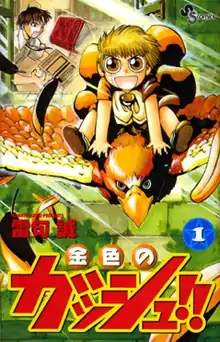 Manga volume 1 cover, featuring Zatch Bell riding Owashi and Kiyo Takamine | |
| 金色のガッシュ!! (Konjiki no Gash!!) | |
|---|---|
| Genre | |
| Manga | |
| Written by | Makoto Raiku |
| Published by | Shogakukan |
| English publisher | |
| Imprint | Shōnen Sunday Comics |
| Magazine | Weekly Shōnen Sunday |
| Demographic | Shōnen |
| Original run | January 10, 2001 – December 26, 2007 |
| Volumes | 33 |
| Anime television series | |
| Directed by |
|
| Produced by |
|
| Written by |
|
| Music by | Kow Otani |
| Studio | Toei Animation |
| Licensed by | |
| Original network | FNS (Fuji TV) |
| English network | |
| Original run | April 6, 2003 – March 26, 2006 |
| Episodes |
|
| Anime film | |
| Zatch Bell! Movie 1: 101st Devil | |
| Directed by | Junji Shimizu |
| Written by | Hiroshi Hashimoto |
| Music by | Kow Otani |
| Studio | Toei Animation |
| Licensed by | |
| Released | August 7, 2004 |
| Runtime | 84 minutes |
| Anime film | |
| Zatch Bell Movie 2: Attack of Mechavulcan | |
| Directed by | Takuya Igarashi |
| Written by | Hiroshi Hashimoto |
| Music by | Kow Otani |
| Studio | Toei Animation |
| Licensed by | |
| Released | August 6, 2005 |
| Runtime | 85 minutes |
| Related media | |
Zatch Bell! was later adapted into a 150-episode anime television series[lower-alpha 2] produced by Toei Animation. It was written by Akatsuki Yamatoya and Hiroshi Hashimoto, and directed by Tetsuji Nakamura and Yukio Kaizawa. The series ran on Fuji TV April 2003 through March 2006, and spanned three seasons, each containing 50 episodes. In addition to an array of licensed merchandise, the franchise also spawned a series of video games and two animated theatrical films.
Viz Media licensed the manga for the English translation in North America on August 2005, but ended the release on June 2009. The television series, also licensed by Viz Media, aired on Cartoon Network's Toonami block and YTV from March 2005 to December 2008 with only 104 episodes dubbed in English. Starz added the English-adapted series to its on-demand catalogue in 2017.
The manga has over 22 million copies in circulation. In 2003, it won the 48th Shogakukan Manga Award for the shōnen category.
Synopsis
Setting
Mamodo[lower-alpha 3] are mystical creatures with supernatural powers from the parallel Mamodo world.[lower-alpha 4] Every 1,000 years, one hundred Mamodo are transported to Earth to compete for the kingship of their world. Each Mamodo carries a spell book[lower-alpha 5] that seals away their powers and requires a human companion to read aloud in order to cast them in the form of spells.[lower-alpha 6] Only one human is allowed to read from that Mamodo's book, whereupon he or she becomes its book owner[lower-alpha 7] and partner.[upper-alpha 1] Spells cast by the Mamodo produce a variety of effects. Along with direct attacks and defenses, there are also spells which trigger a Mamodo's special ability that can temporarily enhance its strength, render the enemy immobile, or empower an object they carry.[upper-alpha 2] Spells in each book are typically different for each Mamodo, but there are others that produce identical spells—an example of this is Zatch Bell and his twin brother, Zeno Bell, for their lightning-based powers. The human and their Mamodo usually start out with one spell but unlock more through experience and hard work. Additionally, the spell book responds to the user's strong emotions,[upper-alpha 3] so that a spell may be generated with greater energy and fervor. The Mamodo tournament involves eliminating opponents, which is achieved by burning their spell book. Once a spell book is burned, that Mamodo loses all claim to the position as king, and is immediately returned to the Mamodo world. The last Mamodo standing without their book destroyed becomes the Mamodo king for the next thousand years.
Plot
Kiyo Takamine is a 14-year-old junior high school student who lives with his mother in the fictional city of Mochinoki of modern-day Japan.[upper-alpha 4] One day, Kiyo's distant father, professor Seitaro Takamine, discovers an unconscious child named Zatch Bell with a strange book at a forest in England. He sends Zatch over to Kiyo, hoping to decipher the book and determine Zatch's past which he has no memory of. Kiyo quickly discovers that Zatch is a Mamado, and that the book causes Zatch to fire lightning from his mouth whenever he reads a spell from it. Over time, Kiyo and Zatch begin to encounter different Mamodo, especially Brago and his partner, French noblewoman Sherry Belmont, who explain the ongoing Mamodo battle. Kiyo and Zatch also discover some Mamodo who do not wish to fight and others who fight for the wrong reasons. Among them is Kolulu, who was forced to fight due to the power of her spells. Seeing this, Zatch resolves to become a kind king and stop the battle from ever happening again. Zatch and Kiyo also meet other Mamodo who share similar viewpoints and befriends them: Kanchomé with Italian movie star Parco Folgore, Tia with pop star Megumi Oumi, Ponygon with German engineer Kafk Sunbeam (although the former does not find his partner until later in the series), and Wonrei with a young Hong Konger Li-en.
As the number of Mamodo declines, Zatch and Kiyo encounter a Mamodo named Zofis, who takes control of several Mamodo that were sealed in stone tablets from the previous battle one thousand years ago. Zatch, Kiyo and his allies are recruited to confront Zofis by Dr. Riddles, an American ex-surgeon with his Mamodo Kido, who help the protagonists unlock new spells. Zatch and company head to an ancient ruin in South America where Zofis and the thousand-year Mamodo are hiding out. During the infiltration, Kido is sent back to the Mamodo world after defeating one of Zofis' minions. Sherry and Brago soon arrive to help fight Zofis and break his mind-control over his own partner, Sherry's childhood friend Koko. Zofis brainwashed Koko and made her do evil things such as burning down a whole village. Sherry and Brago overwhelm Zofis but not without the intervention of Kiyo and his friends. Sherry frees Koko, and Zofis is sent back to the Mamodo world.
Shortly thereafter, a mysterious floating tower appears over New Zealand. With the help of newer allies, Kiyo, Zatch, and their friends track down the tower, which is actually a semi-mechanical Mamodo giant named Faudo. It was brought to Earth by its rogue Mamodo guardian Riou, who plans to use it for the tournament but requires powerful spells of several Mamodo to activate it. He coerces these Mamodo by placing a curse on their book owners, including Li-en—if Faudo is not awakened after four days, the curse would kill its victims. Seeing the threat Faudo poses on Earth, the protagonists make their way to it. They succeed in breaking Riou's curse but release Faudo in the process, and Riou sends it toward Japan. As the protagonists frantically attempt to stop Faudo, Kiyo dies in a scuffle with Riou but is quickly revived, and several more of Zatch's allies are sent back to the Mamodo world, Wonrei among them. Amid the battle, a Mamodo resembling Zatch, who turns out to be his twin brother Zeno Bell, defeats Riou and seizes control of Faudo. As Zatch and Zeno fight each other inside Faudo, a flashback shows Zeno had long resented his brother because their father King Bell bestowed Zatch the power of Bao, his strongest spell. Zeno was treated cruelly at a young age, while Zatch lived with another family peacefully. Eventually, Zeno comes to realize that Zatch also suffered and apologizes for everything he has done. His book burnt, Zeno is sent back to the Mamodo world, and Faudo is thwarted before it reaches Japan.
Later, when it falls to only ten Mamodo left in the tournament,[upper-alpha 5] Zatch and company learn about an evil and nihilistic Mamodo named Clear Note. With the aid of Dufort, Zeno's former partner, the protagonists undergo rigorous training in preparation for the battle. However, during the interim, Kanchomé is sent back to the Mamodo world following an ambush by Clear Note. Kiyo, Megumi, and Sunbeam resolve to win against Clear Note for the sake of Kanchomé and Folgore. In the resulting confrontation, Tia and Ponygon hold out against Clear Note long enough before their spellbook is eventually burnt. Zatch's strong determination causes his spellbook to unlock spells from all the Mamodo he and Kiyo previously encountered. Using those spells, Clear Note is defeated, leaving Zatch and Brago as the only remaining Mamodo. After Kiyo's graduation ceremony, Zatch and Brago engage in the final confrontation, with the former emerging victorious. For helping Zatch become king, Kiyo is given the option of receiving a wish and forgetting about Zatch, or get nothing but retain his memories of Zatch; he chooses the second option. Three weeks later, a letter is sent from the Mamodo to their human partners, with Zatch's letter revealing that all is well in the Mamodo world.
The anime adaptation observes changes from the manga's storyline. These include additional subplots and characters not featured in the original story.[upper-alpha 6] Certain scenes and key events are also altered or chronologically rearranged. For example, Zatch and Kiyo first learn about Zeno Bell from another Mamodo they encounter, rather than from Tia as in the manga—she and Megumi corroborate the sighting later on. Ponygon also appears earlier in the anime's timeline than in the manga's. The final season of the anime deviates slightly from the manga due to numerous plot lines omitted. In particular, Kiyo's death does not occur, and Zeno never repents even when he returns to the Mamodo world. As a result of the changes, some Mamodo who lose out in the manga survive. The anime leaves out the events involving Clear Note, thus the demise of Zatch's main allies and of any remaining Mamodo is ambiguous. Instead, the series culminates in an epilogue showing Zatch and Brago preparing to fight each other as the last two Mamodo standing, with the winner not revealed.
Production
After Raiku's series in the Shōnen Sunday Super ended, Raiku looked at his old drafts he created in the past for an idea for his next series.[3] One of his ideas was a mercenary who uses a giant sword to defeat enemies. After playing with that idea for three months, Raiku decided to abandon it and go with another idea.[3] His next idea was a story where a middle school student finds an old toy and with the help of a noble knight, combats evil and after taking this up with his agent, he was advised to use a cuter character to fight and thus, Zatch was created.[3] After Raiku worked on the idea for a few months, it was published.[3] Raiku said that he intended to create a "passionate story about a heartwarming friendship" and that he used the concept as a "base" while adding the mamodo, book, and spell concepts. He was inspired by a western magic story that he read to create Zatch's red spell book. The reason Zatch uses lightning spells because his name had the word "Raiku" means "lightning" in Japanese. He mentions he created Folgore with the words "Invincible Italian Man" as a base.[4]
While writing volume five and six which takes place in England, Raiku went to England on a research trip.[5]
Zatch Bell! ended in December 2007. Shogakukan sent Raiku back his original manga artwork.[6] However, five full color pieces were missing.[7] On May 21, 2008, Raiku announced that he would no longer do business with Shogakukan. During the same year Raiku sued Shogakukan over the lost Zatch Bell!-related artwork.[6] Later that year Raiku settled for 2.55 million yen.[7]
The studio in which Makoto Raiku did his series is a unique. He had a large collection of autographs from manga artists displayed on the foyer which was the first thing one saw in the building.[8] His studio featured a high ceiling to prevent him getting claustrophobic, and he spent all day there for a deadline.[8] Raiku collected figurines and displayed them on his wall while he in his studio writing. Raiku admitted that most of his work took place in a restaurant where he did most of his storyboarding.[8] He said that there was less distraction since he was just surrounded by people and not games or the Internet.[8] Story boarding for a regular chapter of Zatch Bell! took about two days for Raiku to do.[8] When the editor approved the storyboard, Raiku called on his four assistants for his work,[8] and a fifth when deadlines are tight.[8] Raiku sold his studio in 2016.[9]
Media
Manga
Written and illustrated by Makoto Raiku, Zatch Bell! was serialized in Shogakukan's Weekly Shōnen Sunday magazine from January 10, 2001,[10] to December 26, 2007.[1] The manga spanned a total of 323 chapters, collected in thirty-three tankōbon volumes, released from May 18, 2001,[11] to June 18, 2008.[12]
The series was licensed for English release by Viz Media.[13] The first two volumes of the series were released on August 2, 2005.[14][15] Viz discontinued the series after volume 25, released on June 9, 2009.[16]
In March 2011, Makoto Raiku released a one-shot chapter of Zatch Bell to promote the re-release of the manga in a new bunkoban format by Kodansha.[17] Sixteen volumes were published between March 8, 2011, and June 7, 2012.[18][19] In July 2018, a digital sixteen-volume kanzenban edition of Zatch Bell was released through Raiku's digital publishing company BIRGDIN BOARD Corp. The re-releases consisted of newly-drawn cover art, color pages from the original Weekly Shōnen Sunday serialization, and a special bonus chapter in each volume, called Zatch Café,[lower-alpha 8] which features the characters from that volume's cover.[20] After successful sales and demand from fans, the kanzenban edition was released in physical format through Kraken in 2019.[21]
Anime
The episodes of the anime series were directed by Tetsuji Nakamura and Yukio Kaizawa and produced by Toei Animation.[22] The episodes were aired on Fuji Television between April 6, 2003, to March 26, 2006, and spanned 150 episodes.[23] The series was released in fifty-one DVD compilations by Shogakukan between November 19, 2003, and March 7, 2007, in Japan.[24][25]
Viz Media obtained the foreign television, home video, and merchandising rights to the Zatch Bell! anime from Toei Studio on August 4, 2005.[13] Subsequently, Viz Media contracted Studiopolis to produce an English dub. Viz Media has licensed its individual Zatch Bell! merchandising rights to several different companies. The English adaptation of the Zatch Bell! was broadcast on Cartoon Network's Toonami from March 5, 2005, to January 20, 2007, with seventy-seven episodes aired. Canada's YTV began airing Zatch Bell! in September 2005 and ended on December 6, 2008, at episode 104.[26] Thirteen DVDs were released by Viz Media between November 8, 2005, and December 4, 2007.[27][28] New Video Group released a DVD box set, Zatch Bell!: The Complete Seasons 1 & 2, on December 3, 2013, which included the first 100 episodes of the North American edited English dub.[29] On June 22, 2017, Starz announced that it would be offering the English-adapted episodes of the series for its video on demand service starting July 1, 2017.[30]
Films
The series spawned two spin-off films. The first film, Zatch Bell!: 101st Devil,[lower-alpha 9] was released in Japanese theaters on August 7, 2004, and released on DVD on December 15, 2004.[31][32] The movie tells the story of a mamodo named Wiseman who steals a mysterious white spell book in order to illicitly participate in the Mamodo tournament and become the Mamodo king. Realizing his evil intentions if he becomes king, Kiyo, Zatch, and their comrades begin their battle against Wiseman. The second film, Zatch Bell!: Attack of Mechavulcan,[lower-alpha 10] was released in Japanese theaters on August 6, 2005, and on DVD on January 2, 2006.[33] The movie tells the story of Dr. M2 who travels from the future Mamodo world to the human world with his army of mechanical Vulcan 300 look-alikes.
Discotek Media licensed both films in North America.[34] They were released on Blu-ray and DVD, containing the original Japanese audio with English subtitles, on March 27 and May 21, 2018, respectively.[35][36]
Video games
A number of video games have been created featuring characters of the Zatch Bell! series, with all but one being action or fighting games. Thus far, the majority of the games have only been published in Japan, but three have been imported and localized in North America. Zatch Bell! Electric Arena, initially released on December 12, 2003, for the Game Boy Advance, was the very first video game for the series. The second game titled Zatch Bell! Mamodo Battles, which debuted on March 25, 2004, for the PlayStation 2 and GameCube, became the series' first console game installment. Lastly, Zatch Bell! Mamodo Fury was released on December 2, 2004 for PlayStation 2 and is the only North American release for the GameCube. A fourth game titled Zatch Bell! Electric Arena 2 was intended to be released in North America, but the plan never materialized. A video card game based on the series' CCG is the only installment not featuring in-combat form of gameplay. Eighting, Banpresto, and Bandai oversaw the development and publication of the Zatch Bell! games; since the merging of Bandai and Namco in 2004, GameCube versions are published under Namco Bandai Games.
Other media
A toy line made by Mattel and a collectible card game, titled Zatch Bell!: The Card Battle, were released by Bandai in the United States and Japan.[37][38][39]
Reception
Manga
As of June 2008, the manga had over 22 million copies in circulation.[40] In 2003, the manga won the Shogakukan Manga Award for best shōnen title of the year.[41]
On TV Asahi's Manga Sōsenkyo 2021 poll, in which 150.000 people voted for their top 100 manga series, Zatch Bell! ranked 33rd.[42]
Mania.com's Jarred Pine's review of the first volume said that the art style was odd yet crude. He also mentioned the art style and explosive action scenes with moments of humor save the series from being recycled material.[43]
Anime
The Zatch Bell! anime series ranked 20th on Animage's anime popularity poll in 2005.[44] The anime ranked 64th of the Top 100 anime in 2005 according to a web poll conducted by TV Asahi.[45]
Anime News Network's Zac Bertschy review of the anime adaption described it as "...mind-numbingly over-the-top, so enthusiastically bizarre, that it's difficult to not get sucked into its strange little world" but criticized how it was like a "battle your way to the top while learning important lessons about teamwork and courage" anime. He commented how the "sheer exuberance and energy" saves the show from being a bland anime and how it would be the perfect show for kids.[46] IGN's review of the series was mostly negative. IGN's Jason Van Horn criticized the animation, plot, and dubbed voice acting.[47] IGN's JKB stated the books are more interesting than the animation.[48]
Common Sense Media describes the story as "isn't just about violence". They also say that there is always challenges, adversities, and questions of identity that the characters face especially Zatch and Kiyo. They compliment how the characters often think aloud when talking about their painful experiences or flashbacks. They applaud on how each of the characters problems in the series are not far off on what kids deal with today. They criticized how the battles uses visuals, languages, sound effects, and dramatic effects that often get drawn out and sometimes become hard to watch. Overall, they said with the graphic violence and the internal struggles that the different characters face throughout the series some parents may not find Zatch Bell! appropriate for their children under ten years old.[49]
Other media
Bandai's The Card Battle game had sold over 300 million units by May 2004.[50]
Notes
- Known in Japan as Konjiki no Gash! (金色のガッシュ!!, Konjiki no Gasshu!!, "Golden Gash!")
- Titled Konjiki no Gash Bell!! (金色のガッシュベル!!, Konjiki no Gasshu Beru!!, "Golden Gash Bell!!") in Japan.
- Mamono (魔物, lit. "demon")
- Demon World (魔界, Makai, lit. "Demon Realm")
- Spellbook (魔本, mahon, lit. "magic book")
- jutsu (術, translates to "art," "technique," or "skill"). Synonomous with Incantation (呪文, jumon, "spell")
- hon no mochinushi (本の持ち主, lit. "owner of the book")
- Known in Japan as Gash Café (ガッシュカフェ, Gasshu Kafe)
- Known in Japan as "Gekijou Ban Konjiki no Gash Bell!! 101 Banme no Mamono" (劇場版 金色のガッシュベル!! 「101番目の魔物」, lit. "Movie Golden Gash Bell!! Unlisted demon #101")
- Known in Japan as "Gekijou Ban Konjiki no Gash Bell!! Mecabarukan no raishuu" (劇場版 金色のガッシュベル!! 「メカバルカンの来襲」, lit. "Movie Golden Gash Bell!! Attack of the Mechavulcan")
- This is one of three scenarios specified in the franchise. The second is the Mamodo world, in which the Mamodo are free to cast spells as they desire. The anime introduces a third scenario called the "In-Between-World" (異世界, Yisekai, lit. "Different World"), where spells can be cast independently but only in the presence of a spell book.
- Only very few Mamodo possess this technique.
- Called Heart Energy in the original, and "strength from within" in the English dub of the anime.
- An episode of the anime places the story at 2003, the same year as the air date.
- Fans refer to this phase as the King's Festival, although the term is not mentioned in the manga.
- They do appear in colored montages at the end of the manga series.
References
- Loo, Egan (December 28, 2007). "Zatch Bell Manga Ends After 7 Years, 323 Installments". Anime News Network. Retrieved August 19, 2009.
- Thompson, Jason (July 3, 2012). Manga: The Complete Guide (Kindle). Del Rey Books. pp. 1350–1352. ISBN 978-0-345-53944-1.
- Raiku, Makoto (May 18, 2001). 金色のガッシュ!!. Zatch Bell (in Japanese). Volume 1. Shogakukan. ISBN 978-4-09-126231-8.
|volume=has extra text (help) - "Origins, Creator Q & A". Viz Media. Archived from the original on January 29, 2010. Retrieved August 19, 2009.
- Raiku, Makoto (July 18, 2002). 金色のガッシュ!!. 金色のガッシュ!! (in Japanese). Volume 6. Shogakukan. ISBN 978-4-09-126236-3.
|volume=has extra text (help) - "News: Gash/Zatch Bell Manga Creator Raiku Sues Shogakukan (Updated)." Anime News Network. June 6, 2008. Retrieved April 17, 2011.
- "News: Gash/Zatch Bell's Raiku Wins 2.55M Yen over Lost Art (Update)." Anime News Network. November 11, 2008. Retrieved April 17, 2011.
- "Place of Creation: “Zatch Bell!” Manga Artist Makoto Raiku in His Workplace. " Gigazine. August 3, 2010. Retrieved November 5, 2015.
- Sherman, Jennifer. "House of Gash/Zatch Bell's Makoto Raiku Posted for Sale Online". Anime News Network. Christopher Macdonald. Retrieved October 21, 2021.
- Raiku, Makoto (January 17, 2011). 雷句誠の今日このごろ。 : 感想コーナー4、そして・・・. Makoto Raiku's official blog (in Japanese). Retrieved February 22, 2019.
あれからもう10年もの年月が流れたのですね・・・。10年前の2001年1月10日。今でも初めて本作を手にとって眼にした時のことは鮮明に思い出されます。第一話のガッシュの真っ直ぐな言葉に受けた衝撃。それは今でも決して忘れません。そして、ラストの爆発頭の清麿達のことも(笑)。
- 小学館: コミック 「金色のガッシュ!! 1」 [Zatch Bell! Vol. 1] (in Japanese). Shogakukan. Archived from the original on January 12, 2013. Retrieved June 28, 2009.
- 小学館: コミック 「金色のガッシュ!! 33」 [Zatch Bell! Vol. 33] (in Japanese). Shogakukan. Archived from the original on January 11, 2013. Retrieved June 28, 2009.
- "Viz Media to releases Manga & Anime Series for Zatch Bell!". Viz Media. Archived from the original on August 31, 2009. Retrieved August 19, 2009.
- "Zatch Bell! Vol. 1". Viz Media. Archived from the original on December 30, 2009. Retrieved June 28, 2009.
- "Zatch Bell! Vol. 2". Viz Media. Archived from the original on December 30, 2009. Retrieved June 28, 2009.
- "Zatch Bell! Vol. 25". Viz Media. Archived from the original on December 30, 2009. Retrieved June 28, 2009.
- "Gash/Zatch Bell Gets New 1-Shot Manga in March". Retrieved May 29, 2011.
- 金色のガッシュ!!(1) (in Japanese). Kodansha. Retrieved February 20, 2019.
- 金色のガッシュ!!(16) (in Japanese). Kodansha. Retrieved February 20, 2019.
- Raiku, Makoto (June 23, 2018). 「金色のガッシュ!!完全版」が、電子書籍で販売されます!!. Makoto Raiku's official blog (in Japanese). Archived from the original on February 23, 2020. Retrieved February 23, 2020.
- Raiku, Makoto (April 19, 2019). 「金色のガッシュ!!完全版」が紙の書籍で出ます!. Makoto Raiku's official blog (in Japanese). Retrieved February 23, 2020.
- "Konjiki no Gash Bell!! staff list". Toei Animation. Archived from the original on January 30, 2009. Retrieved July 14, 2009.
- "Konjiki no Gash Bell!! episode list". Toei Animation. Archived from the original on January 30, 2009. Retrieved July 14, 2009.
- 金色のガッシュベル!! 1 (in Japanese). Retrieved June 12, 2009.
- "金色のガッシュベル!! Level-3 17" (in Japanese). Retrieved June 12, 2009.
- "Viz Media to releases Manga & Anime Series for Zatch Bell!". Viz Media. Archived from the original on September 10, 2009. Retrieved August 19, 2009.
- "Zatch Bell!, Vol. 1 (DVD)". Viz Media. Archived from the original on February 17, 2009. Retrieved July 16, 2021.
- Jones, Davey C. (December 31, 2007). "Zatch Bell vol. 13: The Sixth Spell". Active Anime. Archived from the original on January 10, 2012. Retrieved July 16, 2021.
- "Zatch Bell! Complete Seasons 1 & 2". New Video. Archived from the original on December 25, 2013. Retrieved July 16, 2021.
- "Starz app July 2017 Movies and TV Titles Announced". ComingSoon.net. June 22, 2017. Retrieved September 13, 2018.
- "Trailers!". Anime News Network. Retrieved August 19, 2009.
- "劇場版「金色のガッシュベル!!101番目の魔物」 [DVD]" (in Japanese). Amazon.co.jp. Retrieved August 19, 2009.
- "劇場版 金色のガッシュベル!! メカバルカンの来襲 [DVD]" (in Japanese). Amazon.co.jp. Retrieved August 19, 2009.
- Pineda, Rafael Antonio (January 14, 2018). "Discotek Licenses Great Mazinger Anime, Toriko Film, 2 Zatch Bell Films". Anime News Network. Retrieved July 16, 2021.
- Ressler, Karen (March 27, 2018). "North American Anime, Manga Releases, March 25-31". Anime News Network. Retrieved July 16, 2021.
- Ressler, Karen (May 1, 2018). "North American Anime, Manga Releases, April 29-May 5". Anime News Network. Retrieved July 16, 2021.
- "Bandai's 'Zatch Bell! TCG'". icv2.com. Retrieved August 19, 2009.
- "Zatch Bell Apparel License Granted". icv2.com. Retrieved August 19, 2009.
- "Mattel Plans Full Zatch Bell Line". icv2.com. Retrieved August 19, 2009.
- 「金色のガッシュ!!」の作者である漫画家、雷句誠さんにいろいろとインタビューしてきました. Gigazine via Livedoor News (in Japanese). June 20, 2008. Archived from the original on February 22, 2014. Retrieved November 29, 2013.
- 小学館漫画賞:歴代受賞者 (in Japanese). Shogakukan. Archived from the original on September 29, 2007. Retrieved August 19, 2009.
- テレビ朝日『国民15万人がガチで投票!漫画総選挙』ランキング結果まとめ! 栄えある1位に輝く漫画は!?. animate Times (in Japanese). Animate. January 3, 2021. Archived from the original on January 3, 2021. Retrieved January 3, 2021.
- Pine, Jarred (August 11, 2005). "Zatch Bell (aka: Konjiki no Gash!!) Vol. #01". Mania.com. Archived from the original on September 1, 2009. Retrieved July 21, 2009.
- トップ > 第28回アニメグランプリ [2006年6月号](現在位置). Animage. June 2006. Archived from the original on October 19, 2010. Retrieved August 11, 2009.
- "TV Asahi Top 100 Anime". Anime News Network. Retrieved August 19, 2009.
- Bertschy, Zac. "Zatch Bell – DVD 1 review". Anime News Network. Retrieved July 21, 2009.
- Horn, Jason Van (January 8, 2007). "Anime Worth Your Time". IGN. Retrieved July 23, 2009.
- "Zatch Bell Vol. 1 & 2 Review". IGN. September 8, 2005. Archived from the original on September 28, 2008. Retrieved July 21, 2009.
- "Zatch Bell! TV Review. " Common Sense Media. November 15, 2009. Retrieved November 8, 2015.
- "Bandai's History". Bandai. November 2004. Archived from the original on March 26, 2009. Retrieved March 21, 2009.
External links
 |
Wikiquote has quotations related to: Zatch Bell! |
- English
- Zatch Bell! website at the Wayback Machine (archive index)
- Zatch Bell at the Wayback Machine (archive index) at VIZ Media
- Zatch Bell! (manga) at Anime News Network's encyclopedia
- Zatch Bell! Starz website
- Japanese
- Shonen Sunday Konjiki no Gash Bell!! website
- Toei Konjiki no Gash Bell!! website
- Fuji TV “Konjiki no Gash Bell!! website

Toei Animation theatrical features (2000–2009) | |
|---|---|
| 2000 | |
| 2001 | |
| 2002 | |
| 2003 | |
| 2004 | |
| 2005 | |
| 2006 | |
| 2007 | |
| 2008 | |
| 2009 | |
