Zirconium(IV) hydroxide
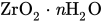
Zirconium (IV) hydroxide, often called hydrous zirconia is an ill-defined material or family of materials variously described as and . All are white solids with low solubility in water. These materials are widely employed in the preparation of solid acid catalysts.[2][3]

| Identifiers | |
|---|---|
3D model (JSmol) |
|
| ChemSpider | |
| ECHA InfoCard | 100.034.959  |
| EC Number |
|
PubChem CID |
|
| UNII | |
CompTox Dashboard (EPA) |
|
| |
| |
| Properties | |
| Zr(OH)4 | |
| Molar mass | 159.253 g/mol |
| Appearance | white filter cake |
| Density | 3.25 g/cm3, solid |
| Melting point | 550 °C (1,022 °F; 823 K) decomposes |
| 0.02 g/100 mL (20 °C) | |
| Hazards | |
| GHS classification and labelling:[1] | |
 | |
| Warning | |
| H315, H319, H335 | |
| P261, P264, P271, P280, P302+P352, P304+P340, P305+P351+P338, P312, P332+P313, P337+P313, P362, P403+P233, P405, P501 | |
Except where otherwise noted, data are given for materials in their standard state (at 25 °C [77 °F], 100 kPa). | |
 verify (what is verify (what is  ?) ?) | |
| Infobox references | |
These materials are generated by mild base hydrolysis of zirconium halides and nitrates. A typical precursor is zirconium oxychloride.[2]
References
- "Zirconium hydroxide". pubchem.ncbi.nlm.nih.gov.
- Chen, Fang Ren; Coudurier, Gisele; Joly, Jean Francois; Vedrine, Jacques C. (1993). "Superacid and catalytic properties of sulfated zirconia". Journal of Catalysis. 143 (2): 616–26. doi:10.1006/jcat.1993.1304.
- "Zirconium Hydroxide". Product Identification. ChemicalLAND21.com. Retrieved 2007-10-25.
This article is issued from Wikipedia. The text is licensed under Creative Commons - Attribution - Sharealike. Additional terms may apply for the media files.