1650s
The 1650s decade ran from January 1, 1650, to December 31, 1659.
| Millennium: | 2nd millennium |
| Centuries: | |
| Decades: | |
| Years: | |
| Categories: |
|
Events
1650
January–June
- April 27 – Battle of Carbisdale: A Royalist army invades mainland Scotland from the Orkney Islands, but is defeated by a Covenanter army.[1]
- May 17 – A quarter of the New Model Army at the Siege of Clonmel in Ireland is trapped and killed.
- June 9 – The Harvard Corporation, the more powerful of the two administrative boards of Harvard, is established (the first legal corporation in the Americas).
- June 23 – Claimant King Charles II of England, Scotland and Ireland arrives in Scotland (at Garmouth), the only one of the three kingdoms that has accepted him as ruler.
July–December
- August 13 – Colonel George Monck forms Monck's Regiment of Foot, forerunner of the Coldstream Guards.
- September 3 – Third English Civil War: Battle of Dunbar (1650) – Parliamentarian forces under Oliver Cromwell defeat a Scottish army, commanded by David Leslie.[2]
- September 27 – The Kolumbo volcano on Santorini experiences a massive eruption (VEI 6).
- September 29 – Henry Robinson opens his Office of Addresses and Encounters, a form of employment exchange, in Threadneedle Street, London.
- November 4 – William III of Orange becomes Prince of the House of Orange at the moment of his birth, succeeding his father, who had died a few days earlier. He does not become stadtholder, so the United Provinces becomes a true republic.
- December 14 – Anne Greene is hanged at Oxford Castle in England for infanticide, having concealed an illegitimate stillbirth. The following day she revives in the dissection room and, being pardoned, lives until 1659.[3][4][5]
- December 25 – Thomas Cooper, former Usher of Gresham's School, England, is hanged as a Royalist rebel.
Date unknown
- The first modern Palio di Siena horserace is held in Italy.
- Puritans chop down the original Glastonbury Thorn in England.
- English highwayman and Captain James Hind campaigns for the Royalist cause (according to his own account).
- Jews are allowed to return to France.
- Three-wheeled wheelchairs are invented in Nuremberg by watchmaker Stephan Farffler.
- Ethiopia deports Portuguese diplomats and missionaries.
- Einkommende Zeitungen becomes the first German newspaper (ceases 1918).
- The town of Sharon, Massachusetts is founded.
- Estimation – Istanbul becomes the largest city of the world, taking the lead from Beijing.[6]
1651
January–June
- January 1 – Charles II is crowned King of Scots at Scone (his first crowning).
- January 24 – Parliament of Boroa in Chile: Spanish and Mapuche authorities meet at Boroa, renewing the fragile peace established at the parliaments of Quillín, in 1641 and 1647.[7][8]
- February 22 – St. Peter's Flood: A first storm tide in the North Sea strikes the coast of Germany, drowning thousands. The island of Juist is split in half, and the western half of Buise is probably washed away.
- March 4–5 – St. Peter's Flood: Another storm tide in the North Sea strikes the Netherlands, flooding Amsterdam.
- March 6 – The town of Kajaani was founded by Count Per Brahe the Younger.[9]
- March 26 – Silver-loaded Spanish ship San José is pushed south by strong winds, subsequently it wrecks in the coast of southern Chile and its surviving crew is killed by indigenous Cuncos.[10][11]
- April – Thomas Hobbes publishes his magnum opus, the political tract Leviathan, in England.
- June 17 – Franco-Spanish War (1635-1659); A squadron of Spanish galleys under John of Austria the Younger capture the French galleon Lion Couronné off Formentera, Balearic Islands, Spain.
- June 28–30 – Battle of Berestechko, Ukraine: The Polish–Lithuanian Commonwealth Army defeats the Zaporozhian Cossacks in one of the biggest land battles of the century, with some 205,000 troops in the field.
July–December
- July 20 – Battle of Inverkeithing in Scotland: The English Parliamentarian New Model Army, under Major-General John Lambert, defeats a Scottish Covenanter army acting on behalf of Charles II, led by Sir John Brown of Fordell.
- September 1 – Siege of Dundee ends with the English Parliamentarian army, under General Monck, decisively defeating Covenanters in the last battle of the Wars of the Three Kingdoms in Scotland.
- September 2 - Assassination of Kösem Sultan by her daughter-in-law, Turhan Sultan.
- September 3 – English Civil War: Charles II of England, leading a largely-Scottish army, is defeated in the Battle of Worcester, the last major battle of the war, and forced to flee.
- October – An English diplomatic team, headed by Oliver St John, goes to The Hague to negotiate an alliance between the Commonwealth of England and the Dutch Republic.
- October 14 – Laws are passed in Massachusetts, forbidding poor people from adopting excessive styles of dress.
- October 15–16 – Escape of Charles II from England to France.[12]
- December 17 – Castle Cornet in Guernsey, the last stronghold which had supported the King in the Third English Civil War, surrenders.
Date unknown
- The Keian Uprising fails in Japan.
- The first coffee house in England is opened in Oxford,[12] indicative of their increasing popularity in Europe.
- The Madanmohan-jiu Temple is built at Samta (India), a village in the Howrah district of West Bengal.
1652
January–June
- January 8 – Michiel de Ruyter marries the widow Anna van Gelder and plans retirement, but months later becomes a vice-commodore in the First Anglo-Dutch War.
- March 29 – A total solar eclipse occurs on (Black Monday, or on 8 April New Style in the Gregorian calendar).
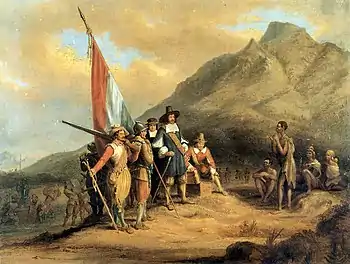
- April 6 – Dutch sailor Jan van Riebeeck establishes a resupply camp for the Dutch East India Company at the Cape of Good Hope in what is now South Africa, thus founding Cape Town.
- May 18 – Rhode Island passes the first law in North America making slavery illegal.[13]
- May 19 (May 29, Gregorian calendar) – First Anglo-Dutch War: Battle of Dover – The opening battle is fought off Dover, between Lt.-Admiral Maarten Harpertszoon Tromp's 42 Dutch ships and 21 English ships divided into two squadrons, one commanded by Robert Blake and the other by Nehemiah Bourne; the result is inconclusive.
- June 13 – George Fox preaches to a large crowd on Firbank Fell in England, leading to the establishment of the Religious Society of Friends (Quakers).
July–December
- August 26 – First Anglo-Dutch War: Battle of Plymouth – A fleet from the England attacks an outward-bound convoy of the United Provinces, escorted by 23 men-of-war and six fire ships, commanded by Vice-Commodore Michiel de Ruyter; the Dutch escape.
- September 7–11 – Guo Huaiyi Rebellion: A peasant revolt against colonial rule in Dutch Formosa is suppressed.
- October 2 – The Great Fire of Oulu destroyed almost all of the houses of the town’s bourgeoisie, the provision warehouses and the drawbridge of Oulu Castle, in the town of Oulu, Finland.[14]
- October 8 – First Anglo-Dutch War: Battle of the Kentish Knock – In a battle fought near the shoal called the Kentish Knock in the North Sea, about 30 km (19 mi) from the mouth of the River Thames, the Dutch are forced to withdraw.
- December 10 – First Anglo-Dutch War: Defeat at the Battle of Dungeness causes the Commonwealth of England to reform its navy.
1653
January–June
- January–June – The Swiss Peasant War is fought.
- January 3 – By the Coonan Cross Oath, the Eastern Church in India cuts itself off from colonial Portuguese tutelage.
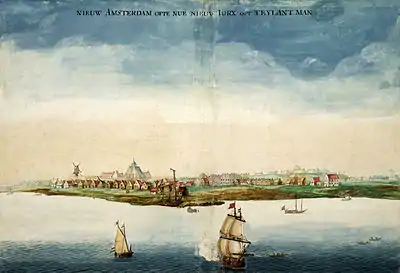
- February 2 – New Amsterdam (later renamed New York City) is incorporated.
- February 3 – Cardinal Mazarin returns to Paris from exile.
- March 14 – A Dutch fleet defeats the English in the Battle of Leghorn; the Dutch commander, Johan van Galen, later dies of his wounds.
- April 20 – Oliver Cromwell expels the Rump Parliament in England.
- April 28 – The Great Fire of Marlborough destroys 224 houses and much of the textile businesses in the Wiltshire town which, "at that date was one of considerable importance, and had merchants of affluence and repute.".[15]
- May 31 – Ferdinand IV is elected King of the Romans.
- June 12–13 – First Anglo-Dutch War: The English navy defeats the Dutch fleet in the Battle of the Gabbard.
July–December
- July 4–December 12 – Barebone's Parliament meets in London, England.
- July 8 – John Thurloe becomes Cromwell's head of intelligence.
- August 8–10 – The Battle of Scheveningen, the final naval battle of the First Anglo-Dutch War is fought off the Texel; the English navy gains a tactical victory over the Dutch fleet.
- November – John Casor leaves Anthony Johnson's farm, after claiming his contract of indenture had expired.
- December 16 – The Instrument of Government in England becomes Britain's first written constitution, under which Oliver Cromwell becomes Lord Protector of England, Scotland, and Ireland,[16][17] being advised by a remodelled English Council of State. This is the start of The First Protectorate, bringing an end to the first period of republican government in the country, the Commonwealth of England.
Date unknown
- Marcello Malpighi becomes a doctor of medicine.
- Stephen Bachiler returns to England.
- The Morning Star Rebellion breaks out in Sweden, against Queen Christina.
- The Taj Mahal mausoleum is completed at Agra.
- Frederick William, Elector of Brandenburg reconfirms the nobility's freedom from taxation, and its unlimited control over the peasants.
- Petite post, a system of postage using prepaid labels and post boxes, is introduced in Paris by Jean-Jacques Renouard de Villayer.
1654
January–June
- January 11 – A Spanish army is defeated by local Mapuche-Huilliches as it tries to cross Bueno River in Southern Chile.[18]
- March 12–13 – The Treaty of Pereyaslav is concluded in the city of Pereyaslav, during the meeting between the Cossacks of the Zaporozhian Host and Tsar Alexey I of Russia, following the end to the Khmelnytsky Uprising in Ukraine, which had started in 1648 and had resulted in the massacre of many thousands of Jews.
- April 5 – The Treaty of Westminster, ending the First Anglo-Dutch War, is signed.[19]
- April 11 – A commercial treaty between England and Sweden is signed.[19]
- April 12 – Oliver Cromwell creates a union between England and Scotland, with Scottish representation in the Parliament of England.[19]
- May 8 – Otto von Guericke demonstrates the power of atmospheric pressure and the effectiveness of his vacuum pump, using the Magdeburg hemispheres, before Ferdinand III, Holy Roman Emperor, and the Imperial Diet in Regensburg.[20]
- June 3 – Louis XIV of France is crowned at Reims.
- June 16 (June 6 Old Style) – Charles X Gustav succeeds his cousin Christina on the Swedish throne. After her abdication on the same day, Christina, now the former reigning queen of a Protestant nation, secretly converts to Catholicism.
July–December
- July – The Russian Army seizes Smolensk and the Thirteen Years' War starts between Russia and Poland over Ukraine.
- July 10 – Peter Vowell and John Gerard are executed in London for plotting to assassinate Oliver Cromwell.
- July 10 – Don Pantaleon, brother of the Portuguese ambassador, is executed after the death of an innocent man following a fracas at the exchange in Exeter.[21]
- August – Oliver Cromwell launches the Western Design, an English expedition to the Caribbean to counter Spanish commercial interests, effectively beginning the Anglo-Spanish War (which will last until after the English Restoration in 1660).[12] The fleet leaves Portsmouth in late December.
- August 22 – Jewish arrival in New Amsterdam: 23 Sephardic Jews arrive as refugees from Brazil and settle in New Amsterdam, forming the nucleus of what will be the second largest urban Jewish community in history, that of New York City,[22][23] and of Congregation Shearith Israel, the first synagogue in North America.
- September 3 – In England, the First Protectorate Parliament assembles.[19]
- September 12 – Oliver Cromwell orders the exclusion of 120 members of Parliament who are hostile to him.[24]
- October 12 – The Delft Explosion, in the arsenal, devastates the city in the Netherlands, killing more than 100, among whom is Carel Fabritius (32), the most promising student of Rembrandt.
- October 31 – Ferdinand Maria, Elector of Bavaria, is crowned. His absolutist style of leadership becomes a benchmark for the rest of Germany.
- November 23 – French mathematician, scientist and religious philosopher Blaise Pascal experiences an intense mystical vision that marks him for life.
1655
January–June
- January 5 – Emperor Go-Sai ascends to the throne of Japan.
- February 14 – The Mapuches launch coordinated attacks against the Spanish in Chile, beginning the Mapuche uprising of 1655.[25]
- February 16 – Dutch Grand Pensionary advisor Johan de Witt marries Wendela Bicker.
- March 8 – John Casor becomes the first legally recognized slave, as a result of a civil case in what will be the United States.
- March 25 – Saturn's largest moon, Titan, is discovered by Christiaan Huygens.
- April 4 – Battle of Porto Farina, Tunis: English admiral Robert Blake's fleet defeats the Barbary pirates.
- April 7 – Pope Alexander VII (born Fabio Chigi) succeeds Pope Innocent X, as the 237th pope.
- April 24 – The Easter Massacre of the Waldensians: Charles Emmanuel II, Duke of Savoy slaughters 1,500 men, women and children; this is memorialized in John Milton's sonnet "On the Late Massacre in Piedmont" and apologized for by Pope Francis in 2015.
- April 26 – The Dutch West India Company denies Peter Stuyvesant's request to exclude Jews from New Amsterdam (Manhattan).
- April 28 – Admiral Blake severely damages the arsenal of the Bey of Tunis.
- May 10–27 – Anglo-Spanish War: Invasion of Jamaica – Forces of the English Protectorate led by William Penn and Robert Venables capture the island of Jamaica from Spain.
- June 13 – Adriana Nooseman-van de Bergh becomes the first actress, in Amsterdam theater.
July–December
- July 20 – The Amsterdam Town Hall (now the Royal Palace) is inaugurated.
- July 27
- The Jews in New Amsterdam petition for a separate Jewish cemetery.
- The Netherlands and Brandenburg sign a military treaty.
- July 30 – Dutch troops capture Fort Assahudi Seram.
- July 31 – Russo-Polish War (1654–67): The Russian army enters the capital of the Grand Duchy of Lithuania, Vilnius, which it holds for 6 years.
- August 9 – Lord Protector Oliver Cromwell divides England into 11 districts, under major-generals.
- August 28 – New Amsterdam and Peter Stuyvesant bar colonial Jews from military service.
- August – The governor of New Netherland, Peter Stuyvesant, attacks the New Sweden (Delaware) colony.
- September 8 – Swedish King Karl X Gustav occupies Warsaw (Poland).
- September 26 – Peter Stuyvesant recaptures Dutch Ft. Casimir, and defeats the New Sweden (Delaware) colony.
- October 15 – The Jews of Lublin are massacred.
- October 19 – Swedish King Karl X Gustav occupies Kraków (Poland).
- November 3 – England and France sign military and economic treaties.
- November 24 – English Lord Protector Oliver Cromwell bans Anglicans.
- December 4 – Middelburg, the Netherlands forbids the building of a synagogue.
- December 18 – The Whitehall Conference ends with the determination that there was no law preventing Jews from re-entering England after the Edict of Expulsion of 1290.
- December 27 – Second Northern War/the Deluge: Monks at the Jasna Góra Monastery in Częstochowa are successful in fending off a month-long siege.
Date unknown
- Stephan Farffler, a 22-year-old paraplegic watchmaker, built the world's first self-propelling chair on a three-wheel chassis using a system of cranks and cogwheels.[26][27] However, the device had an appearance of a hand bike more than a wheelchair since the design included hand cranks mounted at the front wheel.[28]
- The Bibliotheca Thysiana is erected, the only surviving 17th century example in the Netherlands, of a building designed as a library.
- A plague outbreak kills 20 people in Malta.[29]
1656
January–June
- January 17 – The Treaty of Königsberg is signed, establishing an alliance between Charles X Gustav of Sweden and Frederick William, Elector of Brandenburg.
- January 24 – The first Jewish doctor in the Thirteen Colonies of America, Jacob Lumbrozo, arrives in Maryland.
- April 1 – Lwów Oath: John II Casimir Vasa, King of Poland, crowns the Black Madonna of Częstochowa as Queen and Protector of Poland in the cathedral of Lwów, after the miraculous saving of the Jasna Góra Monastery during the Deluge, an event which changed the course of the Second Northern War.
- April 2 – The Treaty of Brussels is signed, creating an alliance between Philip IV of Spain and the exiled Royalists of the British Isles, led by Charles II.
- April 28 – Dutch East India Company ship Vergulde Draeck is wrecked off Ledge Point, Western Australia, on a voyage from Cape of Good Hope to Batavia; 7 crew make safety but rescue missions fail to find other survivors.
- May 12 – The Dutch capture the city of Colombo, Sri Lanka, marking the start of Dutch Ceylon.
July–December
- July – In an attempt to rescue survivors of the Vergulde Draeck, a search party is sent ashore, in Goede Hoop's boat, which smashes against rocks and sinks; 8 sailors drown; 3 more disappear ashore.
- July 27 – A Writ of Excommunication is issued against Baruch Spinoza.
- July 28–30 – Battle of Warsaw: Led by King Charles X Gustav of Sweden, the armies of the Swedish Empire and the Margraviate of Brandenburg defeat the forces of the Polish–Lithuanian Commonwealth, near Warsaw.
- September 15 – Köprülü Mehmed Pasha becomes Grand Vizier of the Ottoman Empire.
- December – The pendulum clock is invented by Christiaan Huygens.
- December 20 – The Treaty of Labiau is signed, between Charles X Gustav of Sweden and Frederick William, Elector of Brandenburg.
Undated
- The Stockholm Banco, the first bank to issue banknotes, is founded in Stockholm, Sweden.
- The only English fifty shilling coin is minted.
- Konoike Zen'amon (son of Konoike Shinroku) founds a baking and money-changing business in Osaka, Japan.
- Adams' Grammar School at Newport, Shropshire, England is founded by William Adams.
- Physician Samuel Stockhausen of the metal mining town of Goslar, Lower Saxony publishes his Libellus de lithargyrii fumo noxio morbifico, ejusque metallico frequentiori morbo vulgò dicto die Hütten Katze oder Hütten Rauch ("Treatise on the Noxious Fumes of Litharge, Diseases caused by them and Miners' Asthma"), a pioneering study of occupational disease.[30][31][32]
1657
January–June
- January 8 – Miles Sindercombe and his group of disaffected Levellers are betrayed, in their attempt to assassinate Oliver Cromwell, by blowing up the Palace of Whitehall in London, and arrested.[33]
- February 4 – Oliver Cromwell gives Antonio Fernandez Carvajal the assurance of the right of Jews to remain in England.
- February 23 – In England, the Humble Petition and Advice offers Lord Protector Cromwell the crown.[34]
- March 2 – The Great Fire of Meireki in Edo, Japan, destroys most of the city and damages Edo Castle, killing an estimated 100,000 people.[35]
- March 23 – Anglo-Spanish War (1654–60): By the Treaty of Paris, France and England form an alliance against Spain;[36] England will receive Dunkirk.
- April 20
- Anglo-Spanish War – Battle of Santa Cruz de Tenerife: English Admiral Robert Blake attempts to seize a Spanish treasure fleet.
- The Jews of New Amsterdam (later New York) are granted freedom of religion, as full citizens.[37]
- May 8 – Lord Protector Cromwell confirms his refusal of the crown of England, preferring the title "Lord Protector".[33]
- June 1
- King Frederick III of Denmark signs a manifesto, de facto declaring war on Sweden.
- The first eleven Quaker settlers arrive in New Amsterdam (later New York), and are allowed to practice their faith.
July–December
- July 13 – Following his refusal to take the oath of allegiance to Oliver Cromwell, English army leader John Lambert is ordered to resign his commissions.[33]
- August 20 – The ship Les Armes d'Amsterdam arrives at Quebec, New France. Among the passengers is Michel Mathieu Brunet dit Lestang (1638–1708), colonist, explorer and co-discoverer of what is today Green Bay, Wisconsin. He is the ancestor of the Brunet, Lestang and Carisse families of North America.
- September – Shah Jahan becomes ill, allowing his son to take control of the Mughal Empire.
- September 19 – Brandenburg and Poland sign the Treaty of Wehlau.
- September 24 – The first autopsy and coroner's jury verdict are recorded, in the Colony of Maryland.
- October 1 – Treaty of Raalte: William III, Prince of Orange is no longer stadtholder of Overijssel.
- October 3 – French troops occupy Mardyck.
- November 6 – Brandenburg and Poland sign the Treaty of Bromberg.
- November 10 – Christina, former Queen of Sweden, has Gian Rinaldo Monaldeschi killed in her presence, at the Palace of Fontainebleau.
- December 27 – The Flushing Remonstrance is signed in New Amsterdam, at the site of the future (1862) Flushing Town Hall in New York.
Date unknown
- The Accademia del Cimento is founded in Florence, Italy.
- England's first chocolate house is opened in London[38] and introduction of tea in England[39][40] while coffee is introduced to France.
- Christiaan Huygens writes the first book to be published on probability theory, De ratiociniis in ludo aleae ("On Reasoning in Games of Chance").
- Andreas Gryphius' drama, Katharina von Georgien, is published.
- Thomas Middleton's tragedy, Women Beware Women, is published posthumously.[36]
1658
January–June
- January 13 – Edward Sexby, who had plotted against Oliver Cromwell, dies in the Tower of London.[41]
- February 6 – Swedish troops of Charles X Gustav of Sweden cross The Great Belt in Denmark, over frozen sea.[42]
- February 26 (March 8 NS) – The peace between Sweden and Denmark is concluded in Roskilde by the Treaty of Roskilde, under which Denmark is forced to cede significant territory.
- March 22 – The ship Waeckende Boey is wrecked on the coast of Java; the four survivors walk overland to Jepara.
- May 1 – Hydriotaphia, Urn Burial and The Garden of Cyrus are published by Thomas Browne in England.
- June 3 – Pope Alexander VII appoints François de Laval vicar apostolic of New France.
- June 14 – Anglo-Spanish War (1654–60) and Franco-Spanish War (1635–59): Battle of the Dunes: A Spanish force attempting to lift a siege of Dunkirk is defeated by the French and English. England is then given Dunkirk, for its assistance in the victory.
- June 25–27 – Anglo-Spanish War: Battle of Rio Nuevo: A Spanish invasion force fails to recapture Jamaica from the English.
July–December
- July – Šarhūda's Manchu fleet annihilates Onufriy Stepanov's Russian flotilla, on the Amur River.
- July 31 – After Shah Jahan completes the Taj Mahal, his son Aurangzeb deposes him as ruler of the Mughal Empire.
- September 3 – Oliver Cromwell dies, and his son Richard assumes his father's former position as Lord Protector of England, Scotland and Ireland.
- September 17 – Portuguese Restoration War: Battle of Vilanova – A Spanish army, having crossed the Minho, defeats the Portuguese.
Date unknown
- Portuguese traders are expelled from Ceylon by Dutch invaders.
- The Dutch in the Cape Colony start to import slaves from India and South-East Asia (later from Madagascar).
1659
January–June
- January 14 – Portuguese Restoration War – Battle of the Lines of Elvas: The Portuguese beat the Spanish.
- January 24 – Pierre Corneille's Oedipe premieres in Paris.
- February 2 – Jan van Riebeeck produces the first South African wine, at the Cape of Good Hope.
- February 11 – The Assault on Copenhagen by Swedish forces is beaten back, with heavy losses.
- February 16 – The first known cheque (400 pounds) is written.[43]
- April 22 – Lord Protector Richard Cromwell dissolves the English Parliament.
- May 21 – The Kingdom of France, the Commonwealth of England and the Dutch Republic sign the Concert of The Hague.
- May 25 – Richard Cromwell resigns as English Lord Protector.
- May 31 – The Netherlands, England, and France sign the Treaty of The Hague.
- June 29 – Russo-Polish War (1654–67) – Battle of Konotop: Ivan Vyhovsky, hetman of Ukraine, and his allies defeat the armies of the Tsardom of Russia, led by Aleksey Trubetskoy, in Ukraine.
July–December
- July – Christiaan Huygens's important work on astronomy, Systema Saturnium, is published.[44]
- July 16 – Princess Henriette Catherine of Nassau marries John George II, Prince of Anhalt-Dessau, in Groningen.
- September 30 – Peter Stuyvesant of New Netherland forbids tennis playing during religious services (first mention of tennis in what will be the U.S.).
- October 12 – The English Rump Parliament dismisses John Lambert, and other generals.
- October 13 – General-major John Lambert drives out the English Rump-government.
- November 7 – Treaty of the Pyrenees: King Louis XIV of France and King Philip IV of Spain agree to French acquisition of the counties of Roussillon and Upper Cerdanya (Principality of Catalonia) and most of Artois, and formally end their 24-year war.
- November 25 – Dutch forces under Michiel de Ruyter free the Danish city of Nyborg from Swedish conquest (earlier in the year).
- December 16 – General Monck demands free parliamentary elections in Scotland.
- December 26 – The Long Parliament reforms occur in Westminster.
Date unknown
- First British colonists arrive on Saint Helena.
- Spanish Infanta Maria Theresa brings cocoa to Paris.
- Diego Velázquez's portrait of Infanta Maria Theresa is first exhibited.
- Thomas Hobbes publishes De Homine.
- Parisian police raid a monastery, sending monks to prison for eating meat and drinking wine during Lent.
- Drought occurs in India.[45]
- Peter Swink, the first known non-white settler to own land in Massachusetts, and first known African to live in Springfield, Massachusetts, arrives. He holds a seat in the town meetings.
== {{ucfirst:{{{1}}}}} == {{preprocess|{{((}}transcluding articles {{!}} {{#ifeq:{{{decade}}}|0|{{void|There is no AD year 0}}|{{Year article|{{{decade}}}0}}}} {{!}} {{for loop|{{!}}|call=Year article|pc1n=1|pc1v={{{decade}}}0|pv=2|1|2|3|4|5|6|7|8|9}} {{))}}}} {{#ifeq:{{{decade}}}|0|{{void|There is no AD year 0}}| {{Transclude {{{1}}}|{{{decade}}}0}} }} {{for loop| |call=Transclude {{{1}}}|{{{decade}}}1|{{{decade}}}2|{{{decade}}}3|{{{decade}}}4|{{{decade}}}5|{{{decade}}}6|{{{decade}}}7|{{{decade}}}8|{{{decade}}}9}} == {{ucfirst:{{{1}}}}} == {{preprocess|{{((}}transcluding articles {{!}} {{#ifeq:{{{decade}}}|0|{{void|There is no AD year 0}}|{{Year article|{{{decade}}}0}}}} {{!}} {{for loop|{{!}}|call=Year article|pc1n=1|pc1v={{{decade}}}0|pv=2|1|2|3|4|5|6|7|8|9}} {{))}}}} {{#ifeq:{{{decade}}}|0|{{void|There is no AD year 0}}| {{Transclude {{{1}}}|{{{decade}}}0}} }} {{for loop| |call=Transclude {{{1}}}|{{{decade}}}1|{{{decade}}}2|{{{decade}}}3|{{{decade}}}4|{{{decade}}}5|{{{decade}}}6|{{{decade}}}7|{{{decade}}}8|{{{decade}}}9}}
References
- Historic Environment Scotland. "Battle of Carbisdale (BTL19)". Retrieved June 18, 2020.
- Historic Environment Scotland. "Battle of Dunbar II (BTL7)". Retrieved June 18, 2020.
- A Scholler in Oxford (1651). Newes from the Dead, or a True and Exact Narration of the Miraculous Deliverance of Anne Greene; whereunto are prefixed certain Poems casually written upon that subject. Oxford: printed by Leonard Lichfield for Tho. Robinson. Includes Latin verses by Christopher Wren.
- Hughes, J. Trevor (1982). "Miraculous Deliverance of Anne Green: An Oxford Case Of Resuscitation In The Seventeenth Century". British Medical Journal. 285 (6357): 1792–1793. doi:10.1136/bmj.285.6357.1792. JSTOR 29509089. PMC 1500297. PMID 6816370.
- Gowing, Laura (2004). "Greene, Anne (c. 1628–1659)". Oxford Dictionary of National Biography (online ed.). Oxford University Press. doi:10.1093/ref:odnb/11413. Retrieved March 14, 2020. (Subscription or UK public library membership required.)
- Barros Arana, Diego. Historia general de Chile (in Spanish). Tomo cuarto (Digital edition based on the second edition of 2000 ed.). Alicante: Biblioteca Virtual Miguel de Cervantes. p. 339.
- Pinochet Ugarte, Augusto; Villaroel Carmona, Rafael; Lepe Orellana, Jaime; Fuente-Alba Poblete, J. Miguel; Fuenzalida Helms, Eduardo (1997). Historia militar de Chile (in Spanish) (3rd ed.). Biblioteca Militar. p. 83.
- Kajaanin kaupunki täyttää tänä vuonna komeat 370 vuotta – juhlitaan kaupunkiamme eri tavoin (in Finnish)
- Solano Astaburuaga, Francisco (1899) [1867]. Diccionario Geográfico de la República de Chile (in Spanish) (2nd ed.). p. 280.
- Barros Arana, Diego. "Capítulo XIV". Historia general de Chile (in Spanish). Tomo cuarto (Digital edition based on the second edition of 2000 ed.). Alicante: Biblioteca Virtual Miguel de Cervantes. p. 340.
- Palmer, Alan; Veronica (1992). The Chronology of British History. London: Century Ltd. pp. 185–186. ISBN 0-7126-5616-2.
- "Time and Place". Slavery and the Making of America. Thirteen. 2004. Retrieved 2018-02-24.
Rhode Island passes laws restricting slavery and forbidding enslavement for more than 10 years.
- Virkkunen, A.H. (1953). Oulun kaupungin historia I [The History of the City of Oulu I] (in Finnish). Kirjola Oy. pp. 128–130.
- "Fires, Great", in The Insurance Cyclopeadia: Being an Historical Treasury of Events and Circumstances Connected with the Origin and Progress of Insurance, Cornelius Walford, ed. (C. and E. Layton, 1876) p30
- Penguin Pocket On This Day. Penguin Reference Library. 2006. ISBN 0-14-102715-0.
- "Commonwealth Instrument of Government, 1653". Modern History Sourcebook. New York: Fordham University. August 1998. Retrieved 2012-07-10.
- Barros Arana, Diego. "Capítulo XIV". Historia general de Chile (in Spanish). Tomo cuarto (Digital edition based on the second edition of 2000 ed.). Alicante: Biblioteca Virtual Miguel de Cervantes. pp. 346–347.
- Williams, Hywel (2005). Cassell's Chronology of World History. London: Weidenfeld & Nicolson. p. 266. ISBN 0-304-35730-8.
- Chisholm, Hugh, ed. (1911). . Encyclopædia Britannica. 12 (11th ed.). Cambridge University Press. p. 670.
- Carlyle, Thomas (ed.), Oliver Cromwell, Letters and Speeches.
- "Jews arrive in the New World". American Jewish Archives. Retrieved 2012-07-10.
- LeElef, Ner (2001). "World Jewish Population". SimpleToRemember. Retrieved 2012-07-10.
Metropolitan Tel Aviv, with 2.5 million Jews, is the world's largest Jewish city. It is followed by New York, with 1.9 million.
- Wu, Bin (2014). Britannia 1066–1884: From Medieval Absolutism to the Birth of Freedom under Constitutional Monarchy, Limited Suffrage, and the Rule of Law. Springer. p. 53. ISBN 9783319046839. OCLC 947041435.
- Barros Arana, Diego. Historia general de Chile (in Spanish). Tomo cuarto (Digital edition based on the second edition of 2000 ed.). Alicante: Biblioteca Virtual Miguel de Cervantes. p. 349.
- Bellis, Mary. "History of the Wheelchair". thoughtco.com. Retrieved April 14, 2017.
- Koerth-Baker, Maggie. "Who Invented the Wheelchair?". mentalfloss.com. Retrieved April 14, 2017.
- "History of Wheelchairs". wheelchair-information.com. Retrieved April 14, 2017.
- Savona-Ventura, Charles (2015). Knight Hospitaller Medicine in Malta [1530–1798]. Self-published. pp. 224–225. ISBN 9781326482220.
- Eisinger, J. (July 1982). "Lead and wine: Eberhard Gockel and the colica Pictonum". Medical History. 26 (3): 279–302. doi:10.1017/s0025727300041508. ISSN 0025-7273. PMC 1139187. PMID 6750289.
- Risse, Guenter B. (2005). New Medical Challenges During the Scottish Enlightenment. Amsterdam: Rodopi. p. 207. ISBN 90-420-1814-3. Retrieved 2009-03-06.
- Rosen, George (1943). The History of Miners' Diseases: a medical and social interpretation (book preview). Schuman's. p. 10. Retrieved 2009-03-06.
- "1657". British Civil Wars. Commonwealth and Protectorate 1638-60. 2010-06-07. Archived from the original on May 9, 2008. Retrieved 2012-02-17.
- Morrill, John (2004). "Cromwell, Oliver (1599–1658)". Oxford Dictionary of National Biography (online ed.). Oxford University Press. doi:10.1093/ref:odnb/6765. Retrieved 2012-02-17. (Subscription or UK public library membership required.)
- Blusse, Leonard; Vaillé, Cynthia (2005). The Deshima Dagregisters, Volume XII 1650-1660. Leiden.
- Williams, Hywel (2005). Cassell's Chronology of World History. London: Weidenfeld & Nicolson. pp. 267–268. ISBN 0-304-35730-8.
- "American Zionism from Herzl to the Holocaust". doi:10.1163/2468-1733_shafr_sim110060068. Cite journal requires
|journal=(help) - "Chocolate Arrives in England". Cadbury. Archived from the original on February 2, 2012. Retrieved February 17, 2012.
- Ukers, William H. (1935). All About Tea. I. New York: The Tea and Coffee Trade Journal. p. 38.
- Mair, Victor H.; Hoh, Erling (2009). The True History of Tea. London; New York: Thames & Hudson. p. 169. ISBN 978-0-500-25146-1.
- "killing". Oxford Reference. doi:10.1093/oi/authority.20110803100036693. Retrieved 14 December 2021.
- Brems, Hans (June 1970). "Sweden: From Great Power to Welfare State". Journal of Economic Issues. Association for Evolutionary Economics. 4 (2, 3): 1–16. doi:10.1080/00213624.1970.11502941. JSTOR 4224039.
A swift and brilliantly conceived march from Holstein across the frozen Danish waters on Copenhagen, by Karl X Gustav in 1658, finally wrests Bohuslin, Sk'ane, and Blekinge from Denmark. Denmark no longer controls both sides of Oresund, and Swedish power is at its peak.
- On display at Westminster Abbey.
- Robert D. Huerta (2003). Giants of Delft: Johannes Vermeer and the Natural Philosophers : the Parallel Search for Knowledge During the Age of Discovery. Bucknell University Press. p. 107. ISBN 978-0-8387-5538-9.
- Khadg Singh Valdiya (2004). Coping with Natural Hazards: Indian Context. Orient Blackswan. p. 219. ISBN 978-81-250-2735-5.