1660s
The 1660s decade ran from 1 January 1660, to 31 December 1669.
| Millennium: | 2nd millennium |
| Centuries: | |
| Decades: | |
| Years: | |
| Categories: |
|
Events
1660
January–June
- January 1
- Colonel George Monck (with his regiment) crosses from Scotland to England at the village of Coldstream, and begins his advance towards London in support of the English Restoration.[1]
- Samuel Pepys begins his diary.[2]
- February 3 – George Monck and his regiment arrive in London.[3]
- February 13 – Charles XI becomes king of Sweden at the age of five, upon the death of his father, Charles X Gustavus.
- February 27 – John Thurloe is reinstated as England's Secretary of State, having been deprived of his offices late in the previous year.
- March 16 – The Long Parliament disbands.
- April 4 – The Declaration of Breda promises amnesty, freedom of conscience, and army back pay, in return for support for the English Restoration.[3]
- May 3 – Treaty of Oliva: Peace is made between Swedish Empire, the Polish–Lithuanian Commonwealth, the Habsburgs and Brandenburg-Prussia.
- May 8 – The Parliament of England declares Prince Charles Stuart, King Charles II of England.
- May 15 – John Thurloe is arrested for high treason, for his support of Oliver Cromwell's regime.
- May 25 – Charles II of England lands at Dover.[4]
- May 27 – The Treaty of Copenhagen is signed, marking the conclusion of the Second Northern War. Sweden returns Trøndelag to Norway, and Bornholm to Denmark.
- May 29 – King Charles II of England arrives in London and assumes the throne, marking the beginning of the English Restoration.[3]
- June 1 – Mary Dyer is hanged for defying a law banning Quakers from the Massachusetts Bay Colony.
- June 29 – John Thurloe is released from custody.
July–December
- August 19 – Dr Edward Stanley preaches a sermon in the nave of Winchester Cathedral, to commemorate the return of the Chapter, following the English Restoration.
- September 25 – Samuel Pepys has his first cup of tea (an event recorded in his diary).[2]
- October 17 – The ten regicides who signed the death warrant of Charles I of England are hanged, drawn and quartered, a process which includes their being disemboweled and their bowels burned before their eyes.
- November 28 – At Gresham College in London, twelve men, including Christopher Wren, Robert Boyle, John Wilkins, and Sir Robert Moray meet after a lecture by Wren, and decide to found "a College for the Promoting of Physico-Mathematicall Experimentall Learning" (later known as the Royal Society).
- December – Andres Malong, a native chieftain of Pangasinan, Philippines, leads a revolt against the Spanish regime.
- December 8 – The first English actress appears on the professional stage in England in a non-singing rôle, as Desdemona in Othello, following reopening of the theatres (variously considered to be Margaret Hughes, Anne Marshall or Katherine Corey).[5][6][7]
Date unknown
- The Royal African Company is founded by the future king James II of England, to trade slaves along the coast of West Africa.
- Blaise Pascal's Lettres provinciales, a defense of the Jansenist Antoine Arnauld, is ordered to be shredded and burned by King Louis XIV of France.
- The expulsion of the Carib indigenous people from Martinique is carried out, by French occupying forces.
- Hopkins School is founded in New Haven, Connecticut.
- The Rigsraad (High Council) of Denmark is abolished[8] and Denmark–Norway becomes an absolute monarchy with the Kingdom of Denmark as a hereditary monarchy by Frederik III.
- A permanent standing army is established in Prussia.
1661
January–June
- January 6 – The Fifth Monarchists, led by Thomas Venner, unsuccessfully attempt to seize control of London; George Monck's regiment defeats them.
- January 30 – The body of Oliver Cromwell is exhumed and subjected to a posthumous execution in London, along with those of John Bradshaw and Henry Ireton.
- February 5 – The Shunzhi Emperor of the Chinese Qing Dynasty dies, and is succeeded by his 7-year-old son the Kangxi Emperor.
- February 14 – George Monck’s regiment becomes The Lord General's Regiment of Foot Guards in England (which later becomes the Coldstream Guards).
- March – Following the death of his mentor, Cardinal Mazarin, King Louis XIV of France starts to rule independently.
- April 7 – The Siege of Fort Zeelandia by Chinese-Japanese warlord Koxinga begins.
- April 23 – King Charles II of England, Scotland, and Ireland is crowned in Westminster Abbey.[9]
July–December
- July 1 – Russo-Swedish War (1656–58) – Treaty of Cardis: Russia surrenders to Sweden all captured territories.
- August 6 – Portugal and the Dutch Republic sign the Treaty of The Hague, whereby New Holland is formally ceded to Portugal by the Dutch Republic.
- September 5 – Fall of Nicolas Fouquet: Louis XIV's Superintendent of Finances is arrested in Nantes.
- October 6 – Guru Har Krishan becomes eighth of the ten Sikh gurus, and at age 5 the youngest, following the death of his father Guru Har Rai.[10]
- October 31 – Death of Köprülü Mehmed Pasha ends his rule as vizier of the Ottoman Empire.
- November 4 – Battle of Kushliki: Polish–Lithuanian forces defeat the Russian army.
Date unknown
- The first modern bank notes are issued in Stockholm, Sweden.
- Great Clearance in China: evacuation of Guangdong is required.[11]
January–June
- January 23 – Battle of Nagyszőllős: János Kemény of Transylvania is killed.
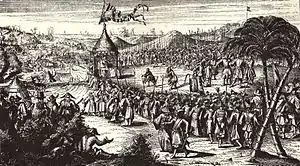
- February 1 – Sino-Dutch conflicts: Chinese general Koxinga seizes the Dutch Fort Zeelandia on the island of Taiwan after a nine-month siege, ending Dutch East India Company rule in the area, then establishes the Kingdom of Tungning. In response, the Kangxi Emperor of the mainland Qing dynasty migrates all residents along the southern coast, by 50 miles.
- March 18 – A short-lived experiment of the first public buses (holding eight passengers) begins in Paris.
- May 3 – John Winthrop the Younger, the son of the first governor of Massachusetts, is honoured by being made a fellow of the Royal Society, England's new scientific society. Winthrop uses his election to the Society to gain access to the king, who grants him a new charter, uniting the colonies of Connecticut and New Haven.
- May 9 – Samuel Pepys witnesses a Punch and Judy show in London (the first on record).
- May 16 – The hearth tax is introduced in England and Wales.
- May 30 – Catherine of Braganza marries Charles II of England; as part of the dowry, Portugal cedes [Mumbai] and Tangier to England.
July–December
- July 15 – The Royal Society, founded by King Charles II of England and Scotland receives an official charter in London.[12]
- August 24 – The Act of Uniformity is introduced,[13] making mandatory in the Church of England the forms of worship prescribed in the new edition of the Book of Common Prayer. This is followed by the Great Ejection of over 2,000 clergy who refuse to take the required oath of conformity to the established church.
- October 27 – Charles II of England sells Dunkirk to France, for £400,000 (2.5 million French livrs).
- November – Zheng Jing claims the Kingdom of Tungning.
- November 28 – The English Royal Society holds its first meeting.
- December 20 – Nicolas Fouquet is banished from France.
- December 26 – Molière's play, The School for Wives, is given its première in Paris.[14]
Date unknown
- Robert Boyle publishes Nova experimenta physico-mechanica in Oxford (2nd edition), setting forth the law bearing his name.
- Joan Blaeu publishes Atlas Maior, sive cosmographia Blaviana in Amsterdam (first complete edition, 11 volumes in Latin).
- Milton, Massachusetts is incorporated as a town.
- John Graunt, in one of the earliest uses of statistics, publishes statistical information about births and deaths in London.
- The Akademie der Bildenden Künste Nürnberg is founded in Germany.
- The dodo bird is seen for the last widely accepted time.[15]
1663
January–June
- January 10 – The Royal African Company is granted a Royal Charter by Charles II of England.[16]
- February – English pirates carry out the sack of Campeche in Mexico.
- March 4 – The Prince Edward Islands in the sub-antarctic Indian Ocean are discovered by Barent Barentszoon Lam, of the Dutch ship Maerseveen, and named Dina (Prince Edward) and Maerseveen (Marion).[17]
- March 5 – Emperor Go-Sai's reign ends, and Emperor Reigen ascends to the throne of Japan.
- March 24 – King Charles II of England issues the Charter of Carolina, establishing the Province of Carolina, and dividing it between eight Lords Proprietors.[16]
- April 17 – The Turks declare war against Leopold I, Holy Roman Emperor.
- May 7 – The Theatre Royal, Drury Lane, opens in London.[16]
- June 8 – Battle of Ameixial: The Portuguese and some English auxiliaries defeat the Spanish.
July–December
- July 8 – King Charles II of England grants John Clarke a Royal Charter for the American Colony of Rhode Island and Providence Plantations.[16]
- July 27 – The English Parliament passes the second Navigation Act, requiring that all goods bound for the American colonies have to be sent in English ships from English ports.
- August 21 – Concerned about the wintry weather, the Parliament of England holds an intercessory fast.[18]
- August 28 – Severe frost hits England.
- July–Sept – The Esopus Wars in and around Kingston, New York, against the Esopus tribe of the Delaware Indians are ended after four years by a coalition of Dutch settlers, Wappinger and Mohawk tribes.
Date unknown
- The Prix de Rome scholarship is established in France for students of the arts.
- The first Maroon community arises in Suriname.
- Robert Hooke discovers that cork is made of "tiny little rooms", which he first calls "Cells".[19]
- Publication at Cambridge in the Massachusetts Bay Colony of the "Eliot Indian Bible" (Mamusse Wunneetupanatamwe Up-Biblum God) becomes the first complete Bible published in the Americas, a translation by English-born Puritan missionary John Eliot of the Geneva Bible, from English into the Massachusett language (Natic or Wômpanâak) variety of the Algonquian languages.[20]
1664
January–June
- January 5 – Battle of Surat: Maratha Chhatrapati Shivaji defeats Mughal captain Inayat Khan, and sacks Surat.
- May 9 – Robert Hooke discovers Jupiter's Great Red Spot.[21]
- June – Gazzetta di Mantova is first published in Mantua, Italy. It's the world's oldest private newspaper still published, and the oldest continuously published in print.[22]
1665
January–June
- January 5 – The Journal des sçavans begins publication in France, the first scientific journal.
- March 4 – The Second Anglo-Dutch War begins.[23]
- March 6 – The Philosophical Transactions of the Royal Society of London begins publication in England, the first scientific journal in English and the oldest to be continuously published.
- March 11 – A new legal code is approved for the Dutch and English towns of New York, guaranteeing all Protestants the right to continue their religious observances unhindered.
- March 16 – Bucharest allows Jews to settle in the city, in exchange for an annual tax of 16 guilders.
- April 12 – The burial of Margaret Porteous is recorded; hers is the first known death during the Great Plague of London. This last major outbreak of Bubonic plague in the British Isles has possibly been introduced by Dutch prisoners of war. Two-thirds of Londoners leave the city, but over 68,000 die. The plague spreads to Derbyshire.
- May 19 – Great fire of Newport, Shropshire, England.
- June 12 – England installs a municipal government in New York City (the former Dutch settlement of New Amsterdam).
- June 13 (June 3 O.S.) – Second Anglo-Dutch War – Battle of Lowestoft: The English Navy, under James Stuart, Duke of York, is victorious against the Dutch.
- June 30 – King Charles II of England issues a second charter for the Province of Carolina, which clarifies and expands the borders of the Lords Proprietors' tracts.
July–December
- July 3 – The first documented case of cyclopia is diagnosed in a horse.
- July 7 – King Charles II of England leaves London with his entourage, fleeing the Great Plague. He moves his court to Salisbury, then Exeter.
- August – The Great Plague forces the closure of the University of Cambridge, where Isaac Newton is a student.[24] Newton retires to his home in Lincolnshire for safety, and stays there for two years. During that time alone, Newton will make groundbreaking discoveries in mathematics, calculus, mechanics, and optics, and lay the foundations for his books Philosophiæ Naturalis Principia Mathematica and Optiks.
- August 2 – Second Anglo-Dutch War: The Dutch fleet defeats the English in the Battle of Vågen.
- August 27 – Ye Bare & Ye Cubbe, the first play in English in the American colonies, is performed in Pungoteague, Virginia.
- September – Robert Hooke's Micrographia is published in London, first applying the term 'cell' to plant tissue, which he discovered first in cork, then in living organisms, using a microscope.
- September 17 – Charles II of Spain becomes king, while not yet four years old.
- September 22 – Molière's L'Amour médecin is first presented, before Louis XIV of France, at the Palace of Versailles, with music by Jean-Baptiste Lully.
- October 5 – The University of Kiel is founded.
- October 21 – Louis XIV of France and Jean-Baptiste Colbert found the Manufacture royale des glaces of Saint Gobain, which is the oldest French company of the CAC 40, with 350 years in 2015.
- October 29 – Battle of Mbwila: Portuguese forces defeat and kill King António I of Kongo.
- November 7 – The London Gazette is first published as The Oxford Gazette.
- December 10 – The Royal Netherlands Marine Corps is founded by Michiel de Ruyter.
Date unknown
- The Colonisation of Réunion begins, with the French East India Company sending twenty settlers.
- Ferdinando Carlo Gonzaga is invested as Duke of Mantua.
- Joan Blaeu completes publication of his Atlas Maior (Theatrum Orbis Terrarum) in Amsterdam.
1666
January–June
- January 17 – The Chair of Saint Peter (Cathedra Petri, designed by Bernini) is set above the altar in St. Peter's Basilica in Rome.[25]
- January 22 – Shah Jahan of the Mughal Empire dies, after falling seriously ill.
- February 1 – The joint English and Scottish royal court returns to London, as the Great Plague of London subsides.[26]
- March 11 – The tower of St. Peter's Church, Riga, collapses, burying eight people in the rubble.
- June 4 – Molière's comedy The Misanthrope is premièred at the Théâtre du Palais-Royal in Paris, by the King's Players.[27]
- June 11–14 (June 1–4 Julian calendar) – Second Anglo-Dutch War: Four Days' Battle – The Dutch Republic fleet under Michiel de Ruyter defeats that of the Kingdom of England in the North Sea, in one of the longest naval engagements in history.[26]
July–December
- July – The town of Piteå, Sweden is completely burned by a large fire.
- August 4 (July 25 Julian calendar) – Second Anglo-Dutch War: St. James's Day Battle – The English fleet, under Prince Rupert of the Rhine and George Monck, 1st Duke of Albemarle, defeats the Dutch off the North Foreland of England.[26]
- August 19–20 (August 9–10 Julian calendar) – Holmes's Bonfire: Rear Admiral Robert Holmes leads an English raid on the Dutch island of Terschelling, destroying 150 merchant ships in the Vlie estuary, and pillaging the town of West-Terschelling.
- September 2–5 – Great Fire of London: A large fire breaks out in the City of London, in the house of a baker on Pudding Lane, near London Bridge. The fire destroys more than 13,000 buildings (including Old St Paul's Cathedral), but only six people are known to have died,[2] while at least 80,000[28] are left destitute and homeless. The resurveying of property is credited with giving both cartography and the practices of surveying a leg up, as well as resulting in the modern definition by John Ogilby of the statute mile, as 1,760 yards.[29]
- September 6 – The Cestui que Vie Act 1666 is passed by the Parliament of England, to provide for disposal of the property of missing persons.
- September 7 – Samuel Pepys describes the aftermath (two days prior) of the Great Fire of London in his diary, and details the city in ruins.
- September 16 – Apostasy of Sabbatai Zevi in Istanbul.
- November 28 – Pentland Rising: Battle of Rullion Green in the Pentland Hills of Midlothian (Scotland), culmination of the brief rising which began on November 15: at least 3,000 men of the Scottish Royal Army, led by Tam Dalyell of the Binns, defeat about 900 rebel Covenanters.
- December 12 – A sobor (church council) of the Russian Orthodox Church deposes Patriarch Nikon of Moscow, but accepts his liturgical reforms. Dissenters from his reforms, known as Old Believers, continue to this day.
- December 22 – The French Academy of Sciences, founded by Louis XIV, first meets.
Date unknown
- Mughal forces of Emperor Aurangzeb, in alliance with the Portuguese, under Shaista Khan and his son Buzurg Umed Khan, expel the Arakans from the Bengal port city of Chittagong, renaming the city as Islamabad.
- Moulai al-Rashid conquers Fes, marking the beginning of Morocco's Alaouite dynasty, which will continue in power into the 21st century.
- Isaac Newton uses a prism to split sunlight into the component colours of the optical spectrum, assisting understanding of the scientific nature of light. He also develops differential calculus. His discoveries this year lead to it being referred to as his Annus mirabilis or Newton's Year of the Morning Star.
- Lund University is founded in Lund, Sweden.[30]
- Dutch artist Johannes Vermeer paints The Art of Painting, his largest and most complex work.
- The first completed printed Bible translation into Armenian, Astuacašunč hnoc' ew noroc' ktakaranac (Oskanean Bible), is published in Amsterdam, edited by Bishop Oskan Yerevantsi.[31]
- Jean Talon completes a census of New France, the first census in North America.
1667
January–June
- January 20 – Russo-Polish War (1654–1667): Poland cedes Kiev, Smolensk, and eastern Ukraine to Russia in the Treaty of Andrusovo, which puts a final end to Poland's status as a major Central European power.
- February – The first theatre in Scandinavia opens, in Lejonkulan and Bollhuset in Stockholm, Sweden.
- March – Louis XIV of France abolishes the livre parisis (Paris pound), in favor of the much more widely used livre tournois (Tours pound). He also designates Gabriel Nicolas de la Reynie as the first chief of "police" of Paris.
- March 27 – In North America (Canada), explorer René-Robert Cavelier, Sieur de La Salle is released from the Society of Jesus (Jesuits).
- April 6 – Dubrovnik earthquake: An earthquake in the Republic of Ragusa kills one fifth of the population.
- April 27 – The blind, impoverished, 58-year-old John Milton seals a contract for publication of Paradise Lost with London printer Samuel Simmons, for an initial payment of £5.[32][33][34] The first edition is published in October[33] and sells out in eighteen months.[35]
- May 24 – The War of Devolution begins: France invades Flanders and Franche-Comté.
- June 9–14 – Raid on the Medway: A Dutch fleet under Admiral Michiel de Ruyter burns Sheerness, sails up the River Medway in England, raids Chatham Dockyard, and tows away the royal flagship The Royal Charles.[26]
- June 15 – The first human blood transfusion is administered by Dr. Jean-Baptiste Denys. He transfuses the blood of a sheep to a 15-year-old boy (though this operation is a success, a later patient dies from the procedure and Denys is accused of murder).
- June 20 – Pope Clement IX succeeds Pope Alexander VII, becoming the 238th pope.
- June 26 – Louis XIV of France conquers Tournai.
July–December
- July 31 – Second Anglo-Dutch War – The Treaty of Breda ends the war, and recognizes Acadia as a French possession.[36][37]
- September 6 – The "Dreadful Hurricane of 1667" ravages southeast Virginia, bringing 12 days of rain, blowing down plantation homes and stripping fields of crops.
- October 18
- Brooklyn is chartered under the name Brueckelen by Mathias Nicolls, Governor of New Netherland.
- Yohannes I becomes king of Ethiopia, following the death of his father Negus Fasilides.
- November 25 – A devastating earthquake rocks Caucasia, killing 80,000 people.
Date unknown
- After Shivaji's escape, hostilities between the Marathas and the Mughals ebb, with Mughal sardar Jaswant Singh acting as intermediary between Shivaji and Aurangzeb for new peace proposals.
- The first military campaign of Stenka Razin is conducted in Russia.
- The French army uses grenadiers.
- Robert Hooke demonstrates that the alteration of the blood in the lungs is essential for respiration.
- Isaac Newton has investigated and written on optics, acoustics, the infinitesimal calculus, mechanism and thermodynamics. The works will be published only years later.
1668
January–June
- January – The Triple Alliance of 1668 is formed between England, Sweden and the United Provinces.
- February 13 – In Lisbon, a peace treaty is established between Afonso VI of Portugal and Carlos II of Spain, by mediation of Charles II of England, in which the legitimacy of the Portuguese monarch is recognized. Portugal yields Ceuta to Spain.
- May 2 – The first Treaty of Aix-la-Chapelle ends the War of Devolution.
July–December
- July 7 – Bishop Isaac Barrow founds the Bishop Barrow Trust with the intention of establishing a university on the Isle of Man; this becomes King William's College.[38]
- July – Welsh privateer Henry Morgan sacks Portobello and Panama City; the lack of booty from the latter attack leads to the city being burned.
- July 25 – The magnitude 8.5 Shandong earthquake causes 43,000 to 50,000 deaths in Shandong during the Qing Dynasty, making it the largest historical earthquake in Eastern China.[39][40]
- August 17 – The magnitude 8.0 North Anatolia earthquake causes 8,000 deaths in northern Anatolia, Ottoman Empire, and is the most powerful earthquake recorded in Turkey.[41][42]
- September 9 – Molière's comedy The Miser (L'Avare) is first performed, in Paris.
- September 21 – The British East India Company takes over Bombay under a Royal Charter of March 27.
Date unknown
- One of the world's earliest central banks, the Sveriges Riksbank, is founded in Stockholm, Sweden.
- Emperor Yohannes I of Ethiopia convenes a church council in Gondar, which decides to expel all Roman Catholics from the country.
- English scientist Isaac Newton builds the first reflecting telescope (Newton's reflector).[43]
1669
January–June
- March 11 – Mount Etna erupts, destroying the Sicilian town of Nicolosi.[44]
- May 31 – Samuel Pepys stops writing his diary.[45]
- June 22 – Roux de Marsilly, accused of plotting the assassination of King Louis XIV of France, is publicly tortured in Paris, France.
- June 25 – François de Vendôme, Duke of Beaufort, disappears in battle, during the siege of Candia in Crete.
July–December
- July – The Hanseatic League, after 400 years of operation, holds its last official meeting in Lübeck.
- September 6 – Francesco Morosini, capitano generale of the Venetian forces in the siege of Candia, surrenders to the Ottomans.
- September 23 – Leopold I, Holy Roman Emperor grants the status and privileges of a university to the Jesuit Academy in Zagreb, the precursor to the modern University of Zagreb.
Date unknown
- Shakushain's revolt breaks out in Hokkaido, Japan.
- Mughal emperor Aurangzeb destroys several Hindu temples (e.g. Kashi Vishwanath and Kesava Deo), imposes the jizya tax, leading to Hindu rebellion.
- Ottoman units burn the eastern part of Kolárovo.
- The Chinese Kangxi Emperor allows coastal residents deported in the Great Clearance of 1662 to return home.
- Famine in Bengal kills 3 million people.
- Phosphorus is discovered by German alchemist Hennig Brand, the first chemical element to be discovered that was not known since ancient times.[46]
- Antonio Stradivari makes his first violin in Cremona.
- Okaya & Co. is founded as Sasaya, a trading company in Nagoya, Japan.
- The Chinese herbal medicine company Tong Ren Tang (同仁堂) is established in Beijing.
- Blaise Pascal's Pensées is posthumously published in Paris.
- Jan Swammerdam publishes his Algemeene Verhandeling van de bloedeloose dierkens, a groundbreaking work in microscopy, as well as entomology.
- The Orange College of Breda is wound up.
- Jean Picard begins measurement of 1 degree of Earth's meridian arc in France.
== {{ucfirst:{{{1}}}}} == {{preprocess|{{((}}transcluding articles {{!}} {{#ifeq:{{{decade}}}|0|{{void|There is no AD year 0}}|{{Year article|{{{decade}}}0}}}} {{!}} {{for loop|{{!}}|call=Year article|pc1n=1|pc1v={{{decade}}}0|pv=2|1|2|3|4|5|6|7|8|9}} {{))}}}} {{#ifeq:{{{decade}}}|0|{{void|There is no AD year 0}}| {{Transclude {{{1}}}|{{{decade}}}0}} }} {{for loop| |call=Transclude {{{1}}}|{{{decade}}}1|{{{decade}}}2|{{{decade}}}3|{{{decade}}}4|{{{decade}}}5|{{{decade}}}6|{{{decade}}}7|{{{decade}}}8|{{{decade}}}9}} == {{ucfirst:{{{1}}}}} == {{preprocess|{{((}}transcluding articles {{!}} {{#ifeq:{{{decade}}}|0|{{void|There is no AD year 0}}|{{Year article|{{{decade}}}0}}}} {{!}} {{for loop|{{!}}|call=Year article|pc1n=1|pc1v={{{decade}}}0|pv=2|1|2|3|4|5|6|7|8|9}} {{))}}}} {{#ifeq:{{{decade}}}|0|{{void|There is no AD year 0}}| {{Transclude {{{1}}}|{{{decade}}}0}} }} {{for loop| |call=Transclude {{{1}}}|{{{decade}}}1|{{{decade}}}2|{{{decade}}}3|{{{decade}}}4|{{{decade}}}5|{{{decade}}}6|{{{decade}}}7|{{{decade}}}8|{{{decade}}}9}}
References
- "January 1". Chambers' Book of Days. Archived from the original on 17 December 2007. Retrieved 9 December 2007.
- Penguin Pocket On This Day. Penguin Reference Library. 2006. ISBN 0-14-102715-0.
- Palmer, Alan; Veronica (1992). The Chronology of British History. London: Century Ltd. pp. 187–188. ISBN 0-7126-5616-2.
- "Friday 25 May 1660". The Diary of Samuel Pepys. Retrieved 24 August 2011.
- The Hutchinson Factfinder. Helicon. 1999. ISBN 1-85986-000-1.
- Howe, Elizabeth (1992). The First English Actresses: Women and Drama, 1660–1700. Cambridge University Press. p. 24.
- Gilder, Rosamond (1931). Enter the Actress: The First Women in the Theatre. Boston: Houghton Mifflin. p. 166.
- Krig og Enevælde: 1648–1746 Archived October 4, 2011, at the Wayback Machine
- Price, Curtis (1995). Purcell studies. Cambridge England New York: Cambridge University Press. p. 245. ISBN 9780521441742.
- Mohindar Pal Kohli (1992). Guru Tegh Bahadur: Testimony of Conscience. Sahitya Akademi. pp. 12–13. ISBN 978-81-7201-234-2.
- Wang, Rigen (2000). "元明清政府海洋政策与东南沿海港市的兴衰嬗变片论" (PDF). The Journal of Chinese Social and Economic History (in Chinese) (2): 1–7.
- The Royal Society. Times Publishing Company. 1960. p. 24.
- Munsel, Joel (1858). The Every Day Book of History and Chronology. D. Appleton & Co.
- Peacock, N. A. (1988). Moliere L'Ecole des femmes. Glasgow: University of Glasgow French and German Publications. p. 1. ISBN 9780852612453.
- Main, Douglas (9 October 2013). "When did the dodo go extinct? Maybe later than we thought". NBC News. Retrieved 4 February 2019.
- Williams, Hywel (2005). Cassell's Chronology of World History. London: Weidenfeld & Nicolson. pp. 270. ISBN 0-304-35730-8.
- Leupe, Pieter Arend Leupe (1868). "De eilanden Dina en Maerseveen in den Zuider Atlantischen Oceaan" in: Verhandelingen en berigten betrekkelijk het zeewezen, de zeevaartkunde, de hydrographie, de koloniën en de daarmede in verband staande wetenschappen, Deel 28, Afd. 2, [no.] 9 (Amsterdam) pp. 242-253.
- Stratton, J. M. (1969). Agricultural Records. John Baker. ISBN 0-212-97022-4.
- Micrographia (1665).
- "The Eliot Indian Bible: First Bible Printed in America". Library of Congress Bible Collection. Washington, D.C.: Library of Congress. 2008. Retrieved 2 December 2014.
- "Jupiter - The Great Red Spot". Enchanted Learning. Retrieved 24 November 2011.
- "5 The top oldest newspapers". Liverpool Echo. England. 8 July 2011. Archived from the original on 10 June 2014.
- "Historical Events for Year 1735 | OnThisDay.com". Historyorb.com. Retrieved 14 August 2016.
- Hitzeroth, Deborah (1994). Sir Isaac Newton. San Diego, CA: Lucent Books. p. 24. ISBN 9781560060468.
- "Cathedra Petri – Altar of the Chair of St. Peter". St Peters Basilica. Retrieved 1 March 2013.
- Palmer, Alan; Veronica (1992). The Chronology of British History. London: Century Ltd. pp. 190–191. ISBN 0-7126-5616-2.
- Frame, Donald M (1968). The Misanthrope and Other Plays by Molière. ISBN 9780451524157.
- Tinniswood, Adrian (2003). By Permission of Heaven: The Story of the Great Fire of London. London: Jonathan Cape. p. 4, 101. ISBN 9780224062268.
- Burke, James. Connections (Pbk ed.). p. 265.
- Foss, Lene; Gibson, David v (2015). The Entrepreneurial University: Context and Institutional Change. Routledge. p. 133. ISBN 978-1-317-56894-0.
- "Armenian Bible". Retrieved 11 December 2016.
- Equivalent to approximately £7,400 income in 2008. "Purchasing Power of British Pounds from 1264 to Present". MeasuringWorth. 2010. Retrieved 13 March 2011.
- Campbell, Gordon (2004). "Milton, John (1608–1674)". Oxford Dictionary of National Biography (online ed.). Oxford University Press. doi:10.1093/ref:odnb/18800. Retrieved 5 July 2013.
The sums involved are modest but quite normal.
(Subscription or UK public library membership required.) - Lindenbaum, Peter (1995). "Authors and Publishers in the Late Seventeenth Century: New Evidence on their Relations". The Library. Oxford University Press. s6-17 (3): 250–269. doi:10.1093/library/s6-17.3.250. ISSN 0024-2160.
- "John Milton's Paradise Lost". Morgan Library & Museum. Archived from the original on 21 July 2011. Retrieved 25 April 2011.
- "Dutch Raid on the Medway, 19–24 June 1667". Military History Encyclopedia on the Web. Archived from the original on September 9, 2011. Retrieved 2012-08-10.
- Cates, William L. R. (1863). The Pocket Date Book. London: Chapman and Hall.
- "Bishop Barrow's Historic Deed". Journal of the Manx Museum. Retrieved 28 August 2014.
- "25 July 1668 Tancheng (Shandong)". Global Historical Earthquake Archive. Retrieved 23 July 2021.
- Jianshe Lei; Dapeng Zhao; Xiwei Xu; Mofei Du; Qi Mi; Mingwen Lu (2020). "P-wave upper-mantle tomography of the Tanlu fault zone in eastern China". Physics of the Earth and Planetary Interiors. 299 (106402): 106402. Bibcode:2020PEPI..29906402L. doi:10.1016/j.pepi.2019.106402.
- "Historic Worldwide Earthquakes". United States Geological Survey. Archived from the original on 25 August 2009. Retrieved 27 September 2021.
- Zabci, C.; Akyüz, H. S.; Karabacak, V.; Sançar, T.; Altunel, E.; Gürsoy, H.; Tatar, O. (2011). "Palaeoearthquakes on the Kelkit Valley Segment of the North Anatolian Fault, Turkey: Implications for the Surface Rupture of the Historical 17 August 1668 Anatolian Earthquake" (PDF). Turkish Journal of Earth Sciences. 20: 411–427. Retrieved 27 September 2021.
- Hall, Rupert (11 April 1996). Isaac Newton: adventurer in thought. p. 67. ISBN 9780521566698.
- "Mount Etna | Eruptions, History, & Facts". Encyclopedia Britannica. Retrieved 7 April 2019.
- "Pepys' last words". The Telegraph. 31 May 2016. Retrieved 13 June 2018.
- Weeks, Mary Elvira (1932). "The discovery of the elements. II. Elements known to the alchemists". Journal of Chemical Education. 9 (1): 11. Bibcode:1932JChEd...9...11W. doi:10.1021/ed009p11.