2021 Khövsgöl earthquake
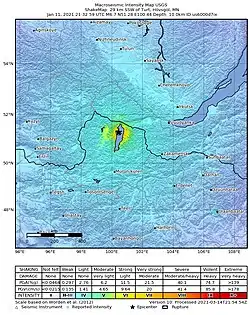
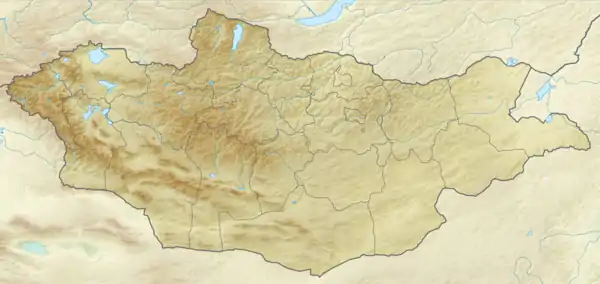
The 2021 Khövsgöl earthquake was a magnitude 6.7 earthquake that occurred on January 11, 2021. It was located about 50 km south of the Russian border in the Khövsgöl Lake.
 | |
  | |
| UTC time | 2021-01-11 21:32:59 |
|---|---|
| USGS-ANSS | ComCat |
| Local date | January 12, 2021 |
| Local time | 05:32 |
| Magnitude | 6.7 Mw |
| Depth | 10.0 km (6.2 mi) |
| Epicenter | 51.281°N 100.438°E[1] |
| Areas affected | Mongolia Russia |
| Max. intensity | VIII (Severe) |
| Casualties | 53 injured[1] |
Tectonic setting
Mongolia has complicated tectonic and structural geology, belonging to the Mongolian-Okhotsk Mobile Zone, between the Siberian Platform and Chinese Platform. The basement rocks formed during the Paleozoic in the Precambrian as Riphean age ophiolite formations experienced rifting from 1.7 to 1.6 billion years ago and again around 800 million years ago. The closing of a late Proterozoic ocean generated the ophiolites and the oldest basement rock. The Baikalides and Altaid mountain belts represent the accretion of island arcs into the Paleozoic. The collision of small microcontinents like Amuria and the large collision between Asia and Gondwana in the Mesozoic and Cenozoic had a major impact on the region. Crustal extension created the Mongolian Plateau, while rifting, crustal thinning, block faulting and basalt eruptions produced terrain very similar to the Basin and Range province in the western United States.[2] One of the strongest earthquakes in Mongolia was the 1957 Bayanhongor earthquake, which measured Mw 8.1 and caused 30 fatalities.
Earthquake
The earthquake was the largest in Mongolia since a 7.0 event in 1967.[3] It was initially reported as 6.8 Mw, before being downgraded to 6.7.[4] It was located about 50 km from the Mongolian town of Turt, and 55 km from the Russian border.[5][6] According to PAGER, 17,000 people felt moderate to strong shaking.[6] It was felt as far away as Irkutsk and Cheremkhovo in Russia.[7]
Damage and casualties
A number of public buildings around Khövsgöl lake and as far south as Mörön were damaged with cracked walls and broken windows. Although no one was killed, 53 people were injured and some had to be treated for symptoms such as heart problems and high blood pressure.[10]
References
- "M 6.7 - 30 km SSW of Turt, Mongolia". United States Geological Survey. Retrieved January 11, 2021.
- Moores, E.M.; Fairbridge, Rhodes W. (1997). Encyclopedia of European & Asian Regional Geology. Springer. p. 545.
- "M 7.0 - central Mongolia". United States Geological Survey. January 5, 1967. Retrieved 22 August 2021.
- "Strong earthquake hits lake in northern Mongolia". Retrieved 22 August 2021.
- "Magnitude 6.7 Earthquake Hits Russia-Mongolia Border Region". Retrieved 22 August 2021.
- "Mongolia - Earthquake (GDACS, USGS, media) (ECHO Daily Flash of 12 January 2021)".
- "Magnitude 6.7 earthquake occurs in the Russia-Mongolia border region".
- "Significant earthquakes - 2021". Retrieved 22 August 2021.
- "M 5.6 - 28 km SW of Turt, Mongolia". Retrieved 22 August 2021.
- "Газар хөдлөлтөөс үүдэж Хөвсгөл аймгийн зургаан суманд барилгын хана, цонх цуурсан байна". Retrieved January 13, 2021.