2022 K League 1
The 2022 K League 1, also known as the Hana 1Q K League 1 for sponsorship reasons, is the 40th season of the top division of professional football in South Korea since its establishment in 1983 as the K League, and the fifth season under its current name, the K League 1. The future champion of 2021 K League 1 are the defending champions.
| Season | 2022 |
|---|---|
| Dates | 19 February - 30 October 2022 |
← 2021 2023 →
All statistics correct as of 26 November 2021. | |

The 2022 season will be divided into two parts. First, there will be 33 Regular Rounds in which 12 teams play a round robin with 3 rounds (Rounds 1–33). Then there will be a Final A and Final B, each with 6 teams divided based on regular round performance, with each final being a round robin (Rounds 34–38).
Promotion and relegation
Teams relegated to the 2022 K League 2
Teams promoted from the 2021 K League 2
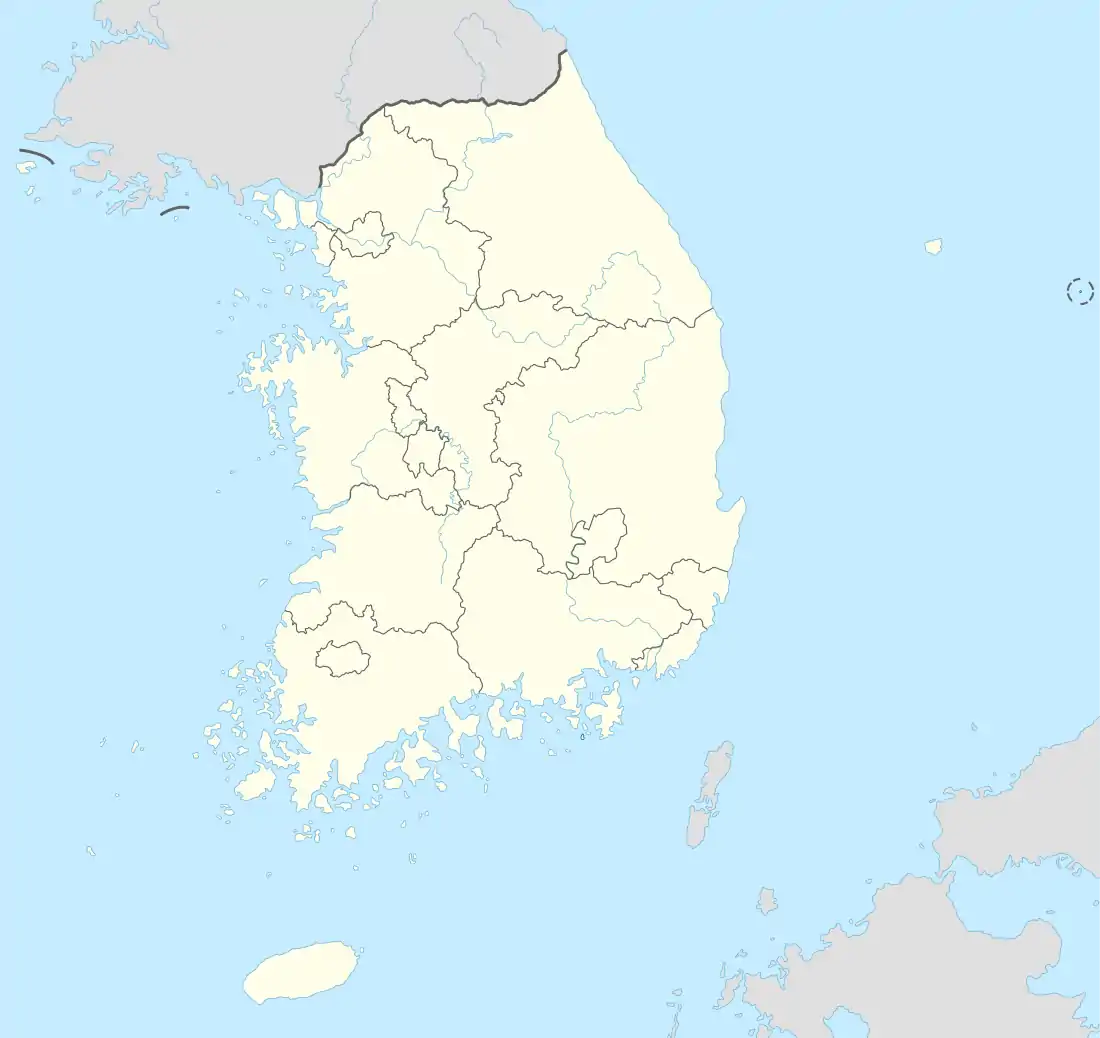
Participating clubs by province
The following twelve clubs will compete in the K League 1 during the 2022 season.[1]
Stadiums
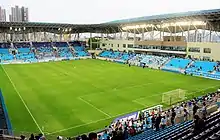
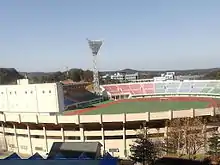
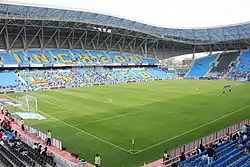
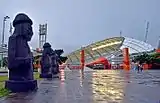
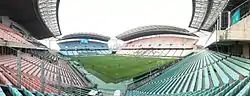
| Daegu FC | Gangwon FC | Gimcheon Sangmu FC | Incheon United | Jeju United | Jeonbuk Hyundai Motors | |
|---|---|---|---|---|---|---|
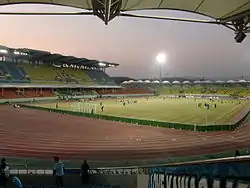
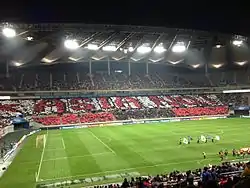
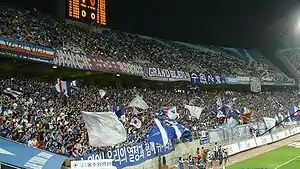
| DGB Daegu Bank Park | Chuncheon Songam Sports Town | Gangneung Stadium | Gimcheon Stadium | Incheon Football Stadium | Jeju World Cup Stadium | Jeonju World Cup Stadium |
| Capacity: 12,415 | Capacity: 20,000 | Capacity: 22,333 | Capacity: 25,000 | Capacity: 20,891 | Capacity: 29,791 | Capacity: 42,477 |
 |
 |
 |
 |
 | ||
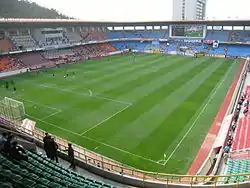
| Pohang Steelers | Seongnam FC | FC Seoul | Suwon Samsung Bluewings |
Suwon FC | Ulsan Hyundai | |
| Pohang Steel Yard | Tancheon Stadium | Seoul World Cup Stadium | Suwon World Cup Stadium | Suwon Stadium | Ulsan Munsu Football Stadium | |
| Capacity: 17,443 | Capacity: 16,146 | Capacity: 66,704 | Capacity: 44,031 | Capacity: 11,808 | Capacity: 44,102 | |
 |
 |
 |
 |
 |
 | |
Foreign players
Restricting the number of foreign players strictly to five per team, including a slot for a player from the Asian Football Confederation countries and a slot for a player from the Association of Southeast Asian Nations. Gimcheon Sangmu FC, being a military-owned team, is not allowed to sign any foreign players. A team could use five foreign players on the field each game, including at least one player from the AFC confederation.  Samuel Pungi, playing for Pohang Steelers, was deemed to be a native player as he had been granted South Korean nationality.
The name in bold indicates that the player was registered during the mid-season transfer window.
.svg.png.webp)

.svg.png.webp)



League table
| Pos | Team | Pld | W | D | L | GF | GA | GD | Pts | Qualification or relegation[lower-alpha 1] |
|---|---|---|---|---|---|---|---|---|---|---|
| 1 | Jeonbuk Hyundai Motors | 0 | 0 | 0 | 0 | 0 | 0 | 0 | 0 | Qualification for the Champions League group stage |
| 2 | Ulsan Hyundai | 0 | 0 | 0 | 0 | 0 | 0 | 0 | 0 | |
| 3 | Daegu FC | 0 | 0 | 0 | 0 | 0 | 0 | 0 | 0 | Qualification for the Champions League play-off round |
| 4 | Jeju United | 0 | 0 | 0 | 0 | 0 | 0 | 0 | 0 | |
| 5 | Suwon FC | 0 | 0 | 0 | 0 | 0 | 0 | 0 | 0 | |
| 6 | Suwon Samsung Bluewings | 0 | 0 | 0 | 0 | 0 | 0 | 0 | 0 | |
| 7 | Pohang Steelers | 0 | 0 | 0 | 0 | 0 | 0 | 0 | 0 | |
| 8 | Incheon United | 0 | 0 | 0 | 0 | 0 | 0 | 0 | 0 | |
| 9 | Gimcheon Sangmu | 0 | 0 | 0 | 0 | 0 | 0 | 0 | 0 | |
| 10 | FC Seoul | 0 | 0 | 0 | 0 | 0 | 0 | 0 | 0 | Qualification for Relegation play-offs |
| 11 | Seongnam FC | 0 | 0 | 0 | 0 | 0 | 0 | 0 | 0 | |
| 12 | Gangwon FC | 0 | 0 | 0 | 0 | 0 | 0 | 0 | 0 | Relegation to K League 2 |
Rules for classification: 1) Points; 2) Goals scored; 3) Goal difference; 4) Number of wins; 5) Head-to-head points.
Notes:
- Teams were split into two groups (Final A and Final B) after each have played 33 matches.
Positions by matchday
Leaders
Qualification for the Champions League group stage
Qualification for the Champions League playoff round
Relegation playoffs
Relegation to the 2023 K League 2
Round 1–33
Fixtures and results
Matches 1–22
Teams play each other twice, once at home, once away.
Matches 23–33
Teams will play each other once.
Final Round Matches 34–38
Teams will play each other once.
|
Final A |
Final B
|
Relegation playoffs
The Promotion-relegation playoffs will be contested between the 2nd placed team in the K League 2 playoff and the 11th placed team in the K League 1, and between the winners of K League 2 playoff and the 10th placed team in the K League 1. The winners will secure a place in the 2023 K League 1.
First leg
| 2nd place of K League 2 | v | 11th place of K League 1 |
|---|---|---|
| Winner of the promotion play-off of K League 2 | v | 10th place of K League 1 |
|---|---|---|
Second leg
| 11th place of K League 1 | v | 2nd place of K League 2 |
|---|---|---|
| 10th place of K League 1 | v | Winner of the promotion play-off of K League 2 |
|---|---|---|
Season statistics
Top scorers
Top assists
AwardsMost Valuable Player of the RoundMonthly Awards
See also
References |