Al-Rashid of Morocco
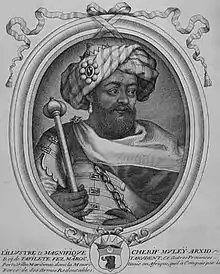
Moulay Al-Rashid ibn Sharif (Arabic: مولاي الرشيد بن شريف), known as Moulay Al-Rashid or Moulay Rachid (also spelt Mulay, Mulai or Mawlay; 1631 – 9 April 1672) (Arabic: مولاي الرشيد), was Sultan of Morocco from 1666 to 1672.[1] He was the son of the founder of the Alaouite Dynasty, Moulay Sharif, who took power in Tafilalt in 1631.[2] In 1635 Moulay Rashid's half-brother Sidi Mohammed succeeded their still living father. During his reign, Sidi Mohammed brought Tafilalt, the Draa River valley, Oujda and the Sahara region under Alaouite power. However, due to internal feuding war broke out between the brothers and Sidi Mohammed was killed on the battlefield by troops of Moulay Rashid August 2nd 1664. From then on Moulay Rashid became Sultan of Tafilalt and went to conquer Taza and assert power in Sijilmasa, capital of Tafilalt. He then became the first Alaouite Sultan of Morocco. He ended the rule of the Dilaites, a Berber movement which ruled the northern part of Morocco. After subjugating the northern coastal areas of Morocco, he also succeeded in capturing Marrakech in 1669. He occupied the Sous and the Anti-Atlas, which solidified Alaouite control over the entirety of Morocco except the wild High Atlas Mountains.[3] He re-subdued the Emirate of Tuat after their rebellion following the death of Sultan Sidi Mohammed of Tafilalt who conquered it in 1652.
| الرَّشيدُ بْن عَلِيُّ الشَّرِيفِ Al-Rashid of Morocco | |
|---|---|
 | |
| Sultan of Morocco | |
| Reign | 1666–1672 |
| Predecessor | Mohammed al-Hajj al-Dila'i ( Dilaite interlude) |
| Successor | Moulay Ismail |
| Sultan of Tafilalet | |
| Reign | 1664-1666 |
| Predecessor | Sidi Mohammed |
| Born | 1631 Tafilalt, Morocco |
| Died | 9 April 1672 (aged 42) Marrakech, Morocco |
| House | House of Alaoui |
| Father | Moulay Sharif ibn Ali |
| Religion | Islam |
Character
Young Moulay Rachid was described as a proud and ambitious man.[4] Moroccan historians portray him as a wise man,[5] more precisely, a man gifted with political wisdom. Moulay Rachid have been recorded to show great respect to scholars, he honored them, sought their company and was generous to them everywhere. Under his reign science flourished and scholars enjoyed great honor and consideration.[6] People who met him describe Moulay Rachid was a man of great liberality in character and simplicity with people. On the latter, one day, he sent for a scholar to read a book with him. This scholar refused to come, and responded like Imam Mālik:
"One comes to science, she does not come to you".
Moulay Rachid often went to the house of this scholar and studied under his direction. According to Al-Qadiri's Nachr Elmatsani (The Chronicles), he assisted the lessons of Cheick al-Yusi at the University of al-Qarawiyyin.[7]
Biography
Youth
Moulay Rachid was born in 1631 at Sijilmasa. He was born the same year his father Moulay Sharif was crowned Emir of Tafilalt.[8] His father lost power in 1636 and officially abdicated in favor of his eldest son Sidi Mohammed April 23, 1640. Aged 15, on April 28th 1646 his brother Sultan Sidi Mohammed was defeated during the battle of Elqa'a by the Dilaite Sultan Mohammed al-Hajj.[9] The Dilaite troops had moved forward to Sijilmasa and sacked the city. Moulay Rashid and his brothers saw the sack of Sijilmasa by Dilaite troops. Adult Moulay Rashid blamed his brother Sultan Sidi Mohammed to have failed in protecting the city and to have let their sacred city be sacked by some Berber troops.
Rebellions against Sultan Sidi Mohammed
After the death of his father Moulay Sharif in 1659, Sultan Sidi Mohammed was once again proclaimed Sultan. Moulay Rachid disavowed to pledge allegiance to his older half-brother the Sultan and withdrew himself from court with his partisans. The latter were Caid Bargua Susi a black man, Caid Bequal and Caid Tufer Arabs and some soldiers.[10] Moulay Rachid headed to Dra’a, a province of the Sultanate of Tafilalt to permanently establish himself there. Sultan Sidi Mohammed aiming at suppressing the rebellion at birth followed him in Dra’a with cavalry and having found him, took Moulay Rachid hostage and his followers as well. His followers who had committed treason were trained on mules with their hock cut off and Moulay Rachid was imprisoned.[10] However, Moulay Rachid found a way to escape prison and having done so, he quickly went on assembling troops. He was starting to be feared as his rebellion went on but for the second time Sultan Sidi Mohammed defeated him and his troops and he was imprisoned once again. This time Moulay Rachid was imprisoned in a smaller cell and Sultan Sidi Mohammed forbade him receiving any visits. Only the Sultan's most loyal black servants were allowed inside his cell to bring him food and other things he might need.[10]
Escape from Tafilalt
Moulay Rachid was for a long time imprisoner in his cell. But cunning as he was, he managed to corrupt the black servant who was allowed to enter his cell to serve him food. It is by dint of flattery and promises that he succeeded to corrupt this loyal servant of his brother the Sultan. Moulay Rachid having noticed that the door of the tower was carried by a small wall of brick, thought to exploit this construction flaw for his escape. He made the black servant swear to bring to following night two peaks to make an opening, as well as weapons and horses.[11] The following night, the Black slave did not miss to bring the previously mentioned. Moulay Rachid worked on the wall from the inside, while the black servant worked on it from the outside and they soon managed to break the wall. Moulay Rachid escaped prison for a second time and although the man had just helped him in this achievement, he killed him with two blows of scimitar on his collar.[12] Moulay Rachid didn't think fit to trust a traitor to his master, even if he owed him his escape. Alone, he thoroughly escaped to centers of authority outside the Sultanate of Tafilalt. He first arrived in Toudga province (Temsena nowadays) whose Master was Sidi Mohammed ben Bou Beker, a marabout.[13] Moulay Rachid remained there some time. He hid his identity and proposed his services to Bou Beker by pretending to be a soldier (ranker). The old man received him and judging him a man of merit, gave him various jobs. Moulay Rachid executed so well his tasks that they slowly became friends. But a day came where some Tafilalt people came to sell dates recognized him and went to great him as the brother of their Sultan. However, the sons of Bou Beker having learnt who he was and suspecting him to have not came here disguised without an agenda resolved to kill him. They made him fall in an ambush from which he managed to escape and took flight to Demnat. There, he tried to recruit followers but failed and after staying there a short time went to the Zaouia of Dila for refuge.[14][15] Moulay Rachid remained there long enough before he had to leave at the demand of the Dilaites.[16][15] People tell the story that he was asked to leave by a fellow man of this zaouia as he feared Moulay Rachid would betray them. According to a tradition conserved among the Dilaites, they foresaw that the destruction of their zaouia would be operated by Moulay Rachid. So he followed the counsel of the man who advised him and left the Zaouia of Dila for Azrou.[17] Some time after staying in the mountain of Azrou he left for Fez where El Doraidi gave him great hospitality.[18][17] This episode happened most likely in 1662. In Morocco the Dilaites power began to crush when Sultan Mohammed al-Hajj perished in 1661 (H.1072). Following his death, El Doraidi who commanded a body of Dilaite troops rebelled with his tribe the Doraid and proclaimed himself Sultan of Fez. In 1662, Abdallah ould Mohammed Elhadj tried to take back Fez but failed. Therefore, for Al Doraid to have had been the one who extended his hospitality to Moulay Rachid these events should have previously happened. Moulay Rachid went to Fez with a small escort. He spent the night outside of Fez el Jedid and the following day he went for Taza.[17][18]
In Taza he reached the end of his peregrination, as unlike his previous destinations he would stay around the Taza region longer and begin his quest for power from this point onward. Taza was a city right outside the northern border of the Sultanate of Tafilalt. The Alaouite northern territory extended from the Moulouya River and included the city Oujda its surrounding oriental Rif and territories until the Tafna River. Their northern borders were mostly populated by Maqil Arabs and Beni Snassen.
Moulay Rachid remained in the oriental Rif region for some time until 1664, his journey there was the springboard that allowed him to rise to power. Concerning the latter, the majority of historians only explain the outcome of his peregrinations around Taza, which was his auto-proclamation as Sultan in 1664. For instance, Moroccan historians (Al-Ifrani and Al-Nasiri mainly) re-count only scarcely his adventures after he attains Taza and focus exclusively on the events after his auto-proclamation as sovereign. Solely records from Germain Mouette relates in all details his peregrinations before his auto-proclamation as Sultan.
Rise to power
At the end of his peregrinations, near Taza, according to Germain Mouette's biography of Moulay Rachid, the concerned seeked, just like he did in Toudga, to offer his services to a prominent man. He offered his services to Ali Soliman the Cheick of Quiviane (Rif region).[19][20] Ali Soliman was the Governor of Quiviane and received Moulay Rachid in his services. First, Ali gave him the charge of his palace. But soon enough, as Moulay Rachid entered in the good graces of his master, coupled with the fact that Ali was convinced of Moulay Rachid’s merit, he consequently discharged upon Moulay Rachid all the care of governing. In fact, Ali made Moulay Rachid his Chief House Stewart, he gave him the charge of his finances and made him his Chief Justice Secretary.[20] [21] Moulay Rachid performed his tasks with equity and justice and the people too, soon came to hold him in great esteem. He did good to everyone and defended the orphans and widows. People praised him for his righteousness, but Moulay Rachid gave glory of everything he did to his master. This behavior of him made Ali Soliman esteem him even more and entrust himself in his person further more. Ali Soliman gave Moulay Rachid the command of some of his troops and tasked him to calm muddles in his territories. With this last nomination, he thus reached his peak as he became Ali Soliman’s Lutenant. Appearances can be deceiving as Moulay Rachid's goal was never to serve Ali Soliman, but rather for the people to esteem him so much that he would have no difficulty making them ally to his cause when he would betray their Master and seize his dominion.[22] To achieve his quest for power, in completing his duties as Ali Soliman’s Lutenant, he sought to start by securing some fortresses of the country.
As Lutenant of Ali Soliman and acting as his trusted confidant Moulay Rachid in truth was seeking to rule and not serve. The man lacked resources and money to attract followers but the odds were more with him than before, since he now commanded a body of troops. He needed to cross this last leap to rise to power. To do so, needed to seize a mighty fortress. He set his sights on the citadel Dar Ibn Mich’al, a fortress of strategic importance.
The Citadel Dar Ibn Mich'al
In his translation of A history of the Alaouite dynasty by Al Zayani, Octave Houdas references Dar Ibn Mich'al as a castle identified as Dar Cheick Chaoui by Renou. He completed his reference by citing that Haroun Ibn Mich'al, the castellan, was an extremely rich Jew who exerted a great influence over the populations in the surroundings of his palace.[23] The earliest accounts of Ibn Mich'al are from the Beni Snassen. They account that Ibn Mich'al established himself among them in their territory and lived in a fortress on one of their mountains,[24] also, that they lived under his protection. We can therefore locate this fortress Moulay Rachid tried to secure for himself in Snassen hill-country.[24][25]
A version of the event from Germain Mouette claims that Moulay Rachid, Lutenant to Ali Soliman wanted to take possession of the citadel he had already located. Accompanied by his men and under the cover of conducting his duties as Lutenant to Ali Soliman, he pretexted a visit to the governor of this secluded fortress. Once inside, Moulay Rachid assaulted the citadel with his men, and made the governor die in torment to make him confess where he hid his treasures. He took away from a Jew who had dominated local trade (most likely Haroun Ibn Mich’al[26] or Joseph Ben-Simon[27]) and who lived in the very same castle the value of almost one million French livre (two hundred thousand metecals, former Moroccan currency) of his riches. Following the capture of the citadel, he distributed some of these plundered riches among his followers to boost their loyalty.
The assault on the citadel and the gain looted property was a decisive factor in equipping the army of Moulay Rachid with the means to assert his power. Sources differ on whether after securing this citadel he had already proclaimed himself Sultan or he thought to take over Ali Soliman's dominions first as he had few followers who could only operate in small scales for guerrilla. In fact, historians state that he was rather proclaimed Mukadam (General in English) by his men and Cheick Al-Lawati leader of his Gharb (East in English) tribe.[28]
The Great war Lord
Moulay Rachid planned to overthrow Ali Soliman from his dominions. Having been made aware of Moulay Rachid’s rebellious achievement Ali Soliman gathered an army of 7000 men and marched against Moulay Rachid before he could grow more powerful.[29] Moulay Rachid’s spies informed him that Ali Soliman was close to his position so to gain advantage of position against him he marched towards Ali Soliman and took camp on a plain. Moulay Rachid’s troops were composed of 1500 infantry men and 600 horsemen well payed and motivated by it. That, in contrast with Ali Soliman’s troops, even thought outnumbering their enemy, were poorly motivated deprived from regular pay and with the resolve of flipping sides to the enemy. Moulay Rachid knowing himself outnumbered exploited this weakness in Ali Soliman’s troops. Before the battle, when their troops were camping one day away from each other, Moulay Rachid sent some of his men to discreetly tell his praises and pay liberalities in the other camp to encourage them to desert to his camp. This strategy succeeded as some of Ali Soliman’s men deserted to Moulay Rachid’s camp before the battle[30] however, it did not close the gap of his opponent's numeric superiority. Ali Soliman thought to quickly engage the battle before the majority of his troops would follow the foot steps of their comrades and desert him. Moulay Rachid accepted the offer.
During the battle, Moulay Rachid's men fought vigorously for his cause as even outnumbered, they held their positions. Ali Soliman’s troops during the fighting started to defect him for Moulay Rachid whose party was stronger. Seeing that the odds were against him, Ali tried to escape the battlefield, but his men who had just defected him captured him and brought him to the Moulay Rachid, the winner.[29] Back in his camp victorious, Moulay Rachid gave to Ali Soliman an ultimatum: he would spear his life if he relinquishes his riches to him, he argued that reason implied him to relinquish them as they were of no use to him any longer. Would he reject this offer, he would suffer a shameful death. Weak and defeated by his once servant, Ali Soliman ceded to the ultimatum. However, back in Quiviane when Ali showed him his riches, Moulay Rachid doubted his honesty and believed he did not show him the full extent of his fortune. Despite Ali Soliman protesting his honesty Moulay Rachid put him to death.[31] Upon executing him, he was quoted to have declared to his followers:
".. A Prince who buries them (riches) in the earth do not deserve to reign; come, my friends, let us share what your pains and affection for myself made you deserve".
— Moulay Rachid
He kept the gold for himself and gave all silver to his officers for sharing with the soldiers.[32]
This last episode of Moulay Rachid’s peregrinations happened right before he proclaimed himself Sultan in 1664. In fact, according to both Moroccan historians whose accounts bypass the details of his peregrinations around Taza and Germain Mouette’s who detailed the latter, Moulay Rachid auto-proclaimed himself sovereign in the Oriental Rif Region.[33][31][34] He did so in Quiviane on the spoils of war won from Ali Soliman. Consequently, he was sworn oath of fidelity by his followers who were mainly Maqil Arabs and the Beni Snassen.[35]
The Battle of Angad
Moulay Rachid following his auto-proclamation as Sultan established himself in Oujda. Sultan Sidi Mohammed who have been peacefully reigning the Sultanate of Tafilalt was made aware of his brother's rebellious achievement in his northern borders.[33] It was Sidi Mohammed who journeyed North to meet Moulay Rachid on the battlefield. He wanted to prevent an immediate attack from his bellicose and strengthened brother on Sijilmasa. The battle took place on August 2nd 1664. Historical source do not extensively detail the battle of Angad.
Before his victory over Ali Soliman, Moulay Rachid had 600 cavalrymen armed with lances, followed by 1500 infantry men armed with rifles and bows and arrows.[36] After Ali Soliman's defeat 7000 of his troops defected to Moulay Rachid. The numbers of the casualties suffered on both camps were not cited but the remainder of Ali Soliman’s men all defected to Moulay Rachid. His ranks were now composed of 2,100 cavalrymen and 8,000 infantry men.[37] In addition to that, following his capture of the citadel of Dar Ibn Mich’al he amassed riches that allowed him to supply a regular army.
His opponent Sidi Mohammed of Tafilalt came to battle him with 5000 cavalrymen and 9000 infantrymen. Moulay Rachid’s disadvantage was obvious as his brother’s troops outnumbered his. However his troops were highly motivated as composed exclusively of voluntary elite troops who made the sermon to defend their newly proclaimed Sultan as he was a man they believed in. To show his esteem, following their oath, Moulay Rachid granted them liberalities in terms of pay.[37]
Made aware that his elder brother journeying North to campaign against him, with his men’s sermon Moulay Rachid in turn marched to meet him on the battlefield.[38] Aware of him being outnumbered he thought to use the terrain to his advantage. Through the mountains, he found a strategic point for him to camp in. He camped in the mountains to protect his outnumbered troops as the mountains were natural fortifications which prevented mass cavalry charge.[37] The rivalling brothers were now just days apart of each other and the battle was imminent.
The battle of Angad took place on the 2nd of August 1664 (Hijri calendar: Friday 9th Muharram 1075)[33][34] on the eponymous Angad Plain. The Angad plain is an arid plateau located south of the Mont of the Beni Snassen (Oriental Rif). While Mouette tell the tale of two battles and a siege between Moulay Rachid and Sultan Sidi Mohammed, most historians agree that the battle of Angad was the unexpected victory that brought Moulay Rachid on the throne of Tafilalet.[39][40][41] Mouette might have confused Sultan Sidi Mohammed with his son Sidi Mohammed Saghir (the younger in English) who tried to succeed his father during the siege of Sijilmassa.
The two rivaling brothers were now witnessing the premises of the battle which was soon to take place on the Plain of Angad, where Moulay Rachid went to meet his brother on the frontline.[42] Sultan Sidi Mohammed was forecasting to capture his brother alive upon defeating him.[33] However, fate decided otherwise as barely the battle started that Sultan Sidi Mohammed received a bullet in the neck, he immediately succumbed to his injury.[43][44][42] Deprived of their leader, Sidi Mohammed’s men lacked guidance and thus were rooted by Moulay Rachid’s men and then killed. Some were made prisoners.[42] The battle of Angad was a unanimous victory for Moulay Rachid. At the end of the battle, Moulay Rachid found his brother's body, he was saddened by the death of his brother and mourned him. He himself washed his brother's corps (ghusl ritual) during the funerals and transported it to the citadel Dar Ibn Mich'al for burial.[43][44][42]
Aftermaths of the Battle of Angad
Back at the citadel Dar Ibn Mich’al, he buried his brother in it. Sultan Sidi Mohammed deceased, his men went to enlarge the ranks of Moulay Rachid’s army and turned their allegiance to him.[43][45] Moulay Rachid found himself at the head of considerable forces. His first move as the de facto Sultan of Tafilalt was to send emissaries to nearby tribes for them to swear allegiance to him in Oujda.[46][47][40] Also, Moulay Rachid inscribed his deceased brother's former troops on the guish registers (army registers) and provided them with clothes, weapons and horses. Such growing forces required greater finances that he lacked after having spent his gained riches on various military matters during the previous period.
On the latter, as a reminder, the day Ibn Mich’al was killed Moulay Rachid took his son with him.[47] His mother came to Oujda to ask for her son given back to her. Moulay Rachid used procrastination towards her until a day he told her he would give her son back to her, only if she would reveal him where are hidden her deceased husband’s riches. The mother ceded to his demand and he went with her at the Kasbah where she showed him a cabinet in a room. He fractured it and found there jars full of gold and silver. He took away those riches which improved his position and used them also as means of payment for his troops. Moulay Rachid finances were getting better and his men’s situation was improving, which occurrence he considered a sign of good omen.[47]
Now the de facto Sultan of Tafilalt, and having strengthened the basis of his new army, he set his sight at achieving the goal his deceased brother Sidi Mohamed almost achieved, conquering Al Maghrib (Morocco in Arabic).
He began by sending emissaries to the Western Rif (Westward from Oujda), and thus camped on the banks of the Moulouya river waiting for new followers returning with his emissaries. But as no one came he marched on Taza, the penultimate step before Fez capital of Al Maghrib (Morocco).
After a fierce battle he managed to seize Taza. The dwellers of the fallen city swore allegiance to him as well as the tribes which surrounded the city.[48][49] When the Fassi heard of the capture of Taza by Moulay Rachid, they united with their neighboring tribes the Hayaina, the Bahlil and the Sefrou people and took the oath to battle him and not to swear allegiance to him. The Fassi wanted to prevent their doom as the Hayaina were massacred by his brother Sultan Sidi Mohammed back in 1663.[50] At the same time, the Masters of every neighborhood in Fez prescribed their dwellers to buy horses and weapons. Every house had to be equipped with a riffle or suffer punishment. Soon enough, more than enough rifles were brought. At Bab Ftouh took place the review of the prescribed war material, they pledged to fight Moulay Rachid on the battlefield.
Moulay Rachid was made aware of Fez's war preparations.[48][51] Nonetheless, he put his plans for Fez on hold for the time being. And instead prioritized Sijilmasa. He went back home to battle Sultan Sidi Mohammed ’s eldest son who claimed the throne of Tafilalt for himself.
Siege of Sijilmasa
Sidi Mohammed Saghir eldest son of the deceased Sultan Sidi Mohammed ruled the Sultanate after news of his father's death. However, due to his father's troops defecting to Moulay Rachid he was left with poor resources to battle the fortified party of his uncle. Moulay Rachid wanting to avoid a bloodbath back home chose to siege Sijilmasa rather that assaulting it. Had he have chosen the later, he would have became very unpopular among the Filali and Ksour Leaders. Upon besieging Sijilmasa for 9 months, devastated by the siege, Sidi Mohammed Saghir took flight at night.[48]
Victorious, in 1665 Moulay Rachid entered Sijilmasa, without bloodshed. He unanimously received oath of fidelity from the Filali, Shurafa and Ksour Leaders and was officially proclaimed Sultan of Tafilalt. He put the other sons of Sultan Sidi Mohammed under the supervision of Moulay Aran[52] his elder half-brother to date and full-brother of Sidi Mohammed. He prioritized the tasks of restoring the city's ramparts, organizing the guard services and calming the region.[53] After achieving so, he named Moulay Aran Khalifa (Viceroy in English) of Sijilmasa[52] and went back to Taza to prepare his military campaign for Fez.
In the 1660s Morocco's political climate was tense. Since 1659, The putschist Abdul Karim Abu Bakr Al-Shabani, who assassinated his nephew the last Saadi Sultan Ahmad al-Abbas, proclaimed himself Sultan of lower Morocco by seizing the Saadi dynasty's initial capital Marrakesh. However as viewed an usurper, he only ruled over the city and never received the Bay'ah from the people.[12] General Khadir Ghaïlan controlled Western Rif (Hebt region and Qsar Katama[54]), and clashed in 1660 with the Dilaite Sultan Mohammed al-Hajj for definition of rural territories. He lost the battle but inflicted considerable casualties[55] to the Dilaites. This, coupled with the death of Sultan Mohammed al-Hajj the following year, in 1661,[56] prompted the Dilaites rapid decline. Moreover, the straw that broke the camel was indisputably Caid Al Doraidi's revolt in Fez, then, capital of the Dilaite State and his auto-proclamation as Sultan of Fez.
Abdallah Al Doraidi however, was solely officially recognized as Master of the Fez Confederation and so, only in time of truce between Fes Jdid and Fes el Bali.[24] Indeed, he never received the Bay'ah, oath sworn to a Sultan, from the Ulama of Fes el Bali as the man wasn't viewed eligible for the position.[24] Al Doraidi, as Master of the Fez Confederation ruled Fes Jdid and had the support of the Andalus quarter within Fes el Bali.[57] Back then, Fez consisted of fortified cities: Fes Jdid 'New Fes' in Arabic, the Mellah of Fez also fortified and Fes el Bali 'Old Fes' in Arabic. Fes el Bali comprised two neighborhood Al Qarawiyyin and Al Andalus divided in two by Oued Fes. The Sultanate of Tafilalt and all the existing other factions were fighting for the throne of Morocco.
Campaigns for Fez
In the Spring of 1665, Sultan Moulay Rachid of Tafilalt moved in the direction of Fez by establishing a military base at Taza. As soon as the Fassi heard of that, along with their allies the Hayaina, they marched there as well. Their goal was to defeat Sultan Moulay Rachid and weaken him to a point where he could no longer launch a military campaign on Fez.[58][59] In April of 1665, the Fassi militias and Hayaina levies marched out of Fez to fight Sultan Moulay Rachid in Taza, he was ready to meet them on the battleground. But, they had barely just arrived in presence of his mhalla (army division) that discord having arisen between them, they were routed and pursued until the Sebou River near Fez where they surrendered. Sultan Moulay Rachid went back on his paces to Taza.[60][61] After their disgraceful defeat, Fez and their allies the Hayaina pleaded for peace but negotiations failed and Sultan Moulay Rachid kept on going his campaign for Fez.
In August 1665, he launched his offensive on Fez by putting camp at its gates and besieging the city.[30] However after 3 days of fighting, as Fez kept resisting to the offensive at its walls, he chose to retreat. In the midst of his pull out, a bullet hit him on his earlobe but he managed to safely retreat. Sultan Moulay Rachid after his previous unbothered victory on fields had planned a quick offensive, but did not reckon Fez's strong defenses against siege weapons. Historic sources do not precise whether he lifted the siege too at the same time of his retreat. One of his General might have been left behind to carry the on going siege. Especially when Germain Mouette precise that Sultan Moulay Rachid sieged Fez for 11 months.[10] In September 1665, Sultan Moulay Rachid came back and besieged Fez for a second time.[30] He put camp on the city’s walls and fierce fighting followed. Fires and fighting caused ravages once again. After having killed and pillaged, Sultan Moulay Rachid of Tafilalt lifted the siege for a second time and doubled back to Taza.[30] Once back in Taza, after his inconclusive campaign on Fez, he put it on hold once again[62] and turned back to another direction, the Rif.
Sultan Moulay Rachid set his sights on the central Rif to destroy the A'aras clan's influence there. This clan was seated around Al Hoceima and was lead by Abou Mohammed Abdallah A'aras. The latter had links of friendship with European powers who were inclined to trade with the Riffians in wax and provisions. This was the case for the Spanish settled in the Fortress enclave of Peñón de Vélez de la Gomera. Likewise for the French who, since 1655-1657, had entered into talks with Abou Mohammed Abdallah A'aras for the establishment of a French Comptoir on the islets situated on Mersat el-Moudjahadin (The Bay of the fighters of the Faith) and Chafarinas Islands.[63] Cardinal Mazarin, the initiator, was willing to put 100 thousand French livre for the realization of these establishments. For the French this was an important enterprise as the Franco-Spanish War (1635–1659) prompted their merchant ships to anchor on Moroccan coasts.[63] During this period, Sultan Moulay Rachid of Tafilalt had banned trade with European powers:
"Al-Rashid is known to have laid a veto upon the formerly free and open Muslim provisioning of the Christian enclaves at the edge of his sphere of influence."
— Patricia Ann Mercer, Political and military developments ... during the early Alawi Period (1659-1727) (1974)
The A'aras clan leader Abou Mohammed Abdallah A'aras revolted against this veto, Sultan Moulay Rachid meant to clash with him.
After having localized his opponent, Sultan Moulay Rachid marched against him. However, the insurgent Abou Mohammed Abdallah A'aras who did not have enough troops to fights took flight to Peñón de Vélez de la Gomera with his family, along with his belongings.[64] There, he put himself under the Spanish King's protection while leaving a son, Abdelaziz, to carry the burden of fighting Sultan Moulay Rachid. Skirmishes took place, however, historic sources are not clear on whether it was Abdelaziz or his father that Sultan Moulay Rachid was fighting. Nevertheless, in March of 1666, during the month of Ramadan, after a number of encounters and fights the A'aras were defeated on their territory.[65][30] Abdelaziz was made prisoner, manacled and taken to Taza.[64] There, he swore allegiance to Sultan Moulay Rachid who consequently speared his life and pardoned him. The A'aras clan was sent in exil to Peñón de Vélez de la Gomera.
Amidst the already globally tense political climate in Morocco, since 1659, anarchy reigned in Fez. Friction and fighting were common between Fes Jdid and Fes el Bali,[64] and the Mellah of Fez suffered oppression under Caid Abdallah Al Doraidi's rule.[66] The latter ruled Fes Jdid and was Master of the Fez confederation but solely in times of truce between the two waring cities. Caid Al Doraidi was formerly registered on the Diwan (Court) of the Saadi princes along with his tribe.[67] He was part of the troops of Mohammed al-Hajj al-Dilai'i when the latter was proclaimed Sultan by the Fassi following the murder of the last Saadi Sultan Ahmad al-Abbas in 1659. But as soon as the Dilaites started to struggled in the North-west against Khadir Ghaïlan, he betrayed them and seized power by coup d'état in Fes Jdid. As ruler, Al Doraidi had the support of the Andalus district in Fes el Bali. Indeed, he had links of friendship with the Master of 'Uduat Al Andalus Ahmed ben Salah whose son, Salah ben Ahmed, had wedded his daughter. In Fes el Bali, the Leader of the Qarawiyyin neighborhood was Ibn Esseghir, the Master of the Lemthiens. While the Leader of the Andalus neighborhood was Ahmed ben Salah. The two Leaders were in open conflict with each other.[68]
Sultan Moulay Rachid at the end of the month of Mai 1666,[67] for the third time, laid siege on Fez. Germain Mouette stated that Sultan Moulay Rachid initially went with 1000 cavalrymen at Fes el Bali's gates, laid camp there and urged them to surrender. The dwellers who had came out and bordered their ramparts argued that if he wanted to be their Master he should seize Fes Jdid as she commanded them and tired them a lot. Germain Mouette's narration of events do collude with the one of Moroccan sources, only the order of occurrence of the events differ.
This time however, Sultan Moulay Rachid came with his whole army and besieged Fez from Fes Jdid walls.[69] The battle for Fez started,[51][67] the two armies clashed in full power but Sultan Moulay Rachid's party was not making any fatal blows to the besieged. As a matter of fact, Caid Abdallah Al Doraidi (named deformed to de ringuy),[10] who commanded in person the defense of Fez, resisted vigorously to Sultan Moulay Rachid's assault. Many skirmishes occurred from either sides, and day after day Fez kept holding the upper hand as Sultan Moulay Rachid's army was wasting away without him being able to crush his opponent in any way. Now convinced he would not be able to capture Fez with a frontal assault, he thought of another way.
Capture of Fez
Despite having brought his whole army for his third siege of Fez, Sultan Moulay Rachid could not enter Fez who was staunchly defended by Caid Abdallah Al Doraidi. He therefore thought of a scenario in which his men could somehow enter the city and take Fez from its inner walls. But to do so, he would need an alibi from inside the city. The Fassi would never collude with him, especially when their party was now on the winning side. However, this was not the case for the Jews of the Mellah of Fez.
The Mellah of Fez is situated between Fes Jdid and Fes el Bali. Since the fall of the Saadi Sultanate in 1659, the Jewish neighborhood in the capital of Fez have suffered steady persecution at both the hand of the Dilaites and under Caid Al Doraidi's rule. In fact, the Dilaites have ordered destruction of synagogues in their Mellah.[66] And after them, Caid Al Doraidi relentlessly demanded the Mellah of Fez heavy contributions.[70] In addition, the anarchy that came following Al Doraidi's coup d'état caused the Mellah of Fez's traffic between the two warring cities to be pillaged by Al Doraidi and ultimately reach a state of total interruption. They turned to emigration as hunger stoke their community and since a change in their Leader's policies towards them was no longer to contemplate. The Mellah of Fez surnamed Al Doraidi "the persecutor" and they certainly did not contemplate a Dilaite comeback after their initial plight in their hands.
With his quest for an ally inside Fez, Sultan Moulay Rachid thought a good alibi in the Jews of the Mellah of Fez. Consequently, important dealings happened as he charged the Jewish community of Taza to reach the Jews of the Mellah of Fez. He promised the latter that if they would help him in his conquest of Fez, he would alleviate the traditional Jizya poll tax on their community.[71] What Sultan Moulay Rachid promised them was something no other North African ruler ever promised to a Jewish community. Along with that, he also promised the Jewish community peace. Considering their sufferings with their ruler and previous one too, the Jews of the Mellah of Fez did not hold him as a foe and accepted to collude with him. With this deal, Sultan Moulay Rachid made himself an unexpected ally inside Fez.
Amidst the ongoing siege of Fez, the Jews of the Fassi Mellah told Moulay Rachid the day and hour they would give him entry in Fez. The day they indicated him was the 3rd of Dhu al-Hijjah 1076 (in Hijri calendar), being June 6th 1666.[51][67] This day, by night, Sultan Moulay Rachid with his elite troops ambushed Fez's defenders. The ambush took place in the gardens near the Mellah of Fez's walls, and was probably meant as a distraction for the entry Gate's watch. The Jews recognized the signal on which they agreed, and subsequently went to take hold of their Gate.[71] They opened their Gate and thus let Sultan Moulay Rachid to enter Fez.
Having entered Fez this night of June 6th 1666, he reached the Mellah of Fez and diligently took possession of the city's first inner gate and its first inner wall. Moulay Rachid brought in all his troops and along with his infantry, he smashed the second Gates with an ax. The surprise was absolute and he entered victorious in Fes Jdid. Caid Abdallah Al Doraidi who thought nothing less than that, having learned that Sultan Moulay Rachid had took possession of Fez's inner Gates and that his troops surrounded the first wall, took flight by the Gate called Bab es-Sabaa (nowadays Bab Dekkakin). Sultan Moulay Rachid informed of his escape had put 100 cavalrymen after him who reached him without difficulty and brought him back to their Sultan. Facing Al Doraidi, Moulay Rachid asked him where he hid his riches. But as he was turning a deaf ear to his demand, Moulay Rachid used confessing torture specially set for him on which Al Doraidi languished on many days.[71]
The following day, June 7th, he attacked Fes el Bali and besieged it.[51][67] most chronicles, support that Ibn Esseghir and his son fled Fes el Bali from Bab Guissa. And two days latter, it was Ahmed ben Saleh who in turn fled. Their leaders having deserted them, the dwellers, judging themselves too weak to resist, and seeing division arising amongst themselves, left the city and went to swear oath of fidelity to Sultan Moulay Rachid whom they unanimously proclaimed sovereign.[51][67]
Moulay Rachid immediately sent troops to look for the runaway Masters. Ben Salah who fled the last was found in the city's suburbs. He was captured and sent to prison in Fes Jdid at the Gate of Dar Ben Chegra. Some of his followers were put to death. Ibn Esseghir and his son were in turn found in Hayaina territories, they were captured and sent to the same prison of Ben Salah. On Sultan Moulay Rachid's orders, they were all executed a week later.[72][51][67]
Reign
Sultan of Fez
Following his conquest of Fez on June 6th 1666, Sultan Moulay Rachid of Tafilalt officially became Sultan of Morocco when he received the Bay'ah from the Ulama of Fez and the inhabitants.[32] The ceremony took place before noon, according to Mohammed al-Ifrani:[67]
"The ceremony over, he granted considerable sums of money to the Ulama and showered them with presents. He (Moulay Rachid) deployed the greatest kindness towards the inhabitants of Fez and showed a strong desire to revive the Sunnah by upholding the religious law; this behavior soon placed him high in the minds of the entire population, who dedicated him a lively affection".
After his Bay'ah ceremony, he married a daughter of Cheick Al-Lawati, his long time supporter. He gave the charge of the royal palace to his new father-in-law and gifted him a sublime palace in Fes el Bali for his use. Sultan Moulay Rachid entrusted him also to calm his furor when anger would get to rule himself onto his subjects. Cheick Al-Lawati would not miss, in the future, to carry out that entrusted responsibility. Following this wedding, the Al-Lawati family would benefit from the favor of the Sultan, as he went further to give governing positions to some of Cheick Al-Lawati's capable sons.[73]
In Autumn 1666, he sent for the auto-exiled Abdallah A'aras, who was in Peñón de Vélez de la Gomera, through his imprisoned son Abdelaziz. Moulay Rachid tasked the latter to urge his father to come back home from his refuge, and that he would be welcomed in Court as one of his esteemed friends. The act was political, as although having conquered Central Rif, symbolism resided in the person of Abdallah A'aras, whose tribe was exiled from their dominions. Now Sultan of Morocco, there was no motive to keep animosity on these fallen people, whose reliement on his side meant that he would hold two thrid of the whole Northern coast of Morocco. It is said that Abdelaziz executed so well his task in urging his father that Sultan Moulay Rachid grateful, freed him and made him Al Caid (Major in Arabic) with 200 horsemen for guards. Abdallah A'aras upon receiving the letter shed tears of joy, as he thought his son dead. The old man, learning of the good treatment his son Abdelaziz was receiving from Moulay Rachid, sent the latter his most beautiful daughter for him to wed. Sultan Moulay Rachid, having had notice of Abdallah A'aras' daughter arrival, accepted the wedding proposal. She was escorted by a large suite and gifts loaded on camels. He subsequently ordered her brother Abdelaziz to go meet his sister with his cavalry, so that she was treated and received as a queen. The future bride and groom met a day away from Fez where they stayed awaiting his future father-in-law. Upon the latter's arrival, after a warm welcome, Moulay Rachid restored him on his dominions in central Rif and ordered back from exile his tribe, the A'aras. The Sultan pressed his desire to keep his new brothers-in-law by his side for future key positions, the grateful Abdallah A'aras insisted the glory of his family resided in him remaining in Court, and that he wished so for his remaining days. Sultan Moulay Rachid gave his second father-in-law a beautiful palace in Fes el Bali for residence. Back in Fez, Sultan Moulay Rachid's second nuptials to the daughter of Abdallah A'aras took place with great fanfare. In a mark of generosity, he pardoned prisoners in all the cities of his kingdom, which according to Germain Mouette, did not contribute little to put him in the esteem of his people.[73]
His second nuptials just over, in October 1666, that took place the Surrender of Meknes. A deputation from this city came to Sultan Moulay Rachid in Fez and expressed their will to be part of his realm. He accepted their allegiance. Sultan Moulay Rachid gave this city as personal appanage to his younger half-brother Moulay Ismail and at the same time, made him Khalifa (Viceroy) of Meknes. After this episode, he lead off preparations for his military campaigns.[73] In this enterprise, he sent for his nephews, the sons of the late Sidi Mohammed I and Moulay Mehrez (his older half-brother). The sons of Sidi Mohammed made excuse for the trip and thereby only his nephews, sons of Moulay Mehrez responded and made the trip to Fez, where they were warmly welcomed. Moulay Ahmed ben Mehrez, the oldest of his nephews who was in his mid-teens would accompany Moulay Rachid in his expected future conquests. Meanwhile, the sons of the late Sidi Mohammed I fearing their absence would be received as an affront, took refuge in the Mountains. Before departing, he tasked a group of rich merchants of Fez to each rebuild a house in Fes Jdid who suffered damage from the past warring period. At his return they would serve as lodging for his soldiers.[32] At last, he named Si Hamdoun Elmezouâr Qadi of Fez before departing in campaign against General Khadir Ghaïlan, the Master Western Rif.[67]
Sultan Moulay Rachid's war preparations over, he had assembled an army composed of 8000 cavalrymen, 32 000 infantryman for his campaign to conquer the Western Rif provinces. His enemy's dominions included the territories between Ksar el-Kebir, Tétouan and Ma'amora (nowadays Mehdya). Sultan Moulay Rachid marched to Ksar el-Kebir the homebase of General Khadir Ghaïlan. The latter, who was not short in displaying courage, upon learning of Moulay Rachid's arrival marched against him with an army of 20 000 men. In fact, even outnumbered, Ghaïlan was confident in victory as his men were veterans accustomed to fight the Christians at their shores. However, on the latter, he might have overlooked his men's moral.
The battle took place near Ksar el-Kebir by it's southern road,[74] Ghaïlan arranged his troops in battalion as he was accustomed to do, a method he kept from constantly fighting European powers. The two armies arrived in a short time in sight of each other's camps, it was Sultan Moulay Rachid who launched the assault, while Ghaïlan's ranks were on the defensive. The Riffian's party withstood the chock with incredible vigor. During the course of the action, General Khadir Ghaïlan exhorted his men to defend their homeland against their enemy and kept motivating them by way of speech. Ghaïlan was eager to catch sight of Sultan Moulay Rachid, he wanted to fight him in a one-on-one duel. However, upon five whole hours of fierce fighting, as he kept watching the horizon, it wasn't Sultan Moulay Rachid he could perceive, but his men defecting to his enemy. As previously mentioned, Ghaïlan fatally overlooked his men's moral. At the beginning his men held with determination their defensive position, but as outnumbered launching offensives required a steady level of motivation, which they reasonably lacked during this battle. Indeed, politically speaking, their countrymen of central Rif had already swore allegiance to Sultan Moulay Rachid with the former Chief of Central Rif Abdallah A'aras restored, and his daughter married to the Sultan. Therefore, a foe he was not for them, thus it lead them to defect to Sultan Moulay Rachid's party as Ghaïlan's slogan of defending one homeland against one enemy was erroneous with the previous alliance of the A'aras to the Alaouite Crown.
Upon Khadir Ghaïlan's men defecting to their opponent, victory for Sultan Moulay Rachid was secured. The defeated fled to Asilah, where Moulay Rachid's men pursued him. He locked himself in this fortified port and remained refuged there some time before finally departing for Algiers in Ottoman Algeria where he had sent there his family and belongings. The cities of Tétouan, Ksar el-Kebir and Salé swore allegiance to Sultan Moulay Rachid.[32][73] He remained some time in Western Rif operation money raises as means of payment for his men. Moulay Rachid availed from the mediation of Cheicks from Salé to secretly pass gifts to influent Cheicks of the Zaouia of Dila. This was the first tactical move signaling his aiming upon the zawiya, divide and rule was his strategy, thus gaining influent partisans. The Western Rif campaign over, he returned to Fez.
Conquest of the Zaouia of Dila
As Sultan in Fez, Moulay Rachid was determined to ended the rule of the Dilaites, a Berber movement which ruled, at its might the northern part of Morocco but started to decline following the death of Sultan Mohammed al-Hajj in 1661. Their territories were consequently reduced to the Middle Atlas and the western plains comprising: the south of Rabat to Azemmour. The Dilaites became great foes to the Alaouites, during the previous reign of Sidi Mohammed I, when they sacked Sijilmasa the pelvis of sharifs, after their victory at the battle of El Qa’a in 1646.
In 1667, the influent Cheicks of the Zaouia of Dila whom Moulay Rachid targeted for bribery, accepted to secretly side with him, and thus betrayed Abdallah ould Mohammed al-Hajj, Master of the Zaouia of Dila. The latter, having been made aware of Moulay Rachid’s plans to conquer his dominions, gathered all of the brotherhood at Dila, and accounting for his peaceful rule and good treatment of them argued that reason implied them to fight their enemy and destroy it. He implored them to remain loyal as they were for the past forty years, and swore to be grateful for it.[75] Following his sermon, his followers, along with the corrupted Cheicks, swore to fight their enemy and not to desert him. Part of Moulay Rachid’s plan resided in the corrupted Cheicks keeping their mask, for the time being.
Death
At 42 years-old,[76] Moulay Rachis died in Marrakesh on April 9, 1672 after a fall from his horse. He was succeeded by his half-brother Moulay Ismail,[77] who was his first Lutenant, his regent when he was campaigning for Marrakesh back in 1669 and his Khalifa of Meknes since late 1666.
Al-Rashid was sometimes known as "Tafiletta" by the English.[1]
Personal Life
Sultan Moulay Rachid married twice in his life, in a polygamous marriage. In Summer of 1666, he first married a daughter of Cheikh Al-Lawati of the Beni Snassen or Arab Maqil.[71][78] Later the same year, he married secondly to a daughter of the restored Abdallah A'aras.[71] He had a harem of slave concubines, one of them a Spanish captive he favored over all his women, he lodged her in the most richly decorated apartments of his harem.[79] Of his marriages he had two sons, but the number of his female offspring are not recorded. Historic chronicles do not precise which wife mothered which child.
After his death in April 1672, his widowed first wife is recorded to have been wedded by Sultan Moulay Ismail.[80] Sultan Moulay Rachid's sons were not kept as heirs to their father as they were infant sons. The Alaouite Dynasty did not allow infant sons to inherit the throne, it was out of the question.[81] As considered unwise, regency was permitted only for male heirs in their early teens, which was the case for the future Sultan Moulay Abdelaziz. Moulay Rachid's sons were kept in the guardianship of their half-uncle Sultan Moulay Ismail who succeeded their father.
In 1680, Sultan Moulay Ismail who was until then guardian of Moulay Rachid's sons, sent them along with his eldest son Abu'al'Ala Prince Moulay Mohammed Mehrez to live in Tafilalt.[82]
References
- Williams, Gerhild Scholz (2014-04-10). Mediating Culture in the Seventeenth-Century German Novel: Eberhard Werner Happel, 1647-1690. University of Michigan Press. p. 162. ISBN 9780472119240.
- Messier, Ronald A.; Miller, James A. (2015-06-15). The Last Civilized Place: Sijilmasa and Its Saharan Destiny. University of Texas Press. p. 151. ISBN 9780292766655.
- Messier, Ronald A.; Miller, James A. (2015-06-15). The Last Civilized Place: Sijilmasa and Its Saharan Destiny. University of Texas Press. p. 153. ISBN 9780292766655.
- Germain Mouette (1683). Histoires Des Conquestes De Mouley Archy, Connu Sous Le Nom De Roy De Tafilet (in French). Edme Coutirot. p. 4.
- Muḥammad al-Ṣaghīr ibn Muḥammad Ifrānī (1888). Nozhet-Elhâdi : Histoire de la dynastie saadienne au Maroc (1511-1670) (in French). p. 494.
- Muḥammad al-Ṣaghīr ibn Muḥammad Ifrānī (1888). Nozhet-Elhâdi : Histoire de la dynastie saadienne au Maroc (1511-1670) (in French). p. 503.
- trans. from Arabic by Eugène Fumet, Ahmed ben Khâled Ennâsiri. Kitâb Elistiqsâ li-Akhbâri doual Elmâgrib Elaqsâ [« Le livre de la recherche approfondie des événements des dynasties de l'extrême Magrib »], vol. IX : Chronique de la dynastie alaouie au Maroc (PDF) (in French). Ernest Leroux. p. 58.
- O. Houdas, Abū al-Qāsim ibn Aḥmad al-Zayyānī (1886). Le Maroc de 1631 à 1812 / de Aboulqâsem ben Ahmed Ezziâni (in French). Paris, Ernest Leroux. p. 2.
- trans. from Arabic by Eugène Fumet, Ahmed ben Khâled Ennâsiri. Kitâb Elistiqsâ li-Akhbâri doual Elmâgrib Elaqsâ [« Le livre de la recherche approfondie des événements des dynasties de l'extrême Magrib »], vol. IX : Chronique de la dynastie alaouie au Maroc (PDF) (in French). Ernest Leroux. p. 22.
- Germain Mouette (1683). Histoires Des Conquestes De Mouley Archy, Connu Sous Le Nom De Roy De Tafilet (in French). Edme Coutirot. pp. 4–5.
- Germain Mouette (1683). Histoires Des Conquestes De Mouley Archy, Connu Sous Le Nom De Roy De Tafilet (in French). Edme Coutirot. p. 6.
- Louis-Sauveur de Chénier (1787). Recherches historiques sur les Maures et histoire de l'Empire de Maroc. [Volume 3] (in French). l’Imprimerie Polytype, rue Favart (Paris). pp. 335–345.
- Publication de la mission scientifique du Maroc (1912). Archives marocaines, Volume XVIII (PDF) (in French). Ernert Leroux. p. 124.
- Ismael Hamet (1923). Histoire du Maghreb : cours professé à l'Institut des hautes études marocaines (in French). Ernert Leroux. p. 321.
- trans. from Arabic by Eugène Fumet, Ahmed ben Khâled Ennâsiri. Kitâb Elistiqsâ li-Akhbâri doual Elmâgrib Elaqsâ [« Le livre de la recherche approfondie des événements des dynasties de l'extrême Magrib »], vol. IX : Chronique de la dynastie alaouie au Maroc (PDF) (in French). Ernest Leroux. p. 59.
- Ismael Hamet (1923). Histoire du Maghreb : cours professé à l'Institut des hautes études marocaines (in French). Ernert Leroux. p. 21.
- trans. from Arabic by Eugène Fumet, Ahmed ben Khâled Ennâsiri. Kitâb Elistiqsâ li-Akhbâri doual Elmâgrib Elaqsâ [« Le livre de la recherche approfondie des événements des dynasties de l'extrême Magrib »], vol. IX : Chronique de la dynastie alaouie au Maroc (PDF) (in French). Ernest Leroux. p. 59.
- O. Houdas, Abū al-Qāsim ibn Aḥmad al-Zayyānī (1886). Le Maroc de 1631 à 1812 / de Aboulqâsem ben Ahmed Ezziâni (in French). Paris, Ernest Leroux. p. 12.
- Louis-Sauveur de Chenier (1787). Recherches historiques sur les Maures et histoire de l'Empire de Maroc. [Volume 3] (in French). L. Chénier (Paris). p. 539.
- Germain Mouette (1683). Histoires Des Conquestes De Mouley Archy, Connu Sous Le Nom De Roy De Tafilet (in French). Edme Coutirot. pp. 8–9.
- Publication de la mission scientifique du Maroc (1912). Archives marocaines, Volume XVIII (PDF) (in French). Ernert Leroux. p. 124.
- Germain Mouette (1683). Histoires Des Conquestes De Mouley Archy, Connu Sous Le Nom De Roy De Tafilet (in French). Edme Coutirot. p. 10.
- O. Houdas, Abū al-Qāsim ibn Aḥmad al-Zayyānī (1886). Le Maroc de 1631 à 1812 / de Aboulqâsem ben Ahmed Ezziâni (in French). Paris, Ernest Leroux. pp. 15 Ref.1.
- Mercer, Patricia Ann (1974). Political and military developments within Morocco during the early Alawi Period (1659-1727). SOAS University of London. p. 61.
- trans. from Arabic by Edouard Michaux-Bellaire, Mohammed al-Qadiri. Nashr al-mathani li-ahl al-qarn al-hadi 'ashr wa al-thani, Archives Marocaines Vol XXIV (in French). Mission scientifique du Maroc. p. 101.
- Haim Zeev Hirschberg (1974). A history of the Jews in North Africa: From the Ottoman conquests to the ... Brill. ISBN 9004062955.
- Mercer, Patricia Ann (1974). Political and military developments within Morocco during the early Alawi Period (1659-1727). SOAS University of London. p. 65.
- Mercer, Patricia Ann (1974). Political and military developments within Morocco during the early Alawi Period (1659-1727). SOAS University of London. p. 66.
- Germain Mouette (1683). Histoires Des Conquestes De Mouley Archy, Connu Sous Le Nom De Roy De Tafilet (in French). Edme Coutirot. p. 14.
- Louis-Sauveur de Chenier (1787). Recherches historiques sur les Maures, et histoire de l'empire de Maroc, Volume 3 (in French). L. Chénier (Paris). pp. 346–347.
- Germain Mouette (1683). Histoires Des Conquestes De Mouley Archy, Connu Sous Le Nom De Roy De Tafilet (in French). Edme Coutirot. p. 18.
- Louis-Sauveur de Chénier (1787). Recherches historiques sur les Maures et histoire de l'Empire de Maroc. [Volume 3] (in French). l’Imprimerie Polytype, rue Favart (Paris). pp. 346–356.
- Muḥammad al-Ṣaghīr ibn Muḥammad Ifrānī (1888). Nozhet-Elhâdi : Histoire de la dynastie saadienne au Maroc (1511-1670) (in French). p. 499.
- trans. from Arabic by Eugène Fumet, Ahmed ben Khâled Ennâsiri. Kitâb Elistiqsâ li-Akhbâri doual Elmâgrib Elaqsâ [« Le livre de la recherche approfondie des événements des dynasties de l'extrême Magrib »], vol. IX : Chronique de la dynastie alaouie au Maroc (PDF) (in French). Ernest Leroux. p. 41.
- O. Houdas, Abū al-Qāsim ibn Aḥmad al-Zayyānī (1886). Le Maroc de 1631 à 1812 / de Aboulqâsem ben Ahmed Ezziâni (in French). Paris, Ernest Leroux. p. 14.
- Germain Mouette (1683). Histoires Des Conquestes De Mouley Archy, Connu Sous Le Nom De Roy De Tafilet (in French). Edme Coutirot. p. 14.
- Germain Mouette (1683). Histoires Des Conquestes De Mouley Archy, Connu Sous Le Nom De Roy De Tafilet (in French). Edme Coutirot. p. 21.
- Germain Mouette (1683). Histoires Des Conquestes De Mouley Archy, Connu Sous Le Nom De Roy De Tafilet (in French). Edme Coutirot. p. 20.
- Muḥammad al-Ṣaghīr ibn Muḥammad Ifrānī (1888). Nozhet-Elhâdi : Histoire de la dynastie saadienne au Maroc (1511-1670) (in French). p. 500.
- O. Houdas, Abū al-Qāsim ibn Aḥmad al-Zayyānī (1886). Le Maroc de 1631 à 1812 / de Aboulqâsem ben Ahmed Ezziâni (in French). Paris, Ernest Leroux. p. 15.
- trans. from Arabic by Eugène Fumet, Ahmed ben Khâled Ennâsiri. Kitâb Elistiqsâ li-Akhbâri doual Elmâgrib Elaqsâ [« Le livre de la recherche approfondie des événements des dynasties de l'extrême Magrib »], vol. IX : Chronique de la dynastie alaouie au Maroc (PDF) (in French). Ernest Leroux. p. 41.
- O. Houdas, Abū al-Qāsim ibn Aḥmad al-Zayyānī (1886). Le Maroc de 1631 à 1812 / de Aboulqâsem ben Ahmed Ezziâni (in French). Paris, Ernest Leroux. p. 15.
- Muḥammad al-Ṣaghīr ibn Muḥammad Ifrānī (1888). Nozhet-Elhâdi : Histoire de la dynastie saadienne au Maroc (1511-1670) (in French). p. 499.
- trans. from Arabic by Eugène Fumet, Ahmed ben Khâled Ennâsiri. Kitâb Elistiqsâ li-Akhbâri doual Elmâgrib Elaqsâ [« Le livre de la recherche approfondie des événements des dynasties de l'extrême Magrib »], vol. IX : Chronique de la dynastie alaouie au Maroc (PDF) (in French). Ernest Leroux. p. 41.
- trans. from Arabic by Eugène Fumet, Ahmed ben Khâled Ennâsiri. Kitâb Elistiqsâ li-Akhbâri doual Elmâgrib Elaqsâ [« Le livre de la recherche approfondie des événements des dynasties de l'extrême Magrib »], vol. IX : Chronique de la dynastie alaouie au Maroc (PDF) (in French). Ernest Leroux. p. 42.
- Muḥammad al-Ṣaghīr ibn Muḥammad Ifrānī (1888). Nozhet-Elhâdi : Histoire de la dynastie saadienne au Maroc (1511-1670) (in French). p. 500.
- trans. from Arabic by Eugène Fumet, Ahmed ben Khâled Ennâsiri. Kitâb Elistiqsâ li-Akhbâri doual Elmâgrib Elaqsâ [« Le livre de la recherche approfondie des événements des dynasties de l'extrême Magrib »], vol. IX : Chronique de la dynastie alaouie au Maroc (PDF) (in French). Ernest Leroux. p. 43.
- trans. from Arabic by Eugène Fumet, Ahmed ben Khâled Ennâsiri. Kitâb Elistiqsâ li-Akhbâri doual Elmâgrib Elaqsâ [« Le livre de la recherche approfondie des événements des dynasties de l'extrême Magrib »], vol. IX : Chronique de la dynastie alaouie au Maroc (PDF) (in French). Ernest Leroux. p. 44.
- Muḥammad al-Ṣaghīr ibn Muḥammad Ifrānī (1888). Nozhet-Elhâdi : Histoire de la dynastie saadienne au Maroc (1511-1670) (in French). p. 501.
- trans. from Arabic by Eugène Fumet, Ahmed ben Khâled Ennâsiri. Kitâb Elistiqsâ li-Akhbâri doual Elmâgrib Elaqsâ [« Le livre de la recherche approfondie des événements des dynasties de l'extrême Magrib »], vol. IX : Chronique de la dynastie alaouie au Maroc (PDF) (in French). Ernest Leroux. p. 38.
- O. Houdas, Abū al-Qāsim ibn Aḥmad al-Zayyānī (1886). Le Maroc de 1631 à 1812 / de Aboulqâsem ben Ahmed Ezziâni (in French). Paris, Ernest Leroux. pp. 16–17.
- Germain Mouette (1683). Histoires Des Conquestes De Mouley Archy, Connu Sous Le Nom De Roy De Tafilet (in French). Edme Coutirot. p. 25.
- trans. from Arabic by Eugène Fumet, Ahmed ben Khâled Ennâsiri. Kitâb Elistiqsâ li-Akhbâri doual Elmâgrib Elaqsâ [« Le livre de la recherche approfondie des événements des dynasties de l'extrême Magrib »], vol. IX : Chronique de la dynastie alaouie au Maroc (PDF) (in French). Ernest Leroux. p. 45.
- trans. from Arabic by Eugène Fumet, Ahmed ben Khâled Ennâsiri. Kitâb Elistiqsâ li-Akhbâri doual Elmâgrib Elaqsâ [« Le livre de la recherche approfondie des événements des dynasties de l'extrême Magrib »], vol. IX : Chronique de la dynastie alaouie au Maroc (PDF) (in French). Ernest Leroux. p. 47.
- Mercer, Patricia Ann (1974). Political and military developments within Morocco during the early Alawi Period (1659-1727). SOAS University of London. p. 67.
- O. Houdas, Abū al-Qāsim ibn Aḥmad al-Zayyānī (1886). Le Maroc de 1631 à 1812 / de Aboulqâsem ben Ahmed Ezziâni (in French). Paris, Ernest Leroux. p. 14.
- Mercer, Patricia Ann (1974). Political and military developments within Morocco during the early Alawi Period (1659-1727). SOAS University of London. p. 66.
- trans. from Arabic by Eugène Fumet, Ahmed ben Khâled Ennâsiri. Kitâb Elistiqsâ li-Akhbâri doual Elmâgrib Elaqsâ [« Le livre de la recherche approfondie des événements des dynasties de l'extrême Magrib »], vol. IX : Chronique de la dynastie alaouie au Maroc (PDF) (in French). Ernest Leroux. p. 45.
- O. Houdas, Abū al-Qāsim ibn Aḥmad al-Zayyānī (1886). Le Maroc de 1631 à 1812 / de Aboulqâsem ben Ahmed Ezziâni (in French). Paris, Ernest Leroux. p. 16.
- trans. from Arabic by Eugène Fumet, Ahmed ben Khâled Ennâsiri. Kitâb Elistiqsâ li-Akhbâri doual Elmâgrib Elaqsâ [« Le livre de la recherche approfondie des événements des dynasties de l'extrême Magrib »], vol. IX : Chronique de la dynastie alaouie au Maroc (PDF) (in French). Ernest Leroux. p. 45.
- Mercer, Patricia Ann (1974). Political and military developments within Morocco during the early Alawi Period (1659-1727). SOAS University of London. p. 69.
- trans. from Arabic by Edouard Michaux-Bellaire, Mohammed al-Qadiri. Nashr al-mathani li-ahl al-qarn al-hadi 'ashr wa al-thani, Archives Marocaines Vol XXIV (in French). Mission scientifique du Maroc. p. 177.
- de La Croix de Castries, Henry Marie (1911). Agents et voyageurs français au Maroc, 1530-1660 / Comte Henry de Castries (in French). Paris: Ernest Leroux. pp. 107–108.
- Germain Mouette (1683). Histoires Des Conquestes De Mouley Archy, Connu Sous Le Nom De Roy De Tafilet (in French). Edme Coutirot. p. 26.
- O. Houdas, Abū al-Qāsim ibn Aḥmad al-Zayyānī (1886). Le Maroc de 1631 à 1812 / de Aboulqâsem ben Ahmed Ezziâni (in French). Paris, Ernest Leroux. p. 16.
- Mercer, Patricia Ann (1974). Political and military developments within Morocco during the early Alawi Period (1659-1727). SOAS University of London. pp. 70–71.
- trans. from Arabic by Eugène Fumet, Ahmed ben Khâled Ennâsiri. Kitâb Elistiqsâ li-Akhbâri doual Elmâgrib Elaqsâ [« Le livre de la recherche approfondie des événements des dynasties de l'extrême Magrib »], vol. IX : Chronique de la dynastie alaouie au Maroc (PDF) (in French). Ernest Leroux. pp. 46–47.
- Muḥammad al-Ṣaghīr ibn Muḥammad Ifrānī (1888). Nozhet-Elhâdi : Histoire de la dynastie saadienne au Maroc (1511-1670) (in French). p. 501.
- Germain Mouette (1683). Histoires Des Conquestes De Mouley Archy, Connu Sous Le Nom De Roy De Tafilet (in French). Edme Coutirot. p. 27.
- "Un recueil de textes historiques judeo-marocains" in "Hesperis" Vol. XXXV (in French). 1948. pp. 357–358.
- Germain Mouette (1683). Histoires Des Conquestes De Mouley Archy, Connu Sous Le Nom De Roy De Tafilet (in French). Edme Coutirot. pp. 28–35.
- Muḥammad al-Ṣaghīr ibn Muḥammad Ifrānī (1888). Nozhet-Elhâdi : Histoire de la dynastie saadienne au Maroc (1511-1670) (in French). p. 501.
- Germain Mouette (1683). Histoires Des Conquestes De Mouley Archy, Connu Sous Le Nom De Roy De Tafilet (in French). Edme Coutirot. pp. 32–40.
- Patricia Ann Mercer (1974). Political and military developments within Morocco during the early Alawi Period (1659-1727). SOAS University of London. pp. 75–85.
- Germain Mouette (1683). Histoires Des Conquestes De Mouley Archy, Connu Sous Le Nom De Roy De Tafilet (in French). Edme Coutirot. pp. 41–51.
- trans. from Arabic by Eugène Fumet, Ahmed ben Khâled Ennâsiri. Kitâb Elistiqsâ li-Akhbâri doual Elmâgrib Elaqsâ [« Le livre de la recherche approfondie des événements des dynasties de l'extrême Magrib »], vol. IX : Chronique de la dynastie alaouie au Maroc (PDF) (in French). Ernest Leroux. p. 57.
- Lemon, Mark; Mayhew, Henry; Taylor, Tom; Brooks, Shirley; Burnand, Sir Francis Cowley; Seaman, Sir Owen (1951). Punch. Punch Publications Limited. p. 689.
- Mercer, Patricia Ann (1974). Political and military developments within Morocco during the early Alawi Period (1659-1727). SOAS University of London. p. 74.
- Germain Mouette (1683). Histoires Des Conquestes De Mouley Archy, Connu Sous Le Nom De Roy De Tafilet (in French). Edme Coutirot. p. 440.
- Germain Mouette (1683). Histoires Des Conquestes De Mouley Archy, Connu Sous Le Nom De Roy De Tafilet (in French). Edme Coutirot. p. 187.
- Mercer, Patricia Ann (1974). Political and military developments within Morocco during the early Alawi Period (1659-1727). SOAS University of London. p. 94.
- Mercer, Patricia Ann (1974). Political and military developments within Morocco during the early Alawi Period (1659-1727). SOAS University of London. p. 129.
Authority control  | |
|---|---|
| General | |
| National libraries | |
| Other | |