Christoph Probst
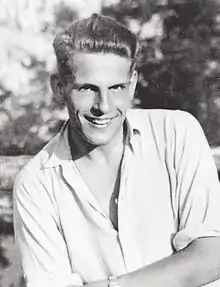
Christoph Ananda Probst (6 November 1919 – 22 February 1943) was a German student of medicine and member of the White Rose (Weiße Rose) resistance group.[1]
Early life
Probst was born in Murnau am Staffelsee. His father, Hermann Probst, was a private scholar and Sanskrit researcher, fostered contacts with artists who were deemed by the Nazis to be "decadent". After his first marriage with Karin Katharina Kleeblatt, Christoph's mother, broke up in 1919, he married Elise Jaffée, who was Jewish.[2] Christoph's sister, Angelika, remembers that her brother was strongly critical of Nazi ideas that violated human dignity.[3]
Probst attended boarding school at Marquartstein and Landheim Schondorf, which was also not conducive to fostering Nazi German ideas, and at 17, he matriculated. After military service, he began his medical studies with great earnestness. Aged 21, he married Herta Dohrn, with whom he had three children: Michael, Vincent and Katja.[4]
White Rose
White Rose was the name of a resistance group in Munich in the time of the Third Reich. The group, founded in June 1942, consisted of students from the Ludwig-Maximilians-University of Munich who distributed leaflets against the Nazis policies.
Christoph Probst came rather late into the White Rose as he did not belong to the same student corps as Hans Scholl, Alexander Schmorell and Willi Graf, and stayed for the most part in the background, as he had to think of his family. Probst belonged, along with the Scholl siblings, Graf and Schmorell to the tightest circle, into which university professor Kurt Huber also came.
The members of White Rose put together, printed and distributed, at the risk of their lives, six leaflets in all. Probst wrote some of the text for the White Rose's leaflet which Hans Scholl was carrying with him when he and his sister Sophie went to the university on 18 February 1943 to distribute leftover copies of the sixth leaflet.[5] They were discovered by a custodian, who delivered them to the Gestapo.[6]
When the Scholl siblings were arrested at the University of Munich, the Gestapo acquired proof against Probst. Before his execution he requested to be and was baptized by a Roman Catholic priest.[5]
On 22 February 1943, Christoph Probst and the Scholls were tried and sentenced together at the Volksgerichtshof by judge Roland Freisler, who was known for often determining sentences even before the trial, and all three were sentenced to death by guillotine. Their sentences were carried out on the very same day at Stadelheim Prison, Munich.[5] He had asked for clemency during interrogation. He also requested a trial for the sake of his wife and three children, who were aged three years, two years and four weeks old. His wife, Herta Probst, was sick with childbed fever at the time. Their grave may be found in the graveyard bordering the execution place, "Am Perlacher Forst".
Legacy
On 3 November 1999, Christoph Probst was included in the martyrology of the Catholic church.[7] At his 100th birthday in 2019 barracks of the Joint Medical Service of the Bundeswehr, north of Munich were named after him.[8]
In film
Christoph Probst was portrayed by Florian Stetter in the film Sophie Scholl: The Final Days (2005).
See also
References
- Michael Probst (2001), "Probst, Christoph Ananda", Neue Deutsche Biographie (in German), 20, Berlin: Duncker & Humblot, pp. 733–734; (full text online)
- "Christoph Probst" (PDF). Archived from the original (PDF) on November 29, 2006. Retrieved 2010-01-21. p 3 (in German)
- Im Schatten der Geschwister Scholl. In: Die Welt, 18 June 2011 (in German)
- Christoph Probst, Gedenkstätte Deutscher Widerstand, gdw-berlin.de
- Christoph Probst Biographie (in German)
- Schmied, Jakub. Gestapo Interrogation Transcripts: Willi Graf, Alexander Schmorell, Hans Scholl, and Sophie Scholl. ZC13267, Volumes 1 – 16. Schmaus. 18 February 1943. E-Document.
- Moll, Helmut (Hrsg. im Auftrag der Deutschen Bischofskonferenz), (2015). Zeugen für Christus. Das deutsche Martyrologium des 20. Jahrhunderts, 6., erweiterte und neu strukturierte Auflage Paderborn u.a., ISBN 978-3-506-78080-5, volume I, pp. 507–509
- Andreas Sachse (8 October 2018). "Einzigartiger Name für Garchinger Kaserne" (in German). Münchner Merkur. Retrieved 18 November 2021.
Bibliography
- Karin Amann, Thomas Ernst et al.: Die Weiße Rose – Gesichter einer Freundschaft. Arti Grafiche fiorin SpA, Mailand. (in German)
- Lilo Fürst-Ramdohr: Freundschaften in der Weißen Rose. Verlag Geschichtswerkstatt Neuhausen, München 1995, ISBN 3-931231-00-3. (in German)
- Jakob Knab: Die innere Vollendung der Person. Christoph Probst. In: Detlef Bald, Jakob Knab (Hrsg.): Die Stärkeren im Geiste. Zum christlichen Widerstand der Weißen Rose. Essen 2012. (in German)
- Christiane Moll (Hrsg.): Alexander Schmorell, Christoph Probst. Gesammelte Briefe. Lukas Verlag, Berlin 2011, ISBN 978-3-86732-065-8. (in German)
- Peter Normann Waage: Es lebe die Freiheit! – Traute Lafrenz und die Weiße Rose. Urachhaus, Stuttgart 2012, ISBN 978-3-8251-7809-3. (in German)
- Inge Scholl: Die Weiße Rose. Fischer Verlag, ISBN 3-596-11802-6. (in German)
- Robert Volkmann, Gernot Eschrich und Peter Schubert: …damit Deutschland weiterlebt. Christoph Probst 1919–1943. (Christoph-Probst-Gymnasium) Gilching 2000, ISBN 3-00-007034-6. (in German)
External links
Authority control  | |
|---|---|
| General | |
| National libraries | |
| Other | |