Aliqoli Mirza Qajar
Aliqoli Mirza Qajar (Persian: علیقلی میرزا قاجار; 7 December 1822 – 14 December 1880) was a Qajar prince and scholar who served as the first Minister of Science in Qajar Iran. He was the forty-seventh son of Fath-Ali Shah (r. 1797–1834), King of Iran.
| Aliqoli Mirza Qajar | |
|---|---|
| Etezad os-Saltaneh | |
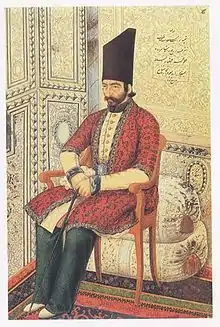
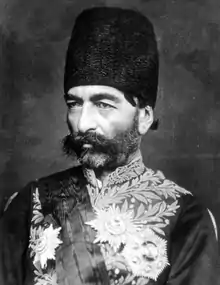 Aliqoli Mirza, late 1870s | |
| Born | 7 December 1822 |
| Died | 14 December 1880 (aged 58) |
| House | Qajar dynasty |
| Father | Fath-Ali Shah Qajar |
| Mother | Gol-Pirhan Khan |
| Religion | Islam |
Fascinated by the ideas of the European Enlightenment, Aliqoli Mirza tried to spread them in Iran. During the heyday of Dar ul-Funun, he was the headmaster of the school and played a key role in its survival. In 1860, Naser al-Din Shah established the Ministry of Science and appointed Ali Mirza as the first Minister of Science. He served for 22 years and held various other positions, such as Minister of Mines and supervisor of education and crafts. He was responsible for building Persia's first telegraph line, the government printing house, and the governorates of Malayer and Tuyserkan.
Aliqoli Mirza wrote several books in various fields, from history to astronomy. His most important scientific work was a Persian-language interpretation of Newton's theories. He donated his personal library to Dar ul-Funun in 1858 and supervised several newspapers, such as the Ruznameh-ye Mellati and Ruznameh-ye elmiya-ye dawlat aliya-ye Iran, the first Persian scholarly journal.
As a writer, Ali Mirza wrote, participated in, or supervised many books during his lifetime: Nameh-ye Daneshvaran, a collection of biographies of Iranian and Muslim scholars; Al-Mutanabin, the history of religions; History of events and accidents in Afghanistan, the first Persian source that recorded the Anglo-Persian War; Exir al-Tavarikh; Fitna of Báb; and his diwan. Aliqoli Mirza died in 1880 and was buried in Ray. Although his conservative proclivities slowed his initiatives, along with a backlash from the clergy, his work was influential in the upcoming Iranian Enlightenment.
Early life
Aliqoli Mirza was born on 7 December 1822, the forty-seventh son of Fath-Ali Shah with his Armenian kanīz from Tbilisi, Gol-Pirhan Khanum.[1] He received the customary princely education and possibly learned some rudiments of modern sciences while serving as an attendant in his father’s court.[1] Ali Mirza was closest to his younger brother, Jalal al-Din Mirza, who later became a scholar as well.[2] His part-time tutor, Mirza Asghar Khan Afshar, had been the ambassador of Iran to France, and taught his knowledge of the Western world to the young prince, introducing him to writers of the Age of Enlightenment such as Rousseau and Voltaire.[3] He was also taught archery, horse riding, and, of his own free will, French.[3][4] In his early puberty, Ali Mirza's conservative nature began to form, as he was put under the teachings of Mirza Nazar Ali Hakim bashi Qazvini, an influential Sufi, who was also his brother-in-law.[5][1]
The young prince also had an interest in Iranian poetry, which grew as he was introduced to Omar Khayyam.[6] Khayyam had an influential role in Aliqoli Mirza's life, as, according to him, he never went to sleep without reading at least one of his poems.[6] Ali Mirza witnessed the rise of Bábism and befriended many Bábists in his youth.[7] One of them was Abdol-Rahim Heravi, who helped him gather a library.[8]
Ali Mirza wrote his first book of historiography, Exir al-Tavarikh, in 1837. He later criticised the work as "excessively influenced by Abd al-Razzak Bey's Ma'ater-e soltaniya".[9]
Career
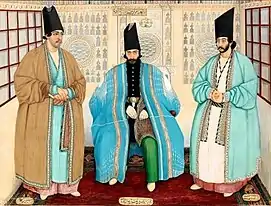
Dispute with Amir Kabir
Aliqoli Mirza entered the politics of Qajar Iran in the early 1840s when his nephew, Mohammad Shah, appointed him regent and later minister to Malek Jahan Khanom.[1][10] He administered her affairs, including the governorate of Khalkhal in Azerbaijan, whose income was earmarked for the expenses of her household.[1] When Mohammad Shah died and the council of the notables – presided by Malek Jahan Khanom – was formed in 1848, Ali Mirza was an adviser and also a candidate for premier, along with Mirza Nazar Ali Khan.[1][10] However, when the new Shah, Naser al-Din, arrived with Mirza Taqi Khan Amir Kabir as the prime minister, the council was disannulled. Mirza Nazar Ali was sent into exile and Malek Jahan’s official role was severely curtailed, but Ali Mirza retained his position as regent.[1] However, his presence on the council made Amir Kabir mistrust him, which persisted until the prime minister's death.[10]
In February 1850, Amir Kabir's agents exposed an alleged Bábi plot to assassinate both the prime minister and the Imam of Friday of Tehran; Ali Mirza was under strong suspicion when the royal guards found Abdol-Rahim Heravi in hiding in his house.[1][11] To absolve himself, he was pressured not only to surrender Abdol-Rahim, but to organise a raid by his servants on a Bábi meeting place in Tehran.[1] However, Ali Mirza mediated for Abdol-Rahim to only be imprisoned; he later took refuge in Ottoman Iraq.[1] Later, to defend himself against the accusations, Ali Mirza wrote Fitna of Báb.[12] Although Ali Mirza may have collaborated with Amir Kabir’s opponents, there is no evidence to support the idea that he was among those who plotted Amir Kabir’s dismissal and later execution. He later even stated that with Amir Kabir's death, "Persia, too, died."[1]
Headmaster of Dar ul-Funun
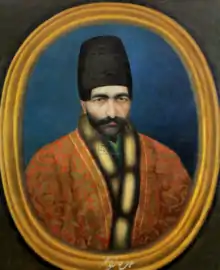
Ali Mirza's first activity at Dar ul-Funun was in 1852 or 1853, when he was appointed as a chief examiner and inspector to Amir Kabir's newly built government college.[1] Although he was no longer in the service of Malek Jahan, he maintained good relations with her to avoid losing his powerful ally. He even married Mah Sultan Khanum, a dancer of the Shah's court, with her blessing.[1] He also received the governorate of Tarom, previously Malek Jahan's estate, along with Malayer and Tuyserkan.[1][13] In 1857, he was bestowed the title Etezad os-Saltaneh (Persian: اعتضادالسلطنه, romanized: Eʿteżād-al-Salṭana, lit. 'Assistant to the Monarchy'[1]), mainly because his book, History of Events and Accidents in Afghanistan, called the Battle of Khushab an honourable failure, since Ali Mirza was one of the witnesses.[10]
Ali Mirza officially became the headmaster of Dar ul-Funun in 1858, and remained until the end of his life.[1] He appointed the young Reza-Qoli Khan Hedayat as the college’s principal and manager of day-to-day affairs, and built a large library, filled with his books and books brought by foreign teachers.[1] Encouraged by Mirza Malkam Khan and the European teachers, in 1858 Ali Mirza proposed to the Shah to build the first government-operated telegraph line in Persia, between Tehran and Tabriz.[1] The telegraph line was engineered by Ahmad Karzbar, one of the teachers of Dar ul-Funun.[10] In July 1859, when the Shah camped in Soltaniyeh, the line was to be used between the capital and Zanjan (specifically the camp), and soon afterwards reached Tabriz.[1] In the same year, Naser al-Din Shah was going to close Dar ul-Funun after the failed assassination, and the accusations being made about Malkam Khan's Faramosh Khaneh. Ali Mirza prevented this by using his influence at the court.[14]
First Minister of Sciences
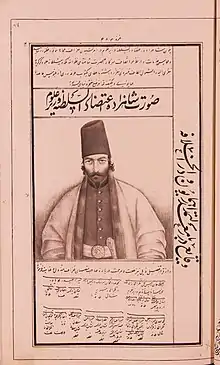
In 1860, Naser al-Din Shah created the Ministry of Sciences and, on the advice of his mother, appointed Ali Mirza as Persia's first Minister of Sciences.[1][15] His decision mainly was on Ali Mirza's mixed outlook of both Modernity and Tradition, since the Shah wanted to prevent a backlash from the clergy.[1] Also, part of it was because Ali Mirza belonged to the Government Consultative Council formed by Naser al-Din Shah in the early 1860s.[1] As the minister, Ali Mirza sent a group of forty-two students to France for further education in scientific, technical, and medical fields, and managed to translate and publish a few French articles in the Ruznameh-ye elmiya-ye dawlat aliya-ye Iran, Persia’s first scholarly journal.[1][16] This group of government-funded students, the only one organized during the reign of Naser al-Din Shah, was selected primarily on the basis of scholarly merit rather than family status.[1] In 1860–1861, Ali Mirza appointed Abu'l-Hasan Khan Ghaffari as the editor of Persia’s official gazette, Ruznameh-ye Dowlat-e Aliyeh-ye Iran, known for its lithographic illustrations.[1] Ali Mirza also had directorship on the Ruznameh-ye Mellati, previously known as Ruznameh-ye mellat-e saniya-ye Iran, a weekly newspaper founded in 1866, under the editorship of Hakim Semnani. In the beginning it was to reflect public opinion, but it soon turned into a literary journal, and published biographical articles on classical and contemporary Persian poets.[1][16]
By the end of the decade, he became supervisor of education and crafts; director of a European-model public hospital in Dar ul-Funun, and director of government newspapers and printing houses in Tehran and in the provinces. He built telegraph lines and modern factories, and he governed his estate, whose income he spent to expand Dar ul-Funun.[1] In 1865–1866, Ali Mirza had another telegraph line built between Bushehr and Jolfa, that connected with British lines and Russian lines in the Caucasus.[17][18] As the telegraph grew speedily in Persia, Naser al-Din Shah in 1876–1877 created the telegraph office, with Aliqoli Khan Mokber al-Dowleh as its minister.[1] Responsibilities for trade, mines, and industries were also assigned to new ministries, although for a time in 1876–1877, Ali Mirza regained control of the mines.[1]
Ali Mirza accompanied the Shah on his trip to Europe in 1873 and was one of the signers of the Reuter concession.[19][1] He launched his most important scholarly contribution, the first modern Persian encyclopedia, Nameh-ye Daneshvaran, by royal decree in 1877.[1]
In 1873, when the Shah organised the Council of Benevolent Reforms on the advice of Moshir al-Dowleh, he recruited Ali Mirza as a member.[20] Ali Mirza at first had hopes of the council becoming a European-style Parliament, but was disappointed to find out that it was an "obsequious propaganda puppet", in his words, and resigned from his position.[16] Afterwards, he joined the opposition of Moshir al-Dowleh, mostly because of his fear of losing his positions.[1]
Downfall and death
By the mid-1870s, Ali Mirza noted the excessive presence of Mohammad Hassan Khan Etemad al-Saltanah at the Shah's side, as he himself was becoming a less important figure for Naser al-Din Shah, especially after the death of Malek Jahan Khanom in 1873.[21] He formed a rivalry with Etemad al-Saltanah when the latter became "the historian of the court" by the Shah's orders.[22] In 1877, most of the occupations held by Ali Mirza in the fields of culture, journalism, and press surveillance were transferred to Etemad al-Saltanah by order of the Shah; Ali Mirza intended to recover the respect of Naser al-Din Shah with Nameh-ye Daneshvaran, and managed to finish the first and also the most extensive volume before his death in 1879.[23][1] After his death, Etemad al-Saltanah became the director of the project and published six volumes before it was abandoned in 1906–1907.[1] The reason for Etemad al-Saltanah's superiority was in his obedient behaviour to the Shah, as he would like to censor every news of the state from Naser al-Din Shah and show others in a negative light to him; whereas Ali Mirza, partly because of the support of Malek Jahan, never hid his opinions.[24]
Aliqoli Mirza died on 14 December 1880, and was buried in Shah Abdol-Azim Shrine.[25] During his life, he had only one wife, with whom he had a son and a daughter.[26] His daughter, Shirin al-Mamalek, founded some of the most prominent literary circles and had an important role in the Triumph of Tehran.[26] His son, Mohammad Hassan Mirza, spent all his belongings after the death of his father, so it was inevitable for him to become a royal servant.[25] During Mozaffar ad-Din Shah's reign, he was bestowed the title Motazed Al-Saltanah and died after 1904.[25]
Literary career
Nameh-ye Daneshvaran
Aliqoli Mirza's most notable work is Nameh-ye Daneshvaran, the first modern Persian encyclopedia: a multi-volume, alphabetically-ordered work, containing biographical articles about Muslim and non-Muslim scholars, poets, physicians, mystics, and others from the rise of Islam to the Qajar period.[1] To gather material, Ali Mirza ordered the Shah's decree to be communicated to the governors of the provinces, so that each could document information about the scholars of their region.[25] He also invited a group of prominent scholars and writers who were willing to collaborate on compiling this work, and after interviewing and examining them, he selected four qualified people and commissioned them to write this book.[25] The selected authors were Sheikh Mohammad Mehdi Shams al-Ulama Abd al-Rabbadi, Mirza Abolfazl Savji, Mullah Abdul Wahab Qazvini, and Mirza Hassan Taleghani.[27] Under the editorship of Sheikh Mohammad, Ali Mirza saw the first volume of the book published during his lifetime. After his death, directorship of the project was handed over to Etemad al-Saltanah, who dismissed Mirza Hassan because of his Bábi beliefs.[1] Etemad al-Saltanah managed to finish six volumes, up to the letter Shin and ending with Shah Nimatullah Wali.[1][28] After that, the project was abandoned in 1906-7, when Etemad al-Saltanah died, and Mozaffar ad-Din Shah was not interested in investing further in it.[1][25]
To write ‘’Nameh-ye Daneshvaran’’, Aliqoli Mirza, in addition to his personal library, used the large library of Aqa seyyed Ali, a merchant of Tehran, with local sources in various dialects, which the authors had to translate as accurately as possible.[29] As explained in the preface, he set up a special framework for compiling biographies, which has some noteworthy points, including the scope of the encyclopedia — the history of all scholars of the Islamic world, in alphabetical order and written in chronological order for each person, explaining difficult terms and words. He inserted a rich selection of each person's works and translated them into Persian if necessary, mentioned anecdotes about them, wrote content in understandable prose for the general public, and avoided any prejudice.[25][1]
Nameh-ye Daneshvaran was used by scholars and writers after its publication, and since then, it has always been used and cited in sources.[30] This work was the first group effort of the new era in Iran, which was created with specific plans, ideas and specific budgets, under the full supervision of the government. A special unit of the Ministry of Science, called the "Nameh-ye Daneshvaran Compilation Assembly", wrote it, and its senior director, Ali Mirza, was familiar with the European teachings of the time.[31]
Al-Mutanabin and Fitna of Báb
Aliqoli Mirza wrote two books on the religions of Iran and Middle East with a history of the claimants of prophecy. One also contains a look at the history of the religions outside of Islam, such as Zoroastranism and Christianity, and also specifically analyses Bábism.[32] Alqoli Mirza modeled it after Biruni's The Remaining Signs of Past Centuries, as he also narrates the history of religions in Iran.[1] Al-Mutanabin begins by narrating the movement of Mazdak, which Ali Mirza knew from Ibn al-Nadim's Al-Fihrist and Ferdowsi's Shahnameh, then analyses his beliefs.[33] He even knew of the once existing Buddhist societies in eastern Iran and Afghanistan.[34] Ali Mirza's notes about the Christians of Iran came from personal correspondence with Armenian patriarchs and visiting Saint Sarkis Cathedral in Tehran.[35] Ali Mirza also describes the history of the claimants of prophethood, and wrote the biographies of several.[1] This account had a short section about Bábism, taken from Mohammad Taqi Sepehr's Tarikh-e Qajariya, and suffers from the same biases and inaccuracies as its source.[1] The last section of the book is a debate between the prince and Karim Khan Kermani, the third leader of Shaykhism. This debate was on whether the rise of Báb was a result of Shaykhism, and thus Bábism could be the heir of Shaykhism, or whether Báb and his followers digressed from the trueness of Shaykh Ahmad's beliefs.[36][25]
Fitna of Báb was written at a time when Ali Mirza was accused of being Bábi and had received threats from the public.[36] The early version of the book was published as an answer to the accusers, and was read in the court in front of Naser al-Din Shah. The Shah, who was pleased with Ali Mirza's work, pardoned him.[37] However, he later rewrote the book into a historical account, containing information on how Bábism was formed and introducing some of its prominent figures, such as Táhirih and Subh-i-Azal. It was also the first Persian source that had an introduction to the Baháʼu'lláh and Baháʼí Faith.[9]
Exir al-Tavarikh
Aliqoli Mirza's first work was the Exir al-Tavarikh, written in two volumes, which he began writing in 1837, when he was 15 years old.[9] The first volume begins with Keyumars, the legendary first king of Persia, and ends with the fall of Zand dynasty.[38][1] The second volume, written in 1842, contains the history of the first Qajar kings and their backgrounds, and continues until the eighth year of the reign of Mohammad Shah. In addition, the scholars, poets, and mystics of the first Qajar era are mentioned in almost every detail.[39][9] In his historiography, Ali Mirza strongly favors some people and sharply opposes others, among these Abol-Qasem Qa'em-Maqam, who portrayed of him at court as an "enemy to the Shah and country" who Ali Mirza described as a "traitor".[40]
Ali Mirza criticised his opinions in the work about most of the people, and described his "one-sided" writing style as traditional historiography.[41] Ali Mirza himself later became the pioneer of so-called Modern Historiography. He described his new technique as: "abandoning the use of obligatory and praising titles and paying attention to the meaning and brevity of the history".[41]
Other works
Ali Mirza wrote various works on different fields, containing history, astronomy and poetry. Falak al-sa'ada written in 1861, an essay on astrology as a pseudo-science, dismissed belief in the auspicious or ominous influences of celestial bodies. His criticism of astrology followed the model of such classical scholars as Biruni, Farabi and Avicenna.[1] From this content, Ali Mirza's progressive thoughts can be considered very unusual for his era; he believed in the originality of human action and in free will.[42] He translated Descartes' Discours de la methode with an introduction of Newtone's works.[1] History of events and accidents in Afghanistan, containing important information about the war with the British Empire, is considered the manifesto of Ali Mirza's Modern Historiography.[41]
Aliqoli Mirza also had many unpublished works, such as his Divan called Javaher-e Manzum under the pen name Fakhri, Arz al-Baladin, a short treatise on geodesy written in 1860, Rasad Khane-y Maragheh on the history of the Maragheh Observatory and Joghrafiay-e Mahal-e Mazandaran on the geography of the Mazandaran province mostly modeled from Yaqut al-Hamawi's Mu'jam Al-Buldan.[1][43]
Legacy
Aliqoli Mira has been described as one of the most Influential intellectual figures of the Qajar era. Having many positions, his motivation was to spread the new modern ideas of the west in Iran and avoid the usual quarrels in the court.[44] He was able to appreciate aspects of modern European technological and educational advances, without losing sight of the achievements of his own culture, and apply them with tact to the Qajar environment.[1] Hajj Sayyah, an intellectual and traveler, with all the criticisms he had of other high-ranking officials of the period took a favourable tone towards him, stating that Ali Mirza was skillful, criticisable, and always ready to listen to suggestions.[45] As an influential prince who could confront the shah’s authority, he could withstand conservative pressure and himself display anti-orthodox views, especially in the areas of modern sciences and the study of religion. He patronised a generation of literary and cultural figures and even harbored non-conformists in his circle.[1]
Ali Mirza's literary circles of 1850s and 1860s included among others the poet Qaani, who with the help of the prince was introduced to the court of the Shah,[44] the essayist Mirza Taher Isfahani and Mirza Ahmad Kashani, a teacher of traditional medicine in Dar ul-Funun.[1] His opponents generally accused him and his literary circle of nocturnal gatherings and hedonistic proclivities, including Ehtesham ol-Saltaneh, who condemned Ali Mirza for womanising and holding drinking competitions.[1][46]
Though by the standards of Amir Kabir’s statesmanship, the achievements of his long tenure as minister were meager, he nevertheless was a realistic conduit for modernisation at a time when external and internal conditions were not favourable for such change.[1] His career traits of cultural nationalism are visible in his patronage of Nameh-ye Daneshvaran, and publication of historical and scientific works about Iran, as well as in his implicit support in the early 1860s for dissident figures, such as his brother Jalal al-Din Mirza and Mirza Malkam Khan's Faramosh Khaneh.[1] His modernist nature reflected upon Dar ul-Funun as it later became one of the sources of the Iranian Enlightenment.[47]
Reference
- Amanat 1998.
- Amiri 2018, p. 12.
- Amiri 2018, p. 13.
- Yaghmai 1967, p. 72.
- Godarzi & Dehghan Nežad 2017, p. 24.
- Amiri 2018, p. 14.
- Amiri 2018, p. 16.
- Amiri 2018, p. 17.
- Godarzi & Dehghan Nežad 2017, p. 28.
- Godarzi & Dehghan Nežad 2017, p. 25.
- Amiri 2018, p. 21.
- Amiri 2018, p. 22.
- Amiri 2018, p. 28.
- Amiri 2018, p. 29–30.
- Amiri 2018, p. 35.
- Godarzi & Dehghan Nežad 2017, p. 26.
- Amiri 2018, p. 38.
- Yaghmai 1967, p. 74.
- Amiri 2018, p. 37.
- Amiri 2018, p. 45.
- Amiri 2018, p. 51.
- Amiri 2018, p. 52.
- Amiri 2018, p. 54.
- Amiri 2018, p. 57.
- Godarzi & Dehghan Nežad 2017, p. 27.
- Amiri 2018, p. 60.
- Baghestani 2009, p. 63.
- Amiri 2018, p. 71.
- Baghestani 2009, p. 64.
- Baghestani 2009, p. 65.
- Baghestani 2009, p. 66.
- Yaghmai 1967, p. 76.
- Amiri 2018, p. 80.
- Amiri 2008, p. 3.
- Yaghmai 1967, p. 77.
- Amiri 2008, p. 4.
- Yaghmai 1967, p. 78.
- Taheri et al. 2020, p. 126.
- Taheri et al. 2020, p. 129.
- Amiri 2008, p. 6.
- Godarzi & Dehghan Nežad 2017, p. 29.
- Amiri 2008, p. 5.
- Amiri 2008, p. 10.
- Godarzi & Dehghan Nežad 2017, p. 39.
- Amiri 2018, p. 123.
- Yaghmai 1967, p. 79.
- Taheri et al. 2020, p. 145.
Bibliography
- Amanat, Abbas (1998). "EʿTEŻĀD- AL- SALṬANA, ʿALĪQOLĪ MĪRZĀ". Encyclopædia Iranica, online edition. New York.
- Amiri, Zahra (2018). Life, works and historiography of Aliqoli Mirza Etezad os-Saltaneh (in Persian). Tehran: Farhang Bonyan Publications. ISBN 9786004671842.
- Amiri, Zahra (2008). "A study of the historiographical methods of Prince Aliqoli Mirza Etezadolsaltaneh". Journal of Historiography (in Persian). 36–37 (36): 1–18.
- Baghestani, Ismael (2009). "massive books of the Qajar era, case study: Name-ye Daneshvaran". Collection of articles of the first national conference on encyclopaedia in Iran. Tehran: Encyclopaedia Foundation of Iran. pp. 62–66. ISBN 9789645515223.
- Godarzi, Masoumeh; Dehghan Nežad, Morteza (Spring 2017). "The Evolution of Historiography in Etezadosaltaneh's Era". Journal of Historical Researches (in Persian). 9 (1): 23–40. doi:10.22108/JHR.2017.21389. OCLC 1244446711.
- Taheri, Mahbobeh; Sarafrazi, Abbas; Khajehmirza, Mahmoud; Asadbeigi, Ardeshir (Autumn 2020). "A Study of the Timeliness of Narrative in the Exir al-Tavarikh Based on Gerard Genet's Theory". Journal of Historical Perspective and Historiography (in Persian). 30 (25): 123–146. doi:10.22051/HPH.2021.32333.1455.
- Yaghmai, Eghbal (1967). "Aliqoli Mirza Etezad Al-Saltanah, First Minister of Sciences". Journal of Education (in Persian). 197–198 (197): 69–80.