Sayf ol-Dowleh
Soltan Mohammad Mirza (Persian: سلطان محمد میرزا; 7 June 1812 – 1899) better known by his honorific title Sayf ol-Dowleh (Persian: سیف الدوله) was an Iranian prince of Qajar dynasty and thirty-ninth son of Fath-Ali Shah, king of Qajar Iran. he was the governor of Isfahan and had a significant contribution in restoring the city which was damaged during the civil war between Zand sovereigns and Agha Mohammad Khan's take over, as he rebuild several of Safavid pavilons and designed his own palace.
| Sayf ol-Dowleh | |
|---|---|
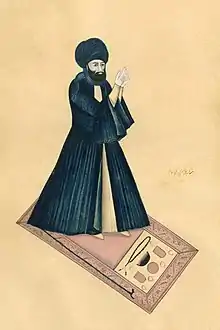
 portrait of Sayf ol-Dowleh, signed by Seyyed Mirza, between circa 1830 and 1835 | |
| Born | 7 June 1812 Tehran |
| Died | 1899 Malayer |
| Burial | Malayer |
| House | Qajar dynasty |
| Father | Fath-Ali Shah |
| Mother | Taj Al-Duleh |
However his later governorate over Isfahan was tied with riots, the plundered roads and his rivalry with Mohammad Bagher Shafti which resulted in calling a Jihad against Sayf ol-Dowleh. although he was able to suppress the Jihad, Isfahan suffered from the damage and with a famine following, was completely on an acute situation. later Mohammad Shah ousted Sayf ol-Dowleh from Government and appointed Khosrow Khan Gorji instead. after that Sayf ol-Dowleh spent his days traveling and died in 1899 in Malayer. he only married once during his lifetime with Bahar Khanum which he divorced later thus left no children of his own. he like many of his sibilings had a taste of poetry and writing as he left several travelogues and a divan.
Early Life
Soltan Mohammad Mirza was born in 7 June 1812, the thirty-ninth son of Fath-Ali Shah. his mother, Taj Al-Duleh was one of the favourite wives of the Shah as he named Sun Throne after her.[1] the Shah appointed a Georgian woman, Maryam to nursing Mohammad Mirza until his Weaning.[2] the young prince from the early childhood was under the tutoring by different tutors, as his brother Iraj Mirza[lower-alpha 1] has wrote, Amanullah Khan Afshar was his Equestrian tutor, Agha Allah Verdi was his Lala and the poet Neshat taught him reading and writing.[2] he was appointed as the governor of Isfahan in 1820 when Fath-Ali Shah during one his Royal tours, demanded an amount of tax from Ali Mohammad Khan, the then governor, he didn't pay which resulted in his removal and appointing the young prince and bestowing him the title of Sayf ol-Dowleh.[3] Yusef Khan-e Gorji was also appointed as his regent.[4]
Until the end of regent, Sayf ol-Dowleh in improving his writing skills, spent in a literary circle which among many figures included the philosopher Zeynalabdin Shirvani, the poet Nezam Vafa Arani and Mohammad Bagher Shafti an influential cleric of the time who became the regent of Sayf ol-Dowleh after death of Yusef Khan.[5] through this circles Sayf ol-Dowleh gained the attention of his other brothers who were active in writing such as Soltan Ahmad Mirza, Farhad Mirza, and Najaf Qoli Mirza.[4] it appears that Sayf ol-Dowleh, gradually surpassed his brothers in field of poetry as he wrote his first poems under the pseudonym "Sultan" at the age of sixteen.[6]
Governor of Isfahan
Administration and contributions
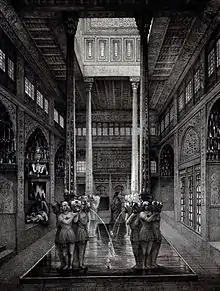
Bagher Shafti in 1830 with the fact that the Shah has a weak authority over the area, decided to take over the government from Sayf ol-Dowleh.[7] in June, Shafti alongside with the city guards marched towards Hasht Behesht where Sayf ol-Dowleh residented.[8] there he involved on a conflict with common people who supported Sayf ol-Dowleh. this conflict resulted in a defeat for him, Shafti took refuge to plenipotentiary of British Empire in Iran, John McNeil, who residented in Isfahan at the time.[9] thus Sayf ol-Dowleh seized the Government and ended his regent time, he later pardoned Shafti mostly because of his influence over the city.[10] after the ensuring of the authority, Sayf ol-Dowleh ordered Hasht Behesht which during the attack was heavily damaged to be reconstructed.[9] he began to reform Isfahan which has been under pressure since the fall of the Safavids, without any progress in the economic and agricultural fields.[11] he built the Tekiyah of the Prince's mother in honour of her childhood nurse, Maryam and restored the Vank Cathedral in order to get a popularity among the Armenian population of the city.[9]
Sayf ol-Dowleh's reforms continued by restoring the barren farms and arresting the outlaw groups who constantly would raid the lands adjacent to the city.[12] he ordered the addition of several fountains and gardens to Char Bagh Palace, where in 1831 he held his wedding with Bahar Khanum daughter of a chief of a Shahsevan tribe.[13] however his marriege didn't last long and ended in a divorce.[13] aside from rebuilding the old pavilions and palaces, Sayf ol-Dowleh also designed the Serpouchideh Palace having Four ponds, a garden, along with a coffeehouse and a zoorkhaneh. this coolection was later destroyed by Mass'oud Mirza Zell-e Soltan the later governor of Isfahan.[13]
However Sayf ol-Dowleh's plans in reforming the city were disrupted by the heavy taxes Fath-Ali Shah demanded which was a result of other Prince-Governors refusing in paying the taxes.[14] Bakhtiari tribes of Isfahan took advantage of the fact and from 1832 started to plunder the roads.[15] they looted merchants properties as wel as the taxes, the fear was so high that Sayf ol-Dowleh's mother, Taj Al-Duleh, canceled her trip to Tehran in middle of the road and settled in one of the villages near Isfahan.[14]
Jihad of Shafti
Towards the later years of his administration, Sayf ol-Dowleh was in a power struggle with Mohammad Bagher Shafti over the city, he wanted to decrease Shafti's influence over Isfahan by empowering the third parties such as Sufis and Christians.[16] in 1833 Mirza Mahdi Zavarei was one of the Sufis who was appointed as the Chancellor. Sayf ol-Dowleh ordered him to teach the Sufi traditions to public and make conflics between Shias and Sufis.[17] Sayf ol-Dowleh also reduced the harsh rules towards the Christians by bringing them into the society, letting them to practice their belives, in this way many of them who originally were from Isfahan returned.[18] this was when Shafti who felt threatened with the presence of Sufis and Christians, ordered a Jihad in 1834 against Sayf ol-Dowleh and his "blasphemous government".[19] Sayf ol-Dowleh requested a large number of troops from Tehran to confront Shafti.[20]
In the same year Fath-Ali Shah on his way to Isfahan died leaving the realm with rebelions from the powerful princes such as Hossein Ali Mirza and a crown prince, Mohammad Mirza who now had to Suppressed the many revolts. Shafti refused to support Mohammad Mirza's Succession as he confirmed Hossein Ali Mirza.[20] knowing that Ali Mirza could not resist against Mohammad Mirza, Sayf ol-Dowleh joined the latter's supporters and confronted Shafti with his troops with flags that states them as "the Iranian army".[21] Shafti on the other hand called for the bandits of Saadatabad led by Abol Ghasem Bolandeh and Baba Qoli Chamelani who looted the north parts of the city.[22] Shafti himself residented in Bidabad claiming himself as the Governor of Isfahan.[23] Sayf ol-Dowleh divided his troops into two parts, one under command of David Saginian which dealt with Chamelani and Blandeh and one under his command to defeat Shafti's forces in Bidabad and arresting him.[22] however on 4 December 1834, an army under command of Shoja-al-Saltana on behest of Ali Mirza, entered Isfahan and occupied the city until a month later when Manouchehr Khan Gorji defeated Shoja al-Saltana and marched towards Fars.[24] as soon as the news of Hossein Ali Mirza's defeat in Shiraz, reached Isfahan, Shafti Surrendered himself and lost all of his belongings.[22]
Removal from Isfahan government
With defeating his uncles, Mohammad Shah established his authority and soon after the rebellious Isfahan also stabilised. but Shafti's revolt had damaged the Isfahan and its near parts as in the same year, the city suffered from Famine.[20] Sayf ol-Dowleh could not do any action as Mohammad Shah marched to Isfahan and in order of retribution, executed many members of the city’s aristocracy and confiscated their property. this also included Sayf ol-Dowleh's mother who was taken hostage for three years in Tehran.[20][25] Sayf ol-Dowleh was ousted from Government of Isfahan when Haji Mirza Aqasi became the grand vizier of the Shah, he for unknown reasons distrusted Sayf ol-Dowleh and persuade Mohammad Shah to dismiss him.[25] thus in 1835, on behest of Mohammad Shah, Khosrow Khan Gorji came to Isfahan, sent Sayf ol-Dowleh to Tehran and became the governor himself.[26]
Later years
From Baghdad to Kairouan
Though at first Mohammad Shah was in distrust with Sayf ol-Dowleh, it seems that he later soften his act with him. Sayf ol-Dowleh was present in Mohammad Shah's campaign of Herat in 1837-1838.[27] He even offered several solutions to the problem of equipment for the artillery, one time he came to Mohammad Shah's camp with a white and very hard stone and ordered that the cannon be made from it; a Large quantities of cannons were made from that stone, which was later used.[28] Sayf ol-Dowleh in aftermath of the war, decided to settle with his mother in Najaf, there he bought lands and began a merchanting career.[27]
in 1848 when Naser al-Din Shah ascended the throne, Sayf ol-Dowleh began his long journey which he has wrote a travelogue for it. his first stop was in Baghdad where he stayed for six years and wrote his most renowned work Sayf al-Resail.[29] in January of 1852, he left Baghdad for Diyarbakır from there to Aleppo, Homs, Alexandria, Kairouan and returned to Iran from Istanbul.[30] throughout the road, he was in correspondence with his nephew, Holaku Mirza, From his letters it can be concluded that he was in a state of melancholic, isolationism and hesitation, he also deeply regretted that he was never able to complete his reforms in Isfahan.[31]
Custodian of Astan Quds Razavi
In his return, Naser al-Din Shah appointed Sayf ol-Dowleh as Ajudan Bashi (adjudant-en-chef) of his court.[31] Sayf ol-Dowleh however abandoned his titles and went for another journey this time throughout Iran.[31] he went for Mashhad, from there to Isfahan, Kashan, and Qazvin where he setteled until 5 March 1872 when Naser al-Din Shah appointed him as the Custodian of Astan Quds Razavi.[32][33] during his time as Custodian, the Sayf ol-Dowleh title often would not be under use instead in the sources he is called by the title of Moin al-Molk.[32]
Sayf ol-Dowleh ordered the expansion of the Imam Reza Shrine library, adding shelves made of pine wood in proportions.[32] His other services include repairing aqueducts, repairing farms and developing housekeeping.[34] Sayf ol-Dowleh's time as Custodian ended in 1874 when he returned to Tehran.[32]
Death
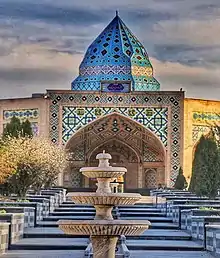
Sayf ol-Dowleh's last journey was with Naser al-Din Shah in his royal tour to Mazandaran in 1876.[32] after that he retired from the government works and setteled in Malayer. Naser al-Din Shah in a sign of gratitude, granted the whole city to him.[35] During his stay in Malayer, Sayf ol-Dowleh, seeing the plight of the people, decided to endow all of Malayer's assets and title deed to the people.[35]
Sayf ol-Dowleh died in 1899 leaving with no children of his own to pay his funeral, however people of Malayer decided to built a tomb for him which today is one of the tourist attractions of the city.[32][36]
Works
Sayf ol-Dowleh's first work in poetry was in his young years which completed years later as his divan.[6] his most renowned work is the mathnavi Sayf al-Resail which he wrote during his time in Baghdad. in Sayf al-Resail, Sayf ol-Dowleh describes Aqasi's hatred of him and Khosrow Khan's oppression in Isfahan then he reaches to his affairs in Baghdad.[37] he also wrote several travelogues about his journeys.[37]
Notes
- not to be confused with Iraj Mirza the poet
References
- Dodangeh 2007, p. 212.
- Masjedi 2002, p. 68.
- Yaghmai 1948, p. 462.
- Masjedi 2002, p. 70.
- Homai 2016, p. 345.
- Yaghmai 1948, p. 463.
- Parsa 2014, p. 29.
- Homai 2016, p. 346.
- Masjedi 2002, p. 71.
- Homai 2016, p. 347.
- Ashrafi 2016, p. 54.
- Homai 2016, p. 350.
- Masjedi 2002, p. 72.
- Masjedi 2002, p. 77.
- Homai 2016, p. 353.
- Parsa 2014, p. 35.
- Masjedi 2002, p. 73.
- Sharghi 1983, p. 142.
- Parsa 2014, p. 36.
- Walcher 2006.
- Homai 2016, p. 355.
- Masjedi 2002, p. 78.
- Parsa 2014, p. 37.
- Hambly 1982.
- Masjedi 2002, p. 80.
- Maeda 2009.
- Masjedi 2002, p. 81.
- Ahangaran 2013, p. 143.
- Ma'ani 1967, p. 50.
- Javidan 2017, p. 169.
- Masjedi 2002, p. 83.
- Masjedi 2002, p. 84.
- Naghdi 2021, p. 453.
- Naghdi 2021, p. 454.
- Chegini 2010, p. 711.
- Chegini 2010, p. 712.
- Masjedi 2002, p. 82.
Bibliography
- Ahangaran, Amir (2013). "An investigation of the reasons for Mohammad Shah Qajar`s defeat in returning the sovereignty of Iran to Herat (1835 – 1839)" (PDF). Journal of Historical research (in Persian) (17): 131–147.
- Ashrafi, Parisa (2016). "Study on the changes in the structure of Isfahan in different historical periods". Journal of Urban Management Studies (in Persian) (3): 45–69.
- Chegini, Mohammad (2010). "Saif al-Dawla endowments in Malayer". Payam Baharestan (in Persian) (7): 708–731.
- Dodangeh, Soghra (2007). "Taj al-Dowleh Isfahani". The Great Islamic Encyclopaedia (in Persian). Tehran. pp. 212–213.
- Hambly, Gavin R. G. (1982). "ḤOSAYN- ʿALĪ MĪRZĀ FARMĀNFARMĀ". Encyclopædia Iranica, online edition. New York.
- Homai, Mahdokht Banu (2016). History of Rulers of Isfahan (in Persian). Isfahan: Institute of Humanities and Cultural Studies. ISBN 9789644264979.
- Javidan, Mina (2017). Tourism and travel in the Qajar period (in Persian). Tehran: Arun Publications. ISBN 9789642319664.
- Naghdi, Reza (2021). History and organization of Astan Quds Razavi in the Qajar era (in Persian). Mashhad: Astan Quds Razavi Islamic Research Foundation. ISBN 9786000604592.
- Ma'ani, Ahmad Golchin (1967). "Haj Mirza Aghasi and Sultan Mohammad Mirza". Yaghma (in Persian) (20): 47–52.
- Maeda, Hirotake (2009). "ḴOSROW KHAN GORJI QĀJĀR". Encyclopædia Iranica, online edition. New York.
- Masjedi, Hossein (Summer 2002). "Sayf ol-Dowleh". Isfahan Journal of Sociology (in Persian) (13): 67–90.
- Parsa, Forough (Autumn 2014). "Seyyed Mohammad Baqir Shafti and interference in government based on the theory of the Deputation of Mujtahids". Historical Inquiries (in Persian) (2): 21–39.
- Sharghi, Masoud (1983). "The situation of two Jewish and Christian minorities in Iran during the Qajar period". Quarterly Journal of History Research (in Persian) (41): 123–160.
- Yaghmai, Habib (Autumn 1948). "Sultan Muhammad Mirza Saif al-Dawlah". Yaghma (in Persian) (10): 462–465.
- Walcher, Heidi (2006). "ISFAHAN viii. QAJAR PERIOD". Encyclopædia Iranica, online edition. New York.