Anarchism in Ukraine
Anarchism in Ukraine has its roots in the democratic and egalitarian organization of the Zaporozhian Cossacks, who inhabited the region up until the 18th century. Philosophical anarchism first emerged from the radical movement during the Ukrainian national revival, finding a literary expression in the works of Mykhailo Drahomanov, who was himself inspired by the libertarian socialism of Pierre-Joseph Proudhon. The spread of populist ideas by the Narodniks also lay the groundwork for the adoption of anarchism by Ukraine's working classes, gaining notable circulation in the Jewish communities of the Pale of Settlement.
| Part of a series on |
| Anarchism |
|---|
 |
|


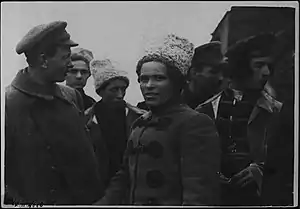
By the outbreak of the 1905 Revolution, a specifically anarchist movement had risen to prominence in Ukraine. The ideas of anarcho-communism, anarcho-syndicalism and individualist anarchism all took root in Ukrainian revolutionary circles, with syndicalism itself developing a notably strong hold in Odessa, while acts of anarchist terrorism by cells such as the Black Banner becoming commonplace. After the revolution was suppressed, Ukrainian anarchism began to reorganize itself, culminating in the outburst following the February Revolution, when Nestor Makhno returned to the country and began to organize among the peasantry.
Ukraine became a stronghold of anarchism during the revolutionary period, acting as a counterweight to Ukrainian nationalism, Russian imperialism and Bolshevism. The Revolutionary Insurrectionary Army of Ukraine (RIAU), led by Makhno, carved out an anarchist Free Territory in the south-east of the country, centered in the former cossack lands of Zaporizhzhia. By 1921, the Ukrainian anarchist movement was defeated by the Bolsheviks, who established the Ukrainian Soviet Socialist Republic in its place.
Anarchism experienced a brief resurgence in Ukraine during the time of the New Economic Policy, but was again defeated following the rise of totalitarianism under the rule of Joseph Stalin. Further expressions of anarchism existed in the breach of Soviet Ukrainian history, before finally reemerging onto the public sphere following the dissolution of the Soviet Union. In the 21st century, the Ukrainian anarchist movement has experienced a resurgence, itself coming into conflict with the rising far-right following Euromaidan.
History
At the western-most point of the Eurasian Steppe, the lands today known as Ukraine came under the control of a number of nomadic societies from the 5th century BCE. First came the Indo-European Scythians and Sarmatians, then the Turkic Khazars, Pechenegs and Cumans, before the migration of Slavs to the region. By the 9th century CE, these Slavs became known as the Rus and had formed a loose federation of principalities, with Kyiv as its center. The Rus were converted to Orthodox Christianity over the following century, before being invaded by the Mongol Empire, which brought about the collapse of Kyivan rule. While ruled by the Golden Horde, the northern states under the rule of Moscow became known as "Russia", while the southern borderlands came to be known as "Ukraine". After the fall of the Horde, Ukraine became a battleground between the competing Polish, Russian and Ottoman Empires,[1] which brought about the development of a distinct Ukrainian culture.[2]

By this time, the Cossacks had emerged from the conflict, establishing themselves along the banks of the Don and Dniepr rivers, where they practiced a form of participatory democracy in popular assemblies (Krugs) and elected their own military leaders (Atamans).[3] While other cossacks would end up pledging their loyalty to one state or another, the Zaporozhian Cossacks in Ukraine were able to maintain their independence.[4] The Zaporozhians were made up of a broad mix of peoples, including those who had fled from serfdom, who as "free Ukrainians" held their own land and were mobilized as part of the Zaporozhian host. The Ukrainian cossacks fought against the Poles, Russians and Ottomans alike, organized into decentralised regiments (polks) and squadrons (sotnias).[5] The Zaporozhian Sich was itself organized along democratic and egalitarian lines, where military and civilian officials were all directly elected for one-year terms and subject to instant recall by the assemblies, while its land was distributed equally among the people.[6]
Dedicated to the preservation of "Cossack freedoms", Stenka Razin led the Don Cossacks in an uprising against the Tsarist autocracy in Russia and later Yemelyan Pugachev led the Ural Cossacks in a peasants' revolt against serfdom, but both of these rebellions were defeated.[4] The Cossack hosts were subsequently dissolved and inducted into the Imperial Russian Army, in which they became loyal soldiers of the Russian Empire, going on to play a vital role in defeating the Napoleonic invasion of 1812 and later becoming the de facto police force in Russia.[7] Likewise, the Zaporozhian Sich was broken up and its people were forced into either serfdom or exile, with Ukraine being brought definitively under Russian imperial rule. Nevertheless, the tradition of the "libertarian-minded warrior-peasants" persisted, setting the groundwork for the libertarian communist movement in Ukraine.[8]
Rising radicalism
Radicalism spread through Ukraine in the wake of the War of 1812, as the rise in calls for abolition of the Tsarist autocracy and serfdom led to the establishment of the Southern Society of the Decembrists in 1821. Ukrainian Decembrists were more radical than their northern counterparts, calling for the overthrow of the monarchy and its replacement with a revolutionary republic.[9] Following the death of Alexander I, the Southern Society in Kyiv staged a revolt against the Russian Empire, but it was suppressed.[10]
Radicalism was raised further during the Ukrainian national revival, as Brotherhoods began to advocate for Ukrainian autonomy and the replacement of the Empire with a pan-Slavic federation organized along liberal democratic lines, with Taras Shevchenko even displaying revolutionary sentiments.[11] The Ukrainian intellectual hromadas, inspired by Russian populism, began to engage with the peasantry - leading to the rise of agrarian socialist tendencies in Ukrainian radical circles.
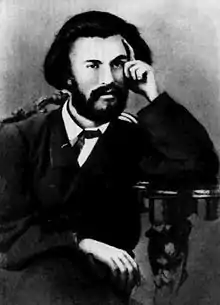
The most prominent of the hromadas was the one in Kyiv, founded in 1859 by populist students of the Lavrovist tendency, who emphasised the education of the peasantry and rejected revolutionary agitation. It was banned by 1863 but renewed its educational activities in 1869, spearheaded by a new generation of students led by Volodymyr Antonovych, Pavlo Chubynsky and Mykhailo Drahomanov.[12] Continuing the democratic-federalist tradition from the Decembrists and the Brotherhoods, Mykhailo Drahomanov blended together elements from liberal democracy, agrarian socialism and Ukrainian nationalism, envisioning the final goal of the democratic-federalist movement to be the achievement of anarchy, as inspired by the works of Pierre-Joseph Proudhon. Having coined the slogan "Cosmopolitanism in the ideas and the ends, nationality in the ground and the forms," Drahomanov rejected separatism due to his philosophical anarchist opposition to nation states. Viewing national liberation as "inseparable from social emancipation", he instead encouraged for the Hromada to concentrate on building a bottom-up form of democracy of small communities organized on a federative basis.[13]
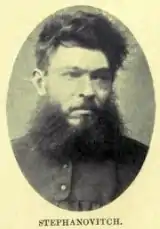
In 1874, the Narodniks' "Going to the People" campaign culminated in a number of Ukrainian revolutionary anarchists (buntars), led by Yakov Stefanovich, organizing a peasant revolt in Chyhyryn, before being suppressed by Russian authorities.[14] Alexander II subsequently issued the Ems Ukaz which banned the use of the Ukrainian language, resulting in the repression of the hromadas and Drahomanov's flight into exile in Geneva,[12] where he established the Geneva Circle, the first Ukrainian socialist organisation. Drahomanov's socialist tendencies brought him into conflict with more moderate members of the Hromada, as well as the "chauvinist" and "dictatorial" Russian revolutionaries, leaving him isolated from many of his contemporaries by 1886.[13] In Galicia, which Drahomanov had placed at the center of the Ukrainian national struggle due to its constitutionalism, Drahomanov's disciple Ivan Franko found himself persecuted by the Austrian authorities and ostracised by local religious conservatives, due to his staunch anti-clericalism.[13]
Nonetheless, in 1890 Franko was able to found the Ukrainian Radical Party (URP), which engaged in a number of activities including the convocation of popular assemblies, the establishment of cooperatives and the education of the peasantry. In 1895, members of the URP were elected to the Galician Diet and the Austrian parliament, by which point its party congresses were beginning to call for Ukrainian independence and endorsed a number of strikes by agricultural workers. Drahomanov's death that same year accelerated a split in the organization, between orthodox radicals that stayed loyal to Drahomanov's platform, younger social democrats that had gravitated towards Marxism and nationalists who were no longer comfortable with the party's socialist line. By losing the latter two factions, the URP took on a definitively agrarian socialist platform and grew to become the second-largest of the Ukrainian political parties in Galicia.[15]
1905 Revolution
Ukrainian Jews in the Pale of Settlement had been extended a number of rights during the reign of Alexander II, but following his assassination by People's Will, a wave of pogroms broke out and the new government of Alexander III implemented the May Laws, which persecuted Jews living in the Pale.[16] In 1903, a strike in Odessa rapidly escalated into a nationwide Ukrainian general strike, with the heavy industry centers of Kyiv, Kharkiv, Mykolaiv and Ekaterinoslav all experiencing mass industrial action.[17] The Minister of Interior Vyacheslav von Plehve responded to the strike wave by propagating a number of anti-semitic and anti-communist conspiracy theories about the labour movement, which resulted in another wave of pogroms breaking out in Ukraine.[18] The living conditions of Pale nourished the growth of the Ukrainian anarchist movement, which grew particularly strong in Jewish towns, where workers' circles began to educate themselves on a number of radical ideas. Dissatisfied with the existing socialist parties, activists of the General Jewish Labour Bund, Socialist Revolutionary Party and Revolutionary Ukrainian Party all deserted party politics for anarchism.[19] The Bread and Freedom group in London organized the distribution of anarchist literature, including the Yiddish language journals Arbeter Fraynd and Germinal, throughout much of the Pale, reaching as far as the anarchist groups in Odessa and Nizhyn.[20]
Popular discontent with the Tsarist autocracy eventually culminated in the 1905 Revolution, during which much of the country rebelled against the Russian Empire, with a general strike in October successfully securing civil liberties and the constitution of the State Duma. But workers and peasants throughout the country, having not had any of their economic demands met, continued to openly revolt against the government.[21] During the suppression of the revolution in December, workers' uprisings broke out in Odessa, Kharkiv and Ekaterinoslav, but they were unsuccessful and the revolution was brought to an end.[22]
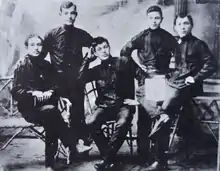
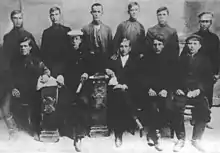
Juda Grossman described the rise of anarchist groups in the wake of the revolution as though they "sprang up like mushrooms after a rain".[23] Jewish anarchist groups sprouted up throughout many of the small towns in the Pale, while in the cities of Ukraine, the anarchist movement that had first appeared in Odessa and Ekaterinoslav had spread to Kyiv and Kharkiv.[24] In Huliaipole, the Union of Poor Peasants was formed to carry out expropriations against the rich, with a young Nestor Makhno joining the group and later being arrested and imprisoned for killing a police officer.[25] The Black Banner, a terrorist organization inspired by the insurrectionary anarchism of Mikhail Bakunin, grew to include a large membership of Russians, Ukrainians and Jews.[26] In Ekaterinoslav, Odessa and Sevastopol, the Black banner organized a number of detachments that carried out bombings on buildings, murdered and robbed rich people, and fought with the police in the streets. Even the merchant vessels that docked in Odessa's port became the target of expropriations.[27] At his trial, a member of the Odessa branch of the Black Banner explained their method of "motiveless terror":[28]
We recognize isolated expropriations only to acquire money for our revolutionary deeds. If we get the money, we do not kill the person we are expropriating. But this does not mean that he, the property owner, has bought us off. No! We will find him in the various cafes, restaurants, theaters, balls, concerts, and the like. Death to the bourgeois! Always, wherever he may be, he will be overtaken by an anarchist's bomb or bullet.
Although the terrorists within the Black Banner had been energised by their attacks in Odessa, a dissenting Communard group had also emerged that called for the organization of a mass uprising, rather than individual acts of propaganda of the deed.[29] Anarchists in major cities began to shift their activities towards the distribution of propaganda, with the Kyiv Group of Anarchist-Communists pursuing a more moderate course, inspired by the works of Peter Kropotkin.[30] Inspired by their Narodnik predecessors, anarcho-communists from Odessa, Ekaterinoslav, Kyiv and Chernihiv "went to the people", distributing radical propaganda among the peasantry.[31] Their leaflet How the Peasants Succeed Without Authority depicted a communal village that lived without government and distributed its resources "from each according to their ability, to each according to their needs".[32] Members of Bread and Freedom denounced the "robber bands" of Odessa, comparing them to the Italian mafia and claiming that their terror campaign demoralized and discredited the movement. Nevertheless, the anarcho-communists continued to advocate for propaganda of the deed, even approving "defensive terror" against the police and Black Hundreds, with a report from Odessa printed in Bread and Freedom declaring that "only the enemies of the people can be enemies of terror!"[33]
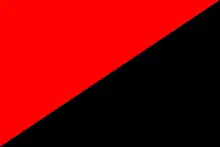
Alongside anarcho-communism, Ukrainian cities also saw the emergence of other anarchist tendencies, such as anarcho-syndicalism in Odessa and individualist anarchism in Kyiv.[34] The anarcho-syndicalists of Odessa declared themselves in opposition to the terrorist tactics of the time, having experienced a number of them first-hand, instead advocating for the construction of labor unions capable of radical industrial action.[35] However, the Odessa Anarcho-Syndicalists soon found themselves establishing their own "battle detachments" to carry out expropriations, using the stolen money to buy more weapons and fund the printing and distribution of their literature, even going on to establish a bomb laboratory.[36] The anarcho-syndicalist leader Daniil Novomirskii justified this use of terrorism as having acted to benefit the movement "as a whole", which he distinguished from the unplanned "motiveless terror" of the Nechayevshchina.[37] The Odessa Anarcho-Syndicalists had adopted the French General Confederation of Labour (CGT) as a model for anarcho-syndicalism in Ukraine, centring trade unions as the means for class struggle, winning short-term gains while building towards a social revolution, in which the unions could themselves seize the means of production.[38] Like their western counterparts, the Odessa syndicalists rejected vanguardism and tasked themselves with combatting socialist entryism in the unions, going on to form the Revolutionary All-Russian Union of Labor as their own version of the industrial union. The Union quickly spread throughout Ukraine, at one point claiming 5,000 members, creating a union presence particularly among the factory and dock workers of Odessa and the bakers and tailors of Ekaterinoslav. On the rise of the Ukrainian anarcho-syndicalist movement, Juda Grossman remarked: "I am convinced that God, if he existed, must be a syndicalist—otherwise Novomirskii would not have enjoyed such great success."[39]
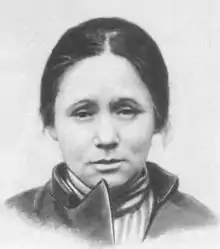
The anti-intellectualism of the Polish revolutionary Jan Wacław Machajski, inspired by Bakunin's insurrectionary anarchism,[40] also made an impression among Ukrainian anarchists, with the Black Banner members Olga Taratuta and Vladimir Striga organizing alongside Makhaevists in a secret society known as the Intransigents.[41] Even the Odessa Anarcho-Syndicalists were influenced by Machajski's anti-intellectualism, with there denounciations of social democracy being rooted in their opposition to the creation of a new intellectual elite, declaring that "the liberation of the workers must be the task of the working class itself".[42]
Despite the best efforts of the syndicalists, their extremist counterparts attracted far more attention from the press and the government.[43] Pyotr Stolypin instituted pacification measures against the terrorist movement, placing the Russian Empire under a state of emergency and unleashing a wave of punishment against the Black Banner and other radical organisations, with a number of militants committing suicide after their capture.[44] The concept of martyrdom entered the anarchist zeitgeist as hundreds of young anarchists were executed in the repression, including the Ukrainian individualist Matrena Prisiazhniuk, who was sentenced to death for raiding a sugar factory, murdering a priest and attempting to murder a police officer. Following her sentence, she remarked:[45]
I am an Anarchist-Individualist [...] My ideal is the free development of the individual personality in the broadest sense of the word, and the overthrow of slavery in all its forms. [...] Proudly and bravely we shall mount the scaffold, casting a look of defiance at you. Our death, like a hot flame, will ignite many hearts. We are dying as victors. Forward, then! Our death is our triumph!
Contempt of court was common among anarchist defendants, with one terrorist from Odessa, Lev Aleshker, attacking the judges: "You yourselves should be sitting on the bench of the accused! [...] Down with all of you! Villainous hangmen! Long live anarchy!" In Aleshker's last testament, he predicted the coming of an anarchist future:[46]
Slavery, poverty, weakness, and ignorance—the eternal fetters of man—will be broken. Man will be at the center of nature. The earth and its products will serve everyone dutifully. Weapons will cease to be a measure of strength and gold a measure of wealth; the strong will be those who are bold and daring in the conquest of nature, and riches will be the things that are useful. Such a world is called "Anarchy." It will have no castles, no place for masters and slaves. Life will be open to all. Everyone will take what he needs—this is the anarchist ideal. And when it comes about, men will live wisely and well. The masses must take part in the construction of this paradise on earth.
Five young anarchists were brought to trial for the bombing of the Cafe Libman in Odessa, all of them being sentenced to the death penalty. One of the defendants, Moisei Mets, denied any criminal guilt while also confessing to the bombing, declaring to the court that they demanded nothing less than "the final annihilation of eternal slavery and exploitation". Before his execution, Mets declared: "Death and destruction to the whole bourgeois order! Hail the revolutionary class struggle of the oppressed! Long live anarchism and communism!"[47]
In Odessa alone, 167 anarchists were tried in the wake of the revolution, including 12 anarcho-syndicalists, 94 members of the Black Banner, 51 sympathisers, 5 members of the SR Combat Organization and 5 members of the Anarchist Red Cross. They were mostly young people of mixed Russian, Ukrainian and Jewish backgrounds, of whom 28 received the death penalty and 5 escaped prison.[48] One of those that escaped was Olga Taratuta, who fled to Geneva and joined the buntars before returning to Ekaterinoslav and joining an anarcho-communist "battle detachment", which saw her arrested again and this time sentenced to hard labor.[49] Vladimir Ushakov had also fled capture in Saint Petersburg, hiding out in Lviv before joining the Ekaterinoslav battle detachment and going on to expropriate a bank in Yalta. He was caught in the act and taken to prison in Sevastopol, where he committed suicide during a failed escape attempt.[50] The leaders of the anarcho-syndicalist movement in Odessa and the anarcho-communist movement in Kyiv were all sentenced to long terms of hard labor.[51]
The mass imprisonment of anarchist agitators affected each of them differently, with some taking the time to educate themselves and write of their experiences.[52] In the Butyrka prison, Nestor Makhno met Peter Arshinov, who educated the young peasant on the anarcho-communist theories of Bakunin and Kropotkin, up until their release following the February Revolution.[25] Makhno subsequently returned to Ukraine, where he began organizing an agricultural workers' union and was later elected chairman of the Huliaipole Soviet, from which he ordered the armed expropriation of land by the peasantry.[53]
During World War I, the URP took part in the establishment of the Ukrainian Sich Riflemen and, following the war, collaborated in the constitution of the West Ukrainian People's Republic, with a number of its members subsequently joining the Central Council of the Ukrainian People's Republic.[15] The federalist orientation of the Central Council was inspired in part by Drahomanov platform, and Drahomanov's influence further inspired the Socialist-Federalists and the Socialist-Revolutionaries.[13]
Makhnovist Revolution
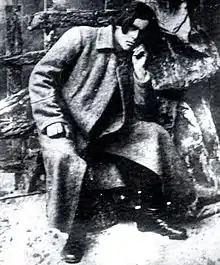
Makhno became active again after the Russian Revolution in the raion of Huliaipole in a peasant region. Anarchist communes formed across south-eastern Ukraine, many of them productive enough to exchange wheat for textiles with workers in Moscow. Makhno at one time fought with Bolsheviks against the White Army and, because of his refusal to subordinate his army under Bolshevik command, he was denounced as a bandit, betrayed, and ultimately defeated by the Bolsheviks. For a duration of three years he formed the Free Territory with his (mostly peasant) Revolutionary Insurrectionary Army of Ukraine. The Free Territory existed only until June 1919, but in that time, communities operated successfully on the economic theories of the anarchist Peter Kropotkin and educational principles of Francisco Ferrer.
Volin was a prolific writer and anarchist intellectual who played an important part in the organization and leadership of Nabat. The Nabat Confederation of Anarchist Organizations,[54] better known simply as Nabat (Набат), was an anarchist organization that came to prominence in Ukraine during the years 1918 to 1920. The area where it held the most influence is sometimes referred to as the Free Territory, though Nabat had branches in all of the major cities in southern Ukraine.[55] Volin was charged with writing a platform for Nabat that could be agreeable to all the major branches of anarchism, most importantly anarcho-syndicalism, collectivist anarchism, anarcho-communism, and individualist anarchism. The uniform platform for Nabat was never truly decided upon, but Volin used what he had written and the inspiration from Nabat to create his Anarchist Synthesis.[56] The proposed platform for Nabat included the following sentence which anticipated synthesis anarchism: "These three elements (syndicalism, communism and individualism) are three aspects of a single process, the building, of the organization of the working class (syndicalism), of the anarcho-communist society which is nothing more than the material base necessary for the complete fullness of the free individual."[57]
Makhno tried to defend the Free Territory against further attacks by the Bolshevik and White armies, but lost ground throughout 1920 and 1921. By the end of 1921, the anarchist groups in Ukraine had been arrested or dispersed. Makhno fled to Romania, then Poland, and finally Paris, where he wrote his memoirs and proposed organizational tactics based on what he had learned in Ukraine.
Following the defeat of the Makhnovist movement and the establishment of the Ukrainian Soviet Socialist Republic, within the Soviet Union, Ukraine was brought definitively under Communist Party rule. Any remaining remnants of anarchism in Ukraine were suppressed, many anarchists being imprisoned in the Gulag, and the New Economic Policy was implemented, transforming the Ukrainian SSR into a state-capitalist economy.[58] Following the Republic's dissolution, many Ukrainian political exiles experienced a sharp turn to right-wing politics, with a number even blaming Drahomanov for the Ukrainian defeat in the war of independence.[13] The Ukrainian Radical Party (URP) nevertheless maintained its commitment to both socialism and Ukrainian independence, in opposition to the right-wing nationalists and the Bolsheviks respectively. It became a member of the Labour and Socialist International and continued electoral activities in the new Republic of Poland, gaining 20,000 members by 1934.[15]
Resurgence
Following the end of the Povolzhye famine, there was widespread disillusionment with the New Economic Policy (NEP) due to rising levels of unemployment. Furthermore, the death of Lenin, the dissolution of the once-powerful Socialist-Revolutionary Party and the purging of leading academics and civil servants had opened a power vacuum in Ukrainian politics. During this time, there was a noted easing of repressive measures against the anarchist movement, leading to a resurgence of the Ukrainian anarchist movement, as a new generation of youths became attracted to the philosophy.[59]
With the Bolsheviks' attention turned to its ongoing internal conflict between Stalinism and Trotskyism, anarchists declared their neutrality in the dispute, while expressing some sympathy for the Group of Democratic Centralism, which had numerous members in Ukraine.[60] Anarchists began to openly criticise the Bolshevik government for its implementation of state capitalism, repression of libertarian socialists and destruction of soviet democracy. Letters from the USSR to exiled Ukrainian anarchists noted a revival in activity, with anarchism gaining sympathy particularly among the All-Union Leninist Young Communist League. Anarchists in Ukraine made contacts with organizations in Russia, with the intention of unifying the renewed movement and eventually holding an "All-Union Congress of Anarchists".[61] The Cheka likewise reported a surge in anarchist activity, particularly among the well-organized anarcho-syndicalists, which had received support from the International Workers' Association (IWA).[62]
There was also an upsurge in violent activity, with anarchists being reported to have gassed a theatre pit in Kharkiv, agitated against taxation in rural Ukrainian villages and attempted to carry out expropriations in Poltava. In Odessa, one armed detachment of about 30 members carried out attacks on infrastructure and local officials, comitting a number of expropriations throughout 1923.[63] The State Political Directorate's usual repression tactics proved ineffective against the anarchists, who engaged in both legal and clandestine activities, recruiting former Communists and organizing strike actions. State-run factories in cities throughout Ukraine were hit by strikes, even approaching the levels of a general strike in Donbas. Anarcho-syndicalists also organized the unemployed, leading a series of unemployment demonstrations in Odessa that culminated in the protestors storming the headquarters of the local government. The repression that followed led to the arrest of 75 anarchists, 16 of whom resisted arrest with arms, and the formal dissolution of the Odessan Anarchist Federation, which coontinued its organizing activities clandestinely.[64] By the mid-1920s, Odessa had become a refuge for foreign anarchists fleeing oppression in Romania and Bulgaria.[65] Italian and French anarchists even emigrated to Ukraine, where they established an agricultural commune near Yalta.[66]
By 1924, there were anarchist groups in at least 28 Ukrainian cities. In the Odessa alone, there were three anarchist workers' circles, a youth group, a published journal and a library, with the police knowing of hundreds of anarchists in the city. Anarchists also organized within independent groups that were disconnected from the anarchist movement, such as Esperanto clubs and masonic bodies, which offered them a clandestine platform for their activities.[67] In Kharkiv, anarchists re-established the Nabat Confederation of Anarchist Organizations, organized strike actions, published propaganda and developed contact with anarchists throughout Ukraine and Russia. In April 1924, they were subject to a wave of raids and arrests, but continued their underground organizing work, even planning an All-Union Anarchist Congress before another wave of arrests forced leading Kharkiv anarchists into exile.[68] In Kyiv, anarcho-syndicallists made attempts to unify the Ukrainian anarchist movement, but the arrest waves continued, resulting in the suppression of anarchist youth groups and a dissident construction workers' union, as well as a number of clandestine groups in various other cities of Ukraine.[69] Despite a subsequent arrest wave in 1925, the anarchist movement remained strong in Poltava, where young people continued to adopt anarchism even as more of them were being arrested, imprisoned and exiled.[70]
The growth of anarchist tendencies among Ukrainian students continued, with a number of youth groups sprouting up in cities throughout Ukraine, leading Communist Party officials to officially call for the repression of the youth anarchist movement.[71] Soviet authorities were troubled by the growth of the anarchist underground and the leading role of anarcho-syndicalists in the workers' movement, as a number of "free trade unions" had organized strike actions, including among the miners in Bakhmut. The police further identified anarchist cells known as "fivers", which agitated within labor collectives, the student and unemployed workers' movements, and even in the Red Army itself.[72] Soviet authorities noted that underground anarchist groups "were often composed of from 25 to 60 persons or more", with some even developing into mass movements among the Ukrainian working classes. Repressive actions against the movement in Kyiv failed to have lasting effects, as anarchist activity continued and even surged afterwards, the authorities noting anarchist attempts to unite into a single Ukrainian organization.[66]
Repression largely resulted in the anarchist movement being pushed further away from legality and into clandestinity, as punitive measures were focused mostly on a few dozen prominent members of the anarchist old guard, with the secret police unable to infiltrate the clandestine "wildcat" groups. Imagined cells of underground anarchists engaged in acts of terrorism and expropriation presented the biggest threat to the Soviet government, which feared the onset of an anarchist-led mass uprising, despite Ukrainian anarchists of the time largely being either unable or unwilling to commit to terrorist tactics.[73] Nevertheless, the inclination of some exiled anarchists in Poland towards carrying out a terror campaign in Russia provided the authorities with evidence of an alleged conspiracy in Ukraine, which allowed the police to intensify repression against the anarchist movement, going on to use the publishing house of Golos Truda as a way of baiting anarchists out of hiding.[74] Following the rise of Joseph Stalin to power and the implementation of totalitarianism, punitive action against dissent was intensified, leading to the complete suppression of the Ukrainian anarchist movement by 1929.[75]
Soviet rule
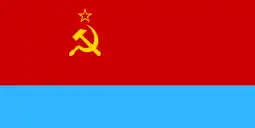
Political repression in Ukraine intensified under the totalitarian rule of Joseph Stalin. The policies of collectivization and dekulakization, as part of the first five-year plan, led to a famine in Ukraine known colloquially as the Holodomor - killing millions of people due to starvation.[76] This was followed by a repressive campaign against the Ukrainian intelligentsia, culminating in the Great Purge of 1937-1938.
During World War II, the former Makhnovist Osip Tsebriy formed the Green Guard to wage guerilla warfare against the Ukrainian SSR, the Reichskommissariat Ukraine and the ultra-nationalist Ukrainian Insurgent Army, briefly reinvigorating the anarchist movement among the Ukrainian peasantry in Kyiv. But it was defeated in 1943 by the Nazis and many of its members were forced into concentration camps.[77] Nazi rule over Ukraine was eventually defeated by Soviet partisans, who restored Soviet rule and began a period of reconstruction in the country. Following the war, the URP formed part of the Ukrainian government in exile and joined together with other left-wing groups to form the Ukrainian Socialist Party in 1950.[15]
After the death of Stalin, the Khrushchev Thaw brought with it a period of De-Stalinization, which allowed the open criticism of Stalin's policies.[78] Many Ukrainian communists particularly criticized the Stalinist policy of Russification, giving way instead to a period of Ukrainization.[79] During the Stalinist period, Mykhailo Drahomanov had been denounced as a "petite bourgeois liberal" and a "Ukrainian nationalist", but following the Thaw, Ukrainian intellectuals began to rediscover Drahomanov's work, making sure to downplay the elements of his theory that didn't conform to Soviet political orthodoxy.[13] However, this progress was reversed under the Brezhnev administration, which advocated for a return to Soviet nationalism - continuing the halted Russification of Ukraine.[80] Drahomanov studies also underwent censorship during the Era of Stagnation but resurfaced once again during the 1980s, when students began to develop his theory into an alternative form of socialism to the prevailing Marxism-Leninism, growing substantially in scale.[13] The political shift in Ukraine, combined with the changes brought by glasnost and Perestroika, saw the country's first democratic elections, which culminated with the Declaration of Independence of Ukraine.[81]
Independent Ukraine
The Ukrainian anarchist movement, which had reformed underground in the 1970s and grew substantially during the Revolutions of 1989, finally re-emerged publicly in the newly independent Ukraine.[82] In 1994, the Revolutionary Confederation of Anarcho-Syndicalists (RKAS) was established in Ukraine, gaining 2,000 members by 2000.[82][83] The RKAS coordinated trade unions, formed "Black Guard" defense units and established worker cooperatives around the country.[82]


In 2011, libertarian Marxist and anarchist members of the Direct Action students' union established the Autonomous Workers' Union (ACT), with local branches in Kyiv and Kharkiv, among other cities. When the Maidan protests swept through Ukraine, the two unions participated in the protests, even taking a prominent role in Kharkiv. However, due to the large presence of far-right and Ukrainian nationalist elements within the protest movement[84] and the lack of coordination of left-wing protestors, anarchists were unable to make their ideas a notable part of the broad platform of the protests.[82] Some anarchists in south-eastern Ukraine came into conflict with the Anti-Maidan movement, largely consisting of Russian nationalists and Communists, after a Maidan protest was attacked.[85]
The escalation of the conflict and the Russian invasion of Ukraine led to the ongoing War in Donbas, in which the Ukrainian state (with far-right paramilitary support) fought against the forces of the Russian state and pro-Russian separatist forces. Many anarchists were caught in the middle of the conflict, even leading to the dissolution of the Donbas-based Revolutionary Confederation of Anarcho-Syndicalists, which was forced to continue its operations illegally and underground.[82]
Following this period of renewed conflict, in 2015 a Ukrainian branch of Revolutionary Action was established, organizing around the principles of solidarity and direct action.[86] The organization has held demonstrations outside the Belarusian embassy,[87][88] organized militant anarchist training camps on the outskirts of Kyiv[89] and have claimed responsibility for attacks on neo-Nazis.[90][91]
On October 27, 2019, insurrectionary anarchists carried out a bomb attack against a mobile communications tower, in the Proletarskyi District in Donetsk. It was reportedly done to draw attention to the torture being performed by the state security forces of the Donetsk People's Republic.[92]
See also
References
- Skirda 2004, p. 8.
- Skirda 2004, pp. 8–9.
- Skirda 2004, pp. 12–13.
- Skirda 2004, p. 13.
- Skirda 2004, p. 15.
- Skirda 2004, pp. 15–16.
- Skirda 2004, pp. 13–14.
- Skirda 2004, p. 16.
- Yarmolinsky 2014, pp. 20–25.
- Yarmolinsky 2014, pp. 44–49.
- Koshelivets, Ivan (2020). "Cyril and Methodius Brotherhood". Encyclopedia of Ukraine. Edmonton: Canadian Institute of Ukrainian Studies. OCLC 51610936. Retrieved 14 December 2021.
- Zhukovsky, Arkadii (2015) [1989]. "Hromada of Kyiv". Encyclopedia of Ukraine. Edmonton: Canadian Institute of Ukrainian Studies. ISBN 9781442632813. OCLC 918591356. Retrieved 15 December 2021.
- Rudnytsky, Ivan Lysiak. "Drahomanov, Mykhailo". Encyclopedia of Ukraine. Edmonton: Canadian Institute of Ukrainian Studies. ISBN 9780802034168. OCLC 724265856. Retrieved 15 December 2021.
- Yarmolinsky 2014, pp. 198–201.
- Himka, John-Paul; Rudnytsky, Ivan Lysiak (1993). "Ukrainian Radical party". Encyclopedia of Ukraine. 5. Toronto: University of Toronto. ISBN 9780802039958. OCLC 499306441.
- Avrich 1971, pp. 15–16.
- Avrich 1971, p. 12.
- Avrich 1971, pp. 16–17.
- Avrich 1971, pp. 17–18.
- Avrich 1971, pp. 39–40.
- Avrich 1971, pp. 40–42.
- Avrich 1971, p. 42.
- Avrich 1971, pp. 42–43.
- Avrich 1971, p. 43.
- Avrich 1971, p. 209.
- Avrich 1971, p. 44.
- Avrich 1971, pp. 47–48.
- Avrich 1971, p. 48.
- Avrich 1971, pp. 48–49.
- Avrich 1971, pp. 54–55.
- Avrich 1971, p. 57.
- Avrich 1971, pp. 57–58.
- Avrich 1971, p. 60.
- Avrich 1971, p. 56.
- Avrich 1971, pp. 61–62.
- Avrich 1971, p. 62.
- Avrich 1971, pp. 62–63.
- Avrich 1971, pp. 77–78.
- Avrich 1971, p. 78.
- Avrich 1971, pp. 102–105.
- Avrich 1971, pp. 105–106.
- Avrich 1971, pp. 110–112.
- Avrich 1971, pp. 63–64.
- Avrich 1971, pp. 64–65.
- Avrich 1971, pp. 65–67.
- Avrich 1971, p. 67.
- Avrich 1971, pp. 67–68.
- Avrich 1971, p. 68.
- Avrich 1971, p. 69.
- Avrich 1971, p. 70.
- Avrich 1971, pp. 70–71.
- Avrich 1971, pp. 112–113.
- Avrich 1971, pp. 209–210.
- Avrich 1971, p. 204.
- Avrich, Paul (July 1968). "Russian Anarchism and the Civil War". The Russian Review. 27 (3): 296–306. doi:10.2307/127258. JSTOR 127258.
- Guérin, Daniel (2005). No Gods, No Masters: An Anthology of Anarchism. Paul Sharkey. AK Press.
- "Estos tres elementos (el sindicalismo, el comunismo, y el individualismo) son tres aspectos de un único y mismo proceso la construcción, por el método de la organización de clase de los trabajadores (el sindicalismo), de la sociedad anarcocomunista que no es más que la base material necesaria a la plenitud completa del individuo libre."Primera Conferencia de las Organizaciones Anarquistas de Ukrania "Nabat"
- Savchenko 2017, pp. 173–186.
- Savchenko 2017, p. 174.
- Savchenko 2017, pp. 174–175.
- Savchenko 2017, p. 175.
- Savchenko 2017, pp. 175–176.
- Savchenko 2017, p. 176.
- Savchenko 2017, pp. 176–177.
- Savchenko 2017, pp. 180–181.
- Savchenko 2017, p. 181.
- Savchenko 2017, p. 177.
- Savchenko 2017, pp. 177–178.
- Savchenko 2017, p. 178.
- Savchenko 2017, pp. 178–179.
- Savchenko 2017, p. 179.
- Savchenko 2017, p. 180.
- Savchenko 2017, p. 182.
- Savchenko 2017, p. 183.
- Savchenko 2017, p. 184.
- "The famine of 1932–33". Encyclopædia Britannica online. Archived from the original on 23 November 2015. Retrieved 2 November 2015.
The Great Famine (Holodomor) of 1932–33 – a man-made demographic catastrophe unprecedented in peacetime. Of the estimated six to eight million people who died in the Soviet Union, about four to five million were Ukrainians ... Its deliberate nature is underscored by the fact that no physical basis for famine existed in Ukraine ... Soviet authorities set requisition quotas for Ukraine at an impossibly high level. Brigades of special agents were dispatched to Ukraine to assist in procurement, and homes were routinely searched and foodstuffs confiscated ... The rural population was left with insufficient food to feed itself.
- Damier, Vadim (November 1998). "Fate of the Makhnovist". Прямое действие. Translated by Riltok. Confederation of Revolutionary Anarcho-Syndicalists. Retrieved 12 May 2021.
- Magocsi 1996, pp. 701.
- Magocsi 1996, pp. 702–703.
- Magocsi 1996, pp. 709.
- Magocsi 1996, pp. 717–724.
- Schmidt, Michael (December 5, 2014). "The neo-Makhnovist revolutionary project in Ukraine". Anarkismo.net. Zabalaza Anarchist Communist Front. Retrieved January 31, 2021.
- Schmidt, Michael (2013). Cartography of Revolutionary Anarchism. Edinburgh: AK Press. p. 112. ISBN 978-1-84935-138-6. OCLC 839317311.
- Autonomous Workers’ Union; CrimethInc. (March 12, 2014). "Ukraine: How Nationalists Took the Lead". CrimethInc. Retrieved January 31, 2021.
- Rautiainen, Antti (7 May 2014). "Anarchism in the context of civil war". Autonomous Action. Retrieved 31 January 2021.
- Ilyash, Igor; Andreeva, Ekaterina (17 March 2017). "Колер пратэсту – чорны. Анархісты гатовыя даць сілавы адпор". Belsat.eu (in Belarusian). Retrieved 14 November 2017.
- "Анархисты в Киеве пикетировали белорусское посольство". Charter 97. 10 February 2015. Retrieved 14 November 2017.
- "Анархисты в Киеве повесили на ограждение посольства Беларуси чучело Лукашенко". Nasha Niva (in Russian). 25 September 2017. Retrieved 14 November 2017.
- "Anarchistic camp near Kiev". Revolutionary Action. 16 April 2019. Retrieved 31 January 2021.
- Hanrahan, Jake (April 10, 2019). "Ukraine's Anarchist Underground". Popular Front. Retrieved 31 January 2021.
- "Attack on nazis from C14 in Kiyv". Revolutionary Action. 16 April 2019. Retrieved 31 January 2021.
- "Anarchist bomb attack in Donetsk". Anarchy Today. October 30, 2019. Archived from the original on January 28, 2021. Retrieved January 31, 2021.
Bibliography
- Arshinov, Peter (1974) [1923]. History of the Makhnovist Movement. Detroit: Black & Red. OCLC 579425248.
- Avrich, Paul (1971) [1967]. The Russian Anarchists. Princeton: Princeton University Press. ISBN 0-691-00766-7. OCLC 1154930946.
- Darch, Colin (2020). Nestor Makhno and Rural Anarchism in Ukraine, 1917–21. London: Pluto Press. ISBN 978-0745338880. OCLC 1225942343.
- Dubovik, Anatoly; Rublyov, D.I. (2009). After Makhno: The Anarchist underground in the Ukraine in the 1920s and 1930s. Translated by Szarapow. London: Kate Sharpley Library. ISBN 9781873605844. OCLC 649796183.
- Eichenbaum, Vsevolod Mikhailovich (1955) [1947]. The Unknown Revolution. Translated by Cantine, Holley. New York: Libertarian Book Club. ISBN 0919618251. OCLC 792898216.
- Magocsi, Paul R. (1996). A History of Ukraine. Toronto: University of Toronto Press. ISBN 0-8020-0830-5. OCLC 757049758.
- Makhno, Nestor (2009). Skirda, Alexandre (ed.). Mémoires et écrits: 1917-1932 (in French). Paris: Ivrea. ISBN 9782851842862. OCLC 690866794.
- Makhno, Nestor (2007) [1928]. The Russian Revolution in Ukraine (March 1917 - April 1918). Translated by Archibald, Malcolm. Edmonton: Black Cat Press. ISBN 9780973782714. OCLC 187835001.
- Makhno, Nestor (1996). Skirda, Alexandre (ed.). The Struggle Against the State and Other Essays. Translated by Sharkey, Paul. Edinburgh: AK Press. ISBN 1873176783. OCLC 924883878.
- Mitchell, Ryan Robert (2009). "Anarchism, Ukraine". In Ness, Immanuel (ed.). The International Encyclopedia of Revolution and Protest. pp. 1–4. doi:10.1002/9781405198073.wbierp1753. ISBN 9781405198073. OCLC 8681978718.
- Palij, Michael (1976). The Anarchism of Nestor Makhno, 1918–1921. Publications on Russia and Eastern Europe of the Institute for Comparative and Foreign Area Studies. 7. Seattle: University of Washington Press. ISBN 0295955112. OCLC 2372742.
- Rudnytsky, Ivan L. (1952). "Drahomanov as a Political Theorist". Mykhaylo Drahomanov: A Symposium and Selected Writings. Annals of the Ukrainian Academy of Arts and Sciences in the U.S. 2. New York: Ukrainian Academy of Arts and Sciences in the U.S. pp. 70–130. OCLC 470314979.
- Savchenko, Viktor (19 September 2017). Svitlana Krys (ed.). "The Anarchist Movement in Ukraine at the Height of the New Economic Policy (1924-25)". East/West: Journal of Ukrainian Studies. Odesa State University of Internal Affairs. 4 (2): 173–186. doi:10.21226/T2CK78. ISSN 2292-7956. OCLC 7180822604. Retrieved 31 January 2021.
- Shubin, Aleksandr (2010). "The Makhnovist Movement and the National Question in the Ukraine, 1917–1921". In Hirsch, Steven J.; van der Walt, Lucien (eds.). Anarchism and Syndicalism in the Colonial and Postcolonial World, 1870–1940. Studies in Global Social History. 6. Leiden: Brill. ISBN 9789004188495. OCLC 868808983.
- Skirda, Alexandre (2004) [1982]. Nestor Makhno: Anarchy's Cossack. Translated by Sharkey, Paul. Edinburgh: AK Press. ISBN 1-902593-68-5. OCLC 58872511.
- Yarmolinsky, Avrahm (2014) [1956]. Road to Revolution: A Century of Russian Radicalism. Princeton, New Jersey: Princeton University Press. ISBN 069161041X. OCLC 890439998.