The Golden Root (Italian fairy tale)
The Golden Root[1] or The Golden Trunk[2] (Italian: Lo turzo d'oro) is a literary fairy tale written by Giambattista Basile in the Pentamerone.
Summary
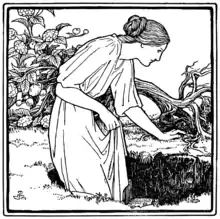
The tale focuses on Parmetella, a poor girl and youngest of three sisters: she, Pascuzza and Cice. They are daughters of a gardener, who gives them pigs to rear in hopes of getting a future dowry. Her sister drive Parmetella to drive the pigs in another part of the meadow, where she finds a fountain and a tree with golden leaves. She takes some and gives to her father, who sells them. She repeats the action until the tree is stripped bare of its foliage.
Some time later, Parmetella notices that the golden-leaved tree has a golden root. So she takes an axe to the root and finds a staircase leading underground. She descends on the hole where the tree trunk once stood and reaches a splendid palace. She wanders through the palace and marvels at its sights, until she sees a table with food and drink. A Moorish slave appears and asks her to be his wife. She consents, and the tells her that she must promise never to light a lamp during the night.
The next night, Parmetella waits until her mysterious companion is asleep, and lights a candle. She sees a handsome man. The man wakes up, curses her for not obeying his orders and vanishes. Parmetella leaves the palace and meets a fairy, who gives her seven spindles, seven figs, a jar of honey, and seven pairs of iron shoes. She instructs her to keep walking until she meets seven women eating human bones, and to use the gifts she received to lure them.
Parmetella finds the house of the ogresses, whom she convinces to swear on her husband's name, Truone-e-lampe ("Thunder-and-Lightning"), not to harm her. Later, their ogress mother appears and the human girl forces her to swear on her son's name not to harm her. The ogress complies.
The ogress mother orders Parmetella, as a first task, to separate twelve sacks of grains, mixed in a single heap. Her husband, Truone-e-lampe, summons an army of ants to use to separate the grains. As a second task, the ogress demands that she fills a dozen mattresses with feathers, which she also accomplishes with her husband's help.
The last task is to get to the witch's sister's house and fetch a box of instruments from her, to be used in the future wedding of Truone-e-lampe with another wife. Following her husband's advice, she enters the sister's house, gives food to the horse and the dog, and compliments the door hinges. She tricks the ogress's niece into the over instead of her, takes the box of instruments and escapes; the witch commands the door hinges, the horse and the dog to stop her, but she leaves unscathed due to her good actions. At a safe distance from the witch, curiosity takes the best of her and opens the box; the musical instruments flying out.[3]
Finally, the ogress mother prepares her son's wedding: she gives a torch to each of her seven daughters, and two to Parmetella to hold, and places her near a well for, when she falls asleep, she may fall into it. Truone-e-lampe's ugly bride passes by Parmetella and mocks her for not kissing the bridegroom, while she has kissed a herdsman for some chestnuts. Truone-e-lampe overhears the bride's confession and fumes silently. After the wedding party is over, in his nuptial chambers, Truone-e-lampe kills his bride.[4]
The ogress mother sees her son in Parmetella's arms, she decides to visit her sister to get rid of her. When she enters her sister's house, the ogress discovers that, out of grief for losing her baby, she has jumped into the oven to die alongside her. The ogress turns into a ram and butts its head against the wall. Truone-e-lampe and Parmetella make peace with his sisters-in-law and live happily.[5]
Analysis
Tale type
The tale can be classified in the Aarne-Thompson-Uther Index as belonging to type ATU 425, "The Search for the Lost Husband". Nancy Canepa indexes it as type 425A, "The Animal as Bridegroom".[6]
Scholars have called attention to structural similarites between the tale and the Graeco-Roman myth of Cupid and Psyche, as related by Apuleius in the 2hd century AD.[7] In fact, The Golden Root is considered to be one of Basile's rewritings of the myth, the other being Il catenaccio ("The Padlock", former tale type AaTh 425L, "The Padlock on the Enchanted Husband").[8]
Motifs
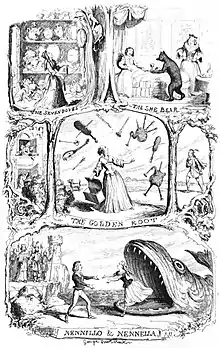
Scholarship notices the resemblance between Parmetella's quest for the box of instruments and Psyche's quest for Persephone's casket, and the result of curiosity for both women.[9] Catalan scholarship locates the motif of the box of musical instruments in Greek, Turkish and South Italian variants.[10]
The heroine is also helped by ants to carry grains from one place to the other. A similar event occurs in the myth of Psyche and in other fairy tales, such as The Queen Bee, by the Brothers Grimm.[11]
Italy
In a Sicilian variant collected by Laura Gonzenbach, Der Kônig Stieglitz, a poor shoemaker sits on a rock to lament his lack of work and suddenly a youth appears, named Cardiddu, saying that the shoemaker called out his name. The youth guides the shoemaker to his rich underground palace and lets him take some riches with him. The youth tells him that he wants to marry the shoemaker's third and youngest daughter. The shoemaker agrees and returns home to explain the situation to his daughters. The third one marries the mysterious prince and they live a good life, but her husband orders her not to open a certain door. He explains that he was a king, banished to this underground castle by a mamma draja who want him to marry her daughter. King Cardiddu leaves for some days and his wife is visited by her sisters. They try to convince their sister to open the door, but she refuses. One night, spurred by curiosity, she lights a candle to see if her husband was asleep. One drop of wax falls on his head and she finds herself out in the forest, the castle having disappeared. King Cardiddu admonishes her and tells her to follow the trail to the witch who enchanted him, and make her swear on his name to avoid being eaten by her. She does as instructed and the witch takes her as her servant. The witch forces her to do difficult tasks, which she accomplishes with her husband's help. The last task by the witch is for her to take a letter and a box to her sister, also a witch. On her way, curiosity gets the better of her and she opens the box, which begins to ring. Her husband appears and silences it. She delivers the box to the witch and returns to the mamma draja, who has made the preparations for the marriage between her daughter and King Cardiddu. The woman is to hold burning candles at the foot of the bridal bed during the nuptial night, but King Cardiddu knows it is a trap, so he makes the mamma draja's daughter change places with the woman. The witch's daughter falls into the trap and the couple escape from the house by transforming into different thing - a sequence that appears in tale type ATU 313, "The Magic Flight".[12] Scholar Jack Zipes translated the tale as King Cardiddu and classified it as type ATU 425A, "The Animal as Bridegroom", with an episode of type 313, "The Girl as Helper in he Hero's Flight".[13]
In another Sicilian variant, collected by Giuseppe Pitrè with the title Marvizia, a prince's daughter owns a potted plant that produces a rose with good seeds to eat. A green bird comes and eats the seeds. The girl wants to own this green bird, but the prince's servants fail to catch it. Then, she dons a disguise as a pilgrim and follows the bird to villages, under the pretense that she is going on a seven year penance. She arrives at a city whose queen misses her son, but shelters the girl. In return, the girl asks for the queen's ring, a memento of her lost son. The queen agress and the girl pilgrim continues on her journey. She arrives at the house of a mammadraga and asks for lodging. The mammadraga invites her in, calls her Marvizia (from Marva, a mallow plant) and sets her on doing strenuous taks. First, the girl, Marvizia, has to clean all copper utensils, and confides to the mammadraga's giant servant, Ali. The green bird appears on the window sill and advises the girl. Next, to wash all the mattresses, and finally to weave clothes for the mammadraga. The next day, the mammadraga turns the green bird into a man, and sets her giant servant Ali to take Marvizia to be devoured by goats. Ali meets the green bird, who gives him a magic staff to create grass to satiate the goats. A shepherd girl gives food to mammadraga, who, after thanking her, decides to make the girl her daughter-in-law. The green bird agrees to the mammadraga's decision, but secretly, uses the Ring of Command to materialize a torch with gunpowder and pellets inside. After their marriage, with Marvizia holding the torch on the foot of the bridal bed, the green bird asks for his new wife to hold the torch. The torch explodes on the shepherdess's hands, taking the mammadraga's house with it. Marvizia, the now human green bird and the giant Ali escape from the mammadraga with the Ring and the Book of Command, the villainess hot in pursuit. The trio escape and meet with the queen who gave Marvizia the ring.[14] Waldemar Kaden, who translated this tale, commented that this was another variant of the myth of Cupid and Psyche.[15]
In a variant from Tuscany, Ermenegilda e Cupido, collected from a Rosina Casina, Ermenegilda is the youngest of three sisters. One day, she enters a palace and, after some wandering, reaches a door that says it is her room. She lives with a mysterious character that comes at night to her bed. She suspects it might be a monster, so the next time he comes, she will light a candle to see him. So she does, and sees a handsome youth. He awakes and tells her he feels betrayed, and that she must seek his mother, a sorceress. Ermenegilda meets her mother-in-law, who discovers she married her son, so she sends her on difficult tasks: to wash a bicoloured piece of cloth to all white, to separate many feathers, and to carry a letter to the sorceress's sister and get from her "i canti, i balli e soni". Finally, the sorceress forces Ermenegilda to carry ten candles, one on each finger, to her son's wedding to another woman.[16]
Spain
In a Valencian variant collected by author Enric Valor i Vives with the title El castell d'entorn i no entorn, poor girl Teresa gives water to a hermit and receives a magic book in return. She opens the book; a ghostly figure of a prince answers from within the book and tells her to go the castle of "Serra dels Plans". There, she seeks employment with Queen Tomanina, mother of Prince Bernat. One day, the queen's elderly housekeeper lies to the queen that the girl boasted that she could accomplish great things. Then, Teresa is tasked with unstitching and cleaning the mattresses of the entire palace. She does with a little help from Prince Bernat. Lastly, the girl is asked to go to the queen's sister, Argelagaina, and to get two boxes from her.[17]
Other Spanish variants of the tale type were located in Mallorca, Catalunya and Eivissa.[18]
Greece
Richard MacGillivray Dawkins translated a Greek variant from the island of Karpathos, with the title Moskambari. In this tale, a poor girl lives with her starving mother. One day, she eats too much of their food and her mother curses her daughter to be eaten by an ogress. A wind blows the girl's kerchief to an ogress's house, who takes her in. The ogress orders the girl to do some tasks for her son's upcoming wedding. First, she has to clan forty rooms; then, to wash clothes without soap and thirdly to stuff mattresses with feathers - all tasks done with help from Moskambari (Musk and Amber), the ogress's son. Finally, the ogress sends the girl to her ogress sister to get fiddles for the wedding. At the ceremony, Moskambari chooses the girl instead of his bride-to-be, who is further humiliated by being made to fart in front of the ogress.[19][20]
In a variant from the island of Lesbos collected from a Mersini by William Roger Paton with the title Melidoni ("Sorrow" or "Care"), a poor fisherman wants to marry his three daughters to suitable suitors. A cafezi advises him to pray to God and to cast his net in the sea. He marries his two elder daughters. When it is the youngest's turn, he catches a lobster in his net and gives it to his daughter as her husband. At first, the girl is sad, but the lobster reveals he is a prince and that the losbter is his ship ("kanani" in Modern Greek, similar to "kananida", a kind of lobster). He warns her not to tell anything to her family. One day, she visits her family and watches over the lobster skin. Meanwhile, she sees outside a prince (her husband) appear three times, each on a more splendid horse and garments than the later. The third time, she tells the prince is her husband and he disappears. She then wears three leather dresses, three pairs of boots with rion soles, and goes on a quest for him. She meets three ogresses on the way, who help her and indicate the way to Melidoni. She meets a disguised Melidoni, who asks her for a kiss. She refuses and he turns her into a button, promising to take her to his mother. Once there, Melidoni changes her back and presents her to his mother. The ogress mother tells her to sweep and not sweep the floor of 40 rooms, to cook and not cook the meat for the ogress, and to fetch yeast from the house of the ogress's sister. She accomplishes it all with her husband's guidance. Melidoni's mother betrothes him to another bride and tells the girl to fill many mattresses with feathers, to make a donkey dance, to feed the dog and to being back a loaf of bread untouched. Finally, on the wedding day, the girl is forced to hold torches, bearing the pain of their burning, and - as her husband instructed the night before - throws them at the bride. They escape back to her father's house.[21]
In a variant collected by Georgios A. Megas with the title Ο χρυσαετός του κόσμου ("The Golden Eagle of the World"), a married couple lives a happy life, until the wife is pressed by her neighbours to ask her husband's name. He says it is "Μαυροτάρταρο της Γης, το Χρυσαετό του Κόσμου" (Black Tartaro of the Earth, the Golden Eagle of the World). He vanishes overnight and the wife goes looking for him. She reaches his mother's house, a dragon, and is taken as a maid. The dragon forces the wife to sweep and not sweep the house, to cook and not cook a piece of lamb, and to go to the dragon's sister to get the "toumoula" and the "moumoula" and bring them back. Her husband advises her to change the donkey's and the dog's food on the way to the sister's house, compliment a crooked fig tree and a river filled with dirty water, get the things and escape. Finally, the dragon mother prepares her son's wedding to another bride, and forces the human girl to wash her husband's clothes in the river and to hold candles near the bridal bed.[22]
See also
- The King of Love
- Prince Wolf (Danish fairy tale)
- Tulisa, the Wood-Cutter's Daughter (Indian fairy tale)
- The Horse-Devil and the Witch
- Graciosa and Percinet (French literary tale)
- Amewakahiko soshi
References
- Basile, Giambattista; Strange, E. F. (Ed.); Taylor, John Edward (translator). Stories from the Pentamerone. London: Macmillan and Co., Limited. 1911. pp. 260-272.
- Canepa, Nancy. Giambattista Basile's The Tale of Tales, or Entertainment for Little Ones. Detroit: Wayne State University Press, 2007. pp. 404-412. muse.jhu.edu/book/14344.
- Praet, Stijn. "“Se lieie la favola”: Apuleian Play in Basile’s Lo cunto de li cunti". In: International Journal of the Classical Tradition 25: 317–318 (2018). https://doi.org/10.1007/s12138-017-0454-6
- Cosquin, Emmanuel. "Contes populaires lorrains recueillis dans un village du barrois (suite)". In: Romania, tome 10 n°37-38, 1881. p. 138. DOI: https://doi.org/10.3406/roma.1881.6138; www.persee.fr/doc/roma_0035-8029_1881_num_10_37_6138
- Maggi, Armando. Preserving the Spell: Basile's "The Tale of Tales" and Its Afterlife in the Fairy-Tale Tradition. The University of Chicago Press, 2015. pp. 41-43. ISBN 9780226242965.
- Canepa, Nancy. Giambattista Basile's The Tale of Tales, or Entertainment for Little Ones. Detroit: Wayne State University Press, 2007. p. 404 (footnote). muse.jhu.edu/book/14344.
- Praet, Stijn. "“Se lieie la favola”: Apuleian Play in Basile’s Lo cunto de li cunti". In: International Journal of the Classical Tradition 25: 318–319 (2018). https://doi.org/10.1007/s12138-017-0454-6
- Maggi, Armando. Preserving the Spell: Basile's "The Tale of Tales" and Its Afterlife in the Fairy-Tale Tradition. The University of Chicago Press, 2015. p. 34. ISBN 9780226242965.
- Gonzenbach, Laura. Fiabe Siciliane. Rilette da Vincenzo Consolo. A cura di Luisa Rubini. Roma: Donzelli editore, 1999. p. 492. ISBN 88-7989-279-7.
- Poveda, Jaume Albero. "Rondalla «El castell d'entorn i no entorn» d'Enric Valor. Anàlisi hermenèutic i folklòrica". In: Miscel·lània Joan Veny. Volume 7. Estudis de llengua i literatura catalanes/LI. L'Abadia de Montserrat, 2005. p. 229. ISBN 9788484157373.
- Deulin, Charles. Les Contes De Ma Mère L'Oye Avant Perrault. Paris: E. Dentu, 1879. p. 89.
- Gonzenbach, Laura. Sicilianische Märchen. Leipzig: Engelmann, 1870. pp. 93-103.
- Zipes, Jack. Beautiful Angiola: The Lost Sicilian Folk and Fairy Tales of Laura Gonzenbach. Routledge, 2004. pp. 324-332, 358. ISBN 9781135511685.
- The Collected Sicilian Folk and Fairy Tales of Giuseppe Pitré. Vol. 1. Edited by Jack Zipes and Joseph Russo. Routledge, 2013. pp. 104-112. ISBN 9781136094026.
- Kaden, Waldemar. Unter den Olivenbäumen. Süditalienische Volksmärchen. Leipzig: Brockhaus 1880. p. 253.
- Pitrè, Giuseppe; Salomone-Marino, Salvatore. Archivio per lo studio delle tradizioni popolari. Volume Secondo. Palermo: Luigi Pedone Lauriel. 1883. pp. 157-165.
- Poveda, Jaume Albero. "Rondalla «El castell d'entorn i no entorn» d'Enric Valor. Anàlisi hermenèutic i folklòrica". In: Miscel·lània Joan Veny. Volume 7. Estudis de llengua i literatura catalanes/LI. L'Abadia de Montserrat, 2005. pp. 225-227. ISBN 9788484157373.
- Oriol, Carme. "Les primeres rondalles d'Enric Valor i la seva catalogació tipològica inèdita". In: Miscel·lània Albert Hauf, Volume 4. L'Abadia de Montserrat, 2012. p. 206. ISBN 9788498833898.
- Dawkins, Richard McGillivray. Modern Greek folktales. Oxford: Clarendon Press. 1953. pp. 61ff.
- Dollerup, Cay; Holbek, Bengt; Reventlow, Iven and Rosenberg Hansen, Carsten. "The Ontological Status, the Formative Elements, the “Filters” and Existences of Folktales". In: Fabula 25, no. 3-4 (1984): 243. https://doi.org/10.1515/fabl.1984.25.3-4.241
- Paton, W. R. “Folktales from the Ægean. [Continued].” Folklore 12, no. 1 (1901): 84–93. http://www.jstor.org/stable/1252899.
- Angelopoulou, Anna; Brouskou, Aígle. "ΚΑΤΑΛΟΓΟΣ ΕΛΛΗΝΙΚΩΝ ΠΑΡΑΜΥΘΙΩΝ". Vol. 3: ΕΠΕΞΕΡΓΑΣΙΑ ΤΥΠΩΝ ΚΑΙ ΠΑΡΑΛΛΑΓΩΝ AT 300-499. Athens: ΚΕΝΤΡΟ ΝΕΟΕΛΛΗΝΙΚΩΝ ΕΡΕΥΝΩΝ Ε.Ι.Ε, 1999. pp. 674-676. ISBN 960-7138-22-8.