Armenia–Georgia relations
Foreign relations exist between Armenia and Georgia. Both countries are former Soviet republics of the Soviet Union. Both countries' governments have had generally-positive relations, but there have also been some problems.
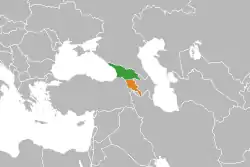 | |
 Georgia |
 Armenia |
|---|---|
| Diplomatic mission | |
| Embassy of Georgia, Yerevan | Embassy of Armenia, Tbilisi |
Georgia is a member of GUAM, which leaves Armenia out of regional transportation and energy projects.
Relations with Georgia are of particular importance for Armenia because under the border blockades imposed against Armenia by Turkey and Azerbaijan because of the ongoing Nagorno-Karabakh conflict, Georgia offers Armenia its only land connection with Europe, with access to its Black Sea ports. However, because of Armenia's reliance on Russia and Georgia, both of which fought in the 2008 South Ossetia War and thus severed diplomatic and economic relations, 70% of Armenia's imports entered via Georgia, especially from Russia, which has imposed an economic blockade on Georgia.
The Javakheti Region in southern Georgia contains a large Armenian population and although there have been local civic organizations, such as United Javakhk, pushing for autonomy, there has been no violence between Armenians and Georgians in the area since the Georgian–Armenian War ended in 1919. Since independence, Georgian clergy have occupied the Armenian churches,[1] and Armenians in Georgia and Armenia have demonstrated against the destruction. On November 28, 2008, Armenian demonstrators in front of the Georgian embassy in Armenia demanded that the Georgian government immediately cease encroachments on the Armenian churches and punish those guilty, calling the Georgian party's actions White Genocide.[2]
Some Armenians believe they are victims of a policy to shift the Samtskhe-Javakheti region's demographic balance since a number of Georgian families were settled there. Armenians are also underrepresented in the government, which leads to the perception of discrimination and mutual distrust. There were several protests, some of them turning violent after clashes with law enforcement agents.[3]
Georgia also supported Azerbaijan against Armenia in United Nations General Assembly Resolution 62/243, and Armenia has repeatedly voted against the United Nations resolutions on Abkhazia that reiterate the right of return of all displaced persons and refugees to Georgia's breakaway regions. Despite the stated differences, disagreements and conflicting interests, bilateral relations between both countries are stable and developing.
Minorities
There are nearly 168,102 Armenians in Georgia, among them 81,089 living in Samtskhe-Javakheti region and 53,409 in Tbilisi.[4] The Georgian minority in Armenia stands at 974 according to the 2011 Census in Armenia.
Country comparison
| Armenia |
Georgia | |
|---|---|---|
| Coat of arms |  |
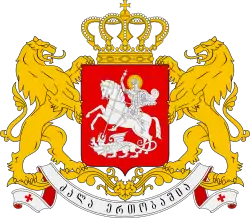 |
| Population | 3,018,854 | 3,713,804 |
| Area | 29,743 km2 (11,484sq mi) | 69,700 km2 (26,900sq mi) |
| Population Density | 108.4/km2 (280.7/sq mi) | 53.5/km2 (138.6/sq mi) |
| Capital | Yerevan | Tbilisi |
| Largest City | Yerevan – 1,121,900 (1,230,000 Metro) | Tbilisi – 1,171,100 (1,485,293 Metro) |
| Government | Unitary parliamentary republic | Unitary parliamentary constitutional republic |
| Official languages | Armenian | Georgian |
| Current Leader | President Armen Sarkissian Prime Minister Nikol Pashinyan |
President Salome Zourabichvili Prime Minister Irakli Garibashvili |
| Main religions | 92.5% Armenian Apostolic Church, 2.3% other Christian, 0.8% Yazidism, 4.4% None/Other |
83.4% Eastern Orthodoxy, Georgian Orthodox Church, 10.7% Islam, 3.9% Armenian Apostolic church, 0.8% Roman Catholic Church, 1.2% None/Other |
| Ethnic groups | 98.1% Armenians, 1.2% Yazidis, 0.4% Russians, 0.3% other | 86.8% Georgians, 6.2% Azerbaijanis, 4.5% Armenians, 0.7% Russians, 2.1% other |
| GDP (nominal) | US$10.106 billion ($3,032 per capita) | US$17.83 billion ($4,285 per capita) |
| GDP (PPP) | $17.941 billion ($5,384 per capita) | $46.05 billion ($12,409 per capita) |
History
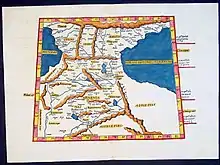
Armenia and Georgia have a long history of cultural and political relations. The interaction peaked in the Middle Ages when both nations engaged in prolific cultural dialogue and allied themselves against the neighboring Muslim empires. There were frequent intermarriages between Armenian and Georgian royal and noble families, and both ethnicities intermingled in several border areas.
The Roman Conquest
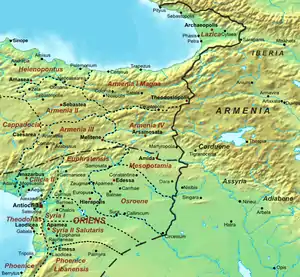
This close association with Armenia brought upon the country an invasion (65 BC ) by the Roman general Pompey, who was then at war with Mithradates VI of Pontus, and Armenia; but Rome did not establish her power permanently over Iberia. Nineteen years later, the Romans again marched (36 BC) on Iberia forcing King Pharnavaz II to join their campaign against Albania.[5]
During this time Armenia and Pontus were actively expanding at the expense of Rome, taking over its Eastern Mediterranean possessions.
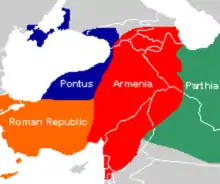
However, the success of the anti-Roman alliance did not last long. As a result of the brilliant Roman campaigns of Pompey and Lucullus from the west, and the Parthian invasion from the south, Armenia lost a significant part of its conquests by 65 BC, devolving into a Roman-Parthian dependency. At the same time, the Kingdom of Pontus was completely destroyed by the Romans and all its territory including Colchis were incorporated into the Roman Empire as her provinces.
The former Kingdom of Colchis became the Roman province of Lazicum ruled by Roman legati. The following 600 years of Georgian history were marked by the struggle between Rome and Persia (Iran) including Parthians and Sassanids who were fighting long wars against each other for the domination in the Middle East including Syria, Mesopotamia, Armenia, Albania, and Iberia.
In the late 4th century, Rome had to give up Albania and most of Armenia to Sassanid Persia. The province of Lazicum was given a degree of autonomy that by the end of the century developed into full independence with the formation of a new Kingdom of Lazica-Egrisi on the territories of smaller principalities of the Zans, Svans, Apsyls, and Sanyghs. This new Western Georgian state survived more than 250 years until 562 when it was absorbed by the Byzantine Empire.
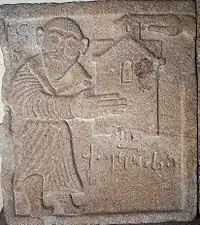
While the Georgian kingdom of Colchis was administered as a Roman province, Caucasian Iberia freely accepted the Roman Imperial protection. A stone inscription discovered at Mtskheta speaks of the 1st-century ruler Mihdrat I (AD 58-106) as "the friend of the Caesars" and the king "of the Roman-loving Iberians." Emperor Vespasian fortified the ancient Mtskheta site of Arzami for the Iberian kings in 75 AD.
In the 2nd century AD, Iberia strengthened her position in the area, especially during the reign of King Pharsman II who achieved full independence from Rome and reconquered some of the previously lost territories from declining Armenia.
In the 3rd century AD, the Lazi tribe came to dominate most of Colchis, establishing the kingdom of Lazica, locally known as Egrisi. Colchis was a scene of the protracted rivalry between the Eastern Roman/Byzantine and Sassanid empires, culminating in the Lazic War from 542 to 562.[6]
Early Middle Ages
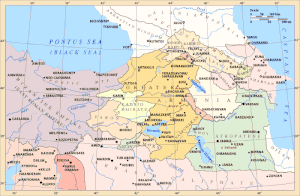
With their status of "King of Kings" (Shahanshah),[7] Armenian kings authority also carried over to the neighboring states of Georgia, Caucasian Albania and several of the Arab emirates.[8]
Middle Ages
The second half of the 11th century was marked by the strategically significant invasion of the Seljuq Turks, who by the end of the 1040s had succeeded in building a vast nomadic empire including most of Central Asia and Persia. In 1071, the Seljuq army destroyed the united Byzantine and Georgian forces in the Battle of Manzikert. By 1081, all of Armenia, Anatolia, Mesopotamia, Syria, and most of Georgia had been conquered and devastated by the Seljuqs. By the end of the 1080s, Georgians were outnumbered in the region by the invaders. The defeat of the Bagratuni Dynasty ended Christian leadership of Armenia for the next millennium.
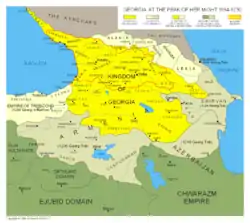
The struggle against the Seljuq invaders in Georgia was led by the young King David IV Bagrationi (reigning 1089-1125). Georgians freed Shirvan and a large portion of Armenia. Thus in 1124 David also became the King of Armenians, incorporating Northern Armenia into the lands of the Georgian Crown. In 1125 King David died, leaving Georgia with the status of strong regional power.
The temporary fall of the Byzantine Empire in 1204 to the Crusaders left Georgia as the strongest Christian state in the whole East Mediterranean area. Muslim power in Greater Armenia was seriously troubled by the resurgent Georgian monarchy. Many local nobles (nakharars) joined their efforts with the Georgians, leading to liberation of several areas in northern Armenia, which was ruled, under the authority of the Georgian crown, by the Mkhargrdzeli, a prominent Armeno-Georgian noble family.
Mongol invasions
The kingdom of Georgia flourished during the 10th to 12th centuries, and fell to the Mongol invasions of Georgia by 1243, and after a brief reunion under George V of Georgia to the Timurid Empire.
Ottoman and Persian domination
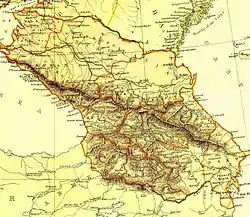
By 1490, Georgia was fragmented into a number of petty kingdoms and principalities, which throughout the Early Modern period struggled to maintain their autonomy against Iranian (successive Safavid, Afsharid and Qajar dynasties) and Ottoman domination until Georgia was finally annexed by the Russian Empire in 1801. Russian possession over Georgia got nominally finalised with Qajar Iran in 1813 in the Treaty of Gulistan following Russia's victory in the Russo-Persian War (1804-1813).[9] Greater Armenia was from the early 16th century up to including the course of the 19th century was also, more dominantly even, divided between the rivalling neighboring Ottoman and successive Iranian dynasties. In the first half of the 19th century, after several centuries under its rule in the early modern era, Iran was forced to cede its last remaining territories in the Caucasus which included modern-day Armenia (also known as Eastern Armenia) to Imperial Russia following its loss in the Russo-Persian War (1826-1828), which got ratified in the 1828 Treaty of Turkmenchay.[9] Greater Armenia was now divided between the Ottoman Empire and Russia.
Provinces of the Russian Empire
.
Transcaucasian Federation (1917–1918)
During the Russian Revolution, the provinces of the Caucasus seceded and formed their own federal state called the Transcaucasian Federation. Competing national interests and war with Turkey led to the dissolution of the republic half a year later, in April 1918.
Interwar Republics (1918-1920)
Relations between Armenia and Georgia were strained by many factors in the interwar period. Georgia held most of the disputed territory and demonstrated Armenia’s vulnerability by frequently interrupting rail traffic and instituting reforms designed to eliminate the Armeno-Russian socioeconomic preponderance in Tiflis. In control of neither essential transportation routes nor a hostage Georgian minority, Armenian leaders capitalized insofar as possible on Georgia’s need for Allied support and its fear of the Russian White Armies.[10]
Interruptions of Rail Traffic
An episode of diplomatic strain arose when Georgian authorities started demanding a share of the relief supplies being transported by Allied organisations through Batum to Armenian refugees. As a result of which, the Georgian government was reprimanded by General Cory, commander of the 27th Division stationed in Transcaucasia.
Following the conclusion of a defense pact against Denikin between Georgia and Azerbaijan, one which Armenia was invited but refused to enter into, the Georgian Government halted railway service carrying relief supplies to Armenia, which persisted until they were denounced and threatened with their cause becoming 'prejudiced' at the Paris Peace Conference by the president of the conference, Georges Clemenceau:
The Council has been made aware of the interference of the Georgian Authorities when food supplies were sent into Armenia in an endeavour on the part of the Allied Governments to stem the tide of starvation and death amongst these unfortunate people. The Council cannot state in too strong terms, that such interference and that such action taken by the Georgian Authorities together with the continuation of such action must entirely prejudice their case. The Council therefore expects that the Authorities in Georgia shall not only give privileges of transportation over the Railway routes at which they at present control, but will devote themselves to assisting in the transmission of these supplies at no more than the normal charge and remuneration for such service. The Council awaits the reply of the Authorities in Georgia as to whether or not they are prepared to acquiesce in this arrangement.[11]
Georgian–Armenian War
During the final stages of World War I, the Armenians and Georgians had been defending against the advance of the Ottoman Empire. In June 1918, in order to forestall an Ottoman advance on Tiflis, the Georgian troops had occupied former districts of Tiflis Governorate, the Lori Province which at the time had a 75% Armenian majority. After the Armistice of Mudros and the withdrawal of the Ottomans, the Georgian forces remained. Georgian Menshevik parliamentarian Irakli Tsereteli offered that the Armenians would be safer from the Turks as Georgian citizens. The Georgians offered a quadripartite conference including Georgia, Armenia, Azerbaijan, and the Mountainous Republic of the Northern Caucasus in order to resolve the issue which the Armenians rejected. In December 1918, the Georgians were confronting a rebellion chiefly in the village of Uzunlar in the Lori region. Within days, hostilities commenced between the two republics.[12]
The Georgian–Armenian War was a briefly fought border war occurring in late 1918 between the Democratic Republic of Georgia and the Democratic Republic of Armenia over the Borchaly Uyezd.
Social Issues
The Armenians of Tiflis who had in recent history become the masters of the illustrious cultural, commercial, and political centre of Tiflis rapidly lost their power and influence to the Georgians, thus becoming a disadvantaged minority. The Mensheviks, pressing steadily with the goal of naturalization of the near half-million Armenians in Georgia proceeded with regulations aimed at loosened the grip of the Armenian bourgeoisie and administrative reforms led to the dismissal of most Armenian and Russian civil servants. In order to relieve congestion in the capital and at the same time to clear it of refugees and other undesirable elements, Minister of Interior Ramishvili issued a decree requiring the exodus of all noncitizens who were not property owners or gainfully employed and all citizens whose heads of household were absent, the latter point relating to the dependents of Armenian men who had left to fight for Armenia or the Volunteer Army.[13]
Ironically, just as Georgian officials were using the harvest season as an excuse for not holding the Armenian National Council elections, they announced that special elections for the Georgian Constituent Assembly would be held from August 10 to 12 in Akhaltsikhe, Akhalkalak, and Borchalu, districts that had not participated in the March general elections because of widespread unrest and their disputed status. Although the Armenian foreign minister and the British military representative at Akhalkalak challenged the legality of such an election, the Dashnaktsutiun in Georgia decided not to declare a boycott, as it had done in March. In the campaign, the Mensheviks spared no means to solidify their control in the districts by winning an electoral victory. The disadvantaged Armenian party denounced the confiscation of its campaign leaflets and the threats of retribution against any village that dared vote the Dashnakist ticket. Whatever the truth of such charges, the Georgian election bureau announced that Menshevik slate Number 1 had received 12,000 votes in Akhalkalak as against 8,000 for Dashnakist slate Number 4 and that, although only half of the 44,000 enfranchised persons in Borchalu had participated, 12,000 of them had cast Menshevik ballots. The Georgian press termed the electoral results a mandate by the Armenian peasantry for permanent union with the democratic Republic of Georgia.[14]
Impacts of War
In the areas where the special elections had been held, the impact of the Turkish invasion and Armeno-Georgian war of the preceding year was still much in evidence. For months the Menshevik People’s Guard made its presence felt in the Belyi-Kliuch district of the Tiflis uyezd and settlements in the adjacent Borchalu uyezd into which the Armenian army had advanced. Armenian journals in Erevan and Tiflis described the pillage, plunder, and pauperization of the once prosperous villages of Shulaver, Bolnis-Khachen, Daghet-Khachen, Samshvildo, Varkhuna, Samtreti, Dumanisi, Vardisuban, and a score of others. On December 19 the Georgian cabinet and the People’s Guard gathered at Ekaterinenfeld to mark the first anniversary of the war, honour the memory of comrades who had fallen, and denounce anew the imperialistic policy of the Armenian government and its dominant party. Hundreds of Georgian Armenians arrested during that war remained in prison and were specifically excluded from the government’s amnesty decrees. The protests of the small Social Revolutionary, Social Federalist, and Dashnakist factions in the Constituent Assembly that the government’s amnesty policies were no different from those of Tsarist reactionaries had no effect on the Menshevik-controlled legislature, which confirmed regulations excluding from pardon subversives or those who had betrayed the Republic during the Armenian invasion.[15]
The sufferings of the people of Akhalkalak dwarfed the tribulations of all other Armenians in Georgia. Thirty thousand had perished as the result of the Turkish occupation, and those who survived were starving. Some mothers attempted to save their daughters by offering them as wives to Georgian militiamen and soldiers. Russian, Jewish, and Georgian entrepreneurs were reportedly buying young girls for 100 to 300 rubles and sending them to brothels; eight- to twelve-year-old orphan boys were being sold for a pittance at Bakuriani; hundreds of women and children were pressed into servitude in the adjacent Muslim districts. All roads leading away from Akhalkalak were strewn with the bodies of fleeing Armenians.[16] In September the Akhalkalak Compatriotic Society informed the Armenian government that, of the more than 80,000 Armenians in the county at the beginning of 1918, only 40,000 were left and that these were rapidly succumbing to famine, foreign marriages, concubinage, or to even worse fates.[17]
Transcaucasian SFSR (1922–1936)
From March 12, 1922, to December 5, 1936, Armenia and Georgia were a part of the Transcaucasian SFSR together with the Azerbaijan SSR. In 1936, the TSFSR was dissolved under Stalin's orders and the socialist republics of Armenia, Azerbaijan, and Georgia were established instead.
Armenian SSR and Georgian SSR (1936–1991)
In the Soviet Union, Armenians and Georgians, along with Russians, Ukrainians, Belarusians, Germans, and Jews were judged as "advanced" peoples, and were grouped together as Western nationalities.[18]
Nevertheless, as with various other ethnic minorities who lived in the Soviet Union under Stalin, tens of thousands of Armenians were executed and deported. In 1936, Lavrenty Beria and Stalin worked to deport Armenians to Siberia in an attempt to bring Armenia's population under 700,000 in order to justify an annexation into Georgia.[19]
.svg.png.webp) Flag of Transcaucasian SFSR
Flag of Transcaucasian SFSR.svg.png.webp) Flag of Georgian SSR
Flag of Georgian SSR.svg.png.webp) Flag of Armenian SSR
Flag of Armenian SSR
Post-Soviet Period
On March 17, 1991, Armenia, along with the Baltics, Georgia and Moldova, boycotted a union-wide referendum in which 78% of all voters voted for the retention of the Soviet Union in a reformed form.[20]
Georgia declared independence on 9 April 1991 and Armenia did the same on 21 September 1991 following the failed Soviet coup attempt in August. The United States recognized the independence of both nations on December 25, 1991.
Armenian-Georgian relations in the post-independence period have been mixed but cooperative. The two states are each one allied with the other one's adversaries (Armenia with Russia, Georgia with Azerbaijan and Turkey), but they are nevertheless obliged to maintain cooperative ties: the border blockades imposed by Turkey and Azerbaijan on Armenia makes Georgia (and, via a single route, Iran) the only possible exit and entry point for Armenian imports and exports.
Recent revelations indicate that Yerevan had taken steps to assure Tbilisi that it had Armenia's all-but-official support in the outbreak of the 2008 South Ossetian and Abkhazian conflict. Armenia offered itself as a safe haven for Georgians escaping the conflict, and at one point, temporarily housed at least 500 Georgian families escaping the war. To this day, Armenia has not recognized South Ossetia and Abkhazia as independent states. However, the establishment of diplomatic relations between Abkhazia, South Ossetia, and the separatist Republic of Artsakh has drawn criticism from the Georgian government, notably during President Salome Zourabichvili’s visit to Armenia in March 2019. Moreover, the Armenian Apostolic Church's decision to place Armenian churches in Abkhazia under the jurisdiction of its South Russian Eparchy instead of the Church's Eparchy of Georgia was rescinded after a meeting between President Zourabichvili and Catholicos Karekin II.
According to Wikileaks, however, Armenia's foreign diplomats grew increasingly frustrated with Tbilisi's inability to respond to calls or diplomatic cables from Yerevan.[21] Despite their reluctance to warmly embrace each other diplomatically, the differences between the two nations are more often highlighted by political rather than social or historical differences.
Positive steps have been taken to strengthen ties between the two nations. In January 2011, Georgian President Mikhail Saakashvilli paid an official visit to Armenia immediately after his initial visit to Washington. Both the Georgian and Armenian presidents seem to hold each other to high esteem, and Georgia's push to remove itself from the Russian sphere of influence in the Caucasus Region has translated to an increase of cooperation, positivity and productivity in relations with its immediate neighbors. Tbilisi recently made an effort to address the socioeconomic plight of the Georgian-Armenians living in Javakheti, a source of tension between the two nations, by building a main road that connects the region with Tbilisi as well as proposing new projects in the region, one of which involves the creation of a national park.
See also
References
- "Armenians of Georgia urge to stop barbarous destruction of Armenian cultural heritage". PanArmenian.net. Retrieved 2008-11-29.
- "PROTEST ACTION AGAINST ENCROACHMENTS ON ARMENIAN CHURCHES IN GEORGIA HELD IN YEREVAN". defacto.am. Retrieved 2008-11-29.
- Foundation, Thomson Reuters. "Humanitarian - Thomson Reuters Foundation News". www.alertnet.org. Retrieved 28 September 2018.
- 2002 Georgia census Archived August 31, 2006, at the Wayback Machine.
- Braund, D., Georgia in Antiquity: A History of Colchis and Transcaucasian Iberia 550 BC – AD 562, Oxford University Press, 1996, p 36
- "J. B. Bury: History of the Later Roman Empire • Vol. 2 Chap. XVI". penelope.uchicago.edu. Retrieved 28 September 2018.
- Tim Greenwood, Emergence of the Bagratuni Kingdoms, p. 52, in Armenian Kars and Ani, Richard Hovannisian, ed.
- (in Armenian) Arakelyan, Babken N. «Աշոտ Ա» (Ashot I). Soviet Armenian Encyclopedia. vol. i. Yerevan: Armenian SSR: Armenian Academy of Sciences, 1974, pp. 486-487.
- Timothy C. Dowling Russia at War: From the Mongol Conquest to Afghanistan, Chechnya, and Beyond pp 728-729 ABC-CLIO, 2 Dec. 2014 ISBN 1598849484
- Hovannisian, Richard G. (1971–1996). The Republic of Armenia. Berkeley: University of California Press. p. 140. ISBN 0-520-01805-2. OCLC 238471.
- Paris Peace Conference, VII, 210-211; RG 256, 180.03502/43, 184.611/582, 867B.48/34; FO 608/79, 342/1/9/15770/17104; WO 33/974, no. 4980; Georgian Archives, Box 20, book 6.
- Armenian the Survival of a Nation, Christopher Walker pg 267-268
- Hovannisian, Richard G. (1971–1996). The Republic of Armenia. Berkeley: University of California Press. p. 148. ISBN 0-520-01805-2. OCLC 238471.
- Hovannisian, Richard G. (1971–1996). The Republic of Armenia. Berkeley: University of California Press. p. 150. ISBN 0-520-01805-2. OCLC 238471.
- Hovannisian, Richard G. (1971–1996). The Republic of Armenia. Berkeley: University of California Press. pp. 150–151. ISBN 0-520-01805-2. OCLC 238471.
- Nor Ashkhatavor, Aug. 21:4, 22:2, 31:2, Sept. 3:2-3, 1919; Ashkhatavor, Sept. 25:4, Dec. 23:2, 24:1-2, 1919; Republic of Armenia Archives, File 660/3, no. 127, Sept. 3, 1919.
- Hovannisian, Richard G. (1971–1996). The Republic of Armenia. Berkeley: University of California Press. p. 151. ISBN 0-520-01805-2. OCLC 238471.
- Martin, Terry (2001). The Affirmative Action Empire: Nations and Nationalism in the Soviet Union, 1923-1939. New York: Cornell University, p. 23. ISBN 0-8014-8677-7.
- Bauer-Manndorff, Elisabeth (1981). Armenia: Past and Present. New York: Armenian Prelacy, p. 178.
- "Baltic states, Armenia, Georgia, and Moldova boycott USSR referendum". Archived from the original on November 16, 2005. Retrieved 2007-02-06.
- "WikiLeaks: Georgia Offended Armenian Government Leaders During August War With Russia - Armenian News By MassisPost". 30 November 2010. Retrieved 28 September 2018.
External links
- Historic Concern: Georgian Armenians say authorities out to rid country of Armenian traces
- Georgia is becoming hostage to Azeri-Turkish alliance: interview with Pavel Chobanyan by Pavel Chobanyan – expert of the Caucasus analytical center, doctor of historical sciences
- (in Italian) gli amici dei nemici, Osservatorio Balcani e Caucaso, 20 gennaio 2011
| | |||||||||||||||
| ||||||||||||||||
| ||||||||||||||||
| Africa | | |
|---|---|---|
| Americas | ||
| Asia | ||
| Europe | ||
| Oceania | ||
| Multilateral organizations | ||
| Conflicts | ||
| Related topics | ||