Tiflis Governorate
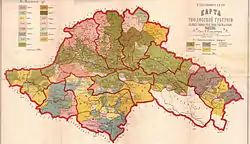
The Tiflis Governorate (Old Russian: Тифлисская губернія; Georgian: ტფილისის გუბერნია) was one of the guberniyas of the Caucasus Viceroyalty of the Russian Empire with its centre in Tiflis (present-day Tbilisi, capital of Georgia). In 1897 it constituted 44,607 sq. kilometres in area and had a population of 1,051,032 inhabitants.[1] The governorate used to border Elisabethpol Governorate, Erivan Governorate, Kutais Governorate, Zakatal Okrug, Dagestan Oblast, Terek Oblast, and Kars Oblast. It covered present southeastern Georgia, northern Armenia and northwestern Azerbaijan.
Tiflis Governorate
Тифлисская губерния | |
|---|---|
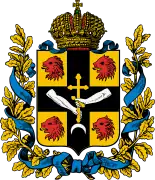 Coat of arms | |
 | |
| Country | Russian Empire |
| Political status | Governorate |
| Region | Caucasus |
| Established | 1846 |
| Abolished | 1917 |
| Area | |
| • Governorate | 44,609 km2 (17,224 sq mi) |
| Population (1916) | |
| • Governorate | 1,473,308 |
| • Density | 33/km2 (86/sq mi) |
| • Urban | 19.72% |
| • Rural | 80.28% |
| History of Georgia |
|---|
.jpg.webp) |
 History of Georgia History of Georgia |
Tiflis Governorate was established in 1846 along with the Kutais Governorate, after the dissolution of the Georgia-Imeretia Governorate. It was initially formed from uyezds of Tiflis, Gori, Telavi, Signakh, Yelizavetpol, Erivan, Nakhichevan and Alexandropol and okrugs of Zakatal, Ossetian and Tushino-Pshavo-Khevsurian. In 1849, uyezds of Erivan, Nakhichevan and Alexandropol were attached to Erivan Governorate. In 1859 Ossetian okrug became part of Gori district and Tushino-Pshavo-Khevsurian okrug was renamed to Tianeti okrug. In 1867, the northern part of Tiflis uyezd was separated as Dusheti one, while Akhaltsikhe uyezd which was created after ceding from Ottoman Empire to Russian Empire in 1829, was detached from Kutaisi Governorate and part of Tiflis one. In 1868 Yelizavetpol uyezd (in the same decree, Kazakh uyezd was formed from northwestern part of Yelizavetpol one and was attached to Elisabethpol Governorate) was part of Elisabethpol Governorate. In 1874, the southern part of Akhaltsikhe uyezd was to become Akhalkalaki one and Tianeti okrug was elevated as uyezd. Finally southern part of Tiflis Uyezd was to become Borchali Uyezd. The governorate lasted in these boundaries for 50 years, until the Democratic Republic of Georgia was founded.[2]
Administrative divisions
Tiflis Governorate consisted of the following uyezds:[1]
- Tiflis
- Akhalkalaki
- Akhaltsikhe
- Borchaly
- Elisabethpol (detached to form the Elisabethpol Governorate in 1868)
- Gori
- Dusheti
- Signakhi
- Telavi
- Tianeti
- Zakatal (detached to form a separate special administrative okrug in 1905)
Demographics
Russian Imperial Census of 1897[3]
As of 1897, 1,051,032 lived in the governorate, with around 20% of them being urban. Ethnic Georgians constituted 44.3% of the population, followed by Armenians (18.7%), Azeris (10.2%), Russians (including Ukrainians and Old Believers, 9.7%), Ossetians (6.4%), Avars (3.2%), Greeks (2.6%), Turks (2.4%), etc. More than half of the population adhered to Eastern Orthodox Christianity with significant Muslim, Catholic and Jewish minorities.[1]
| Uyezd | Georgians | Armenians | Azerbaijanis[4] | Russians | Ossetians | Avars | Greeks | Turks | Ukrainians | Poles | Germans | Jews | Kurds | Chechens | Dargins | Lezgins |
|---|---|---|---|---|---|---|---|---|---|---|---|---|---|---|---|---|
| TOTAL | 44.3% | 18.7% | 10.2% | 7.5% | 6.4% | 3.2% | 2.6% | 2.4% | ... | ... | ... | ... | ... | ... | ... | ... |
| Akhalkalaki | 8.9% | 72.3% | 9.0% | 7.1% | ... | ... | ... | ... | ... | ... | ... | ... | 1.1% | ... | ... | ... |
| Akhaltsikhe | 17.7% | 22.0% | 18.0% | 2.5% | ... | ... | ... | 35.1% | ... | ... | ... | ... | 2.0% | ... | ... | ... |
| Borchali | 6.1% | 36.9% | 29.4% | 6.3% | ... | ... | 16.6% | ... | ... | ... | 1.9% | ... | ... | ... | ... | ... |
| Gori | 65.0% | 4.0% | ... | 2.8% | 26.2% | ... | ... | ... | ... | ... | ... | ... | ... | ... | ... | ... |
| Dusheti | 73.4% | 2.5% | ... | 1.4% | 21.4% | ... | ... | ... | ... | ... | ... | ... | ... | ... | ... | ... |
| Zakatal | 14.7% | 2.5% | 34.4% | ... | ... | 37.6% | ... | ... | ... | ... | ... | ... | ... | ... | 8.8% | 1.2% |
| Signakhi | 82.9% | 6.2% | 5.2% | 4.3% | ... | ... | ... | ... | ... | ... | ... | ... | ... | ... | ... | ... |
| Telavi | 85.9% | 7.1% | 2.8% | 1.0% | ... | 2.6% | ... | ... | ... | ... | ... | ... | ... | ... | ... | ... |
| Tianeti | 88.7% | 1.6% | ... | 1.9% | ... | ... | ... | ... | ... | ... | ... | ... | ... | 6.2% | ... | ... |
| Tiflis | 34.2% | 24.7% | 5.9% | 22.1% | ... | ... | 1.9% | ... | 1.5% | 2.1% | 2.3% | 1.4% | ... | ... | ... | ... |
Caucasian Calendar of 1917
The 1917 Caucasian Calendar which produced statistics of 1916 indicates 1,473,308 residents in the Tiflis Governorate, including 780,010 men and 693,298 women, 1,255,176 of whom were the permanent population, and 218,132 were temporary residents.[5]
| Uyezd (district) | Russians | Other Europeans | Georgians | Armenians | North Caucasians | Kurds | Other Asian Nationalities | Gypsies | Jews | TOTAL | ||||
|---|---|---|---|---|---|---|---|---|---|---|---|---|---|---|
| Orthodox | Sectarian | Muslim | Yezidi | Christian[lower-alpha 1] | Shia Muslim | Sunni Muslim[lower-alpha 2] | ||||||||
| Akhalkalak | 436 | 7,106 | 13 | 10,304 | 82,775 | 0 | 904 | 0 | 0 | 0 | 5,431 | 0 | 204 | 107,173 |
| 0.4% | 6.6% | 0.0% | 9.6% | 77.2% | 0.0% | 0.8% | 0.0% | 0.0% | 0.0% | 5.1% | 0.0% | 0.2% | 100.0% | |
| Akhaltsikhe | 804 | 0 | 81 | 45,492 | 28,225 | 19 | 1,801 | 0 | 89 | 4 | 16,710 | 471 | 3,251 | 96,947 |
| 0.8% | 0.0% | 0.1% | 46.9% | 29.1% | 0.0% | 1.9% | 0.0% | 0.1% | 0.0% | 17.2% | 0.5% | 3.4% | 100.0% | |
| Borchaly | 5,045 | 3,727 | 3,601 | 10,419 | 63,702 | 366 | 0 | 0 | 30,762 | 17,910 | 33,320 | 255 | 244 | 169,351 |
| 3.0% | 2.2% | 2.1% | 6.2% | 37.6% | 0.2% | 0.0% | 0.0% | 18.2% | 10.6% | 19.7% | 0.2% | 0.1% | 100.0% | |
| Gori | 2,401 | 6 | 68 | 162,426 | 32,822 | 37,567 | 0 | 0 | 1,450 | 138 | 36 | 0 | 4,102 | 241,016 |
| 1.0% | 0.0% | 0.0% | 67.4% | 13.6% | 15.6% | 0.0% | 0.0% | 0.6% | 0.1% | 0.0% | 0.0% | 1.7% | 100.0% | |
| Dushet | 270 | 0 | 125 | 57,595 | 3,671 | 4,619 | 0 | 0 | 0 | 61 | 29 | 0 | 60 | 66,430 |
| 0.4% | 0.0% | 0.2% | 86.7% | 5.5% | 7.0% | 0.0% | 0.0% | 0.0% | 0.1% | 0.0% | 0.0% | 0.1% | 100.0% | |
| Signakh | 9,805 | 1,874 | 15 | 118,283 | 15,008 | 210 | 0 | 0 | 3,201 | 3,275 | 1,862 | 0 | 331 | 153,864 |
| 6.4% | 1.2% | 0.0% | 76.9% | 9.8% | 0.1% | 0.0% | 0.0% | 2.1% | 2.1% | 1.2% | 0.0% | 0.2% | 100.0% | |
| Telav | 225 | 15 | 40 | 56,978 | 8,480 | 1,308 | 0 | 0 | 873 | 0 | 14 | 0 | 22 | 67,955 |
| 0.3% | 0.0% | 0.1% | 83.8% | 12.5% | 1.9% | 0.0% | 0.0% | 1.3% | 0.0% | 0.0% | 0.0% | 0.0% | 100.0% | |
| Tiflis | 113,148 | 7,891 | 20,958 | 133,624 | 175,338 | 3,623 | 3,227 | 4,697 | 19,595 | 17,594 | 10,115 | 394 | 11,018 | 521,222 |
| 21.7% | 1.5% | 4.0% | 25.6% | 33.6% | 0.7% | 0.6% | 0.9% | 3.8% | 3.4% | 1.9% | 0.1% | 2.1% | 100.0% | |
| Tionet | 56 | 0 | 2 | 47,515 | 1,726 | 39 | 0 | 0 | 0 | 0 | 0 | 0 | 12 | 49,350 |
| 0.1% | 0.0% | 0.0% | 96.3% | 3.5% | 0.1% | 0.0% | 0.0% | 0.0% | 0.0% | 0.0% | 0.0% | 0.0% | 100.0% | |
| TOTAL | 132,190 | 20,619 | 24,903 | 642,636 | 411,747 | 47,751 | 5,932 | 4,697 | 55,970 | 38,982 | 67,517 | 1,120 | 19,244 | 1,473,308 |
| 9.0% | 1.4% | 1.7% | 43.6% | 27.9% | 3.2% | 0.4% | 0.3% | 3.8% | 2.6% | 4.6% | 0.1% | 1.3% | 100.0% | |
Governors
The administration tasks in the governorate were executed by a governor. Sometimes, a military governor was appointed as well. The governors of Tiflis Governorate were[6]
- 1847–1849 Sergei Nikolayevich Yermolov, governor;
- 1849–1855 Ivan Malkhazovich Andronnikov (Andronikashvili), military governor;
- 1855–1857 Nikolay Yevgenyevich Lukash, military governor;
- 1858–1860 Alexander Khristianovich Kapger, military governor;
- 1860–1876 Konstantin Ivanovich Orlovsky, governor;
- 1876–1878 Maximilian von der Osten-Sacken, governor;
- 1878–1883 Konstantin Dmitriyevich Gagarin, governor;
- 1883–1887 Alexander Ignatyevich Grosman, governor;
- 1887–1889 Karl Leo Sissermann, governor;
- 1889–1897 Georgy Dmitriyevich Shervashidze (Giorgi Shervashidze), governor;
- 1897–1899 Fyodor Alexandrovich Bykov, governor;
- 1899–1905 Ivan Nikolayevich Svechin, governor;
- 1905–1907 Paul Bernhard Demetrius Rausch von Traubenberg, governor;
- 1907–1911 Mikhail Alexandrovich Lyubich-Yarmolovich-Lozina-Lozinsky, governor;
- 1911–1914 Andrei Gavrilovich Chernyavsky, governor;
- 1914–1916 Ivan Mikhaylovich Strakhovsky, governor;
- 1916–1917 Alexander Nikolayevich Mandrika, acting governor.
References
- Caucasus Greeks and Ossetians were also included in the number of Christians.
- Sunni Muslims concentrated in the Akhalkalak and Akhaltsikhe Uyezds were mainly Meskhetian Turks
- Brockhaus and Efron Encyclopaedia: Tiflis Governorate (in Russian)
- Coats of Arms of the Cities of the Georgia-Imeretia Governorate of the Russian Empire Archived 2008-01-06 at the Wayback Machine
- Denoted as Tatars in the source.
- Кавказский календарь .... на 1917 год (in Russian). pp. 363–366.
- Н. Ф. Самохвалов, ed. (2003). Губернии Российской Империи. История и руководители. 1708-1917. Moscow: Ministry of Internal Affairs of Russian Federation. pp. 372–376, 467–468.
Further reading
- William Henry Beable (1919), "Governments or Provinces of the Former Russian Empire: Tiflis", Russian Gazetteer and Guide, London: Russian Outlook – via Open Library