Asuka Strikes!
"Asuka Strikes!"[lower-alpha 1] is the eighth episode of the Japanese anime television series Neon Genesis Evangelion, which was created by Gainax, written by Hideaki Anno and Yoji Enokido and directed by Kazuya Tsurumaki. It was first broadcast on TV Tokyo on November 22, 1995. The series is set fifteen years after a worldwide cataclysm, and is mostly set in the futuristic, fortified city Tokyo-3. The episode's protagonist is Shinji Ikari, a teenage boy who was recruited by his father Gendo to the organization Nerv to pilot a giant bio-mechanical mecha named "Evangelion" into combat with beings called "Angels". During the episode, Asuka Langley Soryu, a girl designated as Evangelion Unit-02 pilot, is introduced; after the attack of the sixth Angel, Gaghiel, Asuka fights together with Shinji aboard the Eva-02, cooperating to defeat the enemy.
| "Asuka Strikes!" | |
|---|---|
| Neon Genesis Evangelion episode | |
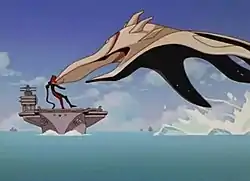 Evangelion Unit-02 (left) and Gaghiel during a battle. "Asuka Strikes!" received positive comments by critics, who praised action elements and the fight against Gaghiel. | |
| Episode no. | Episode 8 |
| Directed by | Kazuya Tsurumaki |
| Written by | Hideaki Anno, Yoji Enokido |
| Original air date | November 22, 1995 |
| Running time | 22 minutes |
Neon Genesis Evangelion director Hideaki Anno conceived "Asuka Strikes!" to lighten the tone of the series after the first six episodes, which were characterized by an introspective and psychological mood. Shinji Higuchi, who previously worked with Anno on Nadia: The Secret of Blue Water and is known for the humorous nature of his work, drew the storyboards, giving the story a teenage, comedic tone. For the installment, the staff drew several real-life vehicles, while also incorporating cultural references to the plays of William Shakespeare and Gainax studio's previous works. The episode's first broadcast scored a 7.6% rating of audience share on Japanese television. "Asuka Strikes!" received a positive reception from audiences and critics alike. Reviewers appreciated the humor, action, and introduction of Asuka's character, ranking it as one of the best episodes in the series.
Plot
Misato Katsuragi, captain of the special paramilitary agency Nerv, brings Shinji Ikari and his friends Toji and Kensuke on a flight to a United Nations carrier battlegroup that is transporting a giant mecha named Evangelion Unit-02 and its german pilot, Asuka Langley Sohryu, to Japan. Escorting Asuka to Japan is Misato's ex-boyfriend, Ryoji Kaji; meanwhile, a massive aquatic creature called Gaghiel, sixth of a series of enemies named Angels, begins attacking the fleet. Asuka determines that she will fight it using Unit-02, and she takes Shinji with her. The Angel drags Unit-02 underwater, and Misato devises a plan to kill it by lodging two sunken battleships in its mouth and then firing all weapons into it. The Angel is killed; some time after, Kaji delivers an embryo-like creature named Adam to Gendo, Nerv's commander, and Asuka transfers to Shinji's class.
Production
Hideaki Anno and Yoji Enokido wrote "Asuka Strikes!".[1] Kazuya Tsurumaki worked as director, Shinji Higuchi drew the storyboards, Masahiko Otsuka worked as assistant director.[2] Takeshi Honda joined as a chief animator; Hidenori Matsubara, Yoh Yoshinari, Shoichi Masuo, and others worked on the animation,[3] while Mahiro Maeda and Mitsumu Wogi served as character designers. The basic plot of the episode had already been chosen by Gainax in 1993 when it published a presentation document of Neon Genesis Evangelion titled "Proposal" (企画書, Kikakusho), which describes "a battle held on the deck of an aircraft carrier".[4] The original title of the episode was "Asuka's morning arrival" (アスカ、来朝),[5][6] later changed to the double title of "Asuka's Arrival" (アスカ、来日) in Japanese and "Asuka Strikes!" in English.[7]
.jpg.webp)
The first six episodes left the staff drained and feeling weighed down by the heavy mood; Hideaki Anno, director of the series, then decided to lighten the tone of the series starting from the seventh and eighth episodes.[8] Particularly important was the contribution of Higuchi, who had already worked on Nadia: The Secret of Blue Water and was known for the humorous character of his works; Higuchi, therefore, infused the episode with adolescent and comic tones.[9][10] Throughout the episode, the staff also used graphic-humorous symbols typical of comedy animes, such as Nadia.[11] Furthermore, the staff referred to "Asuka Strikes!" and the ninth episode as the "island arc" after the Nadia episode saga of the same name, which they found to be similar.[12] Asuka was also originally inserted by Anno to lighten the episodes, and only during the work it was decided to put his hand on her fragility. In the episode, she was introduced as a sunny girl, without the director thinking to re-evaluate her figure as much as in the final version and without foreshadowing. The director originally "didn't completely grasp the character" at first, but she came to life with her recurring lines, "Are you stupid?" and "What a chance!", pronounced for the first time in the installment.[13] Anno also said that he had forgotten about Rei Ayanami while writing the installment, as he didn't feel particularly close to the character, so he didn't even include her in a sequence.[14]
The installment also features real existing military vehicles, such as Sukhoi Su-33, Yakovlev Yak-38,[15] Northrop Grumman EA-6B Prowler, Northrop Grumman E-2 Hawkeye and Mil Mi-2.[16][17] A helicopter that does not really exist in the real world named Mil MI-55D was designed for the episode.[18][19] In addition, the official film book of the series noted that Gaghiel's battle with the battleships is realistically impossible; for the film books, Gainax could have deliberately ignored the realism of the clash, in an attempt to seek the catharsis of the viewer.[20] According to the original script, three battleships should have been used for the battle, but during the realization only two were used.[21] In the original intentions of the authors, the Angel who should have fought at sea against Unit 02 was Sachiel, an idea that was set aside and reused for Gaghiel, while Sachiel was then made to appear in the first episode.[22] Staff inserted some German technical jargon terms to use during the operations, such as bewegung, nerven anschlussess, anslösung, rinkskleidung [sic].[23] Yuko Miyamura, Asuka's voice actress, took lessons at a language school to practice before finding out it was technical jargon, and when she asked her native speaker teacher for advice he told her he didn't understand it.[13] Tomomichi Nishimura and Jin Yamanoi participated as voice actors for the captain and vice-captain of the Over The Rainbow. A background radio program was written for the episode;[24] Nishimura, Yuriko Yamaguchi, and Kotono Mitsuishi played the characters on the program.[25] Singer Aya also sang a version of Fly Me To The Moon in bossa nova style as the final theme song for "Asuka Strikes!".[26]
References and themes
The Nimitz-class aircraft carrier USS Harry S. Truman, renamed Over The Rainbow in homage to the namesake The Wizard of Oz' song, also appears in the installment.[27][28] Other ships that appear in the episode are the Kiev-class Soviet aircraft carrier Novorossiysk,[29] the Russian battlecruiser Kirov, the Russian destroyer Udaloy, the JS Kongō,[30][31] Iowa-class battleships USS Illinois (BB-65)[32] and the USS Kentucky (BB-66).[33][34] Russian aircraft carrier Admiral Kuznetsov, Arleigh Burke-class guided missile destroyer USS Ramage,[35] USS Ticonderoga (CG-47), Tachikaze, Hatakaze, Asagiri-class destroyers and Chikugo-class destroyer escorts are also visible in some scenes.[36] The code names of the units for internal use in the fleet are instead derived from titles of plays by William Shakespeare,[37] including Othello,[38] Cymbeline,[39] Titus Andronicus[40] and The Tempest.[41]
During the battle against Gaghiel the valves of Kings, or Kingston's valves, are mentioned, special valves used to fill the hull of a boat with water, located in the back of some old ships,[42][43] also mentioned in the original video animation by Gainax studio GunBuster.[44] At the end of the episode, Gendo also describes Adam as "the first human being", in homage to a similar scene in Nadia: The Secret of Blue Water.[45][46] According to writer Dennis Redmond, the admiral of Over the Rainbow would also constitute a tribute to Nadia; for him, "Asuka Strikes! "manage to pastiche all the classic ocean adventures from Moby Dick up to Jaws".[47] Yuichiro Oguro, editor of some of the extra content of the Japanese home video editions of the series, noted how from "Asuka Strikes!" onward the series portrays the characters and their interpersonal communications in a positive light.[48] Shinji and Asuka in the episode cooperate to defeat an Angel, also beginning the series' action arc.[49][50] Anime News Network's Nick Creamer also noted how from the eighth episode Neon Genesis Evangelion preponderantly adopts a monster of the week pattern.[51]
Reception
Asuka provides a natural foil for the dourness of Rei and timid uncertainty of Shinji. [...] Evangelion doesn't have too many light-hearted episodes. .... . "Asuka Strikes!" is an exception to the rule, and it's one of the better balanced and paced episodes of the first arc. Asuka and Kaji provided much needed energy and humour, while providing some much needed backstory.
The episode was first broadcast on November 22, 1995, and scored a 7.6% rating of audience share on Japanese television.[53][54] In 1996, it ranked nineteenth among Animage's Anime Grand Prix list of "Best Anime Episodes".[55] Official merchandise based on the episode has also been released.[56][57][58][59] The installment was received positively by critics and reviewers, who lauded its direction, plot, humour, action, and the introduction of Asuka's character. Digitally Obsessed's reviewer Joel Cunningham praised "Asuka Strikes!", describing it as "the funniest episode in the series"; Cunningham particularly enjoyed the "hilarious" relationship between Shinji and Asuka, saying, "A great introduction of a great character, and some very amusing dialogue, make this one of the standouts of the show thus far".[60] Max Covil (Film School Rejects) ranked it among the best episodes of the series, since "an Asuka-centered episode is usually a great sign of quality, and this is a lot of fun";[61] he also eulogized the first shot portraying Asuka in the shadows for bringing a sense of mystery for the new character.[62] Animation Planet magazine' John Beam positively reviewed "Asuka Strikes!"; he similarly praised the show for its "outstanding characterizations, animations, and dramatic presentation".[63]
Animé Café's Japanese reviewer Akio Nagatomi negatively received the episode. He criticized the introduction of Asuka and Kaji, which he said were stereotypical and cliché characters, as well as the introduction of Eva-02 "with a 'Phantom of the Opera' style cloak". The reviewer was particularly critical of Asuka, the script, and details of the plot and setting, which he felt were unrealistic. Despite this he expressed words of praise for the direction, saying that "the show does have flow; something to which a lot of other feature's can't lay claim".[64] Thompson Smith (Looper) described Gaghiel as one of the less interesting Angels in Neon Genesis Evangelion. According to Smith, it provides a problem for Asuka to solve in her first appearance, but "lacks any sort of significance beyond all that".[65] Comic Book Resources' Theo Kogod criticized Asuka's behavior in her first appearance; he negatively transposed the scene in which her skirt accidentally rises due to the sea breeze and slaps Toji, Kensuke, and Shinji, and, since none of the boys could control the weather, Kogod considered it "an overreaction - the first of many".[66] In contrast, Daniel Dockery (SyFy Wire) ranked the battle between Eva-02 and Gaghiel among the best "non-depressing moments" in Neon Genesis Evangelion. He compared the confrontation to Steven Spielberg's Jaws, and "every work of art, whether it's an anime or a song or a finger-painted mural, should aspire to be Jaws".[67]
The sequence where the episode title appears with the sound effect of Asuka's slaps received appreciation.[68] Screen Rant's Adam Beach ranked the battle against Gaghiel among the best fights in Neon Genesis Evangelion; Beach described it as "memorable", both for Asuka's introduction and the marine setting, praising its "interesting choreography".[69] His collegue Jack Cameron expressed a similar point of view.[70] Alex Walker (Kotaku) ranked "Asuka Strikes!" among the best Neon Genesis Evangelion episodes.[52] Writers Kazuhisa Fujie and Martin Forster also asserted that Asuka's line "Are you stupid?" has become popular since her first appearance in the eighth episode.[71] Newtype magazine praised its drawings and Asuka's facial expressions.[72] According to Next Flicks, her introduction "is when thematically Evangelion comes into its stride".[73] For Anthony Gramuglia (Comic Book Resources), she is a breath of fresh air compare to Shinji's insecurities presented in the previous seven episodes, and this invigorates the series with a "great deal of joy": "She changes the show, offering a diversity of perspective that livens things up".[74] Crunchyroll's reviewer Noelle Ogawa analogously wrote: "From her confident introduction aboard a battleship to her forceful and agressive [sic] battle style in her bright red Eva, she is a joy every time she's on screen".[75] Jemima Sebastian from IGN compared a scene from Godzilla vs. Kong (2021), in which King Kong on a ship suffers an underwater attack from Godzilla, to the fight between Gaghiel and Eva-02, describing it as a possible homage to Evangelion.[76]
References
 Text was copied/adapted from Episode 08 at Evangelion wiki, which is released under a Creative Commons Attribution-Share Alike 3.0 (Unported) (CC-BY-SA 3.0) license.
Citations
- Porori 2009, p. 80.
- Poggio 2008, p. 23.
- Groundwork of Evangelion (in Japanese). 1. Gainax. 2000. p. 217. ISBN 4903713008.
- Evangelion Chronicle (in Japanese). 18. Sony Magazines. p. 25.
- Gainax (1998). Neon Genesis Evangelion Newtype 100% Collection (in Japanese). Kadokawa Shoten. p. 88. ISBN 4-04-852700-2.
- Neon Genesis Evangelion Theatralical VHS Box Booklet (in Japanese). King Amusement Creative. 1997.
- Neon Genesis Evangelion Film Book (in Japanese). 3. Kadokawa Shoten. p. 32.
- "庵野秀明 - Part II". 新世紀エヴァンゲリオン残酷な天使のように (in Japanese). Magazine Magazine. 1997. ISBN 4-906011-25-X.
- Poggio 2008, p. 32.
- Oguro, Yūichirō. "第41回 エヴァ雑記「第八話 アスカ、来日」". Style.fm (in Japanese). Archived from the original on October 10, 2018. Retrieved July 23, 2020.
- Cannarsi 1998, p. 31.
- Platinum Booklet. 2. ADV.
- あんた、バカぁと、言われてみたい。(庵野秀明、宮村優子). Animage (in Japanese). Tokuma Shoten. July 1996.
- Takekuma 1997, pp. 93–96.
- Neon Genesis Evangelion Film Book (in Japanese). 3. Kadokawa Shoten. p. 40.
- Porori 2009, p. 83.
- Cannarsi 1998, pp. 56–57.
- Cannarsi 1998, pp. 26–27.
- Neon Genesis Evangelion Film Book (in Japanese). 3. Kadokawa Shoten. p. 24.
- Neon Genesis Evangelion Film Book (in Japanese). 3. Kadokawa Shoten. p. 35.
- Neon Genesis Evangelion Film Book (in Japanese). 3. Kadokawa Shoten. p. 42.
- Evangelion Chronicle (in Japanese). 23. Sony Magazines. pp. 7–8.
- Neon Genesis Evangelion Film Book (in Japanese). 3. Kadokawa Shoten. p. 36.
- Cannarsi 1998, p. 41.
- Eva Tomo no Kai エヴァ友の会 [Eva Fan Club] (in Japanese). 4. Gainax. 1996.
- Cannarsi 1998, p. 34.
- Cannarsi 1998, pp. 13–14.
- Neon Genesis Evangelion Film Book (in Japanese). 3. Kadokawa Shoten. p. 25.
- Cannarsi 1998, pp. 48–49.
- Cannarsi 1998, pp. 50–51.
- Evangelion Chronicle (in Japanese). 8. Sony Magazines. p. 25.
- Evangelion Chronicle (in Japanese). 2. Sony Magazines. p. 26.
- Cannarsi 1998, p. 52.
- Evangelion Chronicle (in Japanese). 8. Sony Magazines. p. 23.
- Cannarsi 1998, p. 53.
- Cannarsi 1998, pp. 54–55.
- Cannarsi 1998, p. 28.
- Evangelion Chronicle (in Japanese). 4. Sony Magazines. p. 25.
- Evangelion Chronicle (in Japanese). 10. Sony Magazines. p. 24.
- Evangelion Chronicle (in Japanese). 16. Sony Magazines. p. 21.
- Evangelion Chronicle (in Japanese). 19. Sony Magazines. p. 19.
- Cannarsi 1998, pp. 32–33.
- Evangelion Chronicle (in Japanese). 6. Sony Magazines. p. 24.
- Neon Genesis Evangelion Film Book (in Japanese). 3. Kadokawa Shoten. p. 43.
- Cannarsi 1998, pp. 44–45.
- Neon Genesis Evangelion Film Book (in Japanese). 3. Kadokawa Shoten. pp. 46–47.
- Redmond, Dennis (2004). The World is Watching: Video as Multinational Aesthetics, 1968–1995. Southern Illinois University Press. p. 137. ISBN 0-8093-2535-7.
- Oguro, Yūichirō. "第44回 エヴァ雑記「第拾壱話 静止した闇の中で」" (in Japanese). Archived from the original on November 28, 2020. Retrieved July 23, 2020.
- Oguro, Yūichirō. "第43回 エヴァ雑記「第拾話 マグマダイバー」" (in Japanese). Archived from the original on October 1, 2021. Retrieved July 23, 2020.
- Oguro, Yūichirō. "第45回 エヴァ雑記「第拾弐話 奇跡の価値は」" (in Japanese). Archived from the original on March 1, 2021. Retrieved July 23, 2020.
- Creamer, Nick (10 July 2019). "Neon Genesis Evangelion". Anime News Network. Archived from the original on 9 September 2019. Retrieved 8 November 2021.
- Walker, Alex (5 July 2021). "The Best Neon Genesis: Evangelion Episodes". Kotaku.com. Kotaku. Archived from the original on 5 July 2021. Retrieved July 23, 2020.
- "Anime Land". Newtype (in Japanese). Kadokawa Shoten. February 1996. p. 66.
- "新世紀エヴァンゲリオン テレビ本放送時 視聴率" (in Japanese). Archived from the original on July 6, 2009. Retrieved December 30, 2020.
- "第18回アニメグランプリ[1996年5月号]". Tokuma Shoten. Archived from the original on October 19, 2010.
- "EVA×錦 弐号機、来日 総刺繍スカジャン". Store.shopping.yahoo.co.jp (in Japanese). Evangelion Store Yahoo! Japan. Archived from the original on 6 November 2021. Retrieved 6 November 2021.
- "新世紀エヴァンゲリオン 全話Tシャツ 「第八話 アスカ、来日」". Store.shopping.yahoo.co.jp (in Japanese). Evangelion Store Yahoo! Japan. Archived from the original on 8 November 2021. Retrieved 6 November 2021.
- "新世紀エヴァンゲリオン ジグソーパズル アスカ、来日". Store.shopping.yahoo.co.jp (in Japanese). Evangelion Store Yahoo! Japan. Archived from the original on 6 November 2021. Retrieved 6 November 2021.
- Porori 2010, p. 125.
- Cunningham, Joel (8 March 2002). "Neon Genesis Evangelion Collection 0:2 (1995)". Digitallyobsessed.com. Digitally Obsessed!. Archived from the original on 2 June 2021. Retrieved 30 May 2021.
- Covill, Max (17 June 2019). "Every Episode of 'Neon Genesis Evangelion' Ranked". Filmschoolrejects.com. FIlm School Rejects. Archived from the original on 8 January 2021. Retrieved 16 May 2021.
- Covill, Max (19 June 2019). "The Perfect Shots of 'Neon Genesis Evangelion'". Filmschoolrejects.com. Film School Rejects. Archived from the original on 16 May 2021. Retrieved 16 May 2021.
- Beam, John (1997). G. Michael Dobbs (ed.). "Neon Genesis Evangelion: Genesis 0:4". Animation Planet. Vol. 1 no. 2. Inkwell Productions. pp. 13–14.
- Nagatomi, Akio. "Shinseiki Evangelion Review Pages – Episode 8: Asuka Strikes!". Abcb.com. The Animé Café. Archived from the original on 2 August 2018. Retrieved 31 May 2021.
- Smith, Thompson (13 August 2021). "The Most Powerful Angels From Neon Genesis Evangelion Ranked". Looper. Archived from the original on 8 November 2021. Retrieved 7 November 2021.
- Kogod, Theo (8 November 2019). "Neon Genesis Evangelion: The 10 Worst Things Asuka Ever Did, Ranked". Comic Book Resources. Archived from the original on 28 January 2021. Retrieved 7 November 2021.
- Dockery, Daniel (June 23, 2019). "The 10 most awesome (non-depressing) moments In Neon Genesis Evangelion". Syfy.com. Archived from the original on January 8, 2021. Retrieved July 23, 2020.
- Neon Genesis Evangelion Film Book (in Japanese). 3. Kadokawa Shoten. p. 27.
- Beach, Adam (7 May 2021). "Neon Genesis Evangelion: The 10 Best Fight Scenes In The Anime, Ranked". Screen Rant. Archived from the original on 19 May 2021. Retrieved 7 November 2021.
- Cameron, Jack (7 July 2019). "Every Battle in Neon Genesis Evangelion Ranked". Screenrant.com. Screen Rant. Archived from the original on 17 November 2020. Retrieved 16 May 2021.
- Fujie & Foster 2004, p. 162.
- Newtype Complete Shinseiki Evangerion Newtype Complete 新世紀エヴァンゲリオン [Newtype Complete Neon Genesis Evangelion] (in Japanese). Kadokawa Shoten. 2005. p. 26.
- "Neon Genesis Evangelion". Next Flicks. Archived from the original on 8 November 2021. Retrieved 7 November 2021.
- "Evangelion's Asuka Is One of the Most Fascinating Characters in Anime". June 29, 2019. Archived from the original on July 18, 2019. Retrieved April 27, 2020.
- Ogawa, Noelle (December 4, 2019). "Why Asuka is One of the Best Anime Characters of All Time". Crunchyroll. Archived from the original on June 2, 2020. Retrieved May 7, 2020.
- Sebastian, Jemima (24 March 2021). "Godzilla vs Kong tiene un par de referencias a Evangelion" (in Spanish). IGN. Archived from the original on 7 November 2021. Retrieved 7 November 2021.
Bibliography
- Takekuma, Kentaro (1997). 庵野秀明パラノ・エヴァンゲリオン (in Japanese). Ōta Shuppan. ISBN 4-87233-316-0.
- Cannarsi, Gualtiero (1998). Evangelion Encyclopedia (in Italian). 4. Dynamic Italia.
- Fujie, Kazuhisa; Foster, Martin (2004). Neon Genesis Evangelion: The Unofficial Guide. United States: DH Publishing, Inc. ISBN 0-9745961-4-0.
- Poggio, Alessandra (2008). Neon Genesis Evangelion Encyclopedia (in Italian). Dynit.
- Porori, Syunsou (2009). The Essential Evangelion Chronicle: Side A (in French). Glénat Editions. ISBN 978-2-7234-7120-6.
- Porori, Syunsou (2010). The Essential Evangelion Chronicle: Side B (in French). Glénat. ISBN 978-2-7234-7121-3.