Battle of Bình Lệ Nguyên
The Battle of Bình Lệ Nguyên (Vietnamese: Trận Bình Lệ Nguyên, Chu Han: 陣平厉原) was a battle between the invading Mongol forces led by Uriyangkhadai and Đại Việt forces led by king Trần Thái Tông. The battle took place on the field of Bạch Hạc, now located in Vĩnh Phúc province, northwest of Hanoi in mid-January 1258. The Mongol army defeated nearly the entire Vietnamese army but failed to capture Trần Thái Tông as he escaped by boat, and the capital Thang Long, which was captured and sacked by the Mongols five days later.[3]
| Battle of Bình Lệ Nguyên (1258) | |||||||
|---|---|---|---|---|---|---|---|
| Part of the First Mongol–Vietnamese War | |||||||
 | |||||||
| Belligerents | |||||||
| Đại Việt | Mongol Empire | ||||||
| Commanders and leaders | |||||||
|
Trần Thái Tông Lê Tần |
Uriyangkhadai Cacakdu Aju | ||||||
| Strength | |||||||
| – | 13,000[1]–25,000[2] | ||||||
Uriyangkhadai led a successful campaign in the southwest of China and pacified the tribes in Yunnan before turning east towards Dai Viet by 1257. In the autumn of 1257, Uriyangkhadai addressed three letters to the Vietnamese king Trần Thái Tông demanding passage through to southern China.[4] After the three successive envoys were imprisoned in the capital Thang Long (modern-day Hanoi) of Dai Viet, Uriyangkhadai invaded Dai Viet in December 1257 with generals Trechecdu and Aju in the rear.
Battle
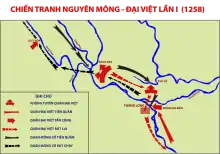
On 17 January, king Trần Thái Tông led his army from atop an elephant to confront the Mongols in the plain of Bach Hac with elephants and infantry.[5] The Mongol army consisted with Yunnanese foot soldiers and Mongol cavalry.[6] From the opposite northern banks of the Red River, they divided into three columns to cross the river.[6] Trechecdu led the first column of 5,000 troops crossing the river, followed by Uriyangkhadai and Aju.[6] After the Mongol had crossed the river, king Thái Tông ordered to attack the enemy.[6] Aju ordered his troops to fire arrows at the elephants' feet.[7] The animals turned in panic and caused disorder in the Vietnamese army, which was routed.[5][7] The general, Lê Tần, persuaded the king to flee the despairing battle.[8] The Vietnamese senior leaders were able to escape on pre-prepared boats while part of their army was destroyed at No Nguyen (modern Viet Tri on the Hong River). The remainder of the Vietnamese force again suffered a major defeat in a fierce battle at the Phú Lộ bridge the day after. This led the Vietnamese king to evacuate the capital. The Đại Việt annals reported that the evacuation was "in an orderly manner;" however this is viewed as an embellishment because the Vietnamese had to retreat in disarray to leave their weapons behind in the capital.[9]
Aftermath
King Thái Tông fled to an offshore island while the Mongols occupying Hanoi and massacring all of its civilians in revenge of the death of one imprisoned Mongol envoy.[10] After 9 days, Uriyangkhadai retreated his forces back to Yunnan. In March 1258, crown prince Trần Hoảng became the new king of Đại Việt as his father Trần Thái Tông retired. Uriyangkhadai demanded that one of the king's prince or brother would be sent to Dadu as hostage.[11]
References
Citations
- Atwood 2004, p. 579.
- Vu & Sharrock 2014, p. 100.
- Taylor 2013, p. 123.
- Vu & Sharrock 2014, p. 84.
- Vu & Sharrock 2014, p. 101.
- Hà & Phạm 2003, p. 68.
- Baldanza 2016, p. 18.
- Hà & Phạm 2003, p. 69.
- Vu & Sharrock 2014, p. 102.
- Sun 2014, p. 207.
- Allsen 2006, p. 407.
Books
- Allsen, Thomas (2006), "Imperial Ideal Compromised: Northern and Southern Courts Across the New Frontier in the Early Yuan Era", in Franke, Herbert; Twittchet, Denis C. (eds.), The Cambridge History of China - Volume 6: Alien regimes and border states, 907—1368, Cambridge: Cambridge University Press, pp. 321–413
- Anderson, James A. (2014), "Man and Mongols: the Dali and Đại Việt Kingdoms in the Face of the Northern Invasions", in Anderson, James A.; Whitmore, John K. (eds.), China's Encounters on the South and Southwest: Reforging the Fiery Frontier Over Two Millennia, United States: Brills, pp. 106–134, ISBN 978-9-004-28248-3
- Atwood, Christopher Pratt (2004). Encyclopedia of Mongolia and the Mongol Empire. New York: Facts of File. ISBN 978-0-8160-4671-3.
- Baldanza, Kathlene (2016). Ming China and Vietnam: Negotiating Borders in Early Modern Asia. Cambridge University Press. ISBN 978-1-316-53131-0.
- Hà, Văn Tấn; Phạm, Thị Tâm (2003). "III: Cuộc kháng chiến lần thứ nhất" [III: The First Resistance War]. Cuộc kháng chiến chống xâm lược Nguyên Mông thế kỉ XIII [The resistance against the Mongol invasion in the 13th century] (in Vietnamese). People's Army Publishing House. ISBN 978-604-89-3615-0.
- Sun, Laichen (2014), "Imperial Ideal Compromised: Northern and Southern Courts Across the New Frontier in the Early Yuan Era", in Anderson, James A.; Whitmore, John K. (eds.), China's Encounters on the South and Southwest: Reforging the Fiery Frontier Over Two Millennia, United States: Brills, pp. 193–231
- Taylor, K.W. (2013), A History of the Vietnamese, Cambridge University Press, ISBN 978-0521699150
- Vu, Hong Lien; Sharrock, Peter (2014). "The First Mongol Invasion (1257-8 CE)". Descending Dragon, Rising Tiger: A History of Vietnam. Reaktion Books.
Articles
- Haw, Stephen G. (2014). "Bayan of the Bārin's Persian Wife, And Other Perplexities". Journal of Asian History. 48 (2): 263–279. doi:10.13173/jasiahist.48.2.0263 – via JSTOR.
- Lane, George (2017). "The Dali Stele & Sayyed 'Ajall". Hududü'l-Alem: İsenbike Togan'a Armağan – via Academia.edu.
- Vĩ, An Lư (2018). "Arab and Persian Historiography from X to XIV century". Science and Technology Development Journal-Social Sciences & Humanities. 2: 42–50 – via Academia.edu.