Battle of Qbaada
The Battle of Qbaada (Adyghe: Ӏаткъуадж зауэ, romanized: 'atqwadj zawə; Russian: Кра́снополя́нская битва) was a last stand battle in 1864 fought between the last remains of the Circassians and the Russian imperial forces during the Russo-Circassian War.[6][2][7][8][3][9][4][10] It is widely accepted as the last battle of the war as no other significant battle, other than minor rebellions, occurred.[11][12][13][4][14]
| Battle of Qbaada | |||||||
|---|---|---|---|---|---|---|---|
| Part of Russo-Circassian War | |||||||
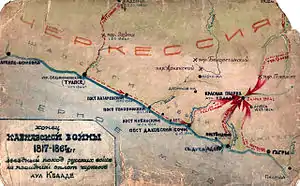 Location on the map | |||||||
| |||||||
| Belligerents | |||||||
 Russian Empire Russian Empire | |||||||
| Commanders and leaders | |||||||
|
Michael Nikolaevich Dimitri Ivanovich Pavel Khristoforovich Grabbe Pavel Shatilov Vasily Alexandrovich | None, soldiers led by their superiors in the disorganized resistance army | ||||||
| Units involved | |||||||
|
|
 Last Circassian ressistance (Equipped with swords) Last Circassian ressistance (Equipped with swords) | ||||||
| Strength | |||||||
| 100,000-250,000 | 20,000 | ||||||
| Casualties and losses | |||||||
| Unknown but heavy | 20,000 | ||||||
| During the Circassian Genocide, about 1,500,000[1][2][3][4] indigenous highland Caucasians were expelled mainly to the Ottoman Empire, and a much smaller number to Persia. An unknown number of those expelled died during deportation.[5] | |||||||
| Part of a series on the |
| Circassians Адыгэхэр |
|---|
 List of notable Circassians |
| Circassian diaspora |
| Circassian tribes |
|
Surviving Destroyed or barely existing |
| Religion |
|
Religion in Circassia |
| Languages and dialects |
|
| History |
|
Ancient Medieval Modern Contemporary Key battles |
| Culture |

History
The battle took place in Qbaada in 1864 between the Circassian army of 20,000 tribal horsemen and a Russian army of 100,000 men, consisting of Cossack and Russian horsemen, infantry and artillery.[3] The Russian forces advanced from four sides.[2]
Circassian forces decided to not surrender to the Russian army, and tried to break the line, but many were hit by Russian artillery and infantry before they managed to reach the front. The remaining fighters continued to fight as militants, took down many units, and were soon defeated. All 20,000 Circassian horsemen died in the war.
The Russian army began celebrating victory on the corpses of Circassian soldiers, and a military-religious parade was held, this was officially the end of the war. The place where this battle took place is known today as Krasnaya Polyana. "Krasnaya Polyana" meaning "red madow", takes its name from the Circassian blood flowing from the hill into the river. Circassian genocide was initiated after the Qbaada battle. The Russian army began raiding and burning Circassian villages, destroying fields to prevent return, cutting down trees, and driving the people to the Black Sea coast, the soldiers used many methods to entertain themselves.[14]
References
- Richmond, Walter (2013). The Circassian Genocide. Rutgers University Press. back cover. ISBN 978-0-8135-6069-4.
- "Çerkes Soykırımı nedir? 21 Mayıs 1864 Çerkes Sürgünü tarihçesi". Milliyet (in Turkish). Retrieved 2021-01-13.
- Неизвестные войны России. Взятие Кбааде и завершение Кавказской войны в 1864 г.
- Ufuk Tavkul, "Kazaklar", Birleşik Kafkasya dergisi, Ankara, 2007, Sayı 6-7, sf. 33
- McCarthy 1995:53, fn. 45
- Semen Esadze. Çerkesya'nın Ruslar Tarafından İşgali. Ankara, 1995, sf. 123-132.
- Jineps,2006,ek-1,s.2
- T.V.Polovinkina, Çerkesya Gönül Yaram. Ankara, 2007, sf. 258
- Nıbe Anzor, 'Çerkes Meclisi 150 Yaşında', (In Turkish)
- "Çerkesler olimpiyat meşalesini söndürdü". www.cumhuriyet.com.tr (in Turkish). Retrieved 2021-01-13.
- Semen Esadze. Çerkesya'nın Ruslar Tarafından İşgali. Ankara, 1995, sf. 123-132.
- Jineps,2006,ek-1,s.2
- T.V.Polovinkina, Çerkesya Gönül Yaram. Ankara, 2007, sf. 258
- Weismann, Ein Blick auf die Circassianer