Brazilian military junta of 1930
The Brazilian military junta of 1930, also known as the Pacification Junta (Portuguese: Junta Pacificadora), was a provisional military junta that governed Brazil from 24 October to 3 November 1930. The junta was a result of the Revolution of 1930, and it was ended when the three generals that had instigated the coup in which they seized control handed power over to revolutionary leader Getúlio Vargas.
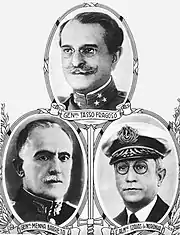
The First Brazilian Republic was dominated by an interstate oligarchy that manipulated elections and handpicked the Brazilian presidency. This oligarchy, between Minas Gerais and São Paulo, was broken when President Washington Luís nominated Júlio Prestes to succeed him. Backed by military rebels, Minas Gerais responded by forming the Liberal Alliance with Paraíba and Rio Grande do Sul, which nominated Getúlio Vargas for the presidency. When Prestes won the March 1930 election, the Alliance claimed electoral fraud and orchestrated an armed revolution beginning on 3 October 1930. In Rio de Janeiro, then capital of Brazil, Generals Augusto Tasso Fragoso, head of the junta, João de Deus Mena Barreto, and José Isaías de Noronha decided that Luís had to be removed from the presidency in order to prevent a civil war.
Luís, having been persuaded to resign by archbishop Sebastião da Silveira Cintra, was ousted by the military leaders, who took control of Brazil as a provisional governing body on 24 October, claiming to be the sole power in the country, despite only controlling Rio de Janeiro. The junta initially considered retaining power, but acquiesced to revolutionaries on 3 November 1930, transferring power to Vargas and the revolutionaries after they arrived in the capital.
Background
.jpg.webp)
.jpg.webp)
Throughout the First Brazilian Republic, the presidency was interchanged every election between politicians of the states of Minas Gerais and São Paulo,[1] in a system called "coffee and milk politics". These two states—the most economically advanced in the country—manipulated elections in their favor and effectively governed Brazil as an oligarchy.[1] Tenentes (English: lieutenants) in the military opposed this system, but their attempted revolts throughout the 1920s were unsuccessful.[2]
The tradition was broken in 1929 when incumbent President Washington Luís, from São Paulo, nominated another man from the same state, Júlio Prestes, as his successor rather than exchanging the position with a politician from Minas Gerais.[3] Luís' decision was decried by Minas Gerais, Paraíba, and Rio Grande do Sul. With the support of the tenentes, they formed the Liberal Alliance and nominated Getúlio Vargas, a politician from Rio Grande do Sul, for president.[3] The coalition advocated reform to address the below-average working conditions of women and children, advocating the adoption of a national Labor Code, and supporting education, hygiene, diet, housing, and recreation.[4]
In March 1930, Prestes won the election against Vargas in an election marred by electoral fraud from both sides, with Vargas reportedly having won Rio Grande do Sul 298,627 to 982 votes.[3][5] Tensions were exacerbated on 26 July 1930, when Vargas' running mate João Pessoa was assassinated by João Dantas. Despite Pessoa's death being attributed to private and public affairs, it revitalized a revolutionary climate amongst the opposition, leading to Vargas and his allies instigating a revolution on 3 October 1930.[3][6] The revolution was backed by the tenentes and state militas in the South, Belo Horizonte, and the Northeast.[7] As Central-West railway workers went on strike and the people of Recife, Pernambuco, turned against their government, revolutionaries swiftly took control of the Northeast under the command of Juarez Távora. As a whole, the revolution was under the command of Góes Monteiro. There was minor resistance to the revolution in Minas Gerais. In São Paulo, the Democratic Party (PD), who had supported Vargas, abstained from any revolutionary activity.[8]
Prelude to a military coup
On 19 October, the popular Cardinal Sebastião Leme, archbishop of Rio de Janeiro,[9] arrived in the capital from Rome. Two days earlier, Cavalcanti had convinced him that, in the interest of peace, he should procure Luís's resignation. When Leme proposed his resignation, the president replied, "What! Then Your Eminence doubts the loyalty of my generals!"[10]
Many generals believed the president's continued stubbornness was useless, and they feared a civil war. Augusto Tasso Fragoso, former Army Chief of Staff, had told former Rio Grande do Sul deputy Lindolfo Collor that he may join the revolution if it became nationwide.[11][12] Though Fragoso stated his opposition to the armed overthrow of constitutional authorities, he said he would "take the attitude which his patriotism indicated."[13] After attending Mass for a general killed in Paraíba, he told General João de Deus Mena Barreto that a rebellion in Rio seemed imminent. Mena Barreto was being urged by his Chief of Staff Colonel Bertoldo Klinger, on behalf of a group of young officers, to intervene to end the hostilities in a military coup favorable to revolutionaries. Concerned about the military hierarchy, Mena Barreto suggested Tasso Fragoso, the most senior officer, head the movement. When he refused, he asked Army Chief of Staff Alexandre Henrique Xavier Leal, who also refused. Finally, on the morning of 23 October, one of Mena Barreto's sons convinced Tasso Fragoso to take charge.[11][13]
Mena Barreto told Klinger to give the president an ultimatum. Many were reluctant to sign it, but Klinger received approval from key members of the Army's general staff. What was being proposed was a "pacification coup." Tasso Fragoso reworded Klinger's document to make it seem like more of an appeal to the president. Tasso Fragoso, Mena Barreto, and their associates convened on the night of 23 October at Fort Copacabana to make plans for the ousting, having received assurance of support from the military police and the outlying barracks at Vila Militar.[11]
The junta
Capitulation of Luís and the junta's formation
.jpg.webp)
The operation which would depose the President was initiated on the morning of 24 October.[11][14] Before dawn, the Minister of War and commander of the 1st Military Region came to talk with Luís, and, just from their faces, it became clear the situation was unsustainable and irreversible. Shortly before 9 a.m., Leme called to speak with Minister of Foreign Affairs Otávio Mangabeira that he had been told Fort Copacabana ordered the President leave by 11 a.m., and, as a warning, they would begin shooting dry powder after 9 a.m. Luís determined his wife and other ladies in the Guanabara Palace, Luís's residence, would evacuate and seek shelter in their friends' house in Cosme Velho. Shots of dry powder began as they left, scaring the entire population of Rio.[11][13]
Klinger's appeal, signed by the generals, appeared early in the press. Consequently, mobs were soon enthusiastically setting fire to pro-government newspapers. Meanwhile, rebel troops were moved from the regiment at Praia Vermelha to the Guanabara Palace. The movement was only hindered by crowds of armed civilians hoping to join the march. The President gathered those present and allowed them to leave, but none did, sticking by his side. Though the President was told he could count on 2,600 soldiers, the police brigade defending the Guanabara Palace chose not to resist. Tasso Fragoso and Mena Barreto, as well as Alfredo Malan d'Angrogne, entered. They found the President, who got up to speak with them, sitting solemnly in a small, gloomy room, surrounded by his cabinet, sons, a few friends, and congressmen, in the distance taunting cries of the crowd outside.[11][13][15]
According to historian John W. F. Dulles, "The President remained every inch the proud man who would fulfill his duty as he saw it."[11] "Only in pieces I leave here," the President said to his ministers.[16] He said there were still soldiers to defend his government. He was completely mistaken, and Tasso Fragoso later explained, "No one wanted his son to put on a uniform and die fighting a man frankly divorced from the common interest."[16][17] After bowing, Tasso Fragoso offered Luís his life, to which the President proclaimed, in a firm and dry tone, "The last thing I cherish at a time like this is my life. My blood will soak the soil so that a better Brazil may emerge, a true national regeneration."[18] After Luís refused to resign and tensions climaxed, the General replied, "Your Excellency will be responsible for the consequences," to which Luís accepted.[18][19] Bowing again, Tasso Fragoso left.[18]
That afternoon, Cardinal Leme, calling on the President at Tasso Fragoso's request, told him the generals had established their provisional government junta on the first floor of the Guanabara Palace. He used his influence with Luís to ease him out of office in safety. Noting the ugly mood of the crowd, Leme said Fort Copacabana would be the safest place for the President, and he was able to get the generals to agree that he would be allowed to set sail for Europe without delay. Those who were by his side concurred, and at 5 p.m., he agreed and was driven to Fort Copacabana. In the presidential limousine with Luís were Leme, Tasso Fragoso, and several others. The President explained to Leme, "Since this morning, I have been a prisoner in this room, with the palace and gardens invaded by troops. I leave, bowing to violence."[18][13][20]
Government
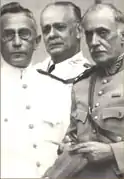
Fragoso, head of the junta,[18] Barreto, and Noronha declared themselves a ruling body, claiming to exist as a "pacifying junta" with a "moderating power",[21][7] despite the fact that the territory they controlled was limited to Rio de Janeiro.[22] Initially, the generals attempted to remain in power, appointing a new minister of war (Leite de Castro), chief of police (Betolodo Klinger), and military governor of São Paulo (Hastínfilo de Moura).[23] Klinger told the press on 28 October that "the false rumor that the Governing Junta will be summarily replaced and will turn over the reins of government to Getúlio Vargas" was ungrounded.[24]
The revolutionaries were caught off guard by the sudden nature of the coup, having been given no notice. During the revolution, a major rebel offensive was supposed to occur on the Paraná–São Paulo border but was delayed due to bad weather from 20—24 October.[25] However, the attack, already in progress by 25 October, was called off when the rebels heard of the coup in the capital.[25][14] Refusing to recognize the junta, Távora proceeded to lead his troops into Salvador, Bahia's capital.[26] Vargas, in charge of the revolution, telegraphed on 24 October that the members of the junta would be "accepted as collaborators and not directors," that they "joined the revolution at the time when its success was assured," and that he would listen to any proposals the junta had before setting out for São Paulo the next day.[23][25] The junta responded on 27 October, declaring that they would await the arrival of Vargas for any further action to be taken in arranging the government.[25] Several more messages would be exchanged between Vargas and the junta.[27]
The junta's attempts at consolidating power proved unsuccessful, however; due to popular demonstration, increasing pressure from troops entering the capital, and the opposition of Vargas, the government held talks with Távora, Collor, and Oswaldo Aranha on 28 October to arrange a new government.[28][29][14][21][22][26] The latter, Aranha, proclaimed in a message to the junta on 28 October that revolutionaries could not "stop in the middle of the road".[26] Additionally, Governor Moura was very unpopular, with backlash towards him being so high that protests erupted in São Paulo, leading to him leaving office on 28 October.[30][23] Klinger's statement to the press, made while talks were being held with Aranha, was also overriden by the junta itself, confirming the junta would hand over the government to Vargas.[24]
Transition of power
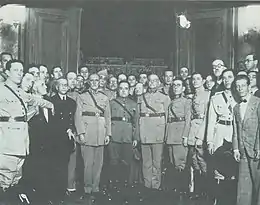
Vargas, refusing to enter Rio de Janeiro until it was controlled by Rio Grande do Sul, arrived in the capital on the morning of the 31 October after 3,000 troops had secured it. Upon arriving and receiving massive praise, Vargas and his comrades hitched their horses to the obelisk at the foot of Avenida Rio Branco as a way of symbolically showing regional victory, and Vargas arrived at the Catete Palace the same day.[21][27][22][31][29][28][25] On 3 November 1930, the junta handed power over to Vargas, beginning Vargas's presidency and officially marking the end of the First Brazilian Republic.[22][31] In a speech accompanying the transition, Fragoso proclaimed the military intervened with the hope that "Brazilians cease spilling blood on behalf of a cause which was not endorsed by the national conscience."[17] He also bashed Luís, saying he had "acted as a veritable king, with complete disdain for everything and everybody."[32] Vargas acclaimed the junta for avoiding the further sacrifice of lives.[32]
Instead of opting for the option of installing himself as if the 1930 election had made him the victor and governing by the 1891 constitution, Vargas set up a Provisional Government with emergency powers.[33] A complete break of the past was pursued. The constitution was suspended and Vargas became Chief of the Provisional Government of the Republic, holding legislative and executive powers. The judiciary remained, though Aranha favored the Supreme Court be extinguished and Vargas ended up removing four judges from it and dismissing various from lower courts.[34]
Aftermath and legacy
All three members of the junta would go on to hold further political office. Barreto would be appointed federal intervenor for Rio de Janeiro in 1931, minister of the Supreme Military Court the same year, and, finally, a mediator in the 1932 Constitutionalist Revolution between São Paulo and the federal government.[35] Fragoso became chief of the Army's General Staff under Vargas, but resigned the next year. He would be appointed minister — and later vice president — of the Supreme Military Court. Fragoso retired in 1938 and became devoted to historical research.[36][37] Noronha would become minister of the Navy under Vargas, dismissed in December 1930. Noronha was retired in 1941.[38] Barreto would be the first junta member to pass away, dying on 25 March 1933. He would be followed by Fragoso on 20 September 1945, and Noronha, the last living junta member, would die on 29 January 1963.[35][36][38]
The involvement of the military was summarized by historian Thomas Skidmore:[39]
As in 1889, when the Republic replaced the Empire, control at the critical moment was assumed by the higher military and then transferred to a new cadre of civilian politicians. In 1930, Army and Navy commanders found themselves cast in a position which was to become increasingly familiar in subsequent Brazilian history: the role of final arbiter in domestic politics.
References
- Meade 2010, p. 123.
- Roett 1992, p. 22.
- Skidmore 1999, p. 107.
- Levine & Crocitti 1999, p. 156.
- Fausto & Fausto 2014, p. 187.
- Fausto & Fausto 2014, p. 188.
- Reid 2014, p. 78.
- Fausto & Fausto 2014, pp. 188–189.
- Abreu.
- Dulles 2012, p. 71.
- Dulles 2012, p. 72.
- Skidmore 2007, pp. 5–6.
- Ribeiro 2005.
- Bourne 1974, p. 45.
- Neto 2012, pp. 505–506.
- Neto 2012, p. 505.
- Skidmore 2007, p. 6.
- Dulles 2012, p. 73.
- Neto 2012, p. 506.
- Bourne 1974, pp. 45–46.
- Bourne 1974, p. 46.
- Skidmore 1999, p. 108.
- Young 1964.
- Dulles 2012, p. 75.
- Young 1967, pp. 66–69.
- Dulles 2012, p. 74.
- "Revolução de 1930: 75 anos". Assembleia Legislativa do Estado de São Paulo. 21 October 2005. Retrieved 5 May 2021.
- "Revolução de 1930". Getulio Vargas Foundation. Retrieved 22 June 2021.
- Fausto & Fausto 2014, p. 189.
- "Governadores do Estado de São Paulo". Assembleia Legislativa do Estado de São Paulo. 21 September 2012. Retrieved 5 May 2021.
- Levine 1970, p. 1.
- Dulles 2012, p. 79.
- Bourne 1974, p. 47.
- Dulles 2012, p. 79.
- "João de Deus Menna Barreto; Biografia". Presidência da República. Retrieved 15 May 2021.
- "Augusto Fragoso; Biografia". Presidência da República. Retrieved 15 May 2021.
- Bourne 1974, p. 53.
- "José Isaías de Noronha; Biografia". Presidência da República. Retrieved 15 May 2021.
- Skidmore 2007, pp. 6–7.
Sources
- Abreu, Alzira Alves de. "Revolução de 1930". FGV CPDOC. Retrieved 7 October 2021.
- Bourne, Richard (1974). Getulio Vargas of Brazil, 1883—1954 Sphinx of the Pampas. London, England: C. Knight. ISBN 978-0-85314-195-2.
- Dulles, John W.F. (2012). Vargas of Brazil: A Political Biography. Austin, Texas: University of Texas Press. ISBN 978-0-292-74078-5.
- Fausto, Boris; Fausto, Sergio (2014). A Concise History of Brazil (Second ed.). Cambridge University Press. ISBN 9-781-107-63524-1.
- Levine, Robert M. (1970). The Vargas regime: The critical years, 1934-1938. New York: Columbia University Press.
- Levine, Robert M.; Crocitti, John J. (1999). The Brazil reader: history, culture, politics. Duke University Press. ISBN 978-0-822-32290-0.
- Meade, Teresa A. (2010). A Brief History of Brazil. Infobase Publishing. ISBN 978-0-8160-7788-5.
- Neto, Lira (2012). Getúlio: dos anos de formação à conquista do poder. São Paulo: Companhia das Letras. ISBN 978-85-359-2093-2.
- Reid, Michael (2014). Brazil: The Troubled Rise of a Global Power. Yale University Press. ISBN 978-0-300-16560-9.
- Ribeiro, Antônio Sérgio (21 October 2005). "Revolução de 1930: 75 anos". Assembleia Legislativa do Estado de São Paulo. Retrieved 5 May 2021.
- Roett, Riordan (1992). Brazil: Politics in a Patrimonial Society; Fourth Edition. Westport, Connecticut: Praeger.
- Skidmore, Thomas E. (1999). Brazil: Five Centuries of Change. United States: Oxford University Press.
- Skidmore, Thomas E. (2010). Brazil: Five Centuries of Change (2º ed.). United States: Oxford University Press. ISBN 978-0-19-537455-1.
- Skidmore, Thomas E. (2007). Politics in Brazil, 1930–1964. New York, New York: Oxford University Press. ISBN 978-0-19-533269-8.
- Young, Jordan M. (1964). "Military Aspects of the 1930 Brazilian Revolution". Hispanic American Historical Review. 44 (2): 180–196 – via Duke University Press.
- Young, Jordan M. (1967). The Brazilian revolution of 1930 and the aftermath. New Brunswick, New Jersey: Rutgers University Press.
| Old Republic (1889–1930) |  | |
|---|---|---|
| Vargas Era (1930–45) | ||
| Republic of '46 (1946–64) | ||
| Military dictatorship (1964–85) | ||
| New Republic (1985–present) | ||