Floriano Peixoto
Floriano Peixoto | |
|---|---|
.jpg.webp) Marshal Floriano in 1891 | |
| President of Brazil | |
| In office 23 November 1891 – 14 November 1894 | |
| Vice President | Manuel Vitorino |
| Preceded by | Deodoro da Fonseca |
| Succeeded by | Prudente de Morais |
| Vice President of Brazil | |
| In office 26 February 1891 – 23 November 1891 | |
| President | Deodoro da Fonseca |
| Preceded by | Position established |
| Succeeded by | Manuel Vitorino |
| Minister of War | |
| In office 19 April 1890 – 22 January 1891 | |
| President | Deodoro da Fonseca |
| Preceded by | Eduardo Wandenkolk |
| Succeeded by | Falcão da Frota |
| President of the Mato Grosso Province | |
| In office 13 September 1884 – 5 October 1885 | |
| Monarch | Pedro II |
| Preceded by | Baron of Batovi |
| Succeeded by | Ramos Ferreira |
| Personal details | |
| Born | 30 April 1839 Maceió, Alagoas, Empire of Brazil |
| Died | 29 July 1895 (aged 56) Barra Mansa, Rio de Janeiro, Brazil |
| Nationality | Brazilian |
| Political party | Independent |
| Spouse(s) | |
| Signature | 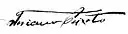 |
| Nickname(s) | The Iron Marshal |
| Military service | |
| Allegiance | .svg.png.webp) Empire of Brazil Empire of Brazil  Brazil Brazil |
| Branch/service |  Brazilian Army Brazilian Army |
| Years of service | 1861–1889 |
| Rank | Field Marshal |
| Battles/wars | Paraguayan War |
Floriano Vieira Peixoto (Portuguese pronunciation: [floɾiˈɐ̃nu viˈe(j)ɾɐ pe(j)ˈʃotu] 30 April 1839 – 29 July 1895), born in Ipioca (today a district of the city of Maceió in the State of Alagoas), nicknamed the "Iron Marshal",[1] was a Brazilian soldier and politician, a veteran of the Paraguayan War, and the second president of Brazil.[2] He was the first vice president of Brazil to have succeeded the president mid-term.
Election
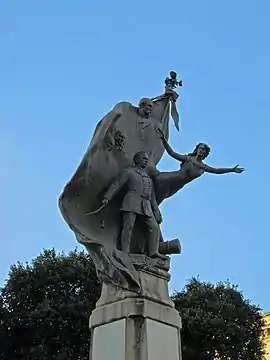
Peixoto was an army marshal when elected vice-president in February 1891. In November 1891, he rose to the presidency after the resignation of Marshal Deodoro da Fonseca, the first president of Brazil. Peixoto came to the presidency in a difficult period of the new Brazilian Republic, which was in the midst of a general political and economic crisis made worse by the effects of the bursting of the Encilhamento economic bubble. As Vice President, he had also served as the President of the Senate.[3]
Presidency
His government was marked by several revolutions. Ruling in an authoritarian fashion, Peixoto defeated a naval officers' rebellion against him in 1893–1894 and the Federalist Riograndense Revolution in the States of Rio Grande do Sul and Santa Catarina, where he ordered many murders and summary executions, during the same years.[4] His government was marked by an increased centralization of power and nationalism, with the florianista cult of personality being the first phenomenon of a favorable political expression towards a republican politician in Brazil.[5]
Legacy
He is often referred to as "the Consolidator of the Republic" or "The Iron Marshal." He left the presidency on 15 November 1894. In spite of his unpopularity, he was responsible for the consolidation of the First Brazilian Republic.
Desterro, the capital of the state of Santa Catarina, was renamed Florianópolis after its defeat by loyalist troops at the end of the Federalist Revolution.
References
- "A República de Ferro". folha online (in Portuguese). Retrieved 12 July 2015.
- Floriano Vieira Peixoto (in Portuguese)
- "República Velha (1889 - 1930)". Senado Federal (in Portuguese).
- https://core.ac.uk/download/pdf/37705125.pdf
- "Florianismo | Atlas Histórico do Brasil - FGV". atlas.fgv.br (in Portuguese). Retrieved 19 May 2018.
External links
 Media related to Floriano Peixoto at Wikimedia Commons
| Old Republic (1889–1930) |  | |
|---|---|---|
| Vargas Era (1930–45) | ||
| Republic of '46 (1946–64) | ||
| Military dictatorship (1964–85) | ||
| New Republic (1985–present) | ||
| Old Republic (1889–1930) |  | |
|---|---|---|
| Republic of 46 (1946–1964) | ||
| Military Regime (1964–1985) | ||
| New Republic (1985–) | ||
Authority control  | |
|---|---|
| General | |
| National libraries | |
| Other | |