Cascatelli
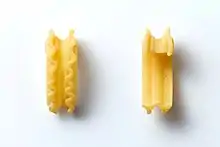
Cascatelli [kaskaˈtɛlli] are a short pasta with a flat strip and ruffles that stick out at a 90-degree angle. The ruffles give the shape texture and create a "sauce trough" that holds sauce.
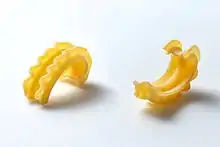 | |
| Type | Pasta |
|---|---|
| Place of origin | United States |
| Created by | Dan Pashman Sfoglini |
| Main ingredients | Durum wheat flour, water |


They are hybrids of the bucatini and mafalda pasta types, highlighting the half-tube components and ribbon-shaped ruffle pasta respectively.
Name
The name comes from the Italian cascate meaning "waterfalls", while cascatelle means "little waterfalls".[1] Pashman decided to end it with -elli to sound like more traditional Italian pasta names that often end with the masculine plural diminutive suffixes -ini, -elli, -illi, -etti to convey the sense of "little."
History
Dan Pashman, host of the "Sporkful" podcast, decided to make a new "ideal" pasta shape that needed to have the perfect bite, an appealing texture, and hold the right amount of sauce. The American pasta company, Sfoglini, partnered with Pashman to make this pasta come true.[2]
Pashman coined terms to describe the three qualities to talk about pasta shapes:
- "Forkability" - how easy it is to get a pasta shape on your fork and keep it there
- "Sauceability" - how well a sauce sticks to it
- "Toothsinkability" - how satisfying it is to sink your teeth into
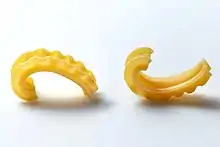 Cascatelli pasta, invented by Dan Pashman of The Sporkful podcast.
The pasta was officially released in 2021, after a three-year research and development process. That process is documented in The Sporkful podcast series "Mission: ImPASTAble."
Composition and use
Cascatelli are a half-tubed pasta made of hard durum wheat flour and water, or semolina. The suggested cook time is 13-17 minutes.
Sfoglini's self-claimed perfect ragù companion for cascatelli is pancetta and red pepper flakes, similar to the classic Roman sauce amatriciana, with ground pork, onion, carrots, and celery which make it more Bolognese.[3] This is similar to the parent pasta, bucatini, which in Italian cuisine is commonly served with amatriciana sauce.[4]
See also
References
- "For Pasta Lovers Bored By Spaghetti, There's A New Short, Wavy, Sauce-Holding Shape". NPR. Retrieved 2021-04-01.
- "Everything you need to know about cascatelli, the new "perfect" pasta shape that's a viral hit". Salon. Retrieved 2021-04-01.
- "Cascatelli with Double Pork Ragu". Sfoglini. Retrieved 2021-04-01.
- "Bucatini Pasta and How to Use It". TheSpruceEats. Retrieved 2018-08-24.
| Types |
| ||||||||||
|---|---|---|---|---|---|---|---|---|---|---|---|
| Cooking | |||||||||||
| Producers |
| ||||||||||
| Equipment manufacturers | |||||||||||
| See also | |||||||||||
| |||||||||||

