Census of Quirinius
The Census of Quirinius was a census of Judea taken by Publius Sulpicius Quirinius, Roman governor of Syria, upon the imposition of direct Roman rule in 6 CE.[1] The Gospel of Luke uses it to date the birth of Jesus, but places it near the death of Herod (4 BCE).[2] No satisfactory explanation of the contradiction seems possible,[3] and most critical scholars think that the gospel is in error.[4]
| Part of a series on |
 |
|


The census
In 6 CE the Roman Empire deposed Herod Archelaus, who ruled the largest section of Judea as a Roman client king, and converted his territory into the Roman province of Judea, and Publius Sulpicius Quirinius, the Legate (governor) of the province of Roman Syria was assigned to carry out a census of the new province for tax purposes. In order to proceed with the census, Quirinius appointed Coponius as new Prefect of Judea.[5][6][7]
The census triggered the revolt of Judas of Galilee,[8] which is also mentioned in the biblical Acts of the Apostles.[9]
The birth of Jesus
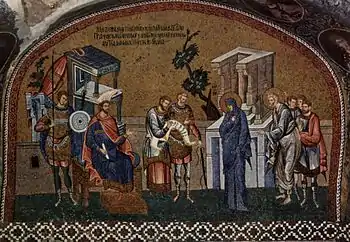
Chapter 2 of the Gospel of Luke correlates the date of the nativity of Jesus to the census.
In those days a decree went out from Emperor Augustus that all the world should be registered. This was the first registration and was taken while Quirinius was governor of Syria. All went to their own towns to be registered. Joseph also went from the town of Nazareth in Galilee to Judea, to the city of David called Bethlehem, because he was descended from the house and family of David. He went to be registered with Mary, to whom he was engaged and who was expecting a child.
There are major difficulties in accepting Luke's account: the gospel links the birth of Jesus to the reign of Herod the Great, but the census took place in 6 CE, nine years after Herod's death in 4 BCE; there was no single census of the entire empire under Augustus; no Roman census required people to travel from their own homes to those of distant ancestors; and the census of Judea would not have affected Joseph and his family, living in Galilee.[4]
Some conservative Christians have argued that Quirinius may have had an earlier and historically unattested term as governor of Syria, or that he previously held other senior positions which may have led him to be involved in the affairs of Judea during Herod's reign, or that the passage should be interpreted in some other fashion;[10][11][12] Luke 2:2 in the English Standard Version, for example, has a footnote which offers "This was the registration before" Quirinius was governor of Syria as an alternate translation, but this is not in the text of any major English translation.[13]
These "exegetical acrobatics" (in the words of Géza Vermes)[14] spring from the assumption that the Bible is inerrant.[15] There is no time in the career of Quirinius before 6 CE when he could have served as governor of Syria, the Romans did not directly tax client kingdoms, and the hostile reaction of the Jews in 6 CE suggests direct taxation by Rome was new at the time.[16][17] Most critical scholars have therefore concluded that Luke's account is in error.[4]
See also
References
Citations
- Gruen 1996, p. 157.
- Sanders 1995, p. 111.
- Edwards 2015, p. 71.
- Brown 1978, p. 17.
- Gruen 1996, p. 156–157.
- Josephus, The Jewish War, Book 2, Chapter 8, Paragraph 1
- Josephus, Antiquities of the Jews, Book 18, Chapter 1, Paragraph 1
- H.H. Ben-Sasson, A History of the Jewish People, Harvard University Press, 1976, ISBN 0-674-39731-2, page 274: "Josephus connects the beginnings of the extremist movement [called the Zealots by Josephus] with the census held under the supervision of Quirinius, the legate of Syria, soon after Judea had been converted into a Roman province (6 AD)."
- Ac 5,37
- Bruce 1974, pp. 193–194.
- Habermas 1984, pp. 152–153.
- Boyd & Eddy 2010, pp. 142–143.
- "Luke 2:2". Bible Gateway. Retrieved 5 April 2021.
- Vermes 2010, p. unpaginated.
- Novak 2001, pp. 296–297.
- Novak 2001, p. 293–298.
- Brown 1977, pp. 552–553.
Bibliography
- Boyd, Gregory A.; Eddy, Paul Rhodes (2010). Lord or Legend?. Grand Rapids: Wipf & Stock.
- Brown, R.E. (1977). The Birth of the Messiah: A Commentary on the Infancy Narratives in Matthew and Luke. Doubleday & Company.
- Brown, R.E. (1978). An Adult Christ at Christmas: Essays on the Three Biblical Christmas Stories. Liturgical Press. ISBN 9780814609972.
- Bruce, F.F. (1974). Jesus and Christian Origins Outside the New Testament. Eerdmans.
- Edwards, James R. (2015). The Gospel of Luke. Eerdmans. ISBN 9780802837356.
- Gruen, Erich S. (1996). "The Expansion of the Empire Under Augustus". In Bowman, Alan K.; Champlin, Edward; Lintott, Andrew (eds.). The Cambridge Ancient History. 10. Cambridge University Press. p. 157. ISBN 9780521264303.
- Habermas, Gary R. (1984). Ancient Evidence for the Life of Jesus. Nashville: Thomas Nelson, Inc.
- Novak, Ralph Martin (2001). Christianity and the Roman Empire: Background Texts. Continuum International. ISBN 9780567018403.
- Sanders, E.P. (1995). The Historical Figure of Jesus. Penguin UK. ISBN 9780141928227.
- Vermes, Géza (2010). Jesus: Nativity - Passion - Resurrection. Penguin UK. ISBN 9780141957449.
External links
 Media related to Census of Quirinius at Wikimedia Commons