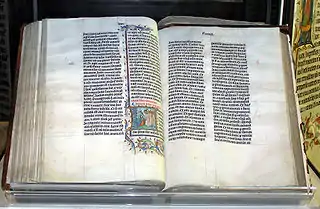
Textual variants in the Gospel of Luke
Textual variants in the Gospel of Luke are the subject of the study called textual criticism of the New Testament. Textual variants in manuscripts arise when a copyist makes deliberate or inadvertent alterations to a text that is being reproduced. An abbreviated list of textual variants in this particular book is given in this article below.
Most of the variations are not significant and some common alterations include the deletion, rearrangement, repetition, or replacement of one or more words when the copyist's eye returns to a similar word in the wrong location of the original text. If their eye skips to an earlier word, they may create a repetition (error of dittography). If their eye skips to a later word, they may create an omission. They may resort to performing a rearranging of words to retain the overall meaning without compromising the context. In other instances, the copyist may add text from memory from a similar or parallel text in another location. Otherwise, they may also replace some text of the original with an alternative reading. Spellings occasionally change. Synonyms may be substituted. A pronoun may be changed into a proper noun (such as "he said" becoming "Jesus said"). John Mill's 1707 Greek New Testament was estimated to contain some 30,000 variants in its accompanying textual apparatus[1] which was based on "nearly 100 [Greek] manuscripts."[2] Peter J. Gurry puts the number of non-spelling variants among New Testament manuscripts around 500,000, though he acknowledges his estimate is higher than all previous ones.[3]
Scholars find that many textual variants in the narratives of the Nativity of Jesus (Luke 2, as well as Matthew 1–2) and the Finding in the Temple (Luke 2:41–52) involve deliberate alterations such as substituting the words 'his father' with 'Joseph', or 'his parents' with 'Joseph and his mother'.[4] Alexander Globe (1980) concluded 'that most of the non-Neutral readings under consideration were introduced to remove inconsistencies between the biblical narratives and abstract doctrinal statements concerning the virginity of Mary.'[4]
Legend
A guide to the symbols used in the body of this article.
- # beginning with 0: uncial
- # not beginning with 0: minuscule
- arab: Arabic versions
- arm: Armenian versions
- 𝔐: Byzantine text-type
- cop: Coptic versions
- eth: Ethiopic versions
- ƒ: Greek manuscripts family
- geo: Georgian versions
- goth: Gothic versions
- it: Italic/Vetus Latina
- lat: most Italic and Vulgate
- latt: all Italic and Vulgate
- ms: individual manuscript
- mss: multiple manuscripts
- : papyrus
- 𝑙: individually numbered lectionary
- Lect: most or all numbered lectionaries
- parenthesized (): approximate reading
- rell: all other extant manuscripts
- slav: Slavic versions
- syr: Syriac versions
- vg: Latin Vulgate
- vid: apparent but uncertain reading

Notable manuscripts
- א: Codex Sinaiticus (01)
- A: Codex Alexandrinus (02)
- B: Codex Vaticanus (03)
- C: Codex Ephraemi Rescriptus (04)
- Dea: Codex Bezae (05)
- Dp: Codex Claromontanus (06)
- Ke: Codex Cyprius (017)
- Kap: Codex Mosquensis I (018)
- Le: Codex Regius (New Testament) (019)
- Lap: Codex Angelicus (020)
- Papr: Codex Porphyrianus (025)
- S: Codex Vaticanus 354 (028)
- V: Codex Mosquensis II (031)
- W: Codex Washingtonianus (032)
- Z: Codex Dublinensis (035)
- Γ: Codex Tischendorfianus IV (036)
- Δ: Codex Sangallensis 48 (037)
- Θ: Codex Koridethi (038)
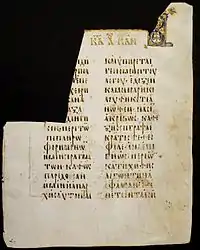
- Ξ: Codex Zacynthius (040)
- Π: Codex Petropolitanus (New Testament) (041)
- Φ: Codex Beratinus (043)
- Ψ: Codex Athous Lavrensis (044)
- Ω: Codex Athous Dionysiou (045)
- ff1: Codex Corbeiensis I
- ff2: Codex Corbeiensis II
- g1: Codex Sangermanensis I
- k: Codex Bobiensis
Textual variants
Luke 1:28[5]
- καὶ εἰσελθὼν πρὸς αὐτὴν εἶπεν Χαῖρε, κεχαριτωμένη, ὁ Κύριος μετὰ σοῦ. (and [he] went to her and said: "Greetings, favoured one, the lord is with you.") – Alexandrian text-type: Westcott and Hort 1881, Westcott and Hort / [NA27 and UBS4 variants], 1864–94, Nestle 1904
- καὶ εἰσελθὼν πρὸς αὐτὴν ὁ ἄγγελος εἶπεν· χαῖρε, κεχαριτωμένη, ὁ κύριος μετὰ σοῦ. (and the angel went to her and said: "Greetings, favoured one, the lord is with you.") – Tischendorf 8th Edition
- Καὶ εἰσελθὼν ὁ ἄγγελος πρὸς αὐτὴν εἴπεν, Χαῖρε, κεχαριτωμένη· ὁ κύριος μετὰ σοῦ, εὐλογημένη σὺ ἐν γυναιξίν. (And the angel went to her and said: "Greetings, favoured one, the Lord is with you, you are blessed among women.") – Byz: Stephanus Textus Receptus 1550, Scrivener's Textus Receptus 1894, RP Byzantine Majority Text 2005, Greek Orthodox Church
Luke 1:29[6]
- ἡ δὲ ἐπὶ τῷ λόγῳ διεταράχθη, (and she was troubled at the words,) – Alexandrian text-type: Westcott and Hort 1881, Westcott and Hort / [NA27 and UBS4 variants], 1864–94, Tischendorf 8th Edition, Nestle 1904
- Ἡ δὲ ἰδοῦσα διεταράχθη ἐπὶ τῷ λόγῳ αὐτοῦ, (And when she saw [him], she was troubled at his words,) – Byz: Stephanus Textus Receptus 1550, Scrivener's Textus Receptus 1894, RP Byzantine Majority Text 2005, Greek Orthodox Church
Luke 1:75
- πάσαις ταῖς ἡμέραις ἡμῶν. (all our days) – Alexandrian text-type
- πάσας τὰς ἡμέρας τῆς ζωῆς ἡμῶν. (all the days of our lives) – Byz
- γυναικί (woman) – Byz
- omitted by Alexandrian text-type
Luke 2:7
- φατνη (manger) – א A B D L W Θ Ξ 700
- τη φατνη (the manger) – Ψ 053 f1 f13 Byz
- τω σπηλαιω φατνη (the cave's manger) – Origen (via Epiphanius)
Luke 2:9
- καὶ ἄγγελος (and the angel) – Alexandrian text-type
- Καὶ ἰδού, ἄγγελος (And see, the angel) – Byz
- εφοβηθησαν σφοδρα (they feared exceedingly) – Β
- εφοβηθησαν φοβον μεγαν (they feared with great fear) – א A D L Ψ 053 f1 f13 Byz
- εφοβηθησαν φοβον μεγαν σφοδρα (they feared with exceedingly great fear) – W copsa
Luke 2:12
- κείμενον (lying) – omitted by Tischendorf 8th Edition
Luke 2:14
- εὐδοκίας (of good will or of favour – genitive) – Alexandrian text-type[7]
- εὐδοκία (good will or favour – nominative) – Byzantine text-type[7]
Luke 2:21
- ἐπλήσθησαν (fulfilled) – א Β A L Ψ 053 f1 f13 Byz
- επληρωθησαν (finished) – Θ 33
- συνετελέσθησαν (completed) – D copsa
Luke 2:21
- αυτον και εκληθη (and he was called) – א Β A L Ψ 053 f1 Βyz
- αυτον εκληθη (he was called) – Θ f13 565
- το παιδιον ωνομασθη (the child was called) – D
Luke 2:22
- αὐτῶν – א, A, B, K, L, W, Δ, Θ, Ξ, Π, Ψ, 053 etc.
- αυτου – D, 2174, syrs, copsa
- αὐτῆς – 76
- omit – 435, copbo
Luke 2:27
- τοὺς γονεῖς (the parents) – almost all manuscripts,[8] including most Byzantine and Alexandrian ones[9]
- omitted by a few late Greek manuscripts, including Minuscule 245, 1347, 1510, 2643[8]
- (Joseph and Mary) – Middle English, Tuscan, and Liège Diatessarons (13th–14th century)[8]
- (they) – Venetian Diatessaron (Codex Marcianus 4975, 14th century)[8]
Luke 2:33[10]
- καὶ ἦν ὁ πατὴρ αὐτοῦ καὶ ἡ μήτηρ θαυμάζοντες (and his father and mother were amazed) – 01, B, D, L, W, 700, Vg, cop.[4] Alexandrian text-type: Westcott and Hort 1881, Westcott and Hort / [NA27 and UBS4 variants], 1864–94, Nestle 1904.[10]
- καὶ ἦν ὁ πατὴρ αὐτοῦ καὶ ἡ μήτηρ αὐτοῦ θαυμάζοντες (and his father and his mother were amazed) – Tischendorf 8th Edition
- καὶ ἦν Ἰωσὴφ καὶ ἡ μήτηρ αὐτοῦ θαυμάζοντες (and Joseph and his mother were amazed) – A, K, X, Δ, Θ, Π, Ψ, 053, ƒ13, 28, 565, ... it syrph, h, pal(MSS), copbo(MSS), goth, Dia.[4] Byz: Stephanus Textus Receptus 1550, Scrivener's Textus Receptus 1894, RP Byzantine Majority Text 2005, Greek Orthodox Church.[10]
Luke 2:38
- καὶ αὐτῇ τῇ ὥρᾳ (and at that hour) – א, A, B, D, L, W, Δ, Ξ, Ψ, 0130, 28, 33
- καὶ αὕτη αὐτῇ τῇ ὥρᾳ (and at that hour she) – Θ, 053, f1, f13, Byz
Luke 2:40[11]
- ἐκραταιοῦτο (became strong) – Alexandrian text-type
- ἐκραταιοῦτο πνεύματι (became strong in spirit) – Byz
Luke 2:41
- οἱ γονεῖς αὐτοῦ (his parents) – almost all manuscripts,[8] including most Byzantine and Alexandrian ones[12]
- ὁ τε Ἰωσὴφ καὶ ἡ Μαριάμ (both Joseph and Mary) – 1012, a, b, g1, 1, r1, and some Diatessarons.[8]
- (his mother) – it (Old Latin) manuscripts c and ff2[8]
- (his kinsfolk) – syrs, syrp, Arabic Diatessaron[8]
Luke 2:42[13]
- ἀναβάντων αὐτῶν (they went up) – Alexandrian text-type
- ἀναβάντων αὐτῶν εἰς Ἰεροσόλυμα (they went up to Jerusalem) – Byz
Luke 2:43[14]
- οὐκ ἔγνωσαν οἱ γονεῖς αὐτοῦ. (his parents didn't know it.) – Alexandrian text-type.[14] 01, B, D, L, W, θ[4]
- οὐκ ἔγνω Ἰωσὴφ καὶ ἡ μήτηρ αὐτοῦ· (Joseph and his mother didn't know it.) – Byz.[14] A, C, Ψ, 0130, ƒ13, it, syrp, h, copbo(MSS)[4] E, Π, 565[8]
- (his kinfolk didn't know it.) – syrs[4]
Luke 2:48
- Ἰδού, ὁ πατήρ σου κἀγὼ ὀδυνώμενοι (ἐ)ζητοῦμεν σε. (Look, your father and I have been anxiously searching you.) – almost all manuscripts,[15] including most Byzantine and Alexandrian ones[16]
- Ἰδού, οἱ σῠγγενεῖς σου κἀγὼ ὀδυνώμενοι (ἐ)ζητοῦμεν σε. (Look, your relatives and I have been anxiously searching you.) – Cvid, β, ε[15]
- Οδυνώμενοι (ἐ)ζητοῦμεν σε. ([We] have been anxiously searching you.) – a, b, ff2, g2, 1, r1[15]
- Ἰδού, ἡμεῖς ὀδυνώμενοι (ἐ)ζητοῦμεν σε. (Look, we have been anxiously searching you.) – syrc[15]
- καὶ μὴ ἄρξησθε λέγειν ἐν ἑαυτοῖς (And do not begin to say to yourselves) – א, A, C, B [w], D, W, Δ, Ξ,
θ, K, M, N, U, Δ, Λ, Π, 33, 157, 579, 28, 565, 700, 1071, 1424, u[w]t
- ἀνοίξας (opened) – B, A, L, W, Ξ, 33, 892, 1195, 1241, ℓ 547, syrs, h, pal, copsa, bo
- ἀναπτύξας (unrolled) – א, Dc, K, Δ, Θ, Π, Ψ, f1, f13, 28, 565, 700, 1009, 1010, 1071, 1079, 1216, 1230, 1242, 1253, 1344, 1546, 1646, 2148, 2174, Byz
- ἁπτύξας (touched) – D*
Luke 5:26
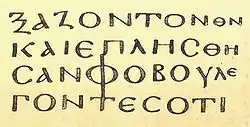
- και εκστασις ελαβεν απαντας και εδοξαζον τον θεον (And ecstasy took hold of them all, and they were glorifying God) – omitted by D M S W X Ψ Ω* 13 69 118 124 157 174 205 209 579 788 1241 itd,e
Luke 5:39
- verse omitted by D itmss
- Codex Bezae contains the following addition immediately after Luke 6:4.
- Τη αυτη ημερα θεασαμενος τινα εργαζομενον τω σαββατω ειπεν αυτω ανθρωπε, ει μεν οιδας τι ποιεις, μακαριος ει ει δε μη οιδας, επικαταρατος και παραβατης ει του νομου. – D
- Eodem die videns quendam operantem sabbato et dixit illi: Homo, siquidem scis, quod facis, beatus es, si autem nescis, maledictus et trabaricator legis. – d
- On that same day, seeing someone working on the Sabbath, he (Jesus) said to him, "Man, if you know what you do, blessed are you; but if you do not know, you are cursed and a transgressor of the law."
- διο ουδε εμαυτον ηξιωσα προς σε ελθειν (For this reason I did not deem myself worthy to come to you) – omitted by D 700* itmss syrs
Luke 7:13
- ο Ιησους (Jesus) – D W f1 700 1241 itf vgmss syrs,p cobo
- ο κυριος (the lord) – rell
- Γερασηνων (Gerasenes) – 𝔓75 B D 0267 latt cosa,boms
- Γεργεσηνων (Gergesenes) – א L X Θ Ξ f1 22 33 157 579 700* 1241 1342 syrpal cobo arm geo Eusebius Epiphanius
- Γαδαρηνων (Gadarenes) – A R W Δ Ψ 0135 f13 700c 1071 Byz syr goth
Luke 8:43
- ιατροις προσαναλωσασα ολον τομ βιον (and had spent all her living upon physicians) – omitted by 𝔓75 B (D) 0279 syrs,pal cosa arm geo Origen
- ἐκλελεγμένος (Elect One) – 𝔓45 𝔓75 א B L Ξ 892 1241 a aur ff2 l vgst syrs
- εκλεκτος (elected) – Θ f1 1365
- αγαπητος (beloved) – A C K P W X Δ Π f13 28 33 565 700 Byz Marcion
- αγαπητος εν ο ευδοκησα (beloved one in whom I am well-pleased) – C3 D Ψ ℓ 19 ℓ 31 ℓ 47 ℓ 48 ℓ 49 ℓ 49m ℓ 183 ℓ 183m ℓ 211m
Luke 9:54[17]
- , ὡς καὶ Ἠλίας ἐποίησε(ν); (", just like Elias did?") – Byz: Stephanus Textus Receptus 1550, Scrivener's Textus Receptus 1894, RP Byzantine Majority Text 2005, Greek Orthodox Church
- omitted by Alexandrian text-type: Westcott and Hort 1881, Westcott and Hort / [NA27 and UBS4 variants], Tischendorf 8th Edition 1864–94, Nestle 1904
Luke 9:55-56
- στραφεις δε επετιμησεν αυτοις (but He turned and rebuked them) – 𝔓45 𝔓75 א B C L W X Δ Ξ Ψ 28 33 565 892 1009 1010 1071 Byzpt Lect
- στραφεις δε επετιμησεν αυτοις και ειπεν, Ουκ οιδατε ποιου πνευματος εστε (but He turned and rebuked them and He said: "You do not know what manner of spirit you are of) – D (ℓ 1127m) d geo
- στραφεις δε επετιμησεν αυτοις καὶ εἶπεν, Οὑκ οἴδατε οἵου πνεύματος ἑστε ὐμεῖς; ὀ γὰρ υἰὸς τοῦ ἁνθρώπου οὑκ ἦλθεν ψυχὰς ἁνθρώπων ἁπολέσαι ἁλλὰ σῶσαι (but He turned and rebuked them and He said: "You do not know what manner of spirit you are of; for the Son of man came not to destroy men's lives, but to save them) – K Π 1079 1242 1546 (f1 omit γαρ) (Θ f13 omit υμεις and γαρ)
- instead μεριμνας και θορυβαζη περι πολλα, ολιγων (ενος) δε εστιν χρεια Μαριαμ γαρ (you are worried and being troubled about many things Miriam, but not much (one thing) is needed) has only θορυβαζη (you are being troubled) with (D has also Μαριὰμ Miriam) (a, b, d, e, ff2, i, l, r1, syrs, Ambrose omit θορυβαζη)
- ἐλθέτω τὸ πνεῦμα σου τὸ ἄγιον εφ ημας και καθαρισατω ημας (May your Holy Spirit come upon us and purify us) – 162, 700
- ἐφ ἡμᾶς ἐλθέτω σου ἡ βασιλεία (let thine kingdom come upon us) – D, itd
- ἐλθέτω ἡ βασιλεία σου (May your kingdom come) – A, B, K, L, X, Θ, Π, Ψ, f1, 28, 33, (565, 1253), 892, 1009, 1010, 1071, 1079, 1195, 1216, 1230, 1242, 1344, 1365, 1546, 1646, 2148, 2174, Byz, Lect, ℓ 69, ℓ 185, ℓ 1127, it, vg, syr, copsa, bo, arm, geo, Origen
- ἐλθάτω ἡ βασιλεία σου (May your kingdom come) – C, P, W, Δ, f13, 1241, (𝔓45 indistinguishable ἐλθάτω or ἐλθέτω)
- omit – geo
Luke 11:13
- κριτὴν ἢ μεριστήν (judge or divider) – 𝔓75, א, B, L, 0191, f1, f13, 33, 700, 892, 1241, copsamss
- δικαστὴν ἢ μεριστήν (judge or divider) – A, K, W, X, Δ, Θ, Π, Ψ, 565, 1009, 1010, 1071, 1079, 1195, 1216, 1230, 1242, 1253, 1344, 1365, 1546, 1646, 2148, 2174, Byz
- μεριστὴν ἢ δικαστήν (divider or judge) – 472, ℓ 1642, eth
- κριτὴν ἢ δικαστήν (divider or judge) – 69
- ἄρχοντα καὶ δικαστήν (ruler and judge) – 157
- κριτήν (judge) – D, it(a), c, d
- δικαστήν (judge) – 28
- μεριστήν (divider) – copsamss
Luke 12:21
- verse omitted by – D, a, b, d
- verse omitted by א, A, B, K, L, W, X, Δ, Θ, Π, Ψ, 063, f1, 28, 33, 565, 892, 1009, 1010, 1079, 1195, 1216, 1242, 1365, Byz, ℓ 184, ℓ 950, copsa, bo, goth, eth
- δύο ἐν ἀγρῷ εἷς παραλημφθήσεται καὶ ὁ ἕτερος ἀφεθήσεται (two in the field; one will be taken and the other left) – D, 1071, 1230, 2174, ℓ 185, ℓ 1579, it, vg, syr, arm, geo, Diatessarona, i, n
- δύο ἔσονται ἐν τῷ ἀγρῷ εἷς παραλημφθήσεται καὶ ὁ ἕτερος ἀφεθήσεται (two men will be in the field; one will be taken and the other left) – 700, 1253, 1344
- δύο ἔσονται ἐν ἀγρῷ εἷς παραλημφθήσεται καὶ ὁ ἕτερος ἀφεθήσεται (two men will be in the field; one will be taken and the other left) – 1646
- δύο ἔσονται ἐν ἀγρῷ εἷς παραλημφθήσεται, ἡ δὲ ἑτέρα ἀφεθήσεται (two will be in the field then; one will be taken, but the other left) – f13
- τὸ ὑπὲρ ὑμῶν διδόμενον... τὸ ὑπὲρ ὑμῶν ἐκχυννόμενον (which is given for you... which is shed for you), omitted by D, a, (b, e have a different word order) d, ff2, i, l (syrcur omits only τὸ ὑπὲρ ὑμῶν ἐκχυννόμενον)
Luke 22:43-44
Luke 22:62
- verse omitted by a, b, e, ff2, i, l, r1 (0171 does not appear to leave space)
.jpg.webp)
- τοῦ κυρίου Ἰησοῦ (of the Lord Jesus) – 𝔓75, א, A, B, C, K, L, W, X, Δ, Θ, Π, Ψ, 0124, f1, f13, 28, 33, 565, 700, 892, 1009, 1010, Byz, Lect, itaur, c, f, q, vg
- του Ιησου (Jesus) – 579, 1071, 1241, syrcur
- omitted by D, a, b, d, e, ff2, l, r1
Luke 24:6
- οὐκ ἔστιν ὢδε, ἀλλ(ὰ) ἠγέρθη (He is not here, but is risen), omitted by D, a, b, d, e, ff2, l, r1, armmss, geoB
Luke 24:9
- απο του μνημειου (from the tomb), omitted by D, a, b, c, d, e, ff2, l, r1, arm, geo
Luke 24:12
- verse omitted by D, a, b, d, e, l, r1
Luke 24:26
- δοξαν – majority of mss
- βασιλειαν – 𝔓75
Luke 24:36
- καὶ λέγει αὐτοῖς εἰρήνη ὑμῖν (and said to them: Peace unto you) – mss of Alexandrian, Casarean, and Byzantine text-types
- omitted by D, a, b, d, e, ff2, l, r1
Luke 24:40
- καὶ τοῦτο εἰπὼν ἔδειξεν αὐτοῖς τὰς χειρᾶς καὶ τοὺς πόδας (and when He said this, He showed them His hands and His feet), omitted by D, a, b, d, e, ff2, l, r1, syrs, syrcur
Luke 24:51
- καὶ ἀνεφέρετο εἰς τὸν οὐρανόν (and taken up into heaven), omitted by א*, D, a, b, d, e, ff2, l
- hiatus in r1, syrs (syrcur) geo1
Luke 24:52 – προσκυνήσαντες αὐτὸν (upon worshiping Him), omitted by D, a, b, d, e, ff2, l (hiat r1), syrs (syrcur), geo2
Luke 24:53
- εὐλογοῦντες τὸν θεόν ("blessing God") – Alexandrian
- αἰνουντες τὸν θεόν ("praising God") – Western
- αἰνουντες καὶ εὐλογοῦντες τὸν θεόν ("praising and blessing God") – Byz. mss
See also
- Alexandrian text-type
- Biblical inerrancy
- Byzantine text-type
- Caesarean text-type
- Categories of New Testament manuscripts
- Comparison of codices Sinaiticus and Vaticanus
- List of New Testament verses not included in modern English translations
- List of major textual variants in the New Testament
- Textual variants in the New Testament
- Western text-type
References
- Adam Fox, John Mill and Richard Bentley: A Study of the Textual Criticism of the New Testament 1675–1729 (Oxford: Basil Blackwell, 1954), pp. 105–115; John Mill, Novum Testamentum Graecum, cum lectionibus variantibus MSS (Oxford 1707)
- Metzger and Ehrman (2005), p.154
- Peter J. Gurry, "The Number of Variants in the Greek New Testament: A Proposed Estimate" New Testament Studies 62.1 (2016), p. 113
- Head, P. M. (April 1993). "Christology and Textual Transmission: Reverential Alterations in the Synoptic Gospels". Novum Testamentum. Brill. 35 (2): 105–129. doi:10.2307/1560881. Retrieved 6 September 2021.
- "Luke 1:28 Text Analysis". Biblehub.com. Retrieved 6 September 2021.
- "Luke 1:29 Text Analysis". Biblehub.com. Retrieved 6 September 2021.
- "Luke 2:14 Text Analysis". Biblehub.com. Retrieved 4 December 2021.
- Ehrman, The Orthodox Corruption of Scripture (1993), p. 56, 118. (e-book)
- "Luke 2:27 Text Analysis". Biblehub.com. Retrieved 10 September 2021.
- "Luke 2:33 Text Analysis". Biblehub.com. Retrieved 6 September 2021.
- "Luke 2:40 Text Analysis". Biblehub.com. Retrieved 6 September 2021.
- "Luke 2:41 Text Analysis". Biblehub.com. Retrieved 10 September 2021.
- "Luke 2:42 Text Analysis". Biblehub.com. Retrieved 6 September 2021.
- "Luke 2:43 Text Analysis". Biblehub.com. Retrieved 6 September 2021.
- Ehrman 1993, p. 55, 118.
- "Luke 2:48 Text Analysis". Biblehub.com. Retrieved 10 September 2021.
- "Luke 9:54 Text Analysis". Biblehub.com. Retrieved 5 September 2021.
Further reading
- Novum Testamentum Graece et Latine, ed. E. Nestle, K. Aland, Stuttgart 1981.
- Bruce M. Metzger & Bart D. Ehrman, "The Text of the New Testament: Its Transmission, Corruption, and Restoration", OUP New York, Oxford, 4 edition, 2005
- Bart D. Ehrman, "The Orthodox Corruption of Scripture. The Effect of Early Christological Controversies on the Text of the New Testament", Oxford University Press, New York - Oxford, 1996, pp. 223–227.
- Bruce M. Metzger, "A Textual Commentary on the Greek New Testament: A Companion Volume to the United Bible Societies' Greek New Testament", 1994, United Bible Societies, London & New York.
External links
- The Comparative Critical Greek New Testament
- Variantes textuais (in Portuguese)
- Varianten Textus receptus versus Nestle-Aland
- The Gospel of Luke part of the Holy Bible