Chilevisión
Chilevisión (often abbreviated as CHV) is a Chilean free-to-air television channel. It is the third oldest Chilean television network, owned by ViacomCBS Networks Americas. Founded by the University of Chile, this educational institution sold a significant percentage of its TV channel to Grupo Cisneros, changing its name to Chilevisión. It was later sold to Claxson Interactive Group in 2000 and then to Chilean investor and president Sebastián Piñera in 2006.
 | |
| Country | Chile |
|---|---|
| Broadcast area | Chile |
| Headquarters | Santiago, Chile |
| Programming | |
| Language(s) | Spanish |
| Picture format | 1080i HDTV (downscaled to 480i for the SDTV feed) |
| Ownership | |
| Owner | ViacomCBS Networks Americas (ViacomCBS Networks International) |
| History | |
| Launched | 4 November 1960[1] |
| Former names | Canal 9 de Televisión de la Universidad de Chile (1960–1980) Teleonce (1980–1984) Universidad de Chile Televisión (1984–1991) Red de Televisión Universidad de Chile (1991–1993) |
| Links | |
| Website | chilevision |
| Availability | |
| Terrestrial | |
| Digital VHF | Listings may vary |
| Analog VHF | Listings may vary |
| Cable | |
| VTR | Channel 21 (Santiago) Channel 711 (HD) |
| Satellite | |
| DirecTV | Channel 151 (SD) Channel 1151 (HD) |
On 28 August 2010, it was announced that Turner Broadcasting System Latin America (later WarnerMedia Latin America) had reached an agreement to purchase it. These assets do not include the analog television channel frequency which is still owned by Universidad de Chile and is used under a paid usufruct scheme, similar to a lease. This contract expired in 2018 and only affected the analog frequencies used by the station. The sale was completed on 6 October 2010.[2]
On 5 April 2021, it was announced that ViacomCBS had reached an agreement to acquire Chilevisión from WarnerMedia Latin America.[3][4] The sale was granted approval on July 5, 2021,[5][6] and completed on October 1, 2021.[7]
History
Origins
When the Institute for Electrical Research and Testing of the Faculty of Physical and Mathematical Sciences of the University of Chile informed the rector Juan Gómez Millas, in 1959, that the experiments were already sufficiently advanced to attempt the permanent operation of a canal, this instructs the Secretary-General, Álvaro Bunster, to establish the corresponding contact with the engineers and to provide the necessary elements for its start-up. Thus, from the very beginning, Channel 9 is assumed as an institutional project of the rectory.
Within the University Council, diverse positions were expressed. The deans of the more traditional faculties viewed the initiative with reluctance. They rejected the idea that "the university continues to embark on projects that, in a way, mean becoming a Corfo-Cultural", according to Álvaro Bunster. But some shared cultural extension principles and discovered a powerful tool for it in the new environment. Among these stood out the Dean of the Faculty of Philosophy and Education, Eugenio González, who started a real battle for university television. In its approach, university television is synonymous with cultural television. This position prevailed, and Bunster - the rector's trusted official - was in charge of shaping it.
Thus, in May 1960, the Audiovisual Department was created, reporting directly to the General Secretary. Historian Leopoldo Castedo traveled from Berkeley, United States to assume the first direction of the debuting Audiovisual Department that, apart from the television section, includes the former departments of Experimental Cinema, Cinematheque, and Photography. As Director of the channel, Raúl Aicardi, a journalist with extensive experience in the radio field and, at that time, working in the Office of Film and Radio of the US Embassy, is in charge of the Chair of Audiovisual Journalism. from the School of Journalism. The Bunster-Castedo-Aicardi formula, as the first managers of the channel, expresses the search to guarantee the central political and institutional control of the channel, the cultural management of the station, and technical efficiency in its operation.
Both the selection of people —all administrative or academic from the university—and the generation of a special instance closely linked to the rectory for the start-up show the explicit institutional will to run the channel as a properly university project.
This first stage of Channel 9 coincides with the end of the second term of the rector Juan Gómez Millas, who in cultural matters continues and deepens the principles of the extension of his predecessor Juvenal Hernández. For the rector of modernization, television is justified as a means to "cooperate with public education, a factor favorable to the scientific and technological development of the country, understanding by scientific not only the natural sciences but the set of human disciplines." So much so, that the first project presented by Leopoldo Castedo to define the channel, proposes a “serious study of the insufficiencies of the national educational system so that TV can make up for this deficiency and reach all those people and sectors - especially peasants with its action. and inhabitants of the rural sector— who, for different reasons, have been excluded from education ”.
For his part, Raúl Aicardi defines university TV from a perspective that contributes certain elements more typical of the communicational field, but within the margins that the university authority has dealt with.
Programming
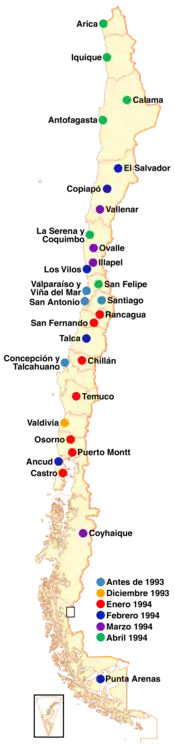
The channel mainly airs celebrity gossip shows, talk shows, newscasts, and Latin American soap operas. It generally ranks third in TV viewership in the country behind TVN and Mega (in that order).
Currently the most important programs of the channel are La mañana de Chilevisión, Chilevision Noticias, La Jueza and Primer Plano.
Availability overseas
Chilevisión International is the international feed of Chilevisión that broadcasts its programming to audiences in Australia/Oceania. The channel launched in October 2007 in Australia and the following year in New Zealand on UBI World TV. The TVN-owned TV Chile subscription channel also broadcasts limited Chilevisión programming throughout the Americas for the Chilean diaspora.
Controversies
In 2012, Chilevisión has been the focus of a controversy over journalistic ethics. On 16 January 2012 aired an interview that the interviewee appeared, Inés Perez,[8] as a deeply class. The interview produced strong reactions, even leading to the creation of social networking groups against the affected woman. Two days later it knew the full interview, and the reactions were returned against the broadcaster because it expressed concern Pérez discriminated assumptions and puts everything in context. In response, the broadcaster defended the veracity of the interview and dismissed the officer who leaked the full video, causing even more adverse reactions among viewers.
2019 advertisement pulling controversy
During 2019, businessman Juan Sutil and food company Agrosuper decided to pull their ads, including some of Agrosuper's brand Super Pollo, from CNN Chile and Chilevision, purportedly because of a CNN Chile show named "Agenda Agricola", which has shown videos of anti-government protests.[9]
Logos
.png.webp) 1962–1964
1962–1964.png.webp) 1964–1970
1964–1970.png.webp) 1970–1972
1970–1972.png.webp) 1972–1975
1972–1975.png.webp) 1975–1978
1975–1978.png.webp) 1978–1980
1978–1980.png.webp) 1980–1991
1980–1991.png.webp) 1991–1992
1991–1992.png.webp) 1992–1993
1992–1993.png.webp) 1993–1998
1993–1998.png.webp) 1998–2002
1998–2002 2002–2006
 2006–2014
 2015–2018
.png.webp) 2018–present
2018–present
See also
References
- "Chilevision History". Chilevision. Retrieved 29 January 2013.
- "Grupo Time Warner materializa compra de Chilevisión". La Tercera. Retrieved 2017-03-18.
- "ViacomCBS Networks Int. To Buy Chilevisión From WarnerMedia, Expand Latin America Footprint". Deadline Hollywood. 5 April 2021. Retrieved 2021-04-05.
- "ViacomCBS Networks International (VCNI) Agrees to Acquire Chilevisión". ViacomCBS. Retrieved 2021-05-20.
- "Chile: Aprueban la compra de Chilevisión por parte de ViacomCBS".
- "FNE aprueba la venta de CHV desde el grupo Warner a Viacom CBS".
- "ViacomCBS Closes Acquisition of WarnerMedia's Chilevision, Boosting Spanish-Language Business".
- "Chilevisión recibe sanción por caso de Inés Pérez / Chilevisión receives penalty by case of Inés Pérez". terra. Retrieved 29 January 2013.
- "El Universal Chile - Tu Portal de Noticias". 23 September 2016.
External links
- Official Site (in Spanish)
Chilevisión programming | ||
|---|---|---|
| Monday-Friday |
| |
| Weekends |
| |
| Reruns | ||
