Cicadidae
Cicadidae, the true cicadas,[1] is the largest family of cicadas, with more than 3,200 species worldwide. The oldest known definitive fossils are from the Paleocene, a nymph from the Cretaceous Burmese amber has been attributed to the family, but could also belong to the Tettigarctidae.[2]
| Cicadidae Temporal range: | |
|---|---|
_(28934344001).jpg.webp) | |
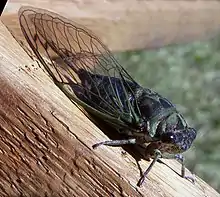
| Neotibicen | |
Scientific classification  | |
| Kingdom: | Animalia |
| Phylum: | Arthropoda |
| Class: | Insecta |
| Order: | Hemiptera |
| Superfamily: | Cicadoidea |
| Family: | Cicadidae John Obadiah Westwood, 1840 |
| Subfamilies | |
|
See text | |
Description and Life Cycle
Description
Cicadas are large insects characterized by their membranous wings, triangular-formation of three ocelli on the top of their heads, and their short, bristle-like antennae.[3]
Life Cycle
Cicadas are generally separated into two categories based on how long they remain underground as nymphs. Annual cicadas remain underground as nymphs for about two years, and adults emerge every year to mate. Periodical cicadas have synchronized life cycles, remaining underground for years and emerging every 13 or 17 years to mate.[4]
Ecology
Communication
Cicadas are known for the noisy sounds they make. One member of this family, Brevisana brevis, the "shrill thorntree cicada", is the loudest insect in the world, able to produce a song that exceeds 100 decibels.[5] Male cicadas can produce four types of acoustic signals: songs, calls, low-amplitude songs, and disturbance sounds.[6] Unlike members of the order Orthoptera (grasshoppers, crickets, and katydids), who use stridulation to produce sounds, members of Cicadidae produce sounds using a pair of tymbals, which are modified membranes located on the abdomen. In order to produce sound, each tymbal is pulled inwards by a connected muscle, and the deformation of the stiff membrane produces a 'click.'[7]
Reproductive Behavior
Newly emerged cicadas climb up trees and molt into their adult stage, now equipped with wings. Males call to attract females, producing the distinct noisy songs cicadas are known for. Females respond to males with a 'click' made by flicking their wings. Once a male has found a female partner, his call changes to indicate that they are a mating pair.[8]
Classification
Cicadidae is one of two families within the superfamily Cicadoidea. This superfamily is in the suborder Auchenorrhyncha, containing cicadas, hoppers, and relatives, within the order Hemiptera, the true bugs. There are five subfamilies within Cicadidae: Cicadettinae, Cicadinae, Tettigomyiinae, Tibicinae,[9] and Derotettiginae.[10]
Subfamilies
Subfamily and tribes within this family include:[11]
Subfamily Cicadettinae Buckton, 1890
- Tribe Aragualnini Sanborn, 2018
- Tribe Carinetini Distant, 1905
- Tribe Chlorocystini Distant, 1905
- Tribe Cicadatrini Distant, 1905
- Tribe Cicadettini Buckton, 1890
- Tribe Hemidictyini Distant, 1905
- Tribe Katoini Moulds & Marshall, 2018
- Tribe Lamotialnini Boulard, 1976
- Tribe Nelcyndanini Moulds & Marshall, 2018
- Tribe Pagiphorini Moulds & Marshall, 2018
- Tribe Parnisini Distant, 1905
- Tribe Pictilini Moulds & Hill, 2018
- Tribe Prasiini Matsumura, 1917
- Tribe Taphurini Distant, 1905
Subfamily Cicadinae Latreille, 1802
- Tribe Arenopsaltriini Moulds, 2018
- Tribe Burbungini Moulds, 2005
- Tribe Cicadini Latreille, 1802
- Tribe Cicadmalleuini Boulard & Puissant, 2013
- Tribe Cosmopsaltriini Kato, 1932
- Tribe Cryptotympanini Handlirsch, 1925
- Tribe Cyclochilini Distant, 1904
- Tribe Distantadini Orian, 1963
- Tribe Dundubiini Distant, 1905
- Tribe Durangonini Moulds & Marshall, 2018
- Tribe Fidicinini Distant, 1905
- Tribe Gaeanini Distant, 1905
- Tribe Jassopsaltriini Moulds, 2005
- Tribe Lahugadini Distant, 1905
- Tribe Leptopsaltriini Moulton, 1923
- Tribe Macrotristriini Moulds, 2018
- Tribe Oncotympanini Ishihara, 1961
- Tribe Orapini Boulard, 1985
- Tribe Platypleurini Schmidt, 1918
- Tribe Plautillini Distant, 1905
- Tribe Polyneurini Amyot & Audinet-Serville, 1843
- Tribe Psaltodini Moulds, 2018
- Tribe Psithyristriini Distant, 1905
- Tribe Sinosenini Boulard, 1975
- Tribe Sonatini Lee, 2010
- Tribe Talcopsaltriini Moulds, 2008
- Tribe Tamasini Moulds, 2005
- Tribe Thophini Distant, 1904
- Tribe Tosenini Amyot & Audinet-Serville, 1843
- Tribe Zammarini Distant, 1905
Subfamily Tettigomyiinae Distant, 1905
- Tribe Lacetasini Moulds & Marshall, 2018
- Tribe Malagasiini Moulds & Marshall, 2018
- Tribe Tettigomyiini Distant, 1905
- Tribe Ydiellini Boulard, 1973
Subfamily Tibicininae Distant, 1905
- Tribe Chilecicadini Sanborn, 2014
- Tribe Platypediini Kato, 1932
- Tribe Selymbriini Moulds & Marshall, 2018
- Tribe Tettigadini Distant, 1905
- Tribe Tibicinini Distant, 1905
Subfamily Derotettiginae Moulds, 2019 [12]
- Tribe Derotettigini Moulds, 2019
See also
References
- Pons, P. True cicadas (Cicadidae) as prey for the birds of the Western Palearctic: a review. Avian Res 11, 14 (2020). https://doi.org/10.1186/s40657-020-00200-1
- MOULDS, M. S. (2018-06-22). "Cicada fossils (Cicadoidea: Tettigarctidae and Cicadidae) with a review of the named fossilised Cicadidae". Zootaxa. 4438 (3): 443–470. doi:10.11646/zootaxa.4438.3.2. ISSN 1175-5334. PMID 30313130.
- https://genent.cals.ncsu.edu/insect-identification/order-hemiptera-suborder-homoptera/family-cicadidae/
- https://www.nwf.org/Educational-Resources/Wildlife-Guide/Invertebrates/Periodical-Cicadas
- https://entomology.unl.edu/scilit/loudest
- Cocroft, R. B., & Pogue, M. (1996). Social Behavior and Communication in the Neotropical Cicada Fidicina mannifera (Fabricius) (Homoptera: Cicadidae). Journal of the Kansas Entomological Society, 69(4), 85–97. http://www.jstor.org/stable/25085708
- Young D, Bennet-Clark H. The role of the tymbal in cicada sound production. J Exp Biol. 1995;198(Pt 4):1001-20. PMID: 9318802.
- "Amazing Cicada Life Cycle."Youtube, uploaded by BBC Studios, 24 Oct. 2008, https://www.youtube.com/watch?v=tjLiWy2nT7U
- Marshall, D. C., Moulds, M., Hill, K. B., Price, B. W., Wade, E. J., Owen, C. L., ... & Simon, C. (2018). A molecular phylogeny of the cicadas (Hemiptera: Cicadidae) with a review of tribe and subfamily classification. Zootaxa, 4424(1), 1-64.
- Chris Simon, Eric R L Gordon, M S Moulds, Jeffrey A Cole, Diler Haji, Alan R Lemmon, Emily Moriarty Lemmon, Michelle Kortyna, Katherine Nazario, Elizabeth J Wade, Russell C Meister, Geert Goemans, Stephen M Chiswell, Pablo Pessacq, Claudio Veloso, John P McCutcheon, Piotr Łukasik, Off-target capture data, endosymbiont genes and morphology reveal a relict lineage that is sister to all other singing cicadas, Biological Journal of the Linnean Society, Volume 128, Issue 4, December 2019, Pages 865–886, https://doi.org/10.1093/biolinnean/blz120
- Marshall, David C.; Moulds, Max; Hill, Kathy B. R.; Price, Benjamin W.; Wade, Elizabeth J.; Owen, Christopher L.; Goemans, Geert; Marathe, Kiran; Sarkar, Vivek; Cooley, John R.; Sanborn, Allen F.; Kunte, Krushnamegh; Villet, Martin H.; Simon, Chris (2018). "A molecular phylogeny of the cicadas (Hemiptera: Cicadidae) with a review of tribe and subfamily classification". Zootaxa. Magnolia Press. 4424 (1): 1–64. doi:10.11646/zootaxa.4424.1.1. PMID 30313477.
- Simon, Chris; Gordon, Eric R. L.; Moulds, Max S.; Cole, Jerrrey A.; Haji, Diler; Lemmon, Alan R.; Lemmon, Emily Moriarty; Kortyna, Michelle; Nazario, Kathrine; Wade, Elizabeth J.; Meister, Russell C.; Goemans, Geert; Chiswell, Stephen M.; Pessacq, Pablo; Veloso, Claudio; McCutcheon, John P.; Lukasik, Piotr (2019). "Off-target capture data, endosymbiont genes and morphology reveal a relict lineage that is sister to all other singing cicadas". Biological Journal of the Linnean Society. Oxford University Press. 128 (4): 865–886. doi:10.1093/biolinnean/blz120.
External links


Authority control: National libraries  |
|---|