Coal power in Turkey
Coal power in Turkey generates a third of the nation's electricity. There are 56 coal-fired power stations in Turkey with a total capacity of 20 gigawatts (GW), and their average thermal efficiency is 35%.
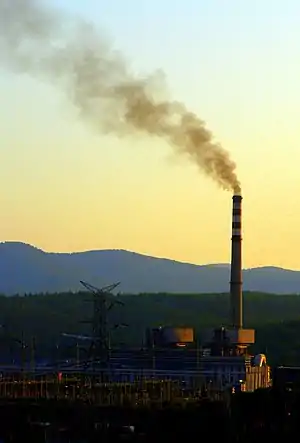
Emissions from coal-fired power stations are the largest category of greenhouse gas emissions by Turkey. Coal-fired stations emit over 1 kg of carbon dioxide for every kilowatt hour generated, over twice that of gas-fired power stations. However, government policy supports continued generation from low quality Turkish lignite.
Older coal-fired power stations emit air pollution, which damages public health. It is estimated that in 2019, air pollution from coal-fired power stations in Turkey caused almost 5,000 premature deaths and over 1.4 million work-days lost to illness. There are flue gas emission limits, but data from mandatory reporting of emission levels is not made public. Academics suggest that, in order to reach Turkey's net zero greenhouse gas emissions target of 2053, coal power should be phased out by the mid-2030s.[3]
Energy policy
The Energy Ministry wants to fully utilize not just renewable energy in Turkey, but also other local energy resources to support the country's development and to reduce dependence on energy imports.[4] As of 2021 Turkey has not ratified the Gothenburg Protocol on emissions ceilings for sulphur dioxide and nitrogen oxides.[5] Despite having ratified the Paris Agreement to limit climate change, as of October 2021 policy is still to increase domestic coal share in the energy mix, and planned increases in coal power are forecast to increase CO2 emissions.[6]: 79, 87
Generating stations
Coal-fired power stations generate approximately one third of the nation's electricity.[7] As of 2021 there are 56 licensed active coal-fired power stations with a total capacity of 20 gigawatts (GW).[8] [note 1] [note 2] In 2021 there was 0.4 GW of unlicensed thermal power,[12]: 26 but how much of this is coal is unclear. The average thermal efficiency of these stations is 35%.[13] Emba Hunutlu power station is under construction in 2021,[14] but no further coal-fired power stations are planned for 2022.[15]
Much of the operational fleet was built in the 21st century. There was oversupply of generating capacity and a drop in demand in 2020,[16] and a quarter of power stations were estimated to be cashflow negative.[17] According to Bloomberg New Energy Finance the capital cost of building 10 GW of coal-power would fund construction of 25 GW of solar power (annual peak electricity demand is on summer afternoons).[18] According to Bloomberg New Energy Finance the capital cost of building 10 GW of coal-power would fund construction of 25 GW of solar power (annual peak electricity demand is on summer afternoons).[18]
Germany is closing lignite-fired plants under 150 MW.[19] Neighbouring Greece is closing down all its lignite-fueled power stations,[20] but Turkey is continuing to build coal power stations, despite overcapacity and abundant sun and wind.[21] The 1320 MW Emba Hunutlu coal fired power station is under construction.[22] Shanghai Electric Power said it would be China's largest ever direct investment in Turkey.[23] However, according to the World Wide Fund for Nature, Turkey could not make a profit if it was not subsidized.[24] Turkey has also approved building of the large Afşin-Elbistan C lignite-fueled station.[25] The Turkey Wealth Fund, the country's sovereign wealth fund, says it is financing the project because the country needs to maintain energy security by reducing fossil fuel imports.[26] The fund aims to pay dividends to the government,[26] but according to Carbon Tracker, a think tank, new coal power will lose money.[27] Afşin-Elbistan C and further new coal-fired power stations may not be started,[28] due to public opposition,[29] and the risk of them becoming stranded assets.[30]
Yunus Emre power station was completed in 2020[31] but has not generated any power to the grid. With a few exceptions stations smaller than 200 MW provide both electricity and heat, often to factories, whereas almost all those larger than 200 MW just generate electricity. Companies owning large amounts of coal power include Eren, Çelikler, Aydem, İÇDAŞ, Anadolu Birlik (via Konya Sugar) and Diler.[12]: 31
Coal industry
Government policy supports continued generation from lignite (brown coal).[32] Lignite is mined locally, whereas almost all hardcoal (anthracite and bituminous coal) is imported.[33] In 2020, 51 million tonnes (83%) of lignite and 22 million tonnes (55%) of hardcoal was burnt in power stations.[34]
Locally mined lignite
Power stations burning lignite tend to be near local coalmines, such as Elbistan, because Turkish lignite's calorific value is less than 12.5 MJ/kg (and Afsin Elbistan lignite less than 5 MJ/kg, which is a quarter of typical thermal coal),[35] and about 90% has lower heat value under 3,000 kcal / kg,[36] so is not worth transporting. According to energy analyst Haluk Direskeneli because of the low quality of Turkish lignite large amounts of supplementary fuel oil is used in lignite fired power stations.[37]
Imported coal
To minimize transport costs, power stations burning imported coal are usually located on the coast: there are clusters in Çanakkale and Zonguldak provinces and around Iskenderun Bay.[38] Coal with up to 3% sulphur and minimum 5,400 kcal/kg can be imported, with capacity to burn about 25 million tons a year: in 2020 almost three quarters of imports were from Colombia.[39] According to thinktank Ember, as of 2021, building new wind and solar power is cheaper than running existing coal plants which depend on imported coal.[40]
Air pollution

Air pollution is a significant environmental and public health problem in Turkey. Levels of air pollution have been recorded above the World Health Organization (WHO) guidelines in 51 out of 81 provinces.[42] A report from the Health and Environment Alliance (HEAL) estimates that in 2019, there were almost 5,000 premature deaths caused by pollution from coal-fired power stations in Turkey, and over 1.4 million work-days lost to illness. The HEAL report estimates that the health costs of illness caused by coal-fired power stations made up between 13 and 27 percent of Turkey's total annual health expenditure (including both public and private sectors).[41]
Some of the older power stations emit air pollution which affects people locally, but there is not enough public data to make good estimates of how much gets past 2020s filters and into peoples lungs.[42][43]
A 1996 court order to shut 3 polluting power stations was not enforced.[44] 2019 early deaths due to coal power air pollution have been estimated somewhere between 2000[45] and 5000, with 1.4 million working days lost due to illness.[46] Five 20th century power stations were shut down at the end of 2019 because they did not meet new pollution limits,[47] but they were all re-licensed after improvements in 2020.[48][49] The effectiveness of the improvements is being questioned.[50][51]
The "Industry Related Air Pollution Control Regulation" says that flue-gas stacks must be at least 10m from the ground and 3m above the roof.[52] Larger power stations must measure local pollutants vented into the atmosphere from the smokestack and report them to the Environment Ministry but, unlike the EU, they are not required to publish the data.[49] New flue gas emission limits were introduced in January 2020.[53][54] 67 smokestacks were sending data to the Environment Ministry in 2021.[55][56][57]
According to Shura Energy Transition Center if external costs, such as air pollution and CO2 emissions, had been taken into account, the cost of power generation in 2018 would have been 26% higher for hard coal and 58% higher for lignite.[58]
Greenhouse gas emissions
Coal-fired power stations emit over 1 kg of carbon dioxide for every kilowatt hour generated,[59] over twice that of gas-fired power stations. Turkey's coal-fired power stations are the largest contributor to the country's greenhouse gas emissions.[note 3] Production of public heat and electricity emitted 138 megatonnes of CO2 equivalent (CO2e) in 2019,[lower-alpha 1] mainly through coal burning.
Turkey has approved the environmental impact assessment to build Afşin-Elbistan C,[25] and according to the assessment over 5 kg of CO2 would be emitted per kWh generated.[note 4] This would be less carbon efficient than any power station on the list of least carbon efficient power stations. The forecast emissions of 60 million tonnes a year from this station represent more than 10% of the nation's total greenhouse gas emissions, and would make the power plant the largest point source in the world.[63]
Because lignite quality varies greatly, to estimate the carbon dioxide emissions from a particular power station, the net calorific value of the lignite it burnt must be reported to the government. But this is not published,[64] unlike some other countries.[65] However public information from space-based measurements of carbon dioxide by Climate TRACE is expected to reveal individual large plants before the 2021 United Nations Climate Change Conference,[66] and smaller ones by GOSAT-GW in 2023 and Sentinel-7 (CO2M) possibly in 2025.
A 2020 study estimated that fitting carbon capture and storage to a power station burning Turkish lignite would increase the cost of its electricity by over 50%.[67] In 2021 Turkey targeted net zero carbon emissions by 2053.[68] After the Paris Agreement on limiting cl,mate change was ratified in 2021 many environmental groups called for the government to set a target year for coal phase-out.[69]
Ash
A 2021 report from İklim Değişikliği Politika ve Araştırma Derneği (Climate Change Policy and Research Association) said that 2020s environmental law was being evaded by the repeated granting of less stringent 1 year temporary operating licenses, and said that coal ash storage permit criteria (inspections by universities) were unclear, so some plants were not properly storing unhealthy coal ash . They summarized inspection reports as:
| Power plant name | Dry Storage | Wet Storage | Surrounding channels | Wall | Pump system | Groundwater Pollution Analysis/Monitoring | Observation Well | Wire Fence | Drainage System | Slope | Other |
|---|---|---|---|---|---|---|---|---|---|---|---|
| Afşin Elbistan B | x | x | x | x | x | x | Dust Control Plan should be prepared. | ||||
| Yatağan | x | x | x | x | x | Impermeable zone problem | |||||
| 18 Mart Çan | x | x | x | x | |||||||
| Kemerköy | x | x | x | x | x | x | The landfill is in the forest area | ||||
| Yeniköy | x | x | x | x | x | The landfill is in the forest area | |||||
| Kangal | x | x | x | x | |||||||
| Soma | x | The safety of embankments, sitting, sliding, etc. monitoring/progress report for monitoring and reporting | |||||||||
| Tunçbilek | x | x | Complying with the provisions of the Regulation on Buildings to be Constructed in Earthquake Zones and the Regulation on Buildings to be Constructed in Disaster Zones | ||||||||
| Orhaneli | x | x | |||||||||
| Seyitömer | x | x | |||||||||
| Çayırhan | x | x | x | x | |||||||
| ÇATES | x | x | x | x | Impermeable zone construction | ||||||
| Afşin Elbistan A | Re-evaluation of the commitments given in the EIA Report for the construction of the Landfill Facility within the scope of the Circular |
Taxes, subsidies and incentives
Lignite-burning power stations have priority over other types of generation.[71]
In 2019 large lignite-burning stations were subsidized with capacity payments totalling over 1 billion lira (over half of total capacity payments)[72] and in 2020 over 1.2 billion lira (over 150 million USD).[73] In 2021 4 plants burning a mixture of lignite and imported coal also received capacity payments.[74] This capacity mechanism has been criticised by some economists, as they say it encourages strategic capacity withholding, with a study of 2019 data showing that a 1% increase in the electricity price correlated with a 1 minute increase in length of plant generation failures.[72] There is also a market clearing price cap of 2000 TL/MWh but, as of 2019, this had never been reached.[72] These economists say that auctions of firm capacity (this is done in some other countries[75]), with a financial penalty if not delivered, would be a better mechanism.[72] Some electricity from these stations is purchased by EÜAŞ at a guaranteed price of USD 50-55/MWh until the end of 2024[6]: 79 or 2027.[76]: 109 In Q4 2021 the guaranteed purchase price was 458 lira per MWh.[77] Imported coal is taxed at USD 70 per tonne minus the price of coal on the international market.[78]
Around the turn of the century government incentives were offered to build cogeneration plants (autoproducers),[79] many small plants were built in industrial parks[80] or in sugar factories.[81][82] About 20 of these small autoproducers were operating by 2021 but there is no list publicly available as they are not connected to the grid and no longer require licences.[83][note 5]
Phase-out
According to a 2021 study by several NGOs if coal power subsidies were completely abolished and a carbon price increased to around 40 USD (which is lower than the 2021 EU Allowance) then no coal power plants would be profitable and all would close down before 2030.[77] Turkey has $3.2 billion in loans for its energy transition.[84]
Notes
- See tr:Türkiye'deki kömür yakıtlı enerji santralleri listesi or its underlying Wikidata for details. The Energy Ministry gives a total of 68 coal-fired power stations,[9] as at end September 2019, this includes unlicensed stations. In November 2021 TEİAŞ said there is 1 asphaltite, 15 imported coal, 47 lignite and 4 hardcoal, which totals 67 (as Yunus Emre is not active presumably they don't count it, news reports say Ilgın sugar factory not operating).[10] The names and details of the others are not known by Wikidata.
- In 2018 coal-fired power stations gross generation was 113 terawatt hours (TWh), which was 37% of total gross generation.[11] The figures in List of active coal-fired power stations in Turkey are net generation.
- UNFCCC category 1.A.1. Energy industries a. Public electricity and heat production:solid fuels. shows 111 megatonnes of CO2, which is larger than any other category.[60]
- By routine calculation 61,636,279.98 tCO2/year[62] divided by 11380 GWh/year[25] equals 61,636.27998 Gg CO2 divided by 11,380 GWh equals 5.4 kg CO2/kWh
- Some former autoproducer licencees are listed in table 20 of the following cite from 2007, but it is not publicly known exactly which are still operating.[82]
- [61]: table 1s1 cell B10
References
- Oberschelp, C.; Pfister, S.; Raptis, C. E.; Hellweg, S. (February 2019). "Global emission hotspots of coal power generation". Nature Sustainability. 2 (2): 113–121. doi:10.1038/s41893-019-0221-6. hdl:20.500.11850/324460. ISSN 2398-9629. S2CID 134220742. Archived from the original on 20 July 2021. Retrieved 16 July 2021.
- "MUÇEP "Muğla'daki tüm santreller kapatılsın"" [Muğla Environment Platform: All thermal power stations in Muğla must be closed!]. Anter Haber (in Turkish). Archived from the original on 9 October 2021. Retrieved 4 January 2020.
- "Türkiye ekonomisini 30 yılda karbonsuzlaştırabilir" (in Turkish).
- "66% of Turkey's electricity produced from local, renewable resources in first 5 months". Daily Sabah. 3 June 2020. Archived from the original on 16 July 2021. Retrieved 16 July 2021.
- "United Nations Treaty Collection". treaties.un.org. Archived from the original on 17 April 2021. Retrieved 31 March 2021.
- "Overview of the Turkish Electricity Market" (PDF).
- "Gas takes bigger share in Turkey's power as drought lowers hydro output". Hürriyet Daily News. Archived from the original on 16 July 2021. Retrieved 16 July 2021.
- "Turkey starts exporting electricity to Iraq". Daily Sabah. 28 December 2020. Archived from the original on 16 July 2021. Retrieved 21 July 2021.
- "T.C. Enerji ve Tabii Kaynaklar Bakanlığı - Elektrik". enerji.gov.tr. Archived from the original on 23 April 2021. Retrieved 16 February 2021.
- "TEİAŞ". Turkish Electricity Transmission Corporation. Archived from the original on 16 July 2021. Retrieved 21 July 2021.
- "Coal". Ministry of Energy and Natural Resources (Turkey). Archived from the original on 17 September 2018. Retrieved 19 April 2020.
- Overview of the Turkish Electricity Market (Report). PricewaterhouseCoopers. October 2021.
- "Kömür ve Linyit Yakıtlı Termik Santraller". Enerji Atlası (in Turkish). Archived from the original on 15 February 2021. Retrieved 28 February 2021.
- Merkezi, Haber (25 October 2021). "Türkiye için Turnusol Testi: Kömürden Çıkış". İklim Haber (in Turkish). Retrieved 28 October 2021.
- "2022'de temiz enerji ön plana çıkacak". www.trthaber.com (in Turkish). Retrieved 28 October 2021.
- "Turkey's electricity demand falls as coronavirus constricts economic activity". Daily Sabah. 31 March 2020. Archived from the original on 3 April 2020. Retrieved 16 July 2021.
- Political decisions, economic realities: The underlying operating cashflows of coal power during COVID-19 (Report). Carbon Tracker. 8 April 2020. Archived from the original on 12 April 2020. Retrieved 16 July 2021.
- Climate Policy Factbook (Report). BloombergNEF. 20 July 2021. p. 29. Archived from the original on 21 July 2021. Retrieved 21 July 2021.
- "EU approves German scheme to compensate hard coal plants for early closure". Energy Live News. 27 November 2020. Archived from the original on 7 April 2021. Retrieved 24 January 2021.
- "Lignite phase-out a key aspect of national energy policy, Mitsotakis says". Kathimerini. 17 February 2020. Archived from the original on 21 February 2020.
- "Wind". Ministry of Energy and Natural Resources (Turkey). Archived from the original on 29 April 2020. Retrieved 16 April 2020.
- "China's power plant project with direct investment in Turkey starts construction". Xinhua. Archived from the original on 25 September 2019. Retrieved 16 April 2020.
- "SEP Turkey Hunutlu Coal-fired Power Project Ratified". Shanghai Electric Power. 9 July 2015. Archived from the original on 16 July 2021. Retrieved 16 July 2021.
- "Yeni̇lenebi̇li̇r Enerji̇ Çağinda Kömürün Fi̇zi̇bi̇li̇tesi̇: Hunutlu Termi̇k Santrali̇ Örneği̇" (PDF). Archived (PDF) from the original on 15 January 2021. Retrieved 9 October 2021.
- "EÜAŞ 1800 MW'lık Afşin C Termik Santrali için çalışmalara başlıyor" [Electricity Generation Company starts work on 1800 MW Afşin C thermal power plant]. Enerji Günlüğü (in Turkish). 27 February 2020. Archived from the original on 2 March 2020. Retrieved 2 March 2020.
- Öztürk, Sinan (21 January 2020). "Turkey Wealth Fund eyes becoming strategic investment arm of the country". Daily Sabah. Archived from the original on 22 January 2020. Retrieved 16 July 2021.
- Roberts, David (14 March 2020). "4 astonishing signs of coal's declining economic viability". Vox. Archived from the original on 18 March 2020. Retrieved 16 July 2021.
- Direskeneli, Haluk (3 January 2020). "Enerji piyasalarında 2020 yılı öngörüleri" [Looking ahead to the 2020 energy market]. Enerji Günlüğü (in Turkish). Archived from the original on 30 November 2020. Retrieved 4 January 2020.
- Shearer, Christine; Myllyvirta, Lauri; Yu, Aiqun; Aitken, Greig; Mathew-Shah, Neha; Dallos, Gyorgy; Nace, Ted (March 2020). Boom and Bust 2020: Tracking the Global Coal Plant Pipeline (PDF) (Report). Global Energy Monitor. Archived (PDF) from the original on 12 December 2020. Retrieved 16 July 2021.
- Livsey, Alan (4 February 2020). "Lex in depth: the $900bn cost of 'stranded energy assets'". Financial Times. Archived from the original on 11 July 2021. Retrieved 16 July 2021.
- "Yunus Emre power station". Global Energy Monitor. Archived from the original on 16 July 2021.
- Eleventh Development Plan (2019-2023) (PDF) (Report). Presidency of Strategy and Budget. 2020. Archived (PDF) from the original on 25 September 2020. Retrieved 18 July 2021.
- EUAS Yıllık Rapor 2020 [2020 Annual Report] (Report). EÜAŞ. Archived from the original on 17 February 2021. Retrieved 16 July 2021.
- "Solid Fuels, December 2020". Turkstat. Archived from the original on 16 July 2021. Retrieved 16 July 2021.
- "Nuclear Power in Turkey". World Nuclear Association. Archived from the original on 30 November 2020. Retrieved 12 June 2020.
- "Coal". Ministry of Energy and Natural Resources (Turkey). Archived from the original on 12 January 2021. Retrieved 21 July 2021.
- Direskeneli, Haluk (6 October 2021). "Coal Plant Without Coal: Only In Turkey – OpEd". Eurasia Review. Retrieved 21 October 2021.
- "Turkish coal imports set to rise in 2020 – analysts". www.montelnews.com. Archived from the original on 9 October 2021. Retrieved 19 April 2020.
- "Turkey softens coal import restrictions | Argus Media". www.argusmedia.com. 21 October 2021. Retrieved 28 October 2021.
- "Turkey: New wind and solar power now cheaper than running existing coal plants relying on imports". Ember. 27 September 2021. Archived from the original on 29 September 2021. Retrieved 29 September 2021.
- Gacal, Funda; Stauffer, Anne (4 February 2021). Chronic coal pollution Turkey (Report). Health and Environment Alliance. Archived from the original on 9 May 2021.
- "Report: Air pollution becoming more lethal in Turkey while scientists struggle to access data". Bianet. 13 August 2020. Archived from the original on 9 October 2021. Retrieved 16 July 2021.
- "Six coal-fired plants continue to emit thick smoke after end of suspension". bianet. 2 July 2020. Archived from the original on 24 February 2021. Retrieved 16 July 2021.
Orhan Aytaş from the Chamber of Mechanical Engineers said the plant has installed a dry cooling system, which was ineffective due to the high amount of sulphur in the smoke of Turkey's coals.
- Case of Okyay and others v. Turkey (PDF) (Report). Council of Europe. 12 October 2005. Archived (PDF) from the original on 9 July 2021. Retrieved 16 July 2021.
- Ayas (2020), p. 13.
- Pollution from coal power costs Turkey as much as 27% of its total health expenditure (Report). Health and Environment Alliance. 4 February 2021. Archived from the original on 9 May 2021. Retrieved 16 July 2021.
- "Turkey shuts power plants for not installing filters". Anadolu Agency. 2 January 2020. Archived from the original on 2 January 2020. Retrieved 2 January 2020.
- "Close Unfiltered Thermal Plants in Turkey During Coronavirus Outbreak". Bianet. 22 May 2020. Archived from the original on 9 October 2021. Retrieved 16 July 2021.
- "Coal-fired plants reopen: Engineers cast doubt on minister's statement that 'obligations fulfilled'". Bianet. 17 June 2020. Archived from the original on 9 October 2021. Retrieved 16 July 2021.
- Aytaç (2020).
- Direskeneli, Haluk (4 January 2021). "Turkey: Energy And Infrastructure Forecast 2021- OpEd". Eurasia Review. Archived from the original on 18 July 2021. Retrieved 7 January 2021.
- Okutan, Hasancan; Ekinci, Ekrem; Alp, Kadir (2009). "Update and revision of Turkish air quality regulation". International Journal of Environment and Pollution. 39 (3/4): 340. doi:10.1504/IJEP.2009.028696. hdl:11729/345. ISSN 0957-4352. Archived from the original on 24 July 2021. Retrieved 24 July 2021.
- "Sanayi̇ Kaynaklı Hava Ki̇rli̇li̇ği̇ni̇n Kontrolü Yönetmeli̇ği̇nde Deği̇şi̇kli̇k Yapılmasına Dai̇r Yönetmeli̇k" [Regulation Amending the Regulation on Control of Industrial Air Pollution]. Resmî Gazete (29211): Appx 1 page 15. 20 December 2014. Archived from the original on 27 February 2019. Retrieved 22 February 2019.
- "Emission standards: Turkey" (PDF). International Energy Agency. Archived (PDF) from the original on 9 October 2021. Retrieved 16 July 2021.
- Şimşek, Barış (31 May 2021). "Turkey's cities with thermal power plants breath 46% cleaner now". Daily Sabah. Archived from the original on 10 June 2021. Retrieved 10 June 2021.
- Morgan, Sam (5 December 2019). "CO2-tracking satellites crucial for climate efforts, say space experts". EURACTIV. Archived from the original on 1 February 2020. Retrieved 3 March 2020.
- "European Sentinel satellites to map global CO2 emissions". BBC News. 31 July 2020. Archived from the original on 24 June 2021. Retrieved 18 November 2020.
- TarantoAydınalp_KöksalDal (2020), p. 10.
- Atilgan et al (2016), p. 177
- Turkstat tables (2020), table 1.A(a)s1 cell G26.
- Turkish Greenhouse Gas Inventory 1990 – 2019 common reporting format (CRF) tables [TurkStat tables] (TUR_2021_2019_13042021_230815.xlsx). Turkish Statistical Institute (Technical report). April 2021. Archived from the original on 14 April 2021. Retrieved 16 July 2021.
- Çınar (2020), p. 319:
"Atmosfere Verilecek CO2 Miktarı: ... = 61.636.279,98 tCO2/yıl" means "Amount of CO2 which will be emitted to the atmosphere: ... = 61,636,279.98 tCO2/year"
- "The World's Biggest Emitter of Greenhouse Gases". Bloomberg.com. 17 March 2020. Archived from the original on 16 February 2021. Retrieved 29 December 2020.
- Turkstat report (2020), pp. 50, 60.
- "Air Markets Program Data". United States Environmental Protection Agency. Archived from the original on 9 October 2021. Retrieved 16 July 2021.
- "Transcript: The Path Forward: Al Gore on Climate and the Economy". Washington Post. ISSN 0190-8286. Archived from the original on 25 April 2021. Retrieved 6 May 2021.
- Coşkun, Tuba; Özkaymak, Prof Dr Mehmet; Okutan, Hasancan (31 December 2020). "Techno-Economic Feasibility Study of the Commercial-Scale Oxy-CFB Carbon Capture System in Turkey". Politeknik Dergisi: 0. doi:10.2339/politeknik.674619.
- "Turkey to follow up climate deal ratification with action: Official". www.aa.com.tr. Archived from the original on 3 October 2021. Retrieved 3 October 2021.
- "Paris Agreement's ratification launches new climate policy era in Turkey". www.aa.com.tr. Archived from the original on 7 October 2021. Retrieved 9 October 2021.
- Çaltı, Nuray; Bozoğlu, Dr. Baran; Aldırmaz, Ahmet Turan; Atalar, Gülşah Deniz (2 June 2021). Özelleştirilmiş Termik Santraller ve Çevre Mevzuatına Uyum Süreçleri [Privatized Thermal Power Plants and Environmental Legislation Compliance Processes] (Report) (in Turkish). İklim Değişikliği Politika ve Araştırma Derneği. Archived from the original on 9 October 2021. Retrieved 27 July 2021.
- Turhan, Ethemcan; Özkaynak, Begüm; Aydın, Cem İskender (2020). Transforming Socio-Natures in Turkey: Landscapes, State and Environmental Movements. Routledge. p. 179. ISBN 978-0-429-42969-9. Archived from the original on 9 October 2021. Retrieved 16 July 2021.
- Durmaz, Tunç; Acar, Sevil; Kizilkaya, Simay (4 October 2021). "Electricity Generation Failures and Capacity Remuneration Mechanism in Turkey". Rochester, NY. Cite journal requires
|journal=(help) - "TEİAŞ". www.teias.gov.tr. Archived from the original on 9 October 2021. Retrieved 28 March 2021.
- AA. "Elektrik santrallerine 187 milyon liralık kapasite mekanizması desteği". www.hurriyet.com.tr (in Turkish). Retrieved 25 October 2021.
- Watson, Frank; Edwardes-Evans, Henry (27 August 2021). "EC approves Belgium's electricity capacity market design". www.spglobal.com. Retrieved 25 October 2021.
- IEA (2021), p. 176.
- "First Step in the Pathway to a Carbon Neutral Turkey: Coal Phase out 2030" (PDF). APLUS Energy for Europe Beyond Coal, Climate Action Network (CAN) Europe, Sustainable Economics and Finance Research Association (SEFiA), WWF-Turkey (World Wildlife Fund), Greenpeace Mediterranean, 350.org and Climate Change Policy and Research Association.
- "Coal imports help Turkish economy in 1H20". www.argusmedia.com. Retrieved 25 October 2021.
- Pamukcu, C.; Konak, G. (2006). "A Review of the Energy Situation in Turkey". Energy Exploration & Exploitation. 24 (4): 223–241. doi:10.1260/014459806779398811. ISSN 0144-5987.
- "An Energy Overview of the Republic of Turkey". www.geni.org. Archived from the original on 10 June 2021. Retrieved 16 February 2021.
- "ithal kömür açmazı" (PDF). Archived (PDF) from the original on 6 July 2021. Retrieved 16 July 2021.
- "Kömür Çalişma Grubu Raporu" (PDF). Archived (PDF) from the original on 16 July 2021.
- "Sektör Raporu | Türkiye Kömür İşletmeleri". www.tki.gov.tr. Archived from the original on 7 October 2021. Retrieved 16 February 2021.
- "EU's looming carbon tax nudged Turkey toward Paris climate accord, envoy says". POLITICO. 6 November 2021. Retrieved 7 November 2021.
Sources
- Ayas, Ceren (2020). Decarbonization of Turkey's economy: long-term strategies and immediate challenges (Report). CAN Europe, SEE Change Net, TEPAV.
- Turkish Greenhouse Gas Inventory report [TurkStat report]. Turkish Statistical Institute (Report). April 2020.
- "Turkish Greenhouse Gas Inventory 1990 - 2018 common reporting format (CRF) tables [TurkStat tables]" (TUR_2020_2018_13042020_112534.xlsx). Turkish Statistical Institute. April 2020.
- Çınar Engineering Consultancy (March 2020). Afşin C power station environmental impact report (Report) (in Turkish). Ministry of Environment and Urban Planning.
- Aytaç, Orhan (May 2020). Ülkemi̇zdeki̇ Kömür Yakitli Santrallar Çevre Mevzuatiyla uyumlu mu? [Are Turkey's coal-fired power stations in accordance with environmental laws?] (PDF) (Report) (in Turkish). TMMOB Maki̇na Mühendi̇sleri̇ Odasi. ISBN 978-605-01-1367-9.
- Taranto, Yael; Aydınalp Köksal, Merih; Dal, Eda (December 2020). The external cost of fossil fuel use in power generation, heating and road transport in Turkey. SHURA Energy Transition Center (Report).
- IEA (March 2021). Turkey 2021 – Energy Policy Review (Technical report). International Energy Agency.
- Boom and Bust 2021: Tracking The Global Coal Plant Pipeline (Report). Global Energy Monitor. 5 April 2021.
External links
- Map of coal plants by Global Energy Monitor
- Map of European coal plants including Turkey by Beyond Coal
- Graph of owners etc.
- List from Openstreetmap
Coal power in Asia | |
|---|---|
| Sovereign states |
|
| States with limited recognition |
|
| Dependencies and other territories |
|
| |

