Paracryptodira
Paracryptodira are an extinct clade of turtles in the order Testudines, known from the Jurassic to Paleogene of North America and Europe. Initially treated as a suborder sister to the Cryptodira,[1] they were then thought to be a very primitive lineage inside the Cryptodira according to the most common use of the latter taxon.[2] They are now considered to be a third fundamental division of the Testudines, alongside Cryptodira and Pleurodira.[3] The paracryptodirian turtles are said to have phylogenic relationships, noted as primary subclades, within the Baenidae and Pleurosternidae. Within each subclade, lies many biodiverse turtles that are continuously being investigated and added to the fossil record.[4][5] Paracryptodires are divided into 3 main groups, Compsemydidae, known from the Late Jurassic to Paleocene of North America and Europe, Pleurosternidae, known from the Late Jurassic to Early Cretaceous of North America and Europe, and Baenidae, known from the Early Cretaceous to Eocene of North America. The latter two groups are more closely related to each other than to Compsemys, forming the clade Baenoidea.
| Paracryptodira Temporal range: | |
|---|---|
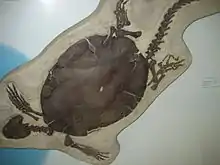 | |
| Chisternon undatum | |
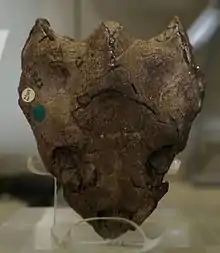 | |
| Dorsetochelys skull | |
Scientific classification  | |
| Kingdom: | Animalia |
| Phylum: | Chordata |
| Class: | Reptilia |
| Order: | Testudines |
| Clade: | †Paracryptodira Gaffney, 1975 |
| Subtaxa | |
|
See text | |
| Synonyms | |
|
Pleurosternoidea | |
Characteristics
Paracryptodira have reduced prefrontal exposure on the dorsal surface of their skulls, reduced fenestrae perilymphaticae, and secondarily reduced supraoccipital crests.[2] In the skull, the posterior foramen for the internal carotid canal is located midway along the basisphenoid-pterygoid suture.[1]
Subtaxa
The infraorder includes these taxa, After Joyce and Rollot, 2020.[6]
- Dinochelys
- Family: †Compsemydidae,[7]
- Compsemys[8] Late Cretaceous-Paleocene North America, Europe
- Riodevemys[9] Villar del Arzobispo Formation, Spain, Late Jurassic (Tithonian)
- Selenemys[9] Lourinhã Formation, Portugal, Late Jurassic (Kimmeridgian)
- Peltochelys Sainte-Barbe Clays Formation, Belgium, Barremian
- Kallokibotion?[10]
- †Uluops
- †Baenoidea[8]
- Family: †Baenidae[8]
- Family: †Pleurosternidae[8]
- Family: Helochelydridae?[10]
Dubious species:
- Species †Polythorax missuriensis[8]
- Species: †Desmemys bertelmanni[8]
- Species: †Glyptops caelatus[8]
- Species: †Glyptops pervicax[8]
- Species: †Probaena sculpta[8]
The oldest possible record of paracryptodires is from the Forest Marble Formation of England, dating to the Bathonian stage of the Middle Jurassic.[11]
References
- Gaffney (1975)
- Joyce (2007)
- Joyce, Walter G.; Anquetin, Jérémy (2019-10-07). "A Review of the Fossil Record of Nonbaenid Turtles of the Clade Paracryptodira". Bulletin of the Peabody Museum of Natural History. 60 (2): 129. doi:10.3374/014.060.0204. ISSN 0079-032X. S2CID 203780510.
- Joyce, Walter G. (April 2017). "A Review of the Fossil Record of Basal Mesozoic Turtles". Bulletin of the Peabody Museum of Natural History. Peabody Museum of Natural History - Yale. 58 (1): 65–113. doi:10.3374/014.058.0105. ISSN 0079-032X. S2CID 54982901.
- Joyce, Walter G.; Anquetin, Jérémy (October 2019). "A Review of the Fossil Record of Nonbaenid Turtles of the Clade Paracryptodira". Bulletin of the Peabody Museum of Natural History. 60 (2): 129–155. doi:10.3374/014.060.0204. ISSN 0079-032X. S2CID 203780510.
- Joyce, Walter G.; Rollot, Yann (2020-05-14). "An alternative interpretation of Peltochelys duchastelii as a paracryptodire". Fossil Record. 23 (1): 83–93. doi:10.5194/fr-23-83-2020. ISSN 2193-0066.
- "Baenoidea. unranked clade Paracryptodira Gaffney 1975 (turtle)". FossilWorks. Retrieved October 19, 2019.
- "Baenoidea. unranked clade Paracryptodira Gaffney 1975 (turtle)". FossilWorks. Retrieved October 19, 2019.
- "Pleurosternidae". Fossilworks. Retrieved October 18, 2019.
- Rollot, Yann; Evers, Serjoscha W.; Joyce, Walter G. (December 2021). "A redescription of the Late Jurassic (Tithonian) turtle Uluops uluops and a new phylogenetic hypothesis of Paracryptodira". Swiss Journal of Palaeontology. 140 (1): 23. doi:10.1186/s13358-021-00234-y. ISSN 1664-2376.
- SCHEYER, TORSTEN M.; ANQUETIN, JÉRÉMY (March 2008). "Bone histology of the Middle Jurassic turtle shell remains from Kirtlington, Oxfordshire, England". Lethaia. 41 (1): 85–96. doi:10.1111/j.1502-3931.2007.00044.x. ISSN 0024-1164.
Sources
- Gaffney, E.S. (1975): A phylogeny and classification of higher categories of turtles. Bulletin of the American Museum of Natural History 155(5): 387–436. PDF fulltext
- Joyce, W.G. (2007): Phylogenetic relationships of Mesozoic turtles. Bulletin of the Peabody Museum of Natural History 48(1): 3–102. DOI:10.3374/0079-032X(2007)48[3:PROMT]2.0.CO;2 HTML abstract