Cygnus NG-17
Cygnus NG-17, previously known as Cygnus OA-17, is the seventeenth planned flight of the Northrop Grumman robotic resupply spacecraft Cygnus and its sixteenth flight to the International Space Station (ISS) under the Commercial Resupply Services (CRS-2) contract with NASA. The mission is planned to launch in February 2022.[1][2][3] This is the sixth launch of Cygnus under the CRS-2 contract.[4][5]
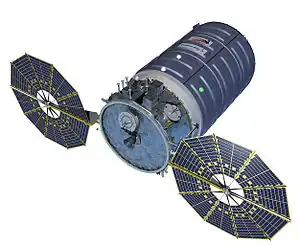 Artists' impression of an Extended Cygnus; the spacecraft type to be used in the mission. | |
| Names | Cygnus OA-17 (2016–2018) |
|---|---|
| Mission type | ISS resupply |
| Operator | Northrop Grumman |
| Spacecraft properties | |
| Spacecraft type | Enhanced Cygnus |
| Manufacturer |
|
| Start of mission | |
| Launch date | 19 February 2022 (planned) [1][2][3] |
| Rocket | Antares 230+ |
| Launch site | Wallops, Pad 0A |
| Contractor | Northrop Grumman |
| End of mission | |
| Disposal | Deorbited |
| Decay date | 2022 (planned) |
| Orbital parameters | |
| Reference system | Geocentric orbit |
| Regime | Low Earth orbit |
| Inclination | 51.66° |
| Berthing at International Space Station | |
| Berthing port | Harmony or Unity |
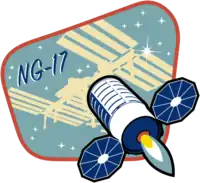 Cygnus NG-17 mission patch | |
Orbital ATK (now Northrop Grumman Innovation Systems) and NASA jointly developed a new space transportation system to provide commercial cargo resupply services to the International Space Station (ISS). Under the Commercial Orbital Transportation Services (COTS) program, Orbital ATK designed, acquired, built, and assembled these components: Antares, a medium-class launch vehicle; Cygnus, an advanced spacecraft using a Pressurized Cargo Module (PCM) provided by industrial partner Thales Alenia Space and a Service Module based on the Orbital GEOStar satellite bus.[6]
History
Cygnus NG-17 is the sixth Cygnus mission under the Commercial Resupply Services-2 contract.
Production and integration of Cygnus spacecraft are performed in Dulles, Virginia. The Cygnus service module is mated with the pressurized cargo module at the launch site, and mission operations are conducted from control centers in Dulles, Virginia and Houston, Texas.[6]
Manifest
Cygnus spacecraft is loaded with 0 kg (0 lb) of research, hardware, and crew supplies.[8]
- Crew supplies: 0 kg (0 lb)
- Science investigations: 0 kg (0 lb)
- Spacewalk equipment: 0 kg (0 lb)
- Vehicle hardware: 0 kg (0 lb)
- Computer resources: 0 kg (0 lb)
Research
The new experiments arriving at the orbiting laboratory will inspire future scientists and explorers, and provide valuable insight for researchers.
NASA Glenn Research Center studies: [9]
- TBD
References
- Baylor, Michael (1 September 2020). "Status - Cygnus NG-17". Next Spaceflight. Retrieved 8 April 2021.
- "Launch Schedule". Spaceflight Now. 31 March 2021. Retrieved 9 April 2021.
- "Microgravity Research Flights". Glenn Research Center. NASA. 22 April 2020. Retrieved 27 December 2020.
 This article incorporates text from this source, which is in the public domain.
 - Gebhardt, Chris (1 June 2018). "Orbital ATK looks ahead to CRS-2 Cygnus flights, Antares on the commercial market". NASASpaceFlight.com. Retrieved 27 December 2020.
- "Northrop Grumman "optimistic" to receive more NASA cargo mission orders". Spaceflight Now. 1 October 2020. Retrieved 27 December 2020.
- "Cygnus Spacecraft". Northrop Grumman. 6 January 2020. Retrieved 27 December 2020.
- "NASA Orders Two More ISS Cargo Missions From Orbital ATK". SpaceNews. 17 August 2015. Retrieved 27 December 2020.
- "Northrop Grumman Commercial Resupply". ISS Program Office. NASA. 1 July 2019. Retrieved 27 December 2020. This article incorporates text from this source, which is in the public domain.
- "ISS Research Program". Glenn Research Center. NASA. 1 January 2020. Retrieved 27 December 2020. This article incorporates text from this source, which is in the public domain.
External links
| Launch vehicles |  | |
|---|---|---|
| Operators | ||
| Past missions |
| |
| Future missions | ||
| ||
| ||
| 2000–2004 |  | |
| 2005–2009 | ||
| 2010–2014 | ||
| 2015–2019 | ||
| 2020–2024 | ||
| Future | ||
| Spacecraft | ||
| ||