Electric fish
An electric fish is any fish that can generate electric fields. A fish that can generate electric fields is called electrogenic while a fish that has the ability to detect electric fields is called electroreceptive. Most electrogenic fish are also electroreceptive.[1] The only group of electrogenic fish who are not electroreceptive come from the family Uranoscopidae.[2] Electric fish species can be found both in the ocean and in freshwater rivers of South America (Gymnotiformes) and Africa (Mormyridae). Many fish such as sharks, rays and catfishes can detect electric fields and are thus electroreceptive, but they are not classified as electric fish because they cannot generate electricity. Most common bony fish (teleosts), including most fish kept in aquaria or caught for food, are neither electrogenic nor electroreceptive.
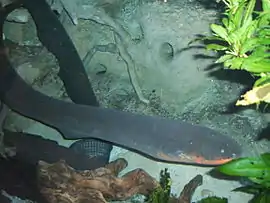
Electric fish produce their electrical fields from a specialized structure called an electric organ. This is made up of modified muscle or nerve cells, which became specialized for producing bioelectric fields stronger than those that normal nerves or muscles produce,[3] primarily for communication and predator defense[4] or navigation.[5] Evidence suggests that this organ evolved independently from muscular tissue.[6] Typically this organ is located in the tail of the electric fish due to a possible need for rigid fixation in order for the electrodes within the organ to function.[6] The electrical output of the organ is called the electric organ discharge, or EOD.[7] EOD’s are typically functionally divided among electric fish. There are two types, pulse and wave, both originating from ancient evolutionary divergences in niche occupancy.[8] EODs also have been observed to produce species-specific patterns[9] or different electric signal/waveform patterns according to their functions.[5]
Electric organ function
The function of the electric organ is most prominently self-defense and communication.[4] Additional functions in some fish also include navigation[5] and sexually dimorphic signaling.[10] The organ in many electric fish can produce differing EODs depending on the function. Polarized arrangement of electrolyte cells in some eels (for example the electric eel, Electrophorus electricus) allow the generation of small voltages that can build or add up creating weak or strong currents.[5] Electrogenic proteins trigger action potential-like sequences that result in the electric potential difference within the cells.[5] Smaller, weaker currents like those produced by Sach’s organ in electric eels are more energy conservative and therefore utilized for navigation and communication while strong currents like those produced by the main organ in eels are used for predation/hunting and defense.[5]
As for sexually dimorphic signaling, the organ can be used to produce distinct EOD or sinusoidal signals to be received across species and picked up by individuals.[10] In one type of weakly electric fish (the brown ghost knifefish, Apteronotus leptorhynchus) two different kinds of chirps are emitted among the males and females depending on the conspecific EOD that is received.[10]
Organ evolution
The electric organ evolved in fish six times in evolutionary history.[11] Most organs evolved from myogenic tissue, however one group of gymnotiformes, the Apteronotidae, derived their electric organ from neurogenic tissue.[2] In the electric fish Gymnarchus niloticus (AKA the African knifefish), the tail, trunk, hypobranchial, and eye muscles have been found to be incorporated into the organ, most likely to provide rigid fixation for the electrodes while swimming.[6] This provides evidence for a convergent evolution. In some other species, complete loss or considerable reduction of the tail fin has occurred, also indicating a convergence. This evolution is hypothesized to provide support against lateral bending while swimming and to maintain symmetry in the electric field for object detection.[6] If an electric fish lives in an environment with little to no obstructions, such as some bottom-living fish, their electric organ has been seen to have less prominent evolutionized convergences between the trunk and the organ.[6]
Strongly electric fish
Strongly electric fish are fish with an electric organ discharge that is powerful enough to stun prey or be used for defense. Typical examples are the electric eel, the electric catfishes, and electric rays. The amplitude of the signal can range from 10 to 860 volts with a current of up to 1 ampere, according to the surroundings, for example different conductances of salt and fresh water.[12] To maximize the power delivered to the surroundings, the impedances of the electric organ and the water must be matched:
- Strongly electric marine fish give low voltage, high current electric discharges. In salt water, a small voltage can drive a large current limited by the internal resistance of the electric organ. Hence, the electric organ consists of many electrocytes in parallel.
- Freshwater fish have high voltage, low current discharges. In freshwater, the power is limited by the voltage needed to drive the current through the large resistance of the medium. Hence, these fish have numerous cells in series.[13]
Weakly electric fish
.en2.jpg.webp)
Weakly electric fish generate a discharge that is typically less than one volt. These are too weak to stun prey and instead are used for navigation, object detection (electrolocation) and communication with other electric fish (electrocommunication). Two of the best-known and most-studied examples are Peters's elephantnose fish (Gnathonemus petersii) and the black ghost knifefish (Apteronotus albifrons). The males of the nocturnal Brachyhypopomus pinnicaudatus, a toothless knifefish native to the Amazon basin, give off big, long electric hums to attract a mate.[15]
The electric organ discharge waveform takes two general forms depending on the species. In some species the waveform is continuous and almost sinusoidal (for example the genera Apteronotus, Eigenmannia and Gymnarchus) and these are said to have a wave-type electric organ discharge. In other species, the electric organ discharge waveform consists of brief pulses separated by longer gaps (for example Gnathonemus, Gymnotus, Leucoraja) and these are said to have a pulse-type electric organ discharge.
EOD patterns
Electric organ discharges are generated from the animal’s electric organ.[9] It emits pulse-like electric signals for a multitude of reasons, depending on the species. Many species use it for communication, while others use it for electrolocation, hunting, or defense.[9] Their electric signals are often very simple as well as stereotyped, ie. always the same.[8] A study from 2018 on two species of weakly electric African fish (Campylomormyrus compressirostris and the blunt jawed elephant nose, Campylomormyrus tamandua) looked at the communication aspect of their signals, specifically what information they are sending and receiving and how they are sending and receiving it.
Previous research has found that the two components of electrocommunication are EODs and sequence pulse interval, AKA SPI (ie. the temporal pattern EODs are released in).[9] Using this as a starting point, the researchers conducted playback experiments to find the differences between EOD waveform and SPI between the two species, specifically how they relate to species recognition and discrimination, and what cues each species use to do this. They found that for SPI, C. compressirostris showed a tendency to burst when resting while C. tamandua presented a discharge pattern that was more heterogeneous.[9] They also saw that the average EOD frequency and the average duration of SPI serial correlations were species specific which suggests that SPI may convey information to the receiver. In addition, the results showed evidence to support the idea that males mediate species recognition and discrimination in C. compressirostris as well as other mormyrid species.[9] The researchers also noticed a significant relationship between EOD waveforms when they were paired with a natural SPI recording in C. compressirostris, however, this preference was not seen in all conditions. The males did not respond to artificial SPI recordings which researchers think suggests that there is some important information within the normal SPIs.[9]
Another group of researchers studied the genetics of three species of the family Gymnotus (the naked back knifefishes G. arapaima, G. mamiraua, and G. jonasi of the Central Amazon Floodplain) and the diversity of their chromosomal and electrical signals.[16] As of 2012, Gymnotus is the most diverse group out of the gymnotiform and mormyriform genera.[8] They looked at their chromosomes and genes to find similarities, differences, and patterns to see how exactly they all evolved and are related to each other. The researchers used these species specifically because they are a model species for studying how postzygotic and prezygotic reproductive isolation events could lead to speciation and diversification.[16] This paper is one of the first karyotypic analyses for these three species that also looks at EOD variation. They made a significant discovery for one species. They found that G. arapaima has a karyotypic formula that has never been seen before for the genus.[16] They decided to place it within a small clade with a few other species, which all have more rows of scales and a larger body size. Their findings suggest G. arapaima to be similar to other species within this clade but also distinct because it has a smaller number of bi-armed chromosomes.[16]
G. mamiraua also displayed a distinct karyotypic formula different from its closest relatives. They hypothesized that this could be from chromosomal rearrangements like translocation and pericentric inversion.[16] This species also has a different NOR (nucleolar organizing region) composition compared to its closest relative, G. cf. mamiraua from the eastern Amazon. They also have evidence that these two populations have different interspacing sequences between ribosomal genes which could be why they may be reproductively isolated due to this karyotypic difference acting as a postzygotic barrier.[16]
Lastly, when studying G. jonasi they found it has the highest number of st/a (subterminal acrocentric region) chromosomes within its group. They also found that it exhibits multiple NORs which only one other species has. Their study shows just how diverse- in terms of species, electric signals, karyotype, and overall genetics- the Gymnotus family is.[16]
The findings of the previous study showed that Gymnotus has significant chromosomal diversity[16] and this is strongly supported by another study. A 2013 study also researched the genus Gymnotus, specifically their electric diversity in the ultimate and proximate perspectives. With the proximate lens, the authors aimed to examine the diversity of EODs and with the ultimate lens they wanted to study signal diversity.[8] They used 11 species, each representing a major clade. Their results integrated data from multiple fields and dozens of authors and researchers to create a big picture depiction of signal diversity, species diversity, and the evolution of the members of this genus.[8]
This paper compared three studies about the phylogeny of this genus and concluded that the genus is stable and will not likely change, even with new species that could be discovered in the future with emerging molecular and morphological tests and data.[8] They found a basal dichotomy between the clade with all remaining Gymnotus species and the G. coatesi clade. The researchers observed several evolutionary ht-EOD structure transitions, too. They also concluded that the ht-EOD differences between closely related Gymnotus species were mostly differences in EOD duration, amplitude, and relative size, all of which oftentimes varied.[8] In the proximate perspective, this variation correlates to the “diversity in innervation patterns of the electrocytes, auto-excitability, electrocyte density and distribution, and the expression of neurogenic components in the EOD”.[8] These components show a strong correlation to the ht-EOD structure and phylogenetic signal. In comparison, with the ultimate perspective they found several extrinsic biotic selective pressures that seem to have an effect on the shaping of the communication aspect of EODs.[8]
EOD evolution
A paper on the three different electric organs of Electrophorus electricus, the electric eel, details what each organ’s function is. Overall, all three are used for navigation, communication, hunting, and defense but each purpose happens in different levels of electric organ discharge.[5] E. electricus is the only species that has evolved three separate organs for discharge and one of the only ones that can generate strong discharges. Their goal was to find the differences between the three electric organs and what proteins, phosphosites, and phosphorylation events occurred that may have caused the changes.[5]
The researchers found that the electrolyte cells in the electric organs of E. electricus have a polarized cell arrangement, which is how they are able to generate small voltages that can add up.[5] The cells are triggered by acetylcholine, which causes an action potential-like sequence of events that results in an electric potential difference inside each electrolyte cell, which, combined with every other cell, sums up to create a large voltage.[5] They also found several new phosphorylation sites in the electrogenic proteins, including one that has only been seen elsewhere in the electric ray species Tetronarce californica. These new sites are not seen in nonelectrogenic species which means they may be unique and important to the ability to generate EODs. These sites very likely evolved independent of one another, because the two species are very distantly related.[5] Finally, they also found a consistent and special abundance pattern in a handful of the electrogenic proteins within each of the three electric organs (the main organ, Sach’s organ, and Hunter’s organ). Having different abundances likely reflects the energy each organ requires to emit EOD’s, whether weak or strong.[5]
A recent study from 2020 looked at the evolution of sensorimotor integration in terms of communication signal diversification in Mormyrid fishes, AKA African weakly electric fishes.[10] Corollary discharge is one of the ways motor control can influence sensory processing which is done by filtering out the individual’s own signals from being processed. Because corollary discharge is responsible for cancelling its own signals, it would make evolutionary sense if signal diversification was selected for. To answer this question the researchers looked at 7 different mormyrid species with varying corollary discharge inhibitions (CDI) and EOD durations.[10] The researchers did find a correlation between signal diversification and CDI, as well as between EOD duration and the onset of CDI (but not duration of CDI). With these findings, they were able to conclude that, in response to an individual’s own EODs, SCDIs evolved to shift their time window in order to impede spikes in KO.[10]
Jamming avoidance response
It had been theorized as early as the 1950s that electric fish near each other might experience some type of interference or inability to segregate their own signal from those of neighbors. This issue does not arise, however, because the electric fish adjust to avoid frequency interference. In 1963, two scientists, Akira Watanabe and Kimihisa Takeda, discovered the behavior of the jamming avoidance response in the knifefish Eigenmannia sp. In collaboration with T.H. Bullock and colleagues, the behavior was further developed.[17] Finally, the work of Walter Heiligenberg expanded it into a full neuroethology study by examining the series of neural connections that led to the behavior.[18] Eigenmannia is a weakly electric fish that can self-generate electric discharges through electrocytes in its tail. Furthermore, it has the ability to electrolocate by analyzing the perturbations in its electric field. However, when the frequency of a neighboring fish's current is very close (less than 20 Hz difference) to that of its own, the fish will avoid having their signals interfere through a behavior known as jamming avoidance response. If the neighbor's frequency is higher than the fish's discharge frequency, the fish will lower its frequency, and vice versa. The sign of the frequency difference is determined by analyzing the "beat" pattern of the incoming interference which consists of the combination of the two fish's discharge patterns.[18]
Neuroethologists performed several experiments under Eigenmannia's natural conditions to study how it determined the sign of the frequency difference. They manipulated the fish's discharge by injecting it with curare which prevented its natural electric organ from discharging. Then, an electrode was placed in its mouth and another was placed at the tip of its tail. Likewise, the neighboring fish's electric field was mimicked using another set of electrodes. This experiment allowed neuroethologists to manipulate different discharge frequencies and observe the fish's behavior. From the results, they were able to conclude that the electric field frequency, rather than an internal frequency measure, was used as a reference. This experiment is significant in that not only does it reveal a crucial neural mechanism underlying the behavior but also demonstrates the value neuroethologists place on studying animals in their natural habitats.[18]
Species
The following is a table of electric fish species listed by family. Most families inhabit fresh water. Two groups of marine fish, the electric rays (Torpediniformes: Narcinidae and Torpedinidae) and the stargazers (Perciformes: Uranoscopidae), are capable of generating strong electric pulses.
| Taxon | Species (348) |
|---|---|
| Gymnotiformes | |
| Apteronotidae
(Ghost knifefish, 46 species in 13 genera) |
Adontosternarchus balaenops, Adontosternarchus clarkae, Adontosternarchus devenanzii, Adontosternarchus sachsi, Apteronotus albifrons, Apteronotus apurensis, Apteronotus bonapspeciesii, Apteronotus brasiliensis, Apteronotus caudimaculosus, Apteronotus cuchillejo, Apteronotus cuchillo, Apteronotus ellisi, Apteronotus eschmeyeri, Apteronotus jurubidae, Apteronotus leptorhynchus, Apteronotus macrolepis, Apteronotus macrostomus, Apteronotus magdalenensis, Apteronotus marauna, Apteronotus mariae, Apteronotus rostratus, Apteronotus spurrellii, Compsaraia compsa, Magosternarchus duccis, Magosternarchus raptor, Megadontognathus cuyuniense, Megadontognathus kaitukaensis, Orthosternarchus tamandua, Parapteronotus hasemani, Platyurosternarchus macrostomus, Porotergus gimbeli, Porotergus gymnotus, Sternarchella curvioperculata, Sternarchella orthos, Sternarchella schotti, Sternarchella sima, Sternarchella terminalis, Sternarchogiton nattereri, Sternarchogiton porcinum, Sternarchorhamphus muelleri, Sternarchorhynchus britskii, Sternarchorhynchus curvirostris, Sternarchorhynchus mesensis, Sternarchorhynchus mormyrus, Sternarchorhynchus oxyrhynchus, Sternarchorhynchus roseni |
| Gymnotidae
(Naked-back knifefish, 29 species in 1 genus) |
Gymnotus anguillaris, Gymnotus arapaima, Gymnotus ardilai, Gymnotus bahianus, Gymnotus carapo, Gymnotus cataniapo, Gymnotus choco, Gymnotus coatesi, Gymnotus coropinae, Gymnotus cylindricus, Gymnotus diamantinensis, Gymnotus esmeraldas, Gymnotus henni, Gymnotus inaequilabiatus, Gymnotus javari, Gymnotus jonasi, Gymnotus maculosus, Gymnotus mamiraua, Gymnotus melanopleura, Gymnotus onca, Gymnotus panamensis, Gymnotus pantanal, Gymnotus pantherinus, Gymnotus paraguensis, Gymnotus pedanopterus, Gymnotus stenoleucus, Gymnotus sylvius, Gymnotus tigre, Gymnotus ucamara |
| Electrophoridae
(1 species in 1 genus) |
Electrophorus electricus (electric eel) |
| Hypopomidae
(Bluntnose knifefish, 14 species in 7 genera) |
Brachyhypopomus beebei, Brachyhypopomus brevirostris, Brachyhypopomus diazi, Brachyhypopomus janeiroensis, Brachyhypopomus occidentalis, Brachyhypopomus pinnicaudatus, Hypopomus speciesedi, Hypopygus lepturus, Hypopygus neblinae, Microsternarchus bilineatus, Racenisia fimbriipinna, Steatogenys duidae, Steatogenys elegans, Stegostenopos cryptogenes |
| Rhamphichthyidae
(Sand knifefish, 15 species in 3 genera) |
Gymnorhamphichthys hypostomus, Gymnorhamphichthys petiti, Gymnorhamphichthys rondoni, Gymnorhamphichthys rosamariae, Iracema caiana, Rhamphichthys apurensis, Rhamphichthys atlanticus, Rhamphichthys drepanium, Rhamphichthys hahni, Rhamphichthys lineatus, Rhamphichthys longior, Rhamphichthys marmoratus, Rhamphichthys pantherinus, Rhamphichthys rostratus, Rhamphichthys schomburgki |
| Sternopygidae
(Glass knifefish, 28 species in 5 genera) |
Archolaemus blax, Distocyclus conirostris, Distocyclus goajira, Eigenmannia humboldtii, Eigenmannia limbata, Eigenmannia macrops, Eigenmannia microstoma, Eigenmannia nigra, Eigenmannia trilineata, Eigenmannia vicentespelaea, Eigenmannia virescens, Rhabdolichops caviceps, Rhabdolichops eastwardi, Rhabdolichops electrogrammus, Rhabdolichops jegui, Rhabdolichops stewspeciesi, Rhabdolichops troscheli, Rhabdolichops zareti, Sternopygus aequilabiatus, Sternopygus arenatus, Sternopygus astrabes, Sternopygus branco, Sternopygus castroi, Sternopygus dariensis, Sternopygus macrurus, Sternopygus obtusirostris, Sternopygus pejeraton, Sternopygus xingu |
| Osteoglossiformes | |
| Gymnarchidae
(African knifefish, 1 species in 1 genus) |
Gymnarchus niloticus |
| Mormyridae
(Freshwater elephantfish, 203 species in 18 genera) |
Boulengeromyrus knoepffleri, Brienomyrus adustus, Brienomyrus brachyistius, Brienomyrus curvifrons, Brienomyrus hopkinsi, Brienomyrus kingsleyae eburneensis, Brienomyrus kingsleyae kingsleyae, Brienomyrus longianalis, Brienomyrus longicaudatus, Brienomyrus niger, Brienomyrus sphekodes, Brienomyrus tavernei, Campylomormyrus alces, Campylomormyrus bredoi, Campylomormyrus cassaicus, Campylomormyrus christyi, Campylomormyrus curvirostris, Campylomormyrus elephas, Campylomormyrus luapulaensis, Campylomormyrus mirus, Campylomormyrus numenius, Campylomormyrus orycteropus, Campylomormyrus phantasticus, Campylomormyrus rhynchophorus, Campylomormyrus tamandua, Campylomormyrus tshokwe, Genyomyrus donnyi, Gnathonemus barbatus, Gnathonemus echidnorhynchus, Gnathonemus longibarbis, Gnathonemus petersii, Heteromormyrus pauciradiatus, Hippopotamyrus aelsbroecki, Hippopotamyrus ansorgii, Hippopotamyrus batesii, Hippopotamyrus castor, Hippopotamyrus discorhynchus, Hippopotamyrus grahami, Hippopotamyrus harringtoni, Hippopotamyrus macrops, Hippopotamyrus macroterops, Hippopotamyrus pappenheimi, Hippopotamyrus paugyi, Hippopotamyrus pictus, Hippopotamyrus psittacus, Hippopotamyrus retrodorsalis, Hippopotamyrus smithersi, Hippopotamyrus szaboi, Hippopotamyrus weeksii, Hippopotamyrus wilverthi, Hyperopisus bebe bebe, Hyperopisus bebe occidentalis, Isichthys henryi, Ivindomyrus opdenboschi, Marcusenius rhodesianus, Marcusenius sanagaensis, Marcusenius schilthuisiae, Marcusenius senegalensis gracilis, Marcusenius senegalensis pfaffi, Marcusenius senegalensis senegalensis, Marcusenius stanleyanus, Marcusenius thomasi, Marcusenius ussheri, Marcusenius victoriae, Marcusenius abadii, Marcusenius annamariae, Marcusenius bentleyi, Marcusenius brucii, Marcusenius cuangoanus, Marcusenius cyprinoides, Marcusenius deboensis, Marcusenius dundoensis, Marcusenius friteli, Marcusenius furcidens, Marcusenius fuscus, Marcusenius ghesquierei, Marcusenius greshoffii, Marcusenius intermedius, Marcusenius kutuensis, Marcusenius leopoldianus, Marcusenius livingstonii, Marcusenius macrolepidotus angolensis, Marcusenius macrolepidotus macrolepidotus, Marcusenius macrophthalmus, Marcusenius mento, Marcusenius meronai, Marcusenius monteiri, Marcusenius moorii, Marcusenius ntemensis, Marcusenius nyasensis, Marcusenius rheni, Mormyrops anguilloides, Mormyrops attenuatus, Mormyrops batesianus, Mormyrops breviceps, Mormyrops caballus, Mormyrops citernii, Mormyrops curtus, Mormyrops curviceps, Mormyrops engystoma, Mormyrops furcidens, Mormyrops intermedius, Mormyrops lineolatus, Mormyrops mariae, Mormyrops masuianus, Mormyrops microstoma, Mormyrops nigricans, Mormyrops oudoti, Mormyrops parvus, Mormyrops sirenoides, Mormyrus bernhardi, Mormyrus caballus asinus, Mormyrus caballus bumbanus, Mormyrus caballus caballus, Mormyrus caballus lualabae, Mormyrus casalis, Mormyrus caschive, Mormyrus cyaneus, Mormyrus felixi, Mormyrus goheeni, Mormyrus hasselquistii, Mormyrus iriodes, Mormyrus kannume, Mormyrus lacerda, Mormyrus longirostris, Mormyrus macrocephalus, Mormyrus macrophthalmus, Mormyrus niloticus, Mormyrus ovis, Mormyrus rume proboscirostris, Mormyrus rume rume, Mormyrus subundulatus, Mormyrus tapirus, Mormyrus tenuirostris, Mormyrus thomasi, Myomyrus macrodon, Myomyrus macrops, Myomyrus pharao, Oxymormyrus boulengeri, Oxymormyrus zanclirostris, Paramormyrops gabonensis, Paramormyrops jacksoni, Petrocephalus ansorgii, Petrocephalus balayi, Petrocephalus bane bane, Petrocephalus bane comoensis, Petrocephalus binotatus, Petrocephalus bovei bovei, Petrocephalus bovei guineensis, Petrocephalus catostoma catostoma, Petrocephalus catostoma congicus, Petrocephalus catostoma haullevillei, Petrocephalus catostoma tanensis, Petrocephalus christyi, Petrocephalus cunganus, Petrocephalus gliroides, Petrocephalus grandoculis, Petrocephalus guttatus, Petrocephalus hutereaui, Petrocephalus keatingii, Petrocephalus levequei, Petrocephalus microphthalmus, Petrocephalus pallidomaculatus, Petrocephalus pellegrini, Petrocephalus sauvagii, Petrocephalus schoutedeni, Petrocephalus simus, Petrocephalus soudanensis, Petrocephalus squalostoma, Petrocephalus sullivani, Petrocephalus tenuicauda, Petrocephalus wesselsi, Pollimyrus adspersus, Pollimyrus brevis, Pollimyrus castelnaui, Pollimyrus isidori fasciaticeps, Pollimyrus isidori isidori, Pollimyrus isidori osborni, Pollimyrus maculipinnis, Pollimyrus marchei, Pollimyrus nigricans, Pollimyrus nigripinnis, Pollimyrus pedunculatus, Pollimyrus petherici, Pollimyrus petricolus, Pollimyrus plagiostoma, Pollimyrus pulverulentus, Pollimyrus schreyeni, Pollimyrus stappersii kapangae, Pollimyrus stappersii stappersii, Pollimyrus tumifrons, Stomatorhinus ater, Stomatorhinus corneti, Stomatorhinus fuliginosus, Stomatorhinus humilior, Stomatorhinus kununguensis, Stomatorhinus microps, Stomatorhinus patrizii, Stomatorhinus polli, Stomatorhinus polylepis, Stomatorhinus puncticulatus, Stomatorhinus schoutedeni, Stomatorhinus walkeri |
| Siluriformes | |
| Malapteruridae
(Electric catfish, 11 species in 1 genus) |
Malapterurus beninensis, Malapterurus cavalliensis, Malapterurus electricus, Malapterurus leonensis, Malapterurus microstoma, Malapterurus minjiriya, Malapterurus monsembeensis, Malapterurus oguensis, Malapterurus shirensis, Malapterurus tanganyikaensis, Malapterurus tanoensis |
| Perciformes | |
| Uranoscopidae
(Stargazers, marine fish, 50 species in 8 genera) |
Astroscopus guttatus, Astroscopus y-graecum, Astroscopus zephyreus, Gnathagnus egregius, Kathetostoma albigutta, Kathetostoma averruncus |
References
- Alves-Gomes, J (2001). "The evolution of electroreception and bioelectrogenesis in teleost fish: a phylogenietic perspective". Journal of Fish Biology. 58 (6): 1489–1511. doi:10.1111/j.1095-8649.2001.tb02307.x.
- Bullock, Theodore H.; Hopkins, Carl D.; Popper, Arthur N.; Fay, Richard R., eds. (2005). "Electroreception". Springer Handbook of Auditory Research. 21. doi:10.1007/0-387-28275-0. ISBN 978-0-387-23192-1.
- Albert, J. S.; Crampton, W. G. R. Electroreception and electrogenesis. pp. 431–472. In: Evans, David H.; Claiborne, James B., eds. (2006). The Physiology of Fishes (3rd ed.). CRC Press. ISBN 978-0-8493-2022-4.
- Macesic, Laura J.; Kajiura, Stephen M. (November 2009). "Electric organ morphology and function in the lesser electric ray, Narcine brasiliensis". Zoology. 112 (6): 442–450. doi:10.1016/j.zool.2009.02.002. PMID 19651501.
- Traeger, Lindsay L.; Sabat, Grzegorz; Barrett-Wilt, Gregory A.; Wells, Gregg B.; Sussman, Michael R. (July 2017). "A tail of two voltages: Proteomic comparison of the three electric organs of the electric eel". Science Advances. 3 (7): e1700523. Bibcode:2017SciA....3E0523T. doi:10.1126/sciadv.1700523. ISSN 2375-2548. PMC 5498108. PMID 28695212.
- LISSMANN, H. W. (1958-03-01). "On the Function and Evolution of Electric Organs in Fish". Journal of Experimental Biology. 35 (1): 156–191. doi:10.1242/jeb.35.1.156. ISSN 1477-9145.
- Nelson, Mark. "What IS an electric fish?". Retrieved 10 August 2014.
- Crampton, William G. R. (July 2019). "Electroreception, electrogenesis and electric signal evolution". Journal of Fish Biology. 95 (1): 92–134. doi:10.1111/jfb.13922. ISSN 0022-1112. PMID 30729523.
- Nagel, Rebecca; Kirschbaum, Frank; Hofmann, Volker; Engelmann, Jacob; Tiedemann, Ralph (December 2018). "Electric pulse characteristics can enable species recognition in African weakly electric fish species". Scientific Reports. 8 (1): 10799. Bibcode:2018NatSR...810799N. doi:10.1038/s41598-018-29132-z. ISSN 2045-2322. PMC 6050243. PMID 30018286.
- Fukutomi, Matasaburo; Carlson, Bruce A. (2020-08-12). "Signal Diversification Is Associated with Corollary Discharge Evolution in Weakly Electric Fish". The Journal of Neuroscience. 40 (33): 6345–6356. doi:10.1523/JNEUROSCI.0875-20.2020. ISSN 0270-6474. PMC 7424872. PMID 32661026.
- Crampton, William G. R. (2019). "Electroreception, electrogenesis and electric signal evolution". Journal of Fish Biology. 95 (1): 92–134. doi:10.1111/jfb.13922. ISSN 1095-8649.
- The Guardian: Shocking news: world's most powerful electric eel found in Amazon. Retrieved 11 Sep 2019
- Kramer, Bernd (2008). "Electric Organ Discharge". In Marc D. Binder; Nobutaka Hirokawa; Uwe Windhorst (eds.). Encyclopedia of Neuroscience. Berlin, Heidelberg: Springer. pp. 1050–1056. ISBN 978-3-540-23735-8. Retrieved 2012-03-25.
- Von der Emde, G. (1999). "Active electrolocation of objects in weakly electric fish". Journal of Experimental Biology, 202 (10): 1205–1215. Full text
- Choi, Charles. "Electric Fish Advertise Their Bodies". Retrieved 10 August 2014.
- Milhomem, Susana Suely Rodrigues; Crampton, William Gareth Richard; Pieczarka, Julio Cesar; dos Santos Silva, Danillo; Cardoso, Adauto Lima; da Silva, Patricia Corrêa; Alves de Oliveira, Jonas; Nagamachi, Cleusa Yoshiko (June 2012). "Chromosomal and electric signal diversity in three sympatric electric knifefish species (Gymnotus, Gymnotidae) from the Central Amazon Floodplain". Reviews in Fish Biology and Fisheries. 22 (2): 485–497. doi:10.1007/s11160-011-9239-1. ISSN 0960-3166. S2CID 7703678.
- Bullock, Theodore Holmes; Heiligenberg, Walter, eds. (1986). Electroreception. Wiley.
- Heiligenberg, Walter (1991) Neural Nets in Electric Fish Cambridge: MIT Press. ISBN 978-0-262-08203-7.
| About fish |  | ||||
|---|---|---|---|---|---|
| Anatomy and physiology | |||||
| Sensory systems | |||||
| Reproduction | |||||
| Locomotion | |||||
| Other behaviour | |||||
| By habitat | |||||
| Other types | |||||
| Commerce |
| ||||
| Major groups | |||||
| Lists |
| ||||
| |||||

