Finnish I Corps (Continuation War)
The I Corps (Finnish: I Armeijakunta) was a short-lived unit of the Finnish Army during the Continuation War. It participated in both the Finnish invasion of Ladoga Karelia and the Finnish invasion of the Karelian Isthmus in 1941 before being disbanded in early 1942.
| I Corps | |
|---|---|
| I Armeijakunta | |
| Active | 1941–1942 |
| Country |  Finland Finland |
| Branch | Army |
| Type | Corps |
| Engagements | |
| Commanders | |
| Notable commanders | Einar Mäkinen |
In the lead up to Continuation War
The I Corps headquarters was first formed before the onset of the war by the peace-time headquarters of the border guard.[1][2] The headquarters-only corps had at this point no operational units assigned to it.[3] On June 29th 1941, the headquarters element was ordered to form the Army of Karelia.[1]
Reconstitution in the Sortavala Region
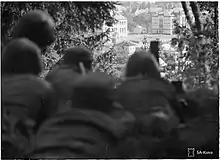
The corps was re-formed in August 1941 under the command of Lieutenant General Einar Mäkinen during the Finnish invasion of Ladoga Karelia to clarify the command structure in the area northwest of lake Ladoga.[4] Consisting of the 7th, 19th and 2nd divisions,[5] the corps was tasked with the containment and destruction of the reinforced Soviet 168th Rifle Division surrounded in the area of Sortavala.[6] The corps captured Sortavala,[7] but failed to prevent parts of the 168th Division from escaping over lake Ladoga.[8]
On the Karelian Isthmus
Following the capture of Sortavala, the corps' organization underwent significant change as its divisions were transferred to other units.[9] In turn, the 10th and 15th divisions were transferred from II Corps to I Corps.[10][11] The corps headquarters was thus moved to the Karelian isthmus,[12] where the 10th Division was currently in the area between the river Vuoksi and lake Krasnoye, while the 15th Division was in the area of river Vuoksi and lake Sukhodolskoye on the northern side of the river.[11] The corps then continued the attack towards Leningrad,[13] eventually reaching the area of Lembolovo where it took a defensive stance.[14]
In early 1942, the corps headquarters – together with commander Mäkinen – were moved to the Svir sector, where they formed the headquarters for the V Corps.[12]
Notes
- Leskinen & Juutilainen 2005, p. 140.
- Sotatieteen laitos 1988, p. 99.
- Sotatieteen laitos 1988, p. 103.
- Leskinen & Juutilainen 2005, pp. 141–142.
- Rautala 2002, p. 19.
- Rautala 2002, p. 65.
- Rautala 2002, p. 67.
- Rautala 2002, pp. 79–80.
- Rautala 2002, p. 80.
- Leskinen & Juutilainen 2005, p. 131.
- Rautala 2004, p. 23.
- Uola 2005.
- Leskinen & Juutilainen 2005, p. 141.
- Rautala 2004, p. 96.
References
- Leskinen, Jari; Juutilainen, Antti, eds. (2005). Jatkosodan pikkujättiläinen (in Finnish). Helsinki: Werner Söderström Osakeyhtiö. ISBN 95-1028690-7.
- Uola, Mikko (2005). "Mäkinen, Einar (1895–1964)". Kansallisbiografia. Studia Biographica (in Finnish). 4. The Finnish Literature Society. ISSN 1799-4349. Retrieved 10 October 2021.
- Sotatieteen laitos, ed. (1988). Jatkosodan historia 1. Sotatieteen laitoksen julkaisuja XXV (in Finnish). 1. Porvoo: Werner Söderström Osakeyhtiö. ISBN 951-0-15327-3.
- Rautala, Ari (2002). Itä-Karjalan valtaus 1941 (in Finnish). Jyväksylä: Gummerus Kirjapaino Oy. ISBN 951-20-6161-9.
- Rautala, Ari (2004). Karjalan Kannaksen takaisinvaltaus kesällä 1941 (in Finnish). Jyväksylä: Gummerus Kirjapaino Oy. ISBN 951-20-6636-X.