Finnish VI Corps (Continuation War)
The VI Corps (Finnish: VI Armeijakunta) was a unit of the Finnish Army during the Continuation War. During the war, the corps participated in the Finnish invasions of Ladoga Karelia and East Karelia, eventually reaching the Svir where it would spend the trench warfare phase of the war. It was on Svir sector when the Soviet Vyborg–Petrozavodsk offensive began, and had to retreat to north of Lake Ladoga to avoid encirclement.
| VI Corps | |
|---|---|
| VI Armeijakunta | |
| Active | 1941–1944 |
| Country |  Finland Finland |
| Branch | Army |
| Type | Corps |
| Engagements | |
| Commanders | |
| Notable commanders |
|
Mobilization
Unlike many of the other Finnish Continuation War corps, the VI Corps was not created directly from a peace-time corps during the 1941 mobilization.[1] Instead, VI Corps saw its creation in the aftermath of Army of Karelia's creation on 29 June: As the V Corps was disbanded, the headquarters element of the V Corps formed the headquarters element for the VI Corps. The command of the corps was given to Paavo Talvela, who had been commanding the II Corps until that point.[2]
The newly created VI Corps consisted of the 11th and 5th Divisions and was concentrated on the Finno-Soviet border between Group O and VII Corps to its north and south, respectively. It held a sector of the border in the areas of Tuupovaara and Onkamo, with the 5th Division on the left (north-east) and the 11th Division on the right (south-west).[3]
Invasion of Ladoga Karelia
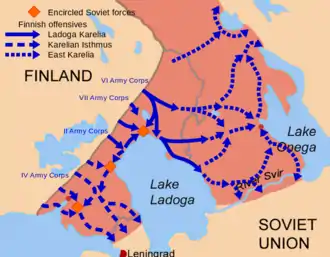
The Army of Karelia's plan for the 1941 Finnish invasion of Ladoga Karelia was to break the enemy lines north of Lake Yanisyarvi, destroing enemy formations on the isthmus between Lake Ladoga and Lake Yanisyarvi. The attack would then continue to the Svir and Lake Onega.[4] As part of this operation, VI Corps would have 11th Division attack south towards Lake Yanisyarvi between Vyartsilya and Korpiselkä, while the 5th Division initially attacked Korpiselkä and Tjokki, from where it would continue to Uuksu via Lake Tolvayarvi.[5]
The Finnish assault started with an artillery preparation on 9 July at 23:40, with the Finnish infantry pushing off 28 minutes later. The Finns, however, had trouble concentrating forces and directing artillery. The attack soon slowed down, with battles in the region of Korpiselkä causing delays of 19 to 20 hours.[6] Around mid-day 11 July, the 5th Division commander was replaced by Ruben Lagus, who was now the commander of both the 5th Division and the 1st Jäger Brigade, the latter of which belonged to Group O. During 12 July, the combined force of the 5th Division and the 1st Jäger Brigade reached Lake Tolvayarvi and an area some 5 kilometres (3.1 mi) north of Uuksu, with Uuksu itself falling to the Finns on the morning of 13 July.[7] The same day, 11th Division had reached the area north of Lake Yanisyarvi.[8]
Following these successes, Talvela requested new orders from the commander of the Army of Karelia, Erik Heinrichs. The corps was given a new objective in the form of the Suistamo–Loimola railway line. The corps's advance units were to take and hold the railway as well as railway bridges in Hämekoski. This would disturb the supply lines of the Soviet forces delaying the VII Corps to the west of Lake Yanisyarvi.[9] On 13 July, the corps was given orders to take Loimola and then attack towards Koirinoja on the shore of Lake Ladoga.[10]
While the 11th Division continued to be engaged in the area north of Lake Yanisyarvi,[11] the 5th Division took Loimola on 14 July.[12] Lagus's forces reached Koirinoja and the shore of Lake Ladoga early in the morning of 15 July,[12] thus splitting in two the Soviet 7th Army, with parts of the 168th and 71st Divisions being cut off north of Lake Ladoga.[13] Also on 15 July, Finnish forces took up blocking positions some 10–15 kilometres (6.2–9.3 mi) east of Loimola.[12] The 11th Division took up positions along the Jänisjoki, preventing the cut-off Soviet formations from breaking east.[14]
Advance to Svir
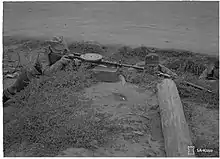
Having reached Lake Ladoga, the 5th Division continued south along the eastern shore of the lake.[15] By 19 July 1941, the Army of Karelia was concerned about possible encirclement by a combination of landings over the lake and Soviet forces counter-attacking from the east, thus ordering the VI Corps to not advance beyond the Vitele-Vedlozero line.[16] On 20 July, VI corps was ordered to cover parts of the Lake Ladoga coast. However, due to a lack of Finnish forces available for coastal defense, the Soviet 4th Naval Infantry Brigade was able to land on Lunkulansaari Island. An attempt to land further troops was repulsed by the Finns on 25 July, and the island was cleared completely of Soviet forces on 26 July. The Finns continued on 27 July by counter-attacking Soviet forces who had landed on Mantsinsaari Island and by repulsing a further landing attempt on 28 July.[17]
Concurrently with these actions, the reinforced 5th Division continued south along the shore of lake, taking Vitele 24 July.[14] The Finns attempted to cut off Soviets retreating from Vitele, but failed to do so.[18] By mid-July, VI Corps was holding a line spanning from River Tuloksa to Säntämä.[19] Ordered to not advance further, the corps would hold this sector until 4 September while repulsing several Soviet counter-attacks from the forces of the Soviet 7th Army.[20]
On 30 August, the commander of the Army of Karelia gave VI corps new orders: The corps was to advance to the Svir while keeping its left flank secure along the line Kotkozero-Vahoijärvi. This task was simplified by the presence of the German 163rd Infantry Division. While not subordinated to the VI Corps, it followed behind ready to advance towards its flank if needed.[21] On 4 September, the corps, consisting at this point of the 5th and 17th Divisions and reinforced by a regiment from the 7th Division, launched its attack.[22] The attack was opposed by the Soviet 3rd Division, 3rd Naval Infantry Brigade, and two regiments,[22] of which the 3rd Naval Infantry Brigade and two regiments were in the region the Finns had chosen as the focus of their assault over the Säntämäjoki River.[23] By the morning of 5 September, the Finns had broken the Soviet line and opened the road to the city of Olonets,[23] with Olonets falling the same evening.[24]
By 8 September, VI corps had reached Svir in Kuuttilahti, Lodeynoye Pole and on the Svir railway station.[25] By reaching the latter, the Finns had technically cut the Murmansk railroad, but this was not meaningful for the supply of Murmansk because another line had been completed from Obozersky to Belomorsk during the winter of 1941.[26] The Finns crossed the Svir on September 12,[27] establishing a bridgehead that would eventually reach the a width of 100 kilometres (62 mi) and a depth of 20 kilometres (12 mi).[26]
Defending Svir
.jpg.webp)
By the end of August 1941, VI corps was in charge of the whole Svir sector, covering the river and the bridgehead with a force consisting of the 11th, 5th, 17th and 7th Divisions. Opposite them were the Soviet 3rd Naval Infantry Brigade and the 314th, 21st, 114th and 272nd Divisions of the Soviet 7th Separate Army.[28]
In addition, the German 163rd Division stood behind the 11th Division on the shore of Lake Ladoga, but was not subordinated to the VI Corps.[28] The division had been brought into the area in preparation for the "handshake at Svir", where Finnish troops advancing from the north would link up with German troops advancing from the southwest. The task of the 163rd Division would have been to cover the flanks of the link up. The division was moved away from the sector later, once it had become clear both that the German forces would not be able to reach Svir from south, and that the Finns were hesitant to advance southwards themselves.[29]
By January 1942, the Finnish General HQ viewed the Svir front as being too large of a sector to be managed by a single corps level formation. On 24 January, the Finnish commander-in-chief Mannerheim ordered the creation of the V Corps, which took control of the eastern Svir sector on 18 February. On 1 March these two corps, together with the VII Corps defending the shore of Lake Onega, formed the new Aunus Group, while the Army of Karelia was officially disbanded. In this new organization, VI corps consisted of the 5th and 17th divisions. To their right was the German 163rd Division and to their right the V corps.[30] Also during January 1942, Talvela was replaced by Aarne Blick.[31][32]
Between December 1941 and April 1942, Soviets launched multiple counter-attacks on the Svir sector.[31] An attack launched on 11 April 1942, created a dangerous breach in the Šelmenitša-Pertjärvi area. The breach was under control on 22 April, but the defense had involved 16 Finnish battalions and cost them 2165 casualties, including 440 killed.[33] The Soviet counter-attacks largely stopped in April 1942,[31] and the Svir front stabilized into stationary or trench warfare.[34][35]
Soviet Vyborg–Petrozavodsk offensive
Following various changes in the corps's subordinate units, including a brief time in 1943 with the Finnish Armoured Division in the line, on 31 May 1944 the corps consisted of the 15th Brigade and the 5th, 8th and 17th Divisions.[36] In this configuration, it was struck by the Soviet Vyborg–Petrozavodsk offensive on 21 June, while Finns were already pulling back forces to the northern side of Svir.[37]
A Soviet landing in Tuloksa soon put the corps in danger of being cut off. The VI Corps commander, Blick, requested permission to pull back from his now-superior Talvela, who instead refused and ordered the corps to conduct a delaying action. Blick cut communications with Talvela, gave out orders to fall back, and only re-established communications once it was too late to countermand his orders. This caused significant animosity between Talvela and Blick, and resulted in the replacement of Blick by Armas-Eino Martola on 6 July.[38] According to historian Antti Juutilainen, Blick's actions "saved his men".[39]
VI Corps eventually retreated to the northern shores of Lake Ladoga, at which point the Soviet forces attempted to encircle them by flanking from the north, via Ilomantsi.[40] This led to the Battle of Ilomantsi, where the Soviet forces were instead encircled themselves, forcing the Soviet 32nd Army to focus on rescue efforts rather than continue the offensive.[41]
Demobilization
Following Finnish victories in Battles of Tali–Ihantala, Vyborg Bay and Ilomantsi, Soviet forces from the Finnish front were redirected to other fronts and the situation stabilized. On 27 July, Soviets informed the neutral Swedes that they would be ready to negotiate for a peace that allowed for a Finnish independence. On the morning of 4 September, the Finnish forces began to observe a cease-fire, as per Finno-Soviet negotiations over the preceding two weeks. The Soviets began to observe the cease-fire 25 hours later, at 08:00 on 5 September.[42] At this point, the VI Corps consisted of the 5th and 8th Divisions.[43] The Moscow Armistice was signed on 19 September 1944, ending the war between the Finnish and Soviet forces.[42]
According to the original Soviet demands, Finnish forces were to be demobilized in two months. However, the situation was complicated by the concurrent Soviet demands that the Finns remove the German forces remaining in northern Finland.[44] Following an 12 October letter from the Allied Control Commission, a plan for the demobilization was finalized by 20 October and presented to the Soviets – following translation difficulties – on 22 October. As a result of disagreements regarding the strength and composition of the post-war Finnish army, the plan had not been approved by the start of November. This was of significant concern for the Finns, as time was running out for completing the demobilization by the original 5 December deadline while the Lapland War continued. The Soviet delegation approved a modified demobilization plan on 5 November, requiring the mobilization to begin by 8 November with a deadline of 5 December for the demobilization to be completed. The demobilization of the Finnish Army was completed by 4 December 1944.[45] The VI Corps HQ's war diary ends on 3 December 1944, with a note that the corps headquarters has been disbanded. The final timestamped entry is a situation report sent at 19:40 on that same date.[46]
Notes
- Sotatieteen laitos 1988, p. 99.
- Sotatieteen laitos 1988, p. 227.
- Sotatieteen laitos 1988, p. 226.
- Sotatieteen laitos 1988, p. 246.
- Sotatieteen laitos 1988, p. 244.
- Sotatieteen laitos 1988, pp. 250–251.
- Sotatieteen laitos 1988, pp. 251–252.
- Sotatieteen laitos 1988, p. 254.
- Sotatieteen laitos 1988, p. 255.
- Sotatieteen laitos 1988, p. 259.
- Sotatieteen laitos 1988, p. 258.
- Sotatieteen laitos 1988, p. 256.
- Sotatieteen laitos 1988, p. 261.
- Sotatieteen laitos 1988, p. 262.
- Sotatieteen laitos 1988, p. 270.
- Sotatieteen laitos 1988, p. 276.
- Sotatieteen laitos 1988, p. 274.
- Sotatieteen laitos 1988, p. 272.
- Sotatieteen laitos 1989, p. 60.
- Sotatieteen laitos 1989, pp. 63–65.
- Sotatieteen laitos 1989, p. 273.
- Sotatieteen laitos 1989, pp. 272–273.
- Sotatieteen laitos 1989, pp. 280–284.
- Sotatieteen laitos 1989, p. 289.
- Sotatieteen laitos 1989, p. 292.
- Leskinen & Juutilainen 2005, p. 144.
- Sotatieteen laitos 1989, p. 308.
- Sotatieteen laitos 1993, p. 180.
- Leskinen & Juutilainen 2005, pp. 145–146.
- Sotatieteen laitos 1993, pp. 181–182.
- Sotatieteen laitos 1993, p. 183.
- Leskinen & Juutilainen 2005, p. 217.
- Leskinen & Juutilainen 2005, p. 1156.
- Nenye et al. 2016, pp. 143–144.
- Leskinen & Juutilainen 2005, p. 341.
- Sotatieteen laitos 1993, p. 185.
- Leskinen & Juutilainen 2005, pp. 219–220.
- Leskinen & Juutilainen 2005, pp. 219–222.
- Leskinen & Juutilainen 2005, p. 804.
- Leskinen & Juutilainen 2005, p. 997.
- Leskinen & Juutilainen 2005, p. 996.
- Nenye et al. 2016, pp. 270–278.
- Leskinen & Juutilainen 2005, p. 789.
- Hietanen 1992, p. 196.
- Hietanen 1992, pp. 198–201.
- VI Armeijakunta 1944, p. 88.
References
- VI Armeijakunta (3 December 1944), VI AKE:n sotapäiväkirja: 1.10.44 – 3.12.44 [VI Corps HQ war diary: 1 October 1944 – 3 December 1944] (in Finnish), retrieved 31 October 2021
- Leskinen, Jari; Juutilainen, Antti, eds. (2005). Jatkosodan pikkujättiläinen [The Small Giant of the Continuation War] (in Finnish). Helsinki: Werner Söderström Osakeyhtiö. ISBN 951-0-28690-7.
- Nenye, Vesa; Munter, Peter; Wirtanen, Toni; Birks, Chris (2016). Finland at War: The Continuation and Lapland Wars 1941–45. Bloomsbury Publishing. ISBN 978-1-47-281528-6.
- Sotatieteen laitos, ed. (1988). Jatkosodan historia 1 [History of the Continuation War, part 1]. Sotatieteen laitoksen julkaisuja XXV (in Finnish). 1. Porvoo: Werner Söderström Osakeyhtiö. ISBN 951-0-15327-3.
- Sotatieteen laitos, ed. (1989). Jatkosodan historia 2 [History of the Continuation War, part 2]. Sotatieteen laitoksen julkaisuja XXV (in Finnish). 2. Porvoo: Werner Söderström Osakeyhtiö. ISBN 951-0-15329-X.
- Sotatieteen laitos, ed. (1993). Jatkosodan historia 4 [History of the Continuation War, part 4]. Sotatieteen laitoksen julkaisuja XXV (in Finnish). 4. Porvoo: Werner Söderström Osakeyhtiö. ISBN 951-0-15330-3.
- Hietanen, Silvo (1992). "Aseista mottimetsään – armeijan kotiuttaminen syksyllä 1944" [From Arms to Forestry Work – Demobilization of the Army in the Fall of 1944]. In Hietanen, Silvo (ed.). Kansakunta sodassa: 3. Kuilun yli [Nation at War: 3. Over the Chasm] (in Finnish). Helsinki: Valtion painatuskeskus and Opetusministeriö. ISBN 951-861-384-2.