Folk dance
A folk dance is a dance developed by people that reflect the life of the people of a certain country or region.[1] Not all ethnic dances are folk dances. For example, ritual dances or dances of ritual origin are not considered to be folk dances. Ritual dances are usually called "Religious dances" because of their purpose. The terms "ethnic" and "traditional" are used when it is required to emphasize the cultural roots of the dance. In this sense, nearly all folk dances are ethnic ones. If some dances, such as polka, cross ethnic boundaries and even cross the boundary between "folk" and "ballroom dance", ethnic differences are often considerable enough to mention.
.jpg.webp)
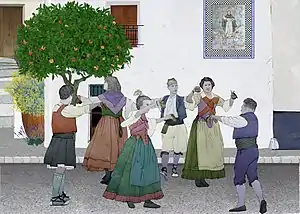
Background
Folk dances share some or all of the following attributes:
Europe
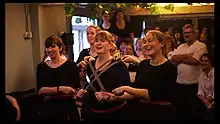
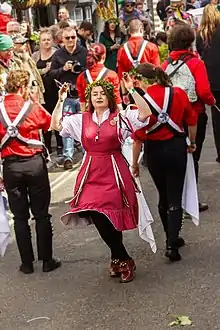
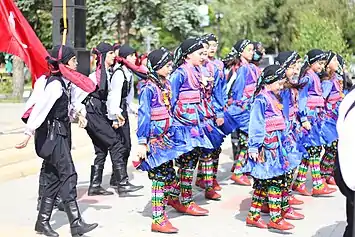
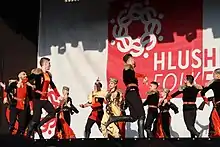
Varieties of European folk dances include:
- Ball de bastons
- Barn dance
- Bulgarian dances
- Clogging
- Dutch crossing
- English country dance
- Fandango
- Flamenco
- Freilekhs
- Georgian dance
- Greek dances
- Hora
- International folk dance
- Irish dance
- Italian folk dance
- Jenkka
- Jota
- Maypole dance
- Morris dance
- Polka
- Polish folk dances
- Russian folk dance
- Turkish dance
- Ukrainian dance
- Verbuňk
- Nordic polska dance
- Square dance
- Sword dance
- Weapon dance
- Kolo
Sword dances include long sword dances and rapper dancing. Some choreographed dances such as contra dance, Scottish highland dance, Scottish country dance, and modern western square dance, are called folk dances, though this is not true in the strictest sense. Country dance overlaps with contemporary folk dance and ballroom dance. Most country dances and ballroom dances originated from folk dances, with gradual refinement over the years.
People familiar with folk dancing can often determine what country a dance is from even if they have not seen that particular dance before. Some countries' dances have features that are unique to that country, although neighboring countries sometimes have similar features. For example, the German and Austrian schuhplattling dance consists of slapping the body and shoes in a fixed pattern, a feature that few other countries' dances have.
Folk dances sometimes evolved long before current political boundaries, so that certain dances are shared by several countries. For example, some Serbian, Bulgarian, and Croatian dances share the same or similar dances, and sometimes even use the same name and music for those dances.
International folk dance groups exist in cities and college campuses in many countries, in which dancers learn folk dances from many cultures for recreation.
Balfolk events are social dance events with live music in Western and Central Europe, originating in the folk revival of the 1970s and becoming more popular since about 2000, where popular European partner dances from the end of the 19th century such as the schottische, polka, mazurka and waltz are danced, with additionally other European folk dances, mainly from France, but also from Sweden, Spain and other countries.
Middle East, Central Asia and South Asia
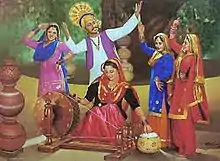
- Ardah
- Armenian dance
- Assyrian folk dance
- Azerbaijani dances
- Bihu, an Assamese dance celebrating the arrival of spring, traditionally the beginning of the Assamese New Year
- Attan - The national dance of Afghanistan. Also a popular folk dance of Pashtuns tribes of Pakistan including the unique styles of Quetta and Waziristan in Pakistan.
- Bhangra, a Punjabi harvest dance in Pakistan and India and music style that has become popular worldwide.
- Chitrali Dance - Chitral, Khyber-Pakhtunkhwa in Pakistan.
- Dabke, a folk dance of the Levant
- Domkach, folk dance of Bihar and Jharkhand, India
- Garba Circular Devotional dance from Gujarat danced the world over
- Israeli folk dance
- Kalbelia is one of the most sensuous dance forms of Rajasthan, performed by the kalbelia tribe
- Khattak Dance - Khyber-Pakhtunkhwa in Pakistan.
- Khigga, a common folk dance among Assyrian people
- Kurdish dance
- Lewa (folk dance) - Baluch folk dance in Pakistan.
various dances such as tamang selo and many others
- Thabal chongba
- Kyushtdepdi - The national dance of Turkmenistan[2]
India
- Bhagavata Mel
- Rajasthani
- Chholiya
- Chhau dance
- Garba
- Gaudiya Nritya
- Kalbelia
- Tippani
- Lavani
- Fugdi
- Bhangra
- Gidda
- Sattriya
- Yakshagana
East and Southeast Asia
China
Cambodia
.jpg.webp)
- Romvong
- Rom kbach
- Robam Neary Chea Chuor
- Peacock Dance
- Chhayam
- Cambodian Coconut Dance
- Cambodian Fish Dance
- Trot Dance
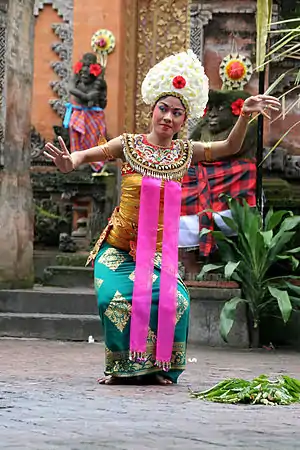
Japan
Korea
Nepal
- Tamang Selo dance
- Chhokara
- Khyali
- Maruni
- Deuda
- Chaulo
- Dhan Nach
- Madikhole
- Phagu (dance)
- Sorathi
- Sakela (Chandi)
- Singaru
- Tarbare
- Bajrayogini dance
- Charitra
- Jat-jatin
- Charya
- Hanuman dance
Philippines

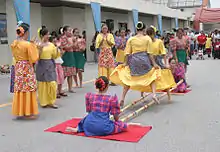
Taiwan
- Bamboo dance (Amis people)
Latin America
Mexico
Venezuela
Oceania
- Hula (Hawaii)
- Haka (New Zealand)
Gallery
.jpg.webp) Kyushtdepdi
Kyushtdepdi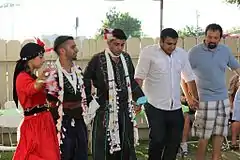
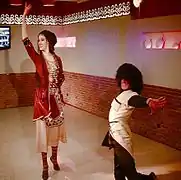 Mtiuluri
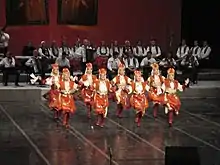
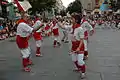 A Ball de bastons stick dance from Catalonia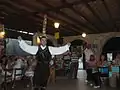
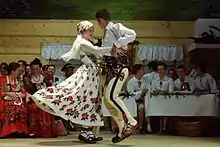 Podhale Gorals dancing
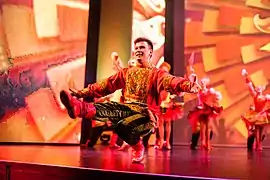 Traditional Russian squat dancing
See also
- List of ethnic, regional, and folk dances sorted by origin
- International folk dance
- Dance basic topics, a list of general dance topics
- Balfolk, contemporary folk dance practised across Europe
- Elizabeth Burchinal, authority on American folk dance
References
- "Definition of FOLK DANCE". www.merriam-webster.com. Retrieved 2020-01-27.
- V@DIM. "Golden age". www.turkmenistan.gov.tm.
- "Tarian Zapin – Yayasan Warisan Johor". Archived from the original on 2018-09-16. Retrieved 2017-05-25.
External links
 |
Wikimedia Commons has media related to Folk dance. |
- Folk Dance Hawaii
- Folk dancing at Curlie
- Dancilla (in German)
- Folklore People Community
- Folk Dance
- Folklore Festivals
- Folklore Festivals
- Society for International Folk Dancing

| Types |  | |
|---|---|---|
| Related | ||
Authority control  | |
|---|---|
| General | |
| National libraries | |
| Other | |