GE 25-ton switcher
The GE 25-ton switcher (also known as a 25-tonner) is a model of diesel-electric switcher locomotive that was produced by GE Transportation at their Erie, Pennsylvania facility between 1941 and 1974.[2][3] Most examples were produced for industrial customers or the United States Armed Forces, although a number of examples were purchased by freight railroads as well.[4] The majority of production was for customers in the United States and Canada, but export models were produced for buyers on every continent except for Oceania.[3][5] Production totaled approximately 550 units over 33 years, making it one of the most widely produced switchers in American history.[6][7]
| GE 25-ton Switcher | |||||||||||||||||||||||||||||||||||||||||||||||||||||||
|---|---|---|---|---|---|---|---|---|---|---|---|---|---|---|---|---|---|---|---|---|---|---|---|---|---|---|---|---|---|---|---|---|---|---|---|---|---|---|---|---|---|---|---|---|---|---|---|---|---|---|---|---|---|---|---|
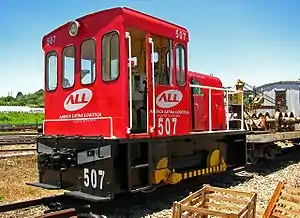 A GE 25-ton switcher in Brazil. This example has been converted to meter-gauge. | |||||||||||||||||||||||||||||||||||||||||||||||||||||||
| |||||||||||||||||||||||||||||||||||||||||||||||||||||||
| |||||||||||||||||||||||||||||||||||||||||||||||||||||||
| |||||||||||||||||||||||||||||||||||||||||||||||||||||||
| |||||||||||||||||||||||||||||||||||||||||||||||||||||||
| Statistics sourced from [1] | |||||||||||||||||||||||||||||||||||||||||||||||||||||||
The small size, low top speed (20 mph or 32 km/h) and low power output (150 hp or 110 kW) of the locomotive made it unsuitable for much beyond switching duties. GE specifically marketed the locomotive as an industrial switcher with a low cost.[7] Many 25-tonners operated for decades, and into the 21st century. A number have been preserved at museums, where some continue to perform switching duties.
Design and production
Design
The 25-ton switcher was designed primarily for switching duties, with low power output and top speed for a locomotive. While not very capable of hauling mainline trains, these features made it cheaper than most other locomotives. For rail-served industries, military installations, and other customers who only needed locomotives for switching and could rely on railroad companies to haul their trains elsewhere, this made it a very attractive purchase. Many were bought to replace steam locomotives, which were far more expensive and had lower rates of availability.[8] The locomotive's small size also allowed it to fit in places where larger locomotives could not, an asset in industrial facilities and yards where clearances were often low.[9][10]

The locomotive was designed as a hood unit to improve visibility for the engineer, essential for switching duties. Power was generated using a 6 cylinder Cummins HBI-600 diesel engine producing 150 hp (110 kW) at 1,800 rpm.[11] This engine powered a single GE GT-1503 main generator, which in turn provided electricity to the single rear-mounted GE-733 traction motor which powered the rear axle. Power was provided to the forward axle using a chain drive.[9][1] The unusual chain drive system for a locomotive was part of the reason for its top speed being limited to 20 mph (32 km/h).[1]
While most examples were built in 4 ft 8+1⁄2 in (1,435 mm) standard gauge, GE produced models anywhere between 3 ft (914 mm) gauge and standard gauge.[7] Some 25-tonners were built to meter-gauge and exported to Brazil.[3]
Production
Throughout the long history of the locomotive's production, minor changes were made to its shape and the location of features such as the bell, exhaust pipe, and lights. Otherwise, the fundamental design was largely unchanged throughout the entirety of the locomotive's 33 year production history. Towards the end of production, GE added an independent axle suspension to new 25-tonners, a feature shared with the GE 35-ton switcher.[11] Many customers made modifications to their 25-tonners after purchase, ranging from minor changes such as moving the bell to completely replacing the prime mover and adding an independent brake.[9]
When the final example was produced in 1974, production totaled approximately 550 locomotives, making the design one of GE's most built locomotive models.[10]
Operating history

25-ton switchers were for many years a very common site at rail-served industries in need of small, cheap locomotives capable of switching cars around the many sidings found on their properties. Some examples of users include grain elevators, U.S. military facilities, steel mills, and commuter railroads.[3][4][9]
As the start of production coincided with the entry of the United States into World War II, much of the production between 1941 and 1945 was for the U.S. military to assist in the war effort. After the war, many of these locomotives were then sold to private owners as surplus.
The 25-tonners have been nicknamed 'critters' by operators and railfans alike, due to their small size. This nickname is shared with similar GE products such as the closely related 23-ton switcher.[1]
Starting in the 1970s, most 25-ton switchers were gradually replaced, either by more powerful and modern switcher locomotives, or by railcar movers.[4] Many railcar movers can also travel on roads for additional flexibility, unlike the 25-tonner. A number continued to operate into the 21st century, a testament to their durability.[10][12] Some have found a second life at railroad museums, where they are used to move equipment.[2][12]
Preservation

A number of 25-tonners have been preserved at museums, and some have been restored to operating condition.
- The Oklahoma Railway Museum owns former MKT #400, which is undergoing restoration to operating condition.[4]
- The Railroad Museum of Long Island owns former Long Island Rail Road #399, which is in operating condition and has been cosmetically restored.[9]
- Golden Spike National Historical Park uses a 25-tonner to move its replicas of Jupiter and Union Pacific No. 119 when they are not under their own power.
- The Nevada Southern Railroad Museum owns locomotive L-2, which served at the Nevada Test Site during the 1960s.[14]
- The Phillipsburg Railroad Historians own a 25-tonner which previously served at an Alstom plant in Easton, PA.[15]
- The C.P.R. Station Heritage Park and Interpretive Centre in Portage la Prairie has a 25-tonner on display, formerly of Manitoba Hydro.
- The Steam Railroading Institute owns a 25-tonner nicknamed "Mighty Mouse" that is in operating condition, formerly operated at a grain elevator.[16]
- The Illinois Railway Museum owns a 1942-vintage 25-tonner in operating condition that worked at cement plants for 78 years prior to being donated to the museum in 2020.[6]
- Central Texas Gravel Locomotive No. 210 is preserved at the Arkansas Railroad Museum and is listed on the National Register of Historic Places.[17] The museum also owns a former Wabash Alloys locomotive, which is also listed on the NRHP.[18]
- The Pennsylvania Trolley Museum owns operable 25-tonner No. 89 which has been converted to 5 ft 2+1⁄2 in (1,588 mm) Pennsylvania Trolley Gauge.[2]
- The Niagara Railway Museum in Fort Erie, Ontario owns an operational 25-tonner built in 1948.[19]
References
 |
Wikimedia Commons has media related to GE 25-ton locomotives. |
- "TM 55-1268 DEPARTMENT OF THE ARMY TECHNICAL MANUAL LOCOMOTIVE DIESEL-ELECTRIC 56'/2' GAGE GENERAL ELECTRIC 23 AND 25 TON, 0-4-0" (PDF). Phillipsburg Railroad Historians.
- "PTM 89 | The Pennsylvania Trolley Museum". 2017-01-07. Retrieved 2021-07-29.
- Komanesky, John (December 24, 2016). "GE 25 Ton roster". thedieselshop.us. Retrieved 2021-07-28.
- "MKT 400 - GE 25-TON". Oklahoma Railway Museum. Retrieved 2021-07-27.
- Solomon, Brian (2014). GE and EMD locomotives : the illustrated history. Minneapolis, MN. p. 56. ISBN 978-0-7603-4612-9. OCLC 868039631.
- "Museum acquires 25-ton diesel". Illinois Railway Museum. December 18, 2020. Retrieved 2021-07-29.
- Peck, C.B. (1950). 1950-1952 Locomotive Cyclopedia of American Practice. New York, NY: Simmons-Boardman Publishing Corporation. p. 194.
- Pit & Quarry. Pit & Quarry Publications. 1947. p. 106.
- "LIRR "25 ton" Locomotive #399". rmli.org. Retrieved 2021-07-27.
- Kawala, Dana (January 25, 2019). "PIKO America General Electric 25-ton switcher". Trains. Retrieved 2021-11-23.
- Marre, Louis A. (1995). Diesel locomotives : the first 50 years : a guide to diesels built before 1972. Waukesha, WI: Kalmbach Pub. Co. p. 193. ISBN 0-89024-258-5. OCLC 34531120.
- "General Electric 25-ton Switcher "Mighty Mouse"". Steam Railroading Institute. Retrieved 2021-11-23.
- "25 Tons of Fun! Piko's GE Switcher in G Scale". Model Railroad News. 2019-02-06. Retrieved 2021-07-29.
- "Locomotive L-2, GE-25 Ton – Nevada Southern Railway". Retrieved 2021-07-28.
- "Critter Move". www.prrh.org. Retrieved 2021-07-28.
- "General Electric 25-ton Switcher "Mighty Mouse" :: Steam Railroading Institute". www.michigansteamtrain.com. Retrieved 2021-07-29.
- "National Register Database and Research - National Register of Historic Places (U.S. National Park Service)". www.nps.gov. Retrieved 2021-07-29.
- "Arkansas Railroad Museum - www.rgusrail.com". www.rgusrail.com. Retrieved 2021-07-29.
- "Museum a reminder of rail's glory days". stcatharinesstandard.com. 2019-01-11. Retrieved 2021-07-29.