PNR 900 class
The PNR 900 class of 1973 are GE Universal Series Diesel-Electric Locomotives in service with the Philippine National Railways. Initially used for long-distance express services throughout Luzon, they were relegated to hauling commuter trains within Metro Manila, a task previously done by PNR's diesel multiple units fleet. This was further exacerbated by the closure of the PNR South Main Line's intercity section in 2012 after an accident in Sariaya, Quezon.
| PNR 900 Class | |||||||||||||||||||||||||||||||||||||||||||||||||||||
|---|---|---|---|---|---|---|---|---|---|---|---|---|---|---|---|---|---|---|---|---|---|---|---|---|---|---|---|---|---|---|---|---|---|---|---|---|---|---|---|---|---|---|---|---|---|---|---|---|---|---|---|---|---|
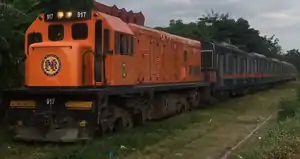 DEL 917 wearing the orange livery hauling 203 series coaches in Manila. | |||||||||||||||||||||||||||||||||||||||||||||||||||||
| |||||||||||||||||||||||||||||||||||||||||||||||||||||
| |||||||||||||||||||||||||||||||||||||||||||||||||||||
| |||||||||||||||||||||||||||||||||||||||||||||||||||||
| |||||||||||||||||||||||||||||||||||||||||||||||||||||
| References:[1][2][3][4][5] | |||||||||||||||||||||||||||||||||||||||||||||||||||||
Out of the 21 units delivered between 1974 and 1992, only five remain in active service, while two await reintroduction after their rebuild at the DESCO facility in Laguna, two undergoing overhaul, two awaiting repair, two beyond economic repair, and eight were scrapped.
History
The GE U14C and U15C are second-generation Universal Series road switchers specially built by GE Transportation for the Philippine National Railways. These were ordered in the 1970s to augment and eventually replace the aging diesel locomotive fleet purchased by PNR's predecessor, the Manila Railroad Company.[6] The locomotives to be replaced include the 1000 class streamliners and the 2000 class roadswitchers, the latter being a first-generation Universal Series locomotive and both entered service in 1956.[7] Despite the earlier diesel locomotives initially having 4 digits, the numbering scheme for the new 900 class has three and seems to follow the numbering scheme of the Manila Railroad 800 class USA locomotives built 30 years prior.[8]
The first batch of five GE U14CP locomotives was ordered in 1973 for ₱10 million (equivalent to US$9.07 million in 2021) and were constructed by GE in Erie, Pennsylvania. The last two units were delivered on February 1974.[9] A second order of ten U14C locomotives were ordered in the late 1970s and were also built in Pennsylvania. This second batch arrived between January and February 1979.[4]
The locomotives were used on various express services throughout the PNR network such as the Amianan Express and the fifth Bicol Express.[6][10] Locomotives used on the North Main Line locomotives are distinguishable from its southern counterparts by the color of the "whiskers" on the cab, with the former being colored white and the latter being colored light yellow. At the same time, the long-distance coaching stock were given a dark green and yellow livery to suit the locomotives.[11]
The last six locomotives (DEL 917 to 922) were built by GE in the former Montreal Locomotive Works plant in Montreal, Quebec, Canada. They entered service in 1992 together with ten 5000 class locomotives, and had a red paint that will be later incorporated into the Philippines 2000 livery.[12] At the same time, earlier locomotives such as 902 were repainted in the same paint scheme.[13] These locomotives were mostly used for Metrotren commuter rail services in the 1990s until the late 2000s.[12]
Rehabilitation
In 2015, PNR signed a contract consortium deal with Miescorrail (now MRail), a subsidiary of Meralco and Desco Inc. to upgrade its 26 locomotive since its acquisition in 1992. The deal involves the disassembly of two of the three locomotives in the first quarter of 2015. The diesel engines will be shipped to a GE facility for a complete upgrade including the installation of the GE Bright Star (BSS) engine control system, a micro-processor based computerized system to provide reliable and efficient performance of the engine. Meanwhile, the brakes and alternators will be repaired by Desco and MRail. Desco and MRail handed over the two locomotives on February 2017.[2]
In anticipation of the introduction of the 9000 class to passenger service, the remaining 900 class is being repainted into the orange livery. The new orange livery scheme is for the locomotives of PNR.[14]
Future replacement
The PNR has no plans yet in retiring the remaining units of the 900 Class. In fact, there are units that have been overhauled and refurbished and a few more units to receive their overhaul too. They will remain at Manila and continue to haul active EMU sets for the Metro South Commuter Line.
Build Numbers
| Locomotive number | Build number | Notes |
|---|---|---|
| 901 | 39238[4] | Built in Erie, Pennsylvania[5] |
| 902 | 39239[4] | |
| 903 | 39240[4] | |
| 904 | 39241[4] | |
| 905 | 39242[4] | |
| 906 | 41848[4] | |
| 907 | 41849[4] | |
| 908 | 41850[4] | |
| 909 | 41851[4] | |
| 910 | 41852[4] | |
| 911 | 41853[4] | |
| 912 | 41854[4] | |
| 913 | 41855[4] | |
| 914 | 41856[4] | |
| 915 | 41857[4] | |
| 917 | 4753.1[5] | Built in Montreal, Canada[3][4] |
| 918 | 4753.2[5] | |
| 919 | 4753.3[5] | |
| 920 | 4753.4[5] | |
| 921 | 4753.5[5] | |
| 922 | 4753.6[5] |
Status
This section includes the last liveries they were last seen using in the case of scrapped locomotives.
| Number | Year | Status | Livery |
|---|---|---|---|
| 901 | 1973 | Scrapped[15] | Green with Yellow Whiskers |
| 902 | 1973 | Inactive, awaiting reintroduction.[16] | Orange |
| 903 | 1973 | Scrapped[15] | Red Philippines 2000 |
| 904 | 1973 | Renumbered as the second 908, then scrapped[15] | Red |
| 905 | 1973 | Scrapped[15] | Green with Yellow Whiskers |
| 906 | 1979 | Inactive.[15] | Blue I |
| 907 | 1979 | Scrapped[15] | Green with Yellow Whiskers |
| 908 | 1979 | Renumbered into 916. See 916 below. | See below |
| 909 | 1979 | Scrapped[15] | Blue I |
| 910 | 1979 | Scrapped[15] | Green with Yellow Whiskers |
| 911 | 1979 | Inactive, awaiting repairs in Caloocan[15] | Blue I |
| 912 | 1979 | Scrapped[15][17] | Yellow and Green (Peñafrancia livery) |
| 913 | 1979 | Inactive, awaiting reintroduction.[18] | Orange |
| 914 | 1979 | Inactive, currently under rehabilitation at DESCO Inc at Biñan, Laguna as of 2021.[19] | Blue II |
| 915 | 1979 | Inactive, awaiting repairs in Caloocan[15] | Blue I |
| 916 | 1979 | Formerly 908. currently under rehabilitation at DESCO Inc at Biñan, Laguna as of 2021.[20] | Blue II |
| 917 | 1991 | Active[14] | Orange |
| 918 | 1991 | Active[21] | Blue II |
| 919 | 1991 | Non-revenue service as a switcher.[22] | Blue II |
| 920 | 1991 | Inactive, beyond economic repair.[15] | Blue I |
| 921 | 1991 | Active, with orange livery.[23] | Orange |
| 922 | 1991 | Active, with orange livery.[24] | Orange |
Incidents and accidents
- On December 31, 1983, DEL 905 and 910 collided between Tagkawayan and Hondagua Station. Both drivers were given Line Clear Certificate by the Station Masters in both stations (905 was heading Northbound while 910 was heading Southbound)
- DEL 908 reportedly hit an NPA officer's son in 1989. The officer retaliated by targeting Unit 908 on several occasions, throwing stones, firing bullets, and even hurling a grenade which detonated and injured crew members. PNR officials have renumbered Unit 908 as Unit 916 to avoid further attacks on the locomotive.
- DEL 912 was bombed by the New People's Army during the tenure of the late President Ferdinand Marcos in the 1980s. The locomotive was written off.
- DEL 920 collided with a dump truck while travelling to Legazpi in 2001. The locomotive's chassis was twisted, causing damage beyond economical repair.[15]
- DEL 922 was involved in the Sariaya derailment on November 12, 2004. The Manila-bound Bicol Express train derailed and fell into a ravine, killing 10 people and injuring 160 more. This later ordered for a total halt for all intercity services of the PNR until 2011.[25]
- On October 26, 2012, PNR Unit 922 hauling coaches servicing as Bicol Express Train 611 rolled over while traveling on a rainy weather in Sariaya, Quezon. The bridge was washed out, causing the coaches to roll over. The rainfall was caused by Typhoon Son-Tinh (known as Tropical Storm Ofel). As a result of the incident, 5 passengers were injured. As a result, the Bicol Express was suspended indefinitely although intercity services continued until 2013.[26]
- A man got run over by DEL 917 at the Abad Santos Triangle in Tondo, Manila on October 2, 2019. The man died as a result of the incident.[27]
Gallery
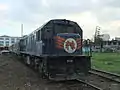 PNR DEL 919 with its third service livery hauling 7A-2000 class cars at Tutuban station.
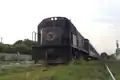 PNR DEL 916 (formerly 908) with its fifth service livery at Posadas Crossing near Sucat station.
(2019-04-25).JPG.webp) DEL 921 in MRail Blue livery hauling 203 series coaches near Santa Mesa station. Today, 921 is wearing the orange livery.
DEL 921 in MRail Blue livery hauling 203 series coaches near Santa Mesa station. Today, 921 is wearing the orange livery.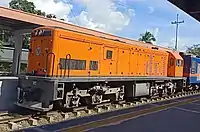
See also
- PNR 2500 Class
- PNR 5000 Class
Notes
- Used for all locomotives that were applied with the new INKA orange livery.
References
- Craig, Robert. "GE U15C Specs". Retrieved June 8, 2014.
- "MRAIL-DESCO TURNS OVER 2 MODERNIZED PNR LOCOMOTIVES". MRail, Inc. February 15, 2017. Archived from the original on June 11, 2020. Retrieved August 24, 2021.
- Craig, Robert. "GE U15C Roster".
- Craig, Robert. "GE U14C Roster".
- Kautzor, Thomas (May 23, 2013). "Today's Railways and Preserved Steam in the Philippines". International Steam. Retrieved April 10, 2021.
- Belen, Gorio (February 15, 1974). 1974 0215 PNR Amianan Express Trains. Retrieved August 24, 2021.
- "1956 0421 MRR Roadswitchers". Retrieved February 15, 2020.
- Smith, Jonathan. "Manila Railroad steam locomotives". Iowa State University. Retrieved January 22, 2021.
- "New PNR locomotives". The Times Journal. February 13, 1974. Retrieved August 24, 2021.
- Bridge, Lindsay (September 24, 1980). PNR 910 at Lupi. Retrieved August 24, 2021.
- Bridge, Lindsay (February 15, 1980). 1980 Camalig, near Legaspi. Retrieved August 24, 2021.
- Bridge, Lindsay (January 13, 1996). 1996 PNR LOCO 922.
- Bridge, Lindsay (January 4, 1992). PNR Loco No. 902 at Paco Station. Retrieved August 24, 2021.
- PNR DEL 917 new looks (August 20, 2019). YouTube. August 24, 2019. Retrieved February 26, 2021.
- Peadon, Brad (June 2019). "June 2019 update". Philippine National Railways Locomotive Status. 3.
- DEL 902 Ponkan. July 18, 2021. Retrieved August 24, 2021.
- DEL 912. Retrieved September 23, 2021.
- PNR GE DEL 913 Returns (16:9 2160p (4K)) (YouTube). July 18, 2021. Retrieved August 24, 2021.
- Transporting DEL 914 for Rehabilitation (7/24/2021) (16:9 2160p (4K)) (YouTube). July 28, 2021. Retrieved August 25, 2021.
- PNR DEL 916 for Rehabilitation and *NO LOGO 922 IN PONKAN!!* (YouTube). July 21, 2021. Retrieved August 24, 2021.
- PNR GE DEL 918 (ULTIMATE MARATHON!!): The Last Days Of Blue Livery (YouTube). June 18, 2021. Retrieved August 24, 2021.
- 4K PNR Compilation Of PNR Trains (DEL 919 ON ACTION!) (YouTube). June 27, 2021. Retrieved August 24, 2021.
- PNR Del 921 in Ponkan Livery (YouTube). May 14, 2021. Retrieved May 14, 2021.
- NEW!! PNR DEL 922 PONKAN BACK ON PASSENGER SERVICE!! (8/8/2021) (YouTube). August 16, 2021. Retrieved August 24, 2021.
- Agence France-Presse (November 25, 2004). "Probe rules out terrorism, sabotage in PNR accident". The Manila Times. Retrieved December 28, 2020.
- "PNR train derails; 5 injured". ABS-CBN News. October 27, 2012. Retrieved February 21, 2021.
- Lalaking bumili lang ng almusal, nakaladkad ng PNR train sa Maynila. YouTube.
- [4K] PNR Del 917 and 921 Ponkan Livery @ Pasay Station. June 10, 2021. Retrieved August 24, 2021.