Abel
Abel[lower-alpha 1] is a Biblical figure in the Book of Genesis within Abrahamic religions. He was the younger brother of Cain, and the younger son of Adam and Eve, the first couple in Biblical history.[1] He was a shepherd who offered his firstborn flock up to God as an offering. God accepted his offering but not his brother's. Cain then killed Abel out of jealousy.
Abel | |
|---|---|
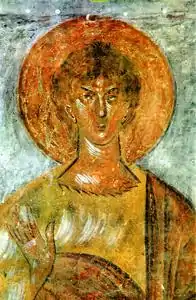 Icon of Abel by Theophanes the Greek | |
| Parent(s) | Adam and Eve |
| Relatives | In Genesis: Cain (sibling) Seth (sibling) According to later traditions: Aclima (sibling) Awan (sibling) Azura (sibling) |
According to Genesis, this was the first murder in the history of mankind.
Genesis narrative
Interpretations
Jewish and Christian interpretations
According to the narrative in Genesis, Abel (Hebrew: הֶבֶל Hébel, in pausa הָבֶל Hā́ḇel; Biblical Greek: Ἅβελ Hábel; Arabic: هابيل, Hābīl) is Eve's second son. His name in Hebrew is composed of the same three consonants as a root meaning "breath". Julius Wellhausen, have proposed that the name is independent of the root.[2] Eberhard Schrader had previously put forward the Akkadian (Old Assyrian dialect) ablu ("son") as a more likely etymology.[3]
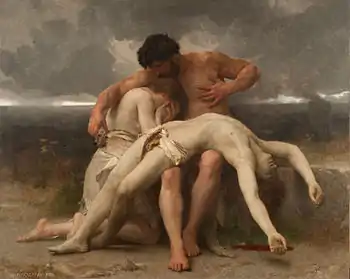
In Christianity, comparisons are sometimes made between the death of Abel and that of Jesus, the former thus seen as being the first martyr. In Matthew 23:35 Jesus speaks of Abel as "righteous", and the Epistle to the Hebrews states that "The blood of sprinkling ... [speaks] better things than that of Abel" (Hebrews 12:24). The blood of Jesus is interpreted as bringing mercy; but that of Abel as demanding vengeance (hence the curse and mark).[4]
Abel is invoked in the litany for the dying in the Roman Catholic Church, and his sacrifice is mentioned in the Canon of the Mass along with those of Abraham and Melchizedek. The Alexandrian Rite commemorates him with a feast day on December 28.[5]
According to the Coptic Book of Adam and Eve (at 2:1–15), and the Syriac Cave of Treasures, Abel's body, after many days of mourning, was placed in the Cave of Treasures, before which Adam and Eve, and descendants, offered their prayers. In addition, the Sethite line of the Generations of Adam swear by Abel's blood to segregate themselves from the unrighteous.
In the Book of Enoch (22:7), regarded by most Christian and Jewish traditions as extra-biblical, the soul of Abel is described as having been appointed as the chief of martyrs, crying for vengeance, for the destruction of the seed of Cain. This view is later repeated in the Testament of Abraham (A:13 / B:11), where Abel has been raised to the position as the judge of the souls.
Mandaean interpretation
According to Mandaean beliefs and scriptures including the Qolastā, the Book of John and Genzā Rabbā, Abel is cognate with the angelic soteriological figure Hibil Ziwa,[6] (Classical Mandaic: ࡄࡉࡁࡉࡋ ࡆࡉࡅࡀ, sometimes translated "Splendid Hibel"),[7] who is spoken of as a son of Hayyi[8] or of Manda d-Hayyi,[9][10] and as a brother to Anush (Enosh) and to Sheetil (Seth),[11] who is the son of Adam.[12] Elsewhere, Anush is spoken of as the son of Sheetil, and Sheetil as the son of Hibil, where Hibil came to Adam and Eve as a young boy when they were still virgins, but was called their son.[13] Hibil is an important lightworld being (uthra) who conquered the World of Darkness.[9] As Yawar Hibil, he is one of multiple figures known as Yawar (Classical Mandaic: ࡉࡀࡅࡀࡓ, lit. 'Helper'), being so named by and after his father.[11]
In the Diwan Abatur, Hibil tells the figure Abatur to go and reside in the boundary between the World of Light and the World of Darkness, and weigh for purity those souls which have passed through all the purgatories and wish to return to the light.
Descent to the World of Darkness
Hibil's soteriological descent to the World of Darkness and his baptisms before and after are detailed in book 5 of the Right Volume of the Ginza Rabba,[11] and also in a separate text named Diwan Masbuta d-Hibil Ziwa ("The Scroll of the Baptism of Hibil Ziwa"). Hibil battles and defeats Krun and seals the abodes of the rulers of darkness.[11] Some versions of this account have parallels with the Hymn of the Pearl included in the Acts of Thomas.[14]
In response to an upset of the dualistic balance of the universe, Manda d-Hayyi summons Hibil,[11] whom the King of Light proceeds to baptise in 360,000[15] or 360[11] yardeni. In connection with this baptism, Hibil is bestowed with 360 robes of light, the Great Mystery,[15] seven staves,[15] and the name Yawar,[11] amongst other attributes.
Hibil is dispatched to the World of Darkness and enters the world of Ruha, lingering for many ages until the Great Mystery instructs him to descend further. He descends to the world of Zartai and Zartanai, remaining there undetected for many ages while aiding the beings of light accompanying him with prayers and supplications, before descending through the worlds of Hagh and Magh and of Gaf and Gafan, and confronting Shdum over the disturbance in the world of light. Shdum directs Hibil further down to Giuo, who directs Hibil further down to Giuo's brother Krun, whom Hibil battles. Krun surrenders and hands over seals to secure Hibil's passage through the World of Darkness.[11]
Hibil ascends, sealing the abodes of Giuo and Shdum, to the world of Qin. According to the Diwan Masbuta d-Hibil Ziwa, Qin-Anatan is the consort of Gaf;[15] according to the Right Ginza, Hibil assumes the appearance of Anatan, who is the husband of Qin.[11] Hibil asks Qin what they are made from, and Qin shows him the murky waters, which the Great Mystery informs him is utter bitterness and the sole constant of the World of Darkness.[11] Hibil then ascends back to the world of Gaf and Gafan. In the Diwan Masbuta d-Hibil Ziwa, Qin had also revealed the mysteries of the jewel, mirror and bitter herb (explained as supplying the strength of the World of Darkness) to Hibil in response to his questions, and he had secretly taken them,[15] while in the Right Ginza, Hibil marries Zahreil, the daughter of Qin, while undercover in the world of Gaf and Gafan, and she shows him the spring with the mirror (said to show the past and future), which he takes.[11] In this version, Hibil is said not to have copulated with Zahreil, since his intention was to locate the mysteries rather than to get married,[11] although some other accounts consider Ptahil a son of Hibil and Zahreil.[16]
Hibil disguises himself as Gaf and appears to Ruha, who is pregnant with Ur. He leads her out of the world of Gaf and Gafan, sealing its gates, seals the gates of the world of Zartai and Zartanai, commands the Great Mystery to confound Ruha, and seals her in her world.[11] The Diwan Masbuta d-Hibil Ziwa also mentions Hibil taking away dark waters and Ptahil.[15]
Hibil offers prayers to the King of Light, who sends for Manda d-Hayyi to send a Letter of Kushta and phial of oil to Hibil, which are received, but Hibil and his companions remain detained by the powers of darkness, until a masiqta is performed, following which they ascend to the middle world. This alarms the guards, in response to which the Great Mana dispatches Yushamin, who interrogates Hibil's identity and permits him re-entry to the World of Light, upon which he is baptised 360 times again.[15]
Islamic interpretation

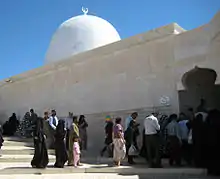
According to Shi'a Muslim belief, Abel ("Habeel") is buried in the Nabi Habeel Mosque, located on the west mountains of Damascus, near the Zabadani Valley, overlooking the villages of the Barada river (Wadi Barada), in Syria. Shi'a are frequent visitors of this mosque for ziyarat. The mosque was built by Ottoman Wali Ahmad Pasha in 1599.
Notes
- /ˈeɪbəl/; Hebrew: הֶבֶל Héḇel, in pausa הָבֶל Hā́ḇel; Biblical Greek: Ἅβελ Hábel; Arabic: هابيل, romanized: Hābīl
References
- The Holy Bible (English Standard Version ed.). Crossway Bibles. 2016. pp. Genesis 1:26–27, Genesis 2:20–24.
- Julius Wellhausen, Skizzen und Vorarbeiten, volume 3, (1887), p. 70.
- Eberhard Schrader, Die Keilinschrift und das Alte Testament, 1872.
- For copies of a spectrum of notable translations and commentaries see Hebrews 12:24 at the Online Parallel Bible.
- Holweck, F. G., A Biographical Dictionary of the Saints. St. Louis, MO: B. Herder Book Co., 1924.
- Drower, E.S. (1932). The Mandaeans of Iraq and Iran. Gorgias Press.com. ISBN 978-1931956499.
- Häberl, Charles G.; McGrath, James F. (2019). The Mandaean Book of John: Text and Translation (PDF). Open Access Version. Berlin/Boston: De Gruyter.
- "Book Five: The Descent of the Savior". Ginza Rabba. Right Volume. Translated by Al-Saadi, Qais; Al-Saadi, Hamed (2nd ed.). Germany: Drabsha. 2019. p. 78.
My Father, Hayyi, said to me, "Why are you standing down Yawar? You are Yawar Hibil the messenger![…]"
- "Glossary". Ginza Rabba. Right Volume. Translated by Al-Saadi, Qais; Al-Saadi, Hamed (2nd ed.). Germany: Drabsha. 2019. pp. 206–213.
- "Book Five: The Descent of the Savior". Ginza Rabba. Right Volume. Translated by Al-Saadi, Qais; Al-Saadi, Hamed (2nd ed.). Germany: Drabsha. 2019. p. 83.
In gratitude we give thanks to Manda ʼd Hayyi and to his son Hibil, who established the order of Hayyi.
- "Book Five: The Descent of the Savior". Ginza Rabba. Right Volume. Translated by Al-Saadi, Qais; Al-Saadi, Hamed (2nd ed.). Germany: Drabsha. 2019. pp. 70–83.
- "Book One, 1st Glorification: The Return of Sheetil, son of Adam to the World of Light". Ginza Rabba. Left Volume. Translated by Al-Saadi, Qais; Al-Saadi, Hamed (2nd ed.). Germany: Drabsha. 2019. pp. 1–9.
- "Book Twelve: The Second Illumination". Ginza Rabba. Right Volume. Translated by Al-Saadi, Qais; Al-Saadi, Hamed (2nd ed.). Germany: Drabsha. 2019. pp. 130–135. [Note: this is book 10 in some other editions.]
- Drower, Ethel Stephana (1954). "Hibil-Ziwa and the Parthian Prince". Journal of the Royal Asiatic Society. 86 (3–4): 152–156. doi:10.1017/S0035869X00106677.
- Drower, Ethel S. (1953). The Haran Gawaita and The Baptism of Hibil-Ziwa: The Mandaic text reproduced together with translation, notes and commentary. Vatican City: Biblioteca Apostolica Vaticana.
- Drower, Ethel S. (1953). The Haran Gawaita and The Baptism of Hibil-Ziwa: The Mandaic text reproduced together with translation, notes and commentary. Vatican City: Biblioteca Apostolica Vaticana. p. 34, translator's footnote #3.
³ Pthahil, son of Hibil-Ziwa and Zahariel: a demiurge, creator of the material world: also called the "Fourth Life".
| Biblical characters |  | ||||||||||||
|---|---|---|---|---|---|---|---|---|---|---|---|---|---|
| Portrayals in media |
| ||||||||||||
| Related theology | |||||||||||||
| Other | |||||||||||||
Authority control  | |
|---|---|
| General | |
| National libraries | |
| Other | |