World of Darkness (Mandaeism)
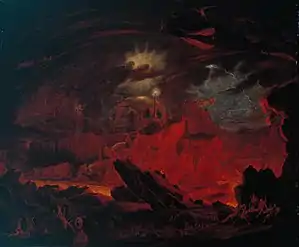
In Mandaeism, the World of Darkness (Classical Mandaic: ࡀࡋࡌࡀ ࡖࡄࡔࡅࡊࡀ, alma d-hšuka) is the underworld located below Tibil (Earth). It is ruled by its king Ur (Leviathan) and its queen Ruha, mother of the seven planets and twelve constellations. The great dark Ocean of Sup (or Suf) lies in the World of Darkness.[1] The great dividing river of Hitpun, analogous to the river Styx in Greek mythology, separates the World of Darkness from the World of Light.[2] Siniawis is one of the regions of the World of Darkness.[3]
| Part of a series on |
| Mandaeism |
|---|
 |
| Religion portal |
The World of Darkness is sometimes referred to as Sheol in the Ginza Rabba and other Mandaean scriptures.
Inhabitants
Various beings inhabit the World of Darkness.
Some infernal beings mentioned in the Ginza Rabba are:[2]
- Anathan – husband of Qin
- Gaf and Gafan
- Giuo (Giu)
- Hagh and Magh (Hag and Mag) – a male and female pair of demons
- Krun (Karun)
- Qin – queen of darkness, mother of Ruha, grandmother of Ur; one of her epithets is Sumqaq
- Shdum – a ruler of the underworld
- Zahreil (Zahrʿil) – daughter of Qin and wife of Hibil Ziwa
- Zartai and Zartanai
Other demons mentioned in the Ginza Rabba are:[4]
- Aṭirpan (Aṭarpan)
- Himun
- Karipiun (Karafiun)
- Karkum
- Lupan
- Shiqlun
- Zamur
According to the Right Ginza, the World of Darkness consists of many demons, dewis, and (evil) spirits, including:[1]
- hmurtha "amulet-spirit"
- lilith
- ʿkuri "temple-spirit"
- priki "shrine-spirit"
- patikri "idol-demon"
- arkoni "archon"
- malaki "angel"
- nalai "vampire"
- niuli "hobgoblin"
- piga "misadventure demon"
- pilgi "mutant demon"
- latabi "devil"
- lihani "net-spirit"
- gadulta "ghost"
- saṭani "Satan"
The Right Ginza describes them as:
- haškia "gloomy"
- ʿkumia "black"
- ṭupšania "filthy"
- mriddia "rebellious"
- rgizia "furious"
- zidania "wrathful"
- zihirania "venomous"
- saklia "foolish"
- ndidia "repulsive"
- ṣahnia "stinking"
- zapuria "putrid"
- harašia "mute"
- ṭriṣia "deaf"
- ṭmimia "insensible"
- tahmia "dull"
- algia "stuttering"
- dugia "unhearing"
- gugia "babbling"
- pigia "idiots"
- šgišia "frightful"
- laiadita "ignorant"
- haṣipia "arrogant"
- hamimia "hot-headed"
- taqipia "powerful"
- haripia "harsh"
- rugzania "ill-tempered"
- raktania "lustful"
- bnia zma "children of blood"
See also
References
- Aldihisi, Sabah (2008). The story of creation in the Mandaean holy book in the Ginza Rba (PhD). University College London.
- "Glossary". Ginza Rabba: The Great Treasure. An equivalent translation of the Mandaean Holy Book. Translated by Al-Saadi, Qais Mughashghash; Al-Saadi, Hamed Mughashghash (2 ed.). Drabsha. 2019.
- Buckley, Jorunn Jacobsen (2002). The Mandaeans: ancient texts and modern people. New York: Oxford University Press. ISBN 0-19-515385-5. OCLC 65198443.
- Ginza Rba. Translated by Gelbert, Carlos. Sydney: Living Water Books. 2011. ISBN 9780958034630.
| People | | ||||||||
|---|---|---|---|---|---|---|---|---|---|
| Historical identities | |||||||||
| Priesthood |
| ||||||||
| Literature |
| ||||||||
| Cosmology |
| ||||||||
| Legendary figures | |||||||||
| Concepts | |||||||||
| Objects and symbols | |||||||||
| Rituals | |||||||||
| Buildings and structures | |||||||||
| Calendar | |||||||||
| Language | |||||||||
Category | |||||||||