Hyaenodon
Hyaenodon ("hyena-tooth") is an extinct type genus of carnivorous mammals from tribe Hyaenodontini within subfamily Hyaenodontinae (in family Hyaenodontidae) that lived in Eurasia and North America during the middle Eocene to early Miocene, existing for about 32.63 million years.[4]
| Hyaenodon | |
|---|---|
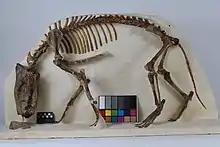 | |
| H. horridus skeleton | |
Scientific classification  | |
| Kingdom: | Animalia |
| Phylum: | Chordata |
| Class: | Mammalia |
| Order: | †Hyaenodonta |
| Superfamily: | †Hyaenodontoidea |
| Family: | †Hyaenodontidae |
| Subfamily: | †Hyaenodontinae |
| Tribe: | †Hyaenodontini Leidy, 1869[1] |
| Genus: | †Hyaenodon Laizer & Parieu, 1838 |
| Type species | |
| †Hyaenodon leptorhynchus Laizer and Parieu, 1838 | |
| Species | |
|
List
| |
| Synonyms | |
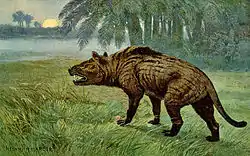
The various species of Hyaenodon competed with each other and with other hyaenodont genera (including Sinopa, Dissopsalis, and Hyainailurus), and played important roles as predators in ecological communities as late as the Miocene in Asia and preyed on a variety of prey species such as primitive horses like Mesohippus and early camels.[5] Species of Hyaenodon have been shown to have successfully preyed on other large carnivores of their time, including a nimravid ("false sabertooth cat"), according to analysis of tooth puncture marks on a fossil Dinictis skull found in North Dakota.[6]
Description
Some species of this genus were among the largest terrestrial carnivorous mammals of their time; others were only of the size of a marten. Remains of many species are known from North America, Europe, and Asia.[7]
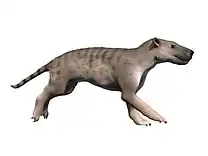
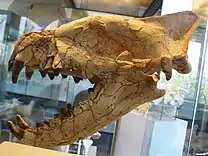
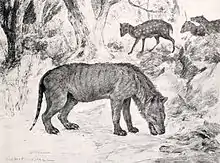
Typical of early carnivorous mammals, individuals of Hyaenodon had a very massive skull, but only a small brain. The skull is long with a narrow snout - much larger in relation to the length of the skull than in canine carnivores, for instance. The neck was shorter than the skull, while the body was long and robust and terminated in a long tail.
The average weight of adult or subadult H. horridus, the largest North American species, is estimated to about 40 kg (88 lb) and may not have exceeded 60 kg (130 lb). H. gigas, the largest Hyaenodon species, was much larger, being 378 kg (833 lb) and around 10 feet (3.0 m).[8] H. crucians from the early Oligocene of North America is estimated to only 10 to 25 kg (22 to 55 lb). H. microdon and H. mustelinus from the late Eocene of North America were even smaller and weighed probably about 5 kg (11 lb).[9]
Compared to the generally larger (but closely related) Hyainailouros, the dentition of Hyaenodon was geared more towards shearing meat and less towards bone crushing.[5]
Tooth eruption
Studies on juvenile Hyaenodon specimens show that the animal had a very unusual system of tooth replacement. Juveniles took about 3–4 years to complete the final stage of eruption, implying a long adolescent phase. In North American forms, the first upper premolar erupts before the first upper molar, while European forms show an earlier eruption of the first upper molar.[10]
Range and species
In North America the last Hyaenodon, in the form of H. brevirostris, disappeared in the late Oligocene. In Europe, they had already vanished earlier in the Oligocene.[7]
References
 |
Wikimedia Commons has media related to Hyaenodon. |
- Leidy J. (1869.) "On the extinct Mammalia of Dakota and Nebraska: including an account of some allied forms from other localities, together with a synopsis of the mammalian remains of North America." Journal of the Academy of Natural Sciences Philadelphia 7: 1–472.
- A. V. Lavrov (1999.) "Adaptive Radiation of Hyaenodontinae (Creodonta, Hyaenodontidae) of Asia." in 6th Congress of the Theriological Society, Moscow, April 13–16, p. 138 [in Russian].
- M. R. Thorpe (1922.) "A new genus of Oligocene Hyaenodontidae." American Journal of Science 3(16):277-287
- PaleoBiology Database: Hyaenodon, basic info
- Wang, Xiaoming; and Tedford, Richard H. Dogs: Their Fossil Relatives and Evolutionary History. New York: Columbia University Press, 2008.p17
- Hoganson, John W; and Person, Jeff. "Tooth puncture marks on a 30 million year old Dinictis skull." Geo News. July 2011. p12-17.
- Wang, Xiaoming, Qiu, Zhanxiang, and Wang, Banyue, 2005. Hyaenodonts and Carnivorans from the Early Oligocene to Early Miocene of Xianshuihe Formation, Lanzhou Basin, Gansu Province, China, Palaeontologia Electronica Vol. 8, Issue 1; 6A: 14p, online
- WANG X. & TEDFORD R. H. 2008. — Dogs, their fossil relatives and evolutionary history. Columbia University Press: 1-219.
- Naoko Egi (2001) Body Mass Estimates in Extinct Mammals from Limb Bone Dimensions: the Case of North American Hyaenodontids _Palaeontology 44 (3) , 497–528 doi:10.1111/1475-4983.00189
- Katharina Anna Bastl, First evidence of the tooth eruption sequence of the upper jaw in Hyaenodon (Hyaenodontidae, Mammalia) and new information on the ontogenetic development of its dentition, Paläontologische Zeitschrift (Impact Factor: 1.1). 10/2013; 88:481-494. DOI: 10.1007/s12542-013-0207-z