Jimmu's Eastern Expedition
The term "Jimmu Tosei" refers to a series of stories in which Emperor Jimmu became emperor of Japan for the first time (Emperor Jimmu) after destroying Naganohiko, who had ruled the Nara Basin and its surrounding area, after leaving Hyuga Province.
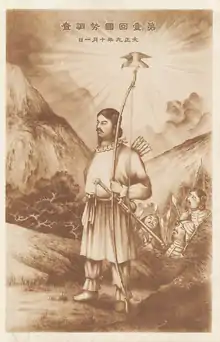
Progress
"Kojiki"
Emperor Jimmu and his brother, Itsuse, consulted in Takachiho, Hyūga Province, about where to go to rule Ashihara no Nakatsukuni. Takachiho in Hyuga, and decided to go east. They left Hyuga for Tsukushi and arrived at Usa (now Usa City) in Toyo Province. Two men, Usatsuhiko and Usatsuhime, built a palace called Ashi Hitotsu Agari-no-miya and gave them food. From there they moved on to Okada Palace in Tsukushi Province, where they spent one year, then seven years at Takeri Palace in Aki Province, and eight years at Takashima Palace in Kibi Province. She met the goddess Kunitsugu on a tortoise at Hayashikimon, and gave her the name of Magashi Nedatsuhiko as a pilot.
Shirakashizu in Naniwa Province[lower-alpha 1]When they anchored in the city, the army of Nagasunebiko was waiting for them. In the battle with the army, Gose no Mikoto was hit by an arrow fired by Nagasunebiko. Gose no Mikoto said, "Since we are the sons of the sun god, it is not good for us to fight against the sun (facing east). Let us turn around and fight with our backs to the sun (facing west). So they went around to the south, but Gose no Mikoto died when they reached the Otono Water Gate in Kii Province.
When Shinwa Ibarebi-no-mikoto came to Kumano, a great bear appeared and immediately disappeared. Then Kamiyame-Iharebiko-no-Mikoto and all the soldiers he was leading fainted. At this time, Takakuraji of Kumano came with a Japanese sword, and Kamiyame-Ihabarebiko immediately awoke. When Kamiyame-Iharebi-no-Mikoto received the great sword from Takakura-shita, the raging god of Kumano was naturally cut down, and the soldiers regained consciousness.
Shinwa Ibarebi no Mikoto asked Takakurashita how he came into possession of the great sword. According to Takakurashita, Amaterasu and Takamimusubi (Takamimusubi) appeared in Takakurashita's dream. The two gods called Kenmikazuchi and said, "China is in turmoil, and my sons are troubled. Since you have pacified the Reed Plains, descend again from the heavens," he ordered. But Kenmikazuchi replied, "Let me unload the great sword that I used to pacify the people." He then told Takakurashita, "I will make a hole in the roof of my storehouse and drop the great sword through it, so that you can carry it to the son of Amaterasu. When he woke up and looked at his storehouse, he found a large sword, which he carried. The great sword was called Ogi Nutojin, or Nuto Mikatama, and is now enshrined in Ishigami Jingu.
He was guided by Yatagarasu, a crow sent by the god Takagi's order, from Kumano to Uda in Yamato via the riverside of Yoshino and then along a more difficult road. In Uda, there were two brothers, Eukashi and Otokashi. First, he sent Yatagarasu to ask them if they would serve Kamuwa Ibarebiko-no-Mikoto, but the elder brother, Otoukashi, shot him with a squeaky whip and drove him away. However, his elder brother, Ukaishi, shot him back with a squeaking arrow. So, pretending to be in the service of Kamuwa Ibarebiko-no-Mikoto, he built a palace and set up an oshiki (a trap that, if stepped on, would pinch and crush the victim to death) in it. His younger brother Ukaishi reported this to Kaminiwa Ibarebiko-no-mikoto. He then sent Michinomi-no-mikoto, the founder of the Otomo-ren and others, and Okume-no-mikoto, the founder of Kume Nao and others, to his brother Ukashis. The two gods darted arrows at him and pressed him, saying, "If you want to serve us, you must first enter the palace and show us how you serve us. Afterwards, he pulled out his brother Ukausi's crushed corpse, chopped it into pieces and scattered them around, and the place is called the "Blood Field of Uda.
In the land of Oshizaka, the eighty kens of Tsuchikumo [lower-alpha 2] of Tsuchikumo was waiting for him. So Kamiyamato Ibarebi no Mikoto gave them a feast and attached a cook to each of them, each with a hidden sword. Then, at a signal, he killed them all at once.
He then fought the brothers Eshiki and Otoshiki. Finally, he fought against Nagasunebiko, whereupon Nigihayahi came and served him, giving him the goods that marked him as the son of Amatsu.
In this way, he subjugated the raging gods and many Tsuchigumos (powerful tribes), and Shinwa Ibarebiko-no-Mikoto became the head of the Yusuhara Palace of the Fire.[lower-alpha 3]He ascended to the throne as Emperor Jinmu in
Afterwards, he took Himetataraisukeyori-hime, son of Omononushi, as his empress and had three children: Hikoyai-no-mikoto, Kamuyaimimi-no-mikoto, and Kamunakawamimi (later Emperor).
Nihon Shoki
Dates in AD era style are converted from the Nihon Shoki (Chronicles of Japan) for reference, but note that that is not a literary-historical or archaeological usage.
Year of the Tiger (667 BC)
- In this year, the god Panyohiko, who was in Hyuga Province
- 昔我が
天神 、高皇産霊尊・大日孁尊、此の豊葦原瑞穂国を挙げて、我が天祖 彦火瓊瓊杵尊に授けたまへり。是に火瓊瓊杵尊、天関 を闢 き雲路を披 け、仙蹕 駈 ひて戻止 ります。是の時に運 、鴻荒 に属 ひ、時、草昧 に鍾 れり。故 、蒙 くして正 を養ひて、此の西の偏 を治 す。皇祖皇考 、乃神乃聖 にして、慶 を積み暉 を重ねて、多 に年所 を歴たり。天祖の降跡 りましてより以逮 、今に一百七十九万二千四百七十余歳 。而るを遼邈 なる地 、猶未だ王沢 に霑 はず。遂に邑 に君有り、村 に長 有りて、各自 疆 を分かちて用 て相凌ぎ礫 はしむ。抑又 塩土老翁に聞きき。曰ひしく、「東 に美 き地 有り、青山四 に周 れり。其の中に亦天磐船に乗りて飛び降る者有り」といひき。余 謂 ふに、彼 の地は必ず以て大業 を恢弘 べて天の下に光宅 るに足りぬべし。蓋 し六合 の中心 か。厥 の飛び降るといふ者は、是饒速日と謂 ふか。何ぞ就 きて都つくらざらむ。
He then set out to conquer the East.
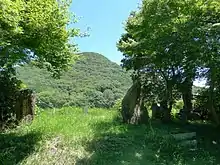
On the 5th day of the 10th lunar month, Prince Banyohiko set off on his expedition to the east, accompanied by his parents and other princes and a naval force. When they reached the gate of Hayatsukyo, he gave the name Shiinetsuhiko to Uzuhiko, the national deity, as a pilot. He arrived in Tsukushi Province 菟狭, where he was invited to and received at the Ashi Hitotsu Agari-no-miya (Shrine of One Pillar Soaring), which had been built by Ashi Hitotsuhiko and Ashi Hitotsu Ehime, the ancestors of the菟狭国造. At this time, Banyohiko-no-Mikoto Emperor married Ehime to Amatae-no-Mikoto (a distant ancestor of the Nakatomi clan), his attendant.
- On December 27th, I arrived at Aki Province and was in the dust palace.
Year of Oto (666 BC)
- On March 6, he entered Kibi Province and built the Takashima Palace. He stayed at Takashima Palace for three years, building boats and storing food for his army.
Year of Boshin (663 BC)
- On February 11, he reached the Facilitator of Namba and named the land Naniwa Province.
- On March 10, he reached the Tsu of the White Shoulder in Kusaka-eup Aoun, Kawachi Province.
On April 9, he marched to Tatsuta, but the road was too steep to continue, so he turned his army to the east and attempted to enter Nakasu (Uchitukuni) via Mount Ikoma. At this time, there was a man named Naganohiko, who ruled the land, and he gathered an army to intercept Panyohiko and his men at Kusae no Saka, and a battle ensued. The battle went badly, and Gose no Mikoto, the elder brother of Panayohiko, was injured by a stray arrow. Panayohikosan realized that he, a descendant of the sun god, would be going against the will of the heavens if he fought against the sun (to the east), and returned his troops. He retreated to Kusakatsu, raised his shield and shouted. For this reason, Kusakatsu was renamed Shieldatsu. Later, it was called Tatesu. From there, the god Panyohiko set sail.
On the 8th day of the 5th month, they reached Yamaki-no-minato, the water gate of black porgy. Here Gose no Mikoto's arrow wound became severe, and he died when he reached Mount Kama in Kii Province.
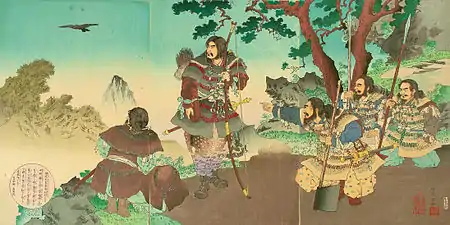
On the 23rd day of the 6th lunar month, they were in Nagusa-eup, where they put to death a female bandit named Nagusa-to-gami, and set sail again via Kumano no Kami-eup, but encountered a storm. Inari-no-mikoto and Mike-irino-no-mikoto, the elder brothers of Panayohiko, were upset that their march was blocked both on land and at sea, so Inari-no-mikoto went into the sea to become a plough-bearer, and Mike-irino-no-mikoto left for the Land of the Rising Sun. Banyohiko-no-mikoto and his son Tegenmimi-no-mikoto proceeded to Arasakazu in Kumano and executed Tanshikido, but the army fell under the poisonous influence of the local deity. At this time, a local resident, Kumano Takakurashita, claiming to have had a vision, presented the God of Health (a sword that once belonged to Takemikazuchi) to the god Banyohiko. With the sword in hand, the army rose and resumed their march. However, the road to the mountains was steep and arduous. At this moment, Yatagarasu appeared and led the army. It is said that Panayohiko told him that it was just as he had dreamed in his dream. Panyohiko and his men were led by Yatagarasu to菟田下県.
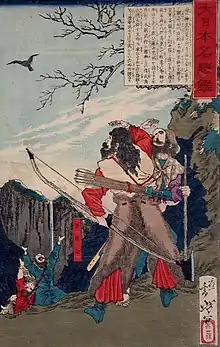
On August 2, he summoned the two men who ruled Uda Prefecture, the elder brother Cunning and the younger brother Cunning. The elder brother did not show up, but the younger brother did, and told them that the elder brother was trying to assassinate Banyohiko-no-mikoto. Banyohiko sent Michiomi-no-mikoto (a distant ancestor of the Otomo clan) to kill him. Panyohiko led a small army around the Yoshino, and all the inhabitants followed.
On the 5th day of the 9th lunar month, when he climbed Mount Takakura in菟田, he saw that it was filled with the troops of the Eighty Owls and his brother Isoshiro. Banyohiko took offence. In a dream that night, he was told by the gods to make eighty sheets of paper and a rig and worship the gods of heaven and earth. He disguised Shiinetsuhiko as an elderly father and his younger brother Cunning as an elderly woman, and sent them to fetch soil from the mountaintop of Mountain of Heavenly Fragrance. With this clay, Panyohiko created 80 earthenware vessels, 80 heavenly handscrolls, and a rigorous earthenware vessel, and worshipped the God of Heaven and Earth at the Tanbu no Kawakami.
On November 7, he sent Yatagarasu to call his elder and younger brothers Isoseong. On November 7, he sent Yatagarasu to summon his elder brother Isosei and his younger brother Isosei, but only the younger brother Isosei came to him.
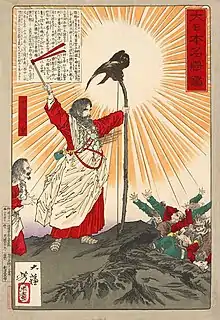
On the 4th of December, the battle with Nagatheiko finally came to an end. The heavens clouded over, and rain and ice began to fall. Then a golden scorpion appeared and landed on the tip of the bow of the god Panyohiko. A golden scimitar appeared and landed on the tip of the bow of the god. For this reason, the name of the eup from which Naganohiko got his name (Naganedu) was changed to Kite no eup. It is now called Torimi. Naganomarehiko sent a messenger to Panyohiko and told him that Kushitama Raohihayahi-no-mikoto, the distant ancestor of the Mononobe clan, was the son of a heavenly deity who had descended from heaven a long time ago on a ship. It is strange that there are two sons of Tenjin. Naganumaeiko showed Panyohiko the sign that Reihatsuhikonomikoto was the son of a heavenly deity, but Panyohiko also showed him the sign that he was the son of a heavenly deity, and both were found to be genuine. However, Naganohime did not stop fighting, so Reihayoninushi killed Naganohime and led the people back to their homes.
The Year of the Self-Myth (662 BC)
- On the 21st day of the 2nd lunar month, the god Panayohiko had the disobedient Shinshirotogi, Isehuri, and Inoshuri killed. In Takaohari-eup, there was a Tsuchigumo, who was small in size and had long arms and legs. So they made a kuzu-net trap and caught and killed him. Because of this, this eup was called Katsuragi.
After March 7, he had his capital built in Kashihara, Nara, southeast of Mount Unebi.
Year of Koshin (661 BC)
- On August 16, Kotoshironushi's daughter, Ehime Totobogetsu Isuzu-hime, was made his full consort.
The Year of the Sparrow (the first year of Emperor Jimmu, 660 BC)
- On January 1, Banyohiko Takeru ascended the Cashihara Palace (Emperor Jimmu), and made his rightful wife the Empress. Two princes were born to the emperor and empress, Kamuyaimimi-no-mikoto and black black mole (later Emperor Sui). The year of birth of Suizei was the 29th year of Emperor Jinmu's reign, so the birth of Kamuyaimimi preceded that of Suizei.
Various theories
- From the standpoint of mythology, similarities with the founding myth of Goguryeo have been pointed out by Akihide Mishina.
South Kyushu theory
- The traditional starting point of Jinmu's Tosei is "Hyuga". If this "Hyuga" is later called Hyuga, the place is South Kyushu.
- In Nihon Shoki, Hikoson Iwayo first reached Shosa (currently Oita Prefecture), and from there Gan. It has moved to Aki Province (currently Hiroshima Prefecture) via the water gate (currently Fukuoka Prefecture). In other words, since he moved to the north from the place of departure (Hyuga) → Shosa → Gansuimon, it is considered that Hinata is south of Shosa.
Northern Kyushu theory
The original starting point of the Jimmu expedition was the northern nine provinces. The rationale is as follows.
- The place of departure is listed as "Hyuga", not "Hyuga Province". In the Chronicles of Japan, the name "Hyuga Province" is attributed to Emperor Keiko, so we can assume that the later name of Hyuga Province was not "Hyuga" at the time of the Jimmu expedition. In the Nakaueki, Hyuga is referred to as "the empty land of meat" and "the fruitless land of deer antlers", indicating that Hyuga was a barren land, and the construction of Kofun began in the late 4th century or 5th century. Kofun]] in the latter half of the 4th century or 5th century, and the fact that it was a backward region makes it unnatural for it to be the place where the Jimmu departed.[1]。
- Hyuga is not a proper noun, but a beautiful name that means facing east or south toward the sun.
- Departing from Southern Kyushu, we would have to pass through the fast-flowing Kanmon Straits twice: Hyuga → Usa → Kanmon Straits → Oka (Dokai Bay → Onga River) → Kanmon Straits → Aki.
- "Hyuga in Tsukushi" should be interpreted as "Hyuga in Tsukushi Province" (there is a place name of "Hyuga" in Fukuoka Prefecture), not "Hyuga Province in Kyushu". For example, even in the area of the stage of the Kyushu theory of the Evil Horse Kingdom, there is Hinata Toge between Itoshima City in Fukuoka Prefecture, where Itokuni was located, and Fukuoka City, where Nakoku was located, and the Hinata River, a second class river, flows there. In Asakura City, Fukuoka Prefecture, there is the Hinata River. In Asakura City, Fukuoka Prefecture, there is a place name called Hinataishi, and in the Yabe River basin of Yame City, Fukuoka Prefecture, there is a place name called Hinatajin. There is also a myth of the three generations of Hyuga in the Itoshima area, which differs from the Chronicles, and a large mirror with an inner scrolling flower design, compared to the Yata no Kagami by Harada Dairoku, was excavated from the Hirabara site.[2]。
- In the Kojiki, Descending from Heaven, Takachiho in Hyuga is described as "opposite the cape of Kasasa, facing Korea (a nation in the southern part of the Korean Peninsula)".
Evidence (various theories) on the timing of the Eastern Expedition
- According to Mitsunori Yasumoto, based on an average reign of about 10 years per generation in ancient times, the active period of Amaterasu would have been around 230–250, and the active period of Jimmu would have been around 280–300.[3][4]
- Based on the average length of reign of foreign royalty and their biological lifespans, Hisao Hoga argues that the average length of reign of ancient emperors was 10 years per generation, which is an unusual figure, and advocates an average of 25 years. He also believes that the reigns of ancient emperors and foreign royalty were based on the X-multiple year calendar, and he puts the reign of Emperor Jinmu at 175–194 years.[5][6]。
Negative theory
- Tadashi Nishitani states that it is unlikely that northern Kyushu conquered Kinki. The main reasons for this are that stone tools disappeared earlier in the Kinki region, and iron tools spread more quickly in earnest. Square trench tombs also migrated from Kinki to Kyushu, but Kyushu's tomb system (such as post stone tombs) did not spread to Kinki. In reality, however, this theory has little basis in fact, as iron arrowheads are said to have existed in the Yamataikoku of the Weijing biography, and many have actually been excavated in Kitakyushu, but few iron arrowheads of the 3rd century have been excavated in the Kinai region.[7]。
- Studies on the movement of Shonai-style pottery during the Umataikoku period confirm the movement of people from Kinki and Kibi to Kyushu, but conversely, there are no examples of pottery from Kyushu moving to Kinki and Kibi during this period (3rd century), making mass migration from Kyushu to Kinki during the Umataikoku period unlikely.[8]。It should be noted, however, that the Jimmu Tōkyō is not necessarily the event of the time of the Jimmu Kingdom as seen in the Wei Wei biography, and not all of the affirmative theories are about the eastward movement on a national scale.
- Reiji Harashima states that the Yamato dynasty's rule over southern Kyushu is assumed to have begun in earnest during the period between the Suiko dynasty and the completion of the Chronicles, and that the story was formed in response to the invasion of Ryukyu by the Sui dynasty in 608, in order for the Yamato dynasty to claim territorial rights over Ryukyu and adjacent southern Kyushu.[9]。
The Eastern Expedition Theory for Securing Mercury
Ken'ichi Kamigaki, referring to mercury veins from Kinki to Shikoku in his book "A Study of Niu: Mercury in Japan from the Perspective of Historical Geography" (Waseda University Press), argues that the Jimmu expedition to the east was the result of a clan that had run out of resources such as mercury vermilion, and in search of an economic base, seized the mercury mines along the Kino River, invaded the Yamato mines in Uda (now shut down), and established the Yamato kingship in the late 3rd century.[10]。In addition, the importance of Ise to the Yamato kingship during the reign of Emperor Sujin is attributed to the Ise mercury mine (Niu mine), and the king is defined as the one who controlled the mercury resources in the early Kofun period.
Notes
- The area around the current Higashi Osaka City. At that time, the inlet of Lake Kawachi extended to this area.
- meaning many brave men
- A palace in Kashihara, southeast of Mount Unebi.
References
- 宝賀寿男「記紀の地名・人名の比定論への疑問」『古樹紀之房間』、2000年。
- 原田大六『実在した神話』、学生社出版、1966。
- http://yamatai.cside.com/tousennsetu/yasumotosetu2.htm
- "邪馬台国東遷説". Archived from the original on November 4, 2020.
- 宝賀寿男「-安本美典氏の邪馬台国論批判-」『季刊/古代史の海』第20号、2000年。
- 宝賀寿男「安本美典氏からの批判に対するお応え(説明・反論・反批判)」『古樹紀之房間』、2017年。
- 山中鹿次『神武東征伝承の成立過程に関して』
- 白石太一郎編『倭国誕生』2002年
- 原島礼二 『神武天皇の誕生』新人物往来社、1975年
- 歴史読本編集部編『ここまでわかった「古代」謎の4世紀』(新人物往来社、 2014年) ISBN 978-4-04-600400-0 pp.14 - 17.