Keikyu N1000 series
The Keikyu N1000 series (京急新1000形, Keikyū Shin-1000-gata) is a DC electric multiple unit (EMU) train type operated by the private railway operator Keikyu on commuter services in the Tokyo area of Japan since 2002.[2][3]
| Keikyu N1000 series | |
|---|---|
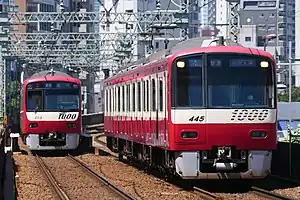 Stainless steel (left) and aluminium (right) N1000 series sets in July 2021 | |
| In service | 2002–present |
| Manufacturer | J-TREC, Kawasaki Heavy Industries, Tokyu Car Corporation |
| Family name | Sustina S13 Series (Batch 20 only) |
| Replaced | 800 series, 1000 series |
| Constructed | 2002– |
| Entered service | 2002 |
| Refurbished | 2017–present |
| Number under construction | 8 vehicles (2 sets) |
| Number built | 484 vehicles (81 sets) |
| Number in service | 476 vehicles (80 sets) |
| Number scrapped | 8 vehicles (1 set; accident damage) |
| Formation | 4/6/8 cars per set |
| Fleet numbers | 8-car sets:
6-car sets:
4-car sets:
|
| Operator(s) | Keikyu |
| Line(s) served | |
| Specifications | |
| Car body construction | Aluminium (batches 1-5) Stainless steel (batches 6-) |
| Car length | 18 m (59 ft 1 in) |
| Width | 2.83 m (9 ft 3 in) |
| Floor height | 1.15 m (3 ft 9 in) |
| Doors | 3 pairs per side |
| Maximum speed | 120 km/h (75 mph) (service) 130 km/h (80 mph) (design) |
| Traction system |
|
| Traction motors | 3-phase AC induction motor (except 1367F) 1367F: Permanent magnet synchronous motor |
| Power output | Siemens, Toshiba, Toyo Denki (8-car), Mitsubishi SiC: 190 kW; Mitsubishi IGBT, Toyo Denki (4 and 6 car): 155kW |
| Acceleration | 3.5 km/(h⋅s) (2.2 mph/s) |
| Deceleration | 4.0 km/(h⋅s) (2.5 mph/s) (regular use) 4.5 km/(h⋅s) (2.8 mph/s) (emergency) |
| Electric system(s) | 1,500 V DC (nominal) from overhead catenary |
| Current collection method | Pantograph |
| Braking system(s) | Electronically controlled pneumatic brakes, regenerative brakes |
| Safety system(s) | C-ATS |
| Multiple working | 600 series, 1500 series, 2100 series |
| Track gauge | 1,435 mm (4 ft 8+1⁄2 in) |
Operations
The eight-car sets are primarily used on limited-stop "Rapid Limited Express" and "Limited Express" services on the Keikyu Main Line, including through-running services to and from the Toei Asakusa Line, Keisei Oshiage Line, Keisei Main Line, and Hokuso Line.[3] Some of these eight cars sets are also being used on the Keikyu Airport Line. Four-car sets are used to form 12-car "Rapid Limited Express" and "Limited Express" services, and are also used singly on all-stations "Local" services.[3] The six-car formations delivered from 2011 are generally used on all-stations "Local" services.[3] The N1000 series sets can be used in multiple with other Keikyu EMU types, including the 600 series, 1500 series, 2000 series, and 2100 series.[3]
Variants
Since the first set was introduced in 2002, the type has undergone a number of design improvements. Sets built from 2002 to 2006 have painted aluminium bodies, whereas sets built from 2007 onward (sets 1073 onward) have stainless steel bodies. More detailed variations are described below.
Batch 1
Delivered February to June 2002.
- 8-car sets x 3: 1001, 1009, 1017
- 4-car sets x 2: 1401, 1405
These sets have single-arm pantographs and were formerly equipped with roller-blind destination indicators and Siemens GTO variable-frequency drive (VVVF) traction equipment.
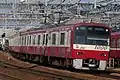 Refurbished 1st-batch set 1001 in October 2020
Batch 2
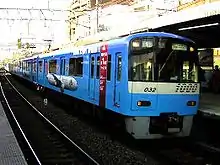
Delivered May to July 2003.
- 8-car sets x 2: 1025, 1033
- 4-car sets x 2: 1409, 1413
The centre pillars of the passenger windows were discontinued.
Set 1409 was upgraded in May 2018, and modifications included LED lights, LCD-displays above the doors, LED-displays on the sides, and replacement of the original GTO-VVVF propulsion systems with IGBT inverters supplied by Toshiba, which is also used on sets 1401 and 1405 from the earlier batch. Set 1413 was also upgraded like set 1409 and started service in December 2018. Set 1025 was refurbished in May and August 2019, and the original Siemens GTO was changed to Toyo Denki IGBT. Set 1033 had Siemens GTO inverters until 18 July 2021, where it operated as a charter from Shinagawa; its last run ultimately took place on 20 July. Following refurbishment, set 1033 received Toyo Denki IGBT inverters.
Batch 3
Delivered January to March 2005.
- 8-car sets x 2: 1041, 1049
- 4-car sets x 2: 1417, 1421
Initially built with Siemens-manufactured IGBT-VVVF inverters. This batch was the first in Keikyu history to use IGBT–VVVF traction equipment from new.
Set 1417 was refurbished in March 2019. This set now has LED lighting, LCD-displays above the doors, other LED displays, and was refitted with Toyo Denki-manufactured IGBT-VVVF inverters. Both 1041 and 1049 were powered by Siemens IGBT-VVVF.
_421.jpg.webp) 3rd-batch 4-car set 1421 in June 2010
3rd-batch 4-car set 1421 in June 2010
Batch 4
Delivered July to August 2005.
- 8-car sets x 1: 1057
- 4-car sets x 4: 1425, 1429, 1433, 1437
Feature full-colour LED destination indicators.
_045.JPG.webp) 4th-batch 4-car set 1425 in March 2008
4th-batch 4-car set 1425 in March 2008
Batch 5
Delivered November 2006.
- 8-car sets x 1: 1065
- 4-car sets x 2: 1441, 1445
No design changes over 4th batch vehicles.
Set 1065 has refurbished and refitted with Toyo Denki IGBT-VVVF.
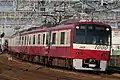 5th-batch 8-car set 1065 with full-colour LED destination indicators in October 2020
Batch 6
Delivered March 2007.
- 8-car set x 1: 1073
Body design changed to unpainted stainless steel. The four-seat transverse bays at the ends of cars were replaced by longitudinal bench seats.
Starting this batch until batch 16, all 8-car trains use Mitsubishi IGBT-VVVF inverters.
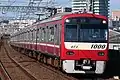 6th-batch 8-car set 1073 in July 2021
Batch 7
Delivered January to February 2008.
- 8-car sets x 2: 1081, 1089
Yellow warning tape was added around the door interiors.
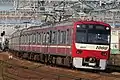 Stainless steel 7th-batch 8-car set 1089 in October 2020
Batch 8
Delivered September to December 2008.
- 8-car sets x3: 1097, 1105, 1113
- 4-car sets x2: 1449, 1453
Starting this batch until batch 20, all 4- and 6-car sets are powered by Toyo-Denki IGBT-VVVF unless noted.
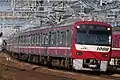 Stainless steel 8th-batch 4-car set 1449 in October 2020
Batch 9
Delivered April to June 2009.
- 4-car sets x8: 1457, 1461, 1465, 1469, 1473, 1477, 1481, 1485
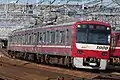 Stainless steel 9th-batch 4-car set 1481 in October 2020
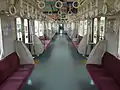 Interior view of car 1482
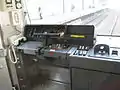 Driver's cab
Batch 10
Delivered during fiscal 2010.[4]
- 8-car sets x 3: 1121, 1129, 1137
- 4-car set x 1: 1489
Audible warnings added for door opening/closing, and pairs of LCD passenger information screens installed above doors.[5]
In addition, 1137 was retired in March 2020 in the aftermath of the level crossing crash on 5 September 2019.[6]
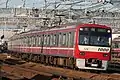 10th-batch 8-car set 1129 in October 2020
Batch 11
Delivered during fiscal 2011.[7]
- 8-car set x 1: 1145
- 6-car sets x 3: 1301, 1307, 1313
The third six-car set, 1313, entered service on 19 March 2012. This set uses LED interior lighting instead of fluorescent tubes.[8]
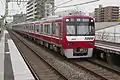 11th-batch 6-car set 1313 in May 2012
Batch 12
Delivered April 2012.
- 8-car sets x1: 1153
- 6-car sets x2: 1319, 1325
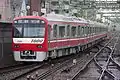 12th-batch 6-car set 1319 in May 2012
Batch 13
Delivered August 2013 to March 2014.
- 8-car sets x1: 1161
- 6-car sets x2: 1331, 1337
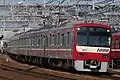 13th-batch 8-car set 1161 in October 2020
Batch 14
Delivered in mid to late 2014.
- 8-car sets x1: 1169
- 6-car sets x3: 1343, 1349, 1355
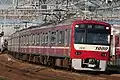 14th-batch 8-car set 1169 in October 2020
Batch 15
Delivered in 2015.
- 6-car sets x2: 1361, 1367
Set 1367 uses Toshiba-manufactured permanent-magnet synchronous motors.
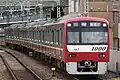 Keikyu N1000 set 1367F. This set uses Toshiba PMSM-VVVF.
1000-1800 series
Two new 1000-1800 series four-car sets (1801 and 1805) were delivered from J-TREC in February 2016. These two sets differ from earlier variants in having centre gangways on the cab ends as well as a vinyl-based red and ivory livery. [9] These two sets entered revenue service on 4 March 2016.[10] In mid 2016, set 1809 was delivered along with Batch 16.
All three sets have stainless steel bodies painted in a red and ivory livery except the side of the doors and windows instead of the vinyl-based livery used on earlier batches.
- 4-car sets x3: 1801, 1805, 1809
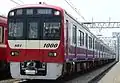 Set 1801 in May 2016
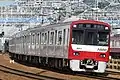 Set 1805 in November 2017
Batch 16
Introduced in fiscal 2016.[11] This batch has stainless steel bodies painted in a red and ivory livery except the side of the doors and windows instead of the vinyl-based livery used on earlier batches.
- 8-car sets x2 from February 2017: 1177, 1185
- 6-car sets x2 from November 2016: 1601, 1607
Starting this batch, all 8-car sets are powered by Mitsubishi SiC-VVVF.
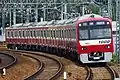 Stainless steel-bodied 16th-batch 8-car set 1185 in May 2017
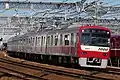 Stainless steel-bodied 16th-batch 6-car set 1601 in October 2020
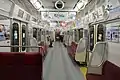 Interior view
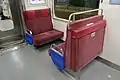 Transverse seating bays
Batch 17
Introduced in fiscal 2017. Start this batch, all trains will have stainless steel bodies painted in a red and ivory livery like batch 16, but also including the side of the doors and windows.[12] Internally, pairs of LCD passenger information screens are provided above each set of doors.[12]
- 8-car sets x3 from February 2018: 1201, 1209, 1217
- 6-car sets x2 from January 2018: 1613, 1619
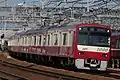 17th-batch 8-car set 1209 in October 2020
Batch 18
Introduced in fiscal 2018.[12]
- 6-car sets x7: 1625, 1631, 1637, 1643, 1649, 1655, 1661
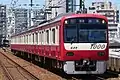 18th-batch set 1649 in July 2021
Batch 19
- 8-car sets x1: 1225
- 6-car sets x1: 1667
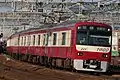 19th-batch 8-car set 1225 in October 2020
Batch 20
Two four-car sets were introduced in 2021. These are the first trains in the fleet to feature rotating banks of seats; these seats can be arranged in a longitudinal or transverse seating configuration when required. The seats are similar to those used on the 2100 series, but they are 10 mm (0.39 in) wider.[13] Power sockets are also provided. They are also the first trainsets in the fleet to feature toilets; car 2 features a universal-access Western toilet,[13] and car 3 features a men's toilet.[14] The trains are intended for use on reserved seat "Wing" services as well as chartered event services. The first set is expected to enter service on 6 May 2021 on a northbound "Morning Wing" service.[15] This batch is equipped with Toyo Denki SiC/IGBT-VVVF hybrid traction equipment, as well as J-TREC-build Sustina body that is similar to that of the Toei 5500 series. All four cars are motored.[13]
Set 1892 entered service on 6 May 2021, with the first trip on Morning Wing to Shinagawa from Miurakaigan.
- 4-car sets x2: 1891, 1892
 20th-batch set 1891 in May 2021
Batch 21
As part of its capital investment plan for fiscal 2021, Keikyu announced that it would order three additional 4-car sets that will also feature rotating banks of seats, akin to those of the previous batch of 4-car sets.[16]
The first of these three sets, numbered 1893, entered service on 29 November 2021.[17]
Formations
As of 9 November 2021, the fleet consists of 27 eight-car sets (numbered 1001 to 1129, 1145 to 1185, and 1201 to 1225), 24 six-car sets (numbered 1301 to 1367 and 1601 to 1667), and 28 four-car sets (numbered 1401 to 1489, 1801 to 1809, and 1891 to 1892).
8-car sets 1001 to 1033
The five eight-car (aluminium bodied) sets 1001 to 1033 are formed as follows, with four motored (M) cars and four trailer (T) cars.[18]
| Designation | Muc | Tpu | Tu | Mu | Ms | Ts | Tps | Msc |
|---|---|---|---|---|---|---|---|---|
| Numbering | 1xxx | 1xxx | 1xxx | 1xxx | 1xxx | 1xxx | 1xxx | 1xxx |
The "Tpu" and "Tps" cars are each fitted with two single-arm pantographs.[18]
8-car sets 1041 to 1065
The five eight-car (aluminium bodied) sets 1041 to 1065 are formed as follows, with six motored (M) cars and two trailer (T) cars.[18]
| Designation | Muc | Tpu | M2u | M1u | M1s | M2s | Tps | Msc |
|---|---|---|---|---|---|---|---|---|
| Numbering | 1xxx | 1xxx | 1xxx | 1xxx | 1xxx | 1xxx | 1xxx | 1xxx |
The "Tpu" and "Tps" cars are each fitted with two single-arm pantographs.[18]
8-car sets 1073 to 1185 and 1201 to 1225
The eighteen eight-car (stainless steel bodied) sets 1073 to 1185 and 1201 to 1225 are formed as follows, with six motored (M) cars and two trailer (T) cars.[18]
| Designation | M2uc | M1u | Tu | M1u' | M2s | Ts | M1s | M2sc |
|---|---|---|---|---|---|---|---|---|
| Numbering | 1xxx | 1xxx | 1xxx | 1xxx | 1xxx | 1xxx | 1xxx | 1xxx |
The "M1u" and "M1s" cars are each fitted with two single-arm pantographs, and the "M1u'" are fitted with one pantograph.[18]
6-car sets 1301 to 1367 and 1601 to 1667
The twenty-four six-car (stainless steel bodied) sets 1301 to 1367 and 1601 to 1667 are formed as follows, with four motored (M) cars and two trailer (T) cars.[18]
| Designation | M2uc | M1u | Tu | Ts | M1s | M2sc |
|---|---|---|---|---|---|---|
| Numbering | 13xx | 13xx | 13xx | 13xx | 13xx | 13xx |
On 1301-1367, the "M1u" cars are fitted with one single-arm pantograph, while "M1s" cars are fitted with two single-arm pantographs. On 1601-1667, the "M1u" and "M1s" cars are each fitted with two single-arm pantographs.[18]
4-car sets 1401 and 1405
The first batch of four-car (aluminium bodied) sets, numbered 1401 and 1405, are formed as follows, with two motored (M) cars and two trailer (T) cars.[18]
| Designation | M1uc | T1pu | T1ps | M1sc |
|---|---|---|---|---|
| Numbering | 14xx | 14xx | 14xx | 14xx |
The "T1pu" and "T1ps" cars are each fitted with one single-arm pantograph.[18]
4-car sets 1409 and 1413
The two four-car (aluminium bodied) sets 1409 and 1413 are formed as follows, with two motored (M) cars and two trailer (T) cars.[18]
| Designation | M1uc | T | Tp | M1sc |
|---|---|---|---|---|
| Numbering | 14xx | 14xx | 14xx | 14xx |
The "Tp" cars are fitted with two single-arm pantographs.[18]
4-car sets 1417 to 1445
The eight four-car (aluminium bodied) sets 1417 to 1445 are formed as follows, with three motored (M) cars and one trailer (T) car.[18]
| Designation | M1uc | M2 | Tp | M1sc |
|---|---|---|---|---|
| Numbering | 14xx | 14xx | 14xx | 14xx |
The "Tp" cars are fitted with two single-arm pantographs.[18] Note that all sets will be converted into the same formation as 1401 to 1413 after the refurbishment.
4-car sets 1449 to 1489, 1801 to 1809, and 1891 to 1892
The 16 four-car (stainless steel bodied) sets 1449 to 1489, 1801 to 1809, and 1891 to 1892 are formed as follows, with four motored (M) cars.[18]
| Designation | M2uc | M1u | M1s | M2sc |
|---|---|---|---|---|
| Numbering | 14xx/18xx | 14xx/18xx | 14xx/18xx | 14xx/18xx |
The "M1u" and "M1s" cars are each fitted with one single-arm pantograph. The 18xx cars have end gangways that can be connected to form 8-car trains for through service to Asakusa and Keisei Lines.[18] The 1890 sets have two single-arm pantographs on "M1s" car.
Refurbishment
On 10 May 2017, Keikyu announced that it would make investments in safety and comfort that would total approximately 21.9 billion yen. Also announced was refurbishment work for eight N1000 series cars.[19] Eight-car set 1001, the first set to be treated, entered service on 18 September 2017.[20] The work includes:
- Replacement of interior veneers, ceilings, floor coverings, passenger doors, and vestibules
- Storage of emergency ladders and fire extinguishers at the top carriage
- Modifications to some of the passenger side windows to allow them to be opened and the subsequent removal of underfloor exhaust fans
- Replacement of Siemens-manufactured traction equipment with domestic equipment
- While set 1001 was refitted with Mitsubishi Electric-manufactured traction equipment akin to those of 17th-batch eight-car sets, subsequent refurbished examples were refitted with Toyo Denki- or Toshiba-manufactured traction equipment.
- Replacement of roller-blind destination indicators in favour of full-colour LED destination indicators
- Replacement of external and internal lighting with LED substitutes
- Replacement of above-door LED passenger information systems with liquid-crystal display systems
- Replacement of storage batteries, broadcasting-related equipment, and security-related equipment
- Addition of door opening/closing indicator for all passenger doors[21]
- New cooling system manufactured by Mitsubishi Electric
Livery variations
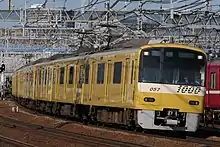
8-car set 1057 was repainted into a special "Yellow Happy Train" livery from May 2014, for the collaboration with the private railway operator Seibu Railway. In return, Seibu repainted one of its 9000 series trainsets into Keikyu livery, known as the "Seibu Red Lucky Train".[22]
Accidents
Set 1137[23] was involved in a collision with a truck on a level crossing near Kanagawa-shimmachi Station on 5 September 2019, killing the truck driver and injured at least 30 others on the train.[24]
This set was damaged beyond repair and was scrapped in March 2020. [6]
References
- "京急 新1000形が大師線運用に" [Keikyu New 1000 series to operate on the Daishi Line]. 鉄道ファン・railf.jp (in Japanese). Koyusha Co., Ltd. 9 January 2008. Archived from the original on 15 September 2021. Retrieved 15 September 2021.
- Keikyu N1000 series Archived 25 December 2008 at the Wayback Machine. Retrieved 17 September 2008. (in Japanese)
- 私鉄車両年鑑 2012: 大手15社営業用車両完全網羅 私鉄車両年鑑2012 [Japan Private Railways Annual 2012]. Tokyo, Japan: Ikaros Publications Ltd. February 2012. p. 123. ISBN 978-4-86320-549-9.
- 私鉄車両編成表 私鉄車両編成表 2011 [Private Railway Rolling Stock Formations - 2011]. Japan: Kotsu Shimbunsha. July 2011. p. 42. ISBN 978-4-330-22711-5.
- 京浜急行電鉄 新1000形10次車 [Keikyu N1000 series 10th-batch cars]. Japan Railfan Magazine. Vol. 50 no. 592. Japan: Koyusha Co., Ltd. August 2010. p. 69.
- "Archived copy". Archived from the original on 12 June 2020. Retrieved 12 June 2020.CS1 maint: archived copy as title (link)
- 京急1000形でLED照明を本採用 [LED lighting used on Keikyu 1000 series]. Japan Railfan Magazine. Vol. 52 no. 614. Japan: Koyusha Co., Ltd. June 2012. pp. 84–85.
- 京浜急行電鉄 新1000形(11次車) [Keikyu New 1000 series (11th batch unit)]. Tetsudō Daiya Jōhō Magazine. Vol. 41 no. 337. Japan: Kotsu Shimbun. May 2012. p. 75.
- 京急 新1000形1800番台が総合車両製作所から出場 [Keikyu New 1000 series 1800 subseries delivered from J-TREC]. Japan Railfan Magazine Online (in Japanese). Japan: Koyusha Co., Ltd. 25 February 2016. Archived from the original on 25 February 2016. Retrieved 25 February 2016.
- 京急 新1000形1800番台が営業運転を開始 [Keikyu New 1000 series 1800 subseries enter service]. Japan Railfan Magazine Online (in Japanese). Japan: Koyusha Co., Ltd. 5 March 2016. Archived from the original on 5 March 2016. Retrieved 5 March 2016.
- 京浜急行電鉄新1000形16次車 [Keikyu New 1000 series 16th-batch EMUs]. Japan Railfan Magazine (in Japanese). Vol. 57 no. 670. Japan: Koyusha Co., Ltd. February 2017. p. 61.
- 京急新1000形17次車 2018年春導入へ [Keikyu New 1000 series 17th batch trainsets to be introduced in spring 2018]. Tetsudo Hobidas (in Japanese). Japan: Neko Publishing Co., Ltd. 30 November 2017. Archived from the original on 1 December 2017. Retrieved 1 December 2017.
- "Keikyu banks on rotating seats". Railway Gazette International. 26 April 2021. Retrieved 20 November 2021.
- "車内設備を一新した新造車両 4両編成2本導入" (PDF). Keikyu (in Japanese). 20 January 2021. Archived (PDF) from the original on 3 February 2021. Retrieved 20 January 2021.
- "京急,3月27日にダイヤ改正を実施" [Keikyu implements timetable revision on March 27]. railf.jp. 27 January 2021. Archived from the original on 30 January 2021. Retrieved 8 February 2021.
- "京急,2021年度の設備投資計画を発表" [Keikyu announces capital investment plan for fiscal 2021]. Japan Railfan Magazine Online (in Japanese). Japan: Koyusha Co., Ltd. 13 May 2021. Retrieved 1 December 2021.
- "【京急】新1000形1893編成営業運転開始 |2nd-train鉄道ニュース" [New 1000 series set 1893 begins commercial operation]. 2nd-train (in Japanese). Retrieved 12 December 2021.
- 私鉄車両編成表 2012 [Private Railway Rolling Stock Formations - 2012]. Japan: Kotsu Shimbunsha. July 2012. p. 42. ISBN 978-4-330-29911-2.
- "2017年度 鉄道事業設備投資計画 安全対策関連など 総額約219億円 | ニュースリリース | 京浜急行電鉄(KEIKYU)" [FY2017 railway business capital investment plan safety measures related total approx. 21.9 billion yen]. 京浜急行電鉄 (in Japanese). Archived from the original on 1 September 2021. Retrieved 31 August 2021.
- 京急 新1000形更新車が営業運転を開始 [Refurbished Keikyu New 1000 series enters revenue service]. Japan Railfan Magazine Online (in Japanese). Japan: Koyusha Co., Ltd. 22 September 2017. Archived from the original on 29 September 2017. Retrieved 29 September 2017.
- "京急 新1000形更新車が公開される|鉄道ニュース|2017年9月17日掲載|鉄道ファン・railf.jp" [Keikyu new 1000 series updated car is revealed]. 鉄道ファン・railf.jp (in Japanese). Koyusha Co., Ltd. 17 September 2017. Archived from the original on 1 September 2021. Retrieved 31 August 2021.
- ""KEIKYU YELLOW HAPPY TRAIN"運行開始" [Keikyu Yellow Happy Train in service]. Tetsudo Hobidas (in Japanese). Japan: Neko Publishing. 30 April 2014. Archived from the original on 18 July 2014. Retrieved 18 July 2014.
- "京急本線で快速特急とトラックが接触…京急川崎-上大岡間で運行見合せ 9月5日中の再開は困難か?" [Rapid express and truck collision on the Keikyu Main Line]. response.jp (in Japanese). IID, Inc. 5 September 2019. Archived from the original on 6 September 2019. Retrieved 6 September 2019.
- "One dead and more than 30 injured in train truck collision". The Japan Times. 5 September 2019. Archived from the original on 6 September 2019. Retrieved 6 September 2019.
External links
 |
Wikimedia Commons has media related to Keikyu N1000 series. |
- Keikyu N1000 series information (in Japanese)
- Kawasaki Heavy Industries product information (in Japanese)
- Siemens order information
Keikyu trainsets | ||
|---|---|---|
| Current |  | |
| Former |
| |