Kenneth Stuart
Lieutenant-General Kenneth Stuart CB DSO MC (September 9, 1891 – November 3, 1945) was a senior Canadian Army officer who saw active service during both the First World War and, later, the Second World War. During the latter conflict his most notable role was as Chief of the General Staff, the head of the Canadian Army, from 24 December 1941 until 27 December 1943.
Kenneth Stuart | |
|---|---|
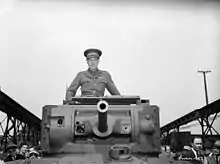 Brigadier Kenneth Stuart in the first Valentine tank built in Canada, 27 May 1941. | |
| Nickname(s) | "Ken" |
| Born | September 9, 1891 Trois-Rivières, Quebec, Canada |
| Died | November 3, 1945 (aged 54) Ottawa, Ontario, Canada |
| Allegiance | .svg.png.webp) Canada Canada |
| Service/ |  Canadian Army Canadian Army |
| Years of service | 1911–1945 |
| Rank | Lieutenant General |
| Unit | Royal Canadian Engineers |
| Commands held | 7th Battalion, Royal Canadian Engineers Royal Military College of Canada Chief of the General Staff |
| Awards | Companion of the Order of the Bath Distinguished Service Order Military Cross |
Early life and military career
Kenneth Stuart was born in Trois-Rivières, Quebec, the son of an Anglican clergyman, on September 9, 1891. He graduated from Bishop's College School, Quebec in 1908 and the Royal Military College of Canada in 1911, graduating tenth out of thirty-three.[1][2] He joined the Royal Canadian Engineers and received further training at the School of Military Engineering in Chatham, England. He returned to Canada in 1913 and was posted to the 1st Fortress Company in Halifax.
At the outbreak of the First World War, he commanded battery of searchlights in Halifax, before going overseas in 1915, initially with the 1st Army Troops Company, Canadian Engineers. He subsequently joined the 7th Field Company, 3rd Canadian Division, and won the Military Cross in 1917. The following year, he was given command of the 7th Battalion, Canadian Engineers. He was awarded the Distinguished Service Order in 1918 for bridging a river under fire on 8 August 1918.
During the inter-war period, Stuart attended the Staff College, Camberley. In 1929 he became the editor of Canadian Defence Quarterly, to which he contributed many articles. In 1934 he was appointed GSO1 at the Royal Military College of Canada, where he pushed for reforms to the curriculum and to the recruitment system. In 1938 he was appointed Director of Military Operations and Intelligence at National Defence Headquarters.
Second World War

At the outbreak of the Second World War in 1939, Stuart was appointed Commandant of the Royal Military College of Canada. He was made Deputy Chief General Staff in 1940, Vice Chief General Staff in 1941 and then Chief of the General Staff later that year.[3] In December 1943 he was appointed Acting General Officer Commanding First Canadian Army in England and then in March 1944 Chief of Staff at Canadian Military Headquarters in England.[3]
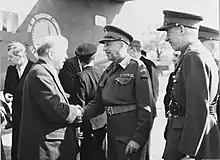
During the Conscription Crisis of 1944, Stuart took a pro-conscription stance, for which he was dismissed by General Andrew McNaughton, the Minister of National Defence. He died the following year.
Stuart opposed the removal of Japanese-Canadians from the Pacific coast, telling Ottawa that "I cannot see that the Japanese Canadians constitute the slightest menace to national security."
Family
Stuart was married to Marguerite Dorothy Stuart, née Bauld, of Halifax; he had met her in England in 1916. They had a son and a daughter. His son Victor (1918–2007) also attended the Royal Military College of Canada, and reached the rank of Group Captain in the Royal Canadian Air Force.
References
- Kenneth Stuart at The Canadian Encyclopedia
- Granatstein, J. L. (2005). The Generals: The Canadian Army's Senior Commanders in the Second World War. Calgary: University of Calgary Press. p. 217.
- Kenneth Stuart at Generals.dk
Bibliography
- Granatstein, Jack (1993). The Generals. Stoddart Publishing. ISBN 978-0-7737-2730-4.

